



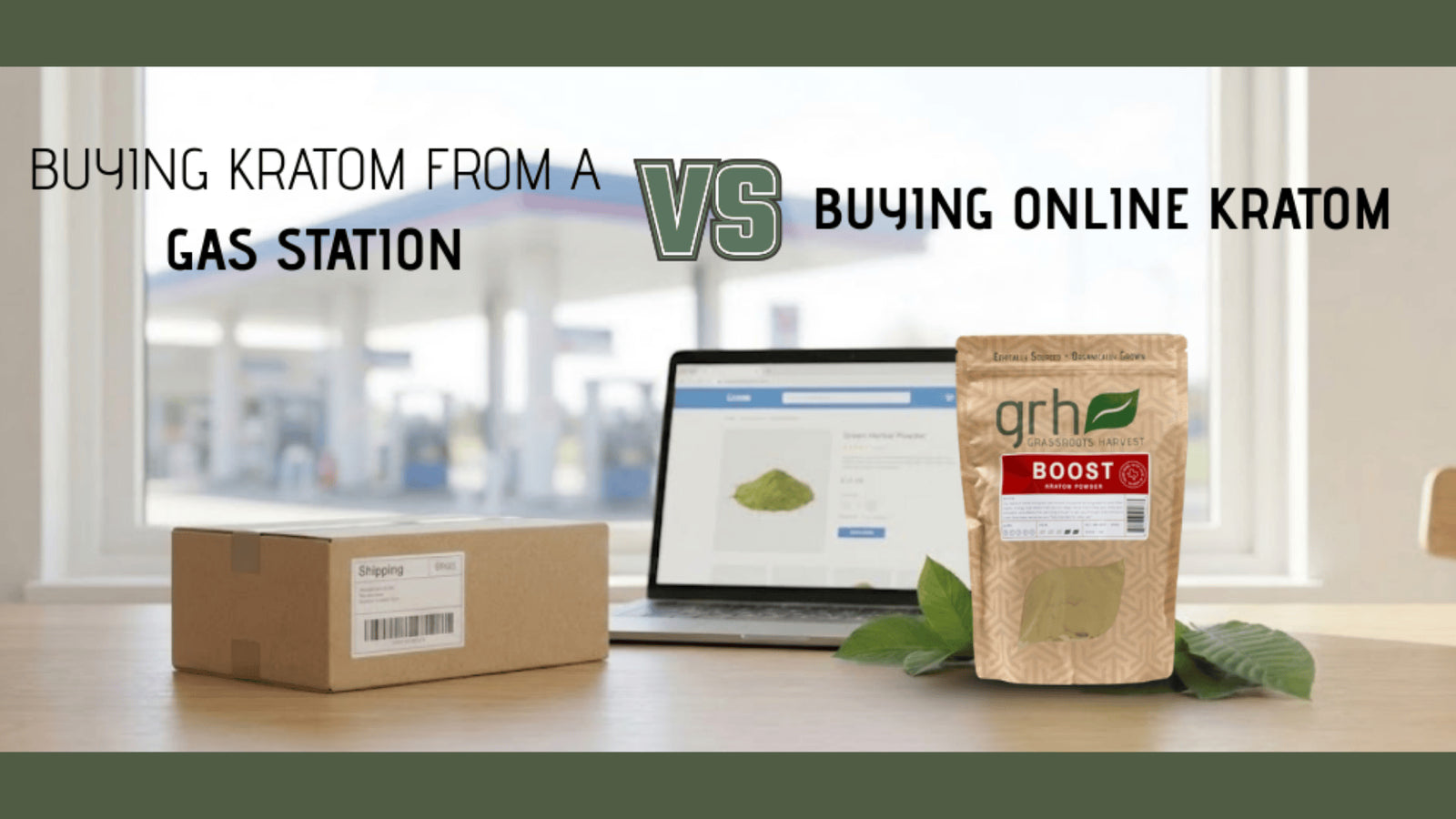
Buying kratom online in 2026 looks deceptively simple. Type "buy kratom online" into a search bar and you'll get back a wall of vendors, each promising the cleanest powder, the freshest harvest, and the lowest price you've seen all week. The catch is that kratom in the U.S. still operates without federal oversight. No FDA approval, no mandatory testing standard, and no central registry telling shoppers which vendors actually do what they claim.
That gap is why a buyer's checklist matters more for kratom than for almost any other supplement you can put in your cart. The good vendors run third-party lab tests on every batch, hold themselves to the American Kratom Association's Good Manufacturing Practices standard, ship from a real business address, and answer the phone when something goes wrong. The bad ones use stock photos of leaves, hide behind PO boxes, and disappear the moment a customer raises a problem. The American Kratom Association estimates that around 15 million Americans use kratom regularly. NIDA notes use has climbed steadily over the past decade, and a meaningful slice of that market still buys from sellers who couldn't pass a basic sourcing audit.
This guide walks through what separates an AKA GMP-audited vendor from a polished storefront with nothing behind it. We cover lab certificates, sourcing transparency, return policies, the legal-state map, payments, shipping, and the red flags that should send you elsewhere. You'll come away with a framework that works for any vendor, not just ours.
Table of Contents
- Why kratom shopping needs its own buyer's checklist
- The AKA GMP standard and how to verify a vendor passed
- Reading a kratom certificate of analysis
- Sourcing transparency: single-origin vs blended powders
- Brand transparency, founders, and the contact page test
- Customer service signals that separate the real shops
- Return policies, payments, and shipping reality
- Legal-state check before you click buy
- Red flags that should end the visit
- How GRH approaches each criterion
- Frequently Asked Questions
- Final Thoughts
TL;DR
- Verify your vendor is on the AKA GMP audited list at americankratom.org before you spend a dollar with them.
- Demand a current batch-specific certificate of analysis showing mitragynine content plus heavy metals, microbials, and salmonella results.
- A real address, a working phone number, and named founders beat any polished brand photography.
- Prices noticeably below market floor (around $0.10 to $0.20 per gram of powder) often mean cut product, not a deal.
- Single-origin Indonesian powder is the gold standard for sourcing transparency. Vague blends with no region of origin are not.
- Check your state and county laws before checkout. Kratom is banned in six states plus several municipalities.
- Credit-card checkout is harder for kratom than for most categories. ACH and crypto are common; a vendor with zero secure payment paths is suspicious.
- If a kratom site has no COA, no GMP badge, no contact info, and no return window, close the tab.
Why kratom shopping needs its own buyer's checklist
Most supplements you can buy online sit inside one of two regulatory frames. Either the FDA has approved the active ingredient and required GMP-level manufacturing, or the supplement falls under the 1994 DSHEA law and gets light-touch enforcement. Kratom doesn't fit either bucket. The FDA hasn't approved it, has issued import alerts against it, and has not blessed any specific manufacturing standard. That leaves shoppers responsible for their own due diligence.
The American Kratom Association stepped into the gap with a voluntary GMP audit program in 2019, and that program is now the closest thing the category has to a baseline. Vendors who pass the audit have agreed to a documented set of testing, labeling, and facility requirements. Vendors who don't pass, or who never bothered to apply, operate at whatever standard they pick for themselves, which can range from genuinely careful to genuinely careless. AKA membership isn't a guarantee of quality, but it's a meaningful filter.

Price is a poor signal in this category. A $4 ounce of Maeng Da powder is almost always cheaper because the vendor cut corners. A $25 ounce isn't automatically better, either. The vetting checklist exists to give you something more reliable than price alone.
The AKA GMP standard and how to verify a vendor passed
The American Kratom Association maintains a public list of vendors who have passed an independent GMP audit conducted by a third-party firm contracted by AKA. The audit covers facility cleanliness, batch records, testing protocols, labeling accuracy, and quality control. It is renewed annually, which matters: a vendor who passed three years ago and hasn't renewed isn't currently in good standing.
To verify a vendor, go to americankratom.org and pull up the GMP-qualified vendor directory. Match the brand name on the list to the website you're shopping on. Two gotchas. First, parent-company names sometimes differ from storefront names, so check both. Second, some vendors display an "AKA member" badge on their site without being on the GMP-qualified list at all; ordinary association membership is not the same as passing the audit. The list is the source of truth.

What the audit actually covers
The GMP standard requires traceable batch records, testing of every batch for the seven mandated markers (mitragynine, 7-hydroxymitragynine, heavy metals, salmonella, E. coli, yeast, mold), accurate labels, and controlled raw-material storage. The auditor visits the facility, reviews documentation, and pulls samples for independent testing. Vendors who can't produce the records on the spot don't pass.
Reading a kratom certificate of analysis
A certificate of analysis (COA) is a one-page document from an independent lab that shows the results of testing on a specific batch. Every GMP-compliant vendor publishes one for every batch, usually linked from the product page or accessible via a QR code on the packaging. If you can't find a COA, that's a no.
The four sections to read carefully:
- Alkaloid content. Look for mitragynine reported as a percentage of dry weight. Commercial kratom powder runs 0.8 percent to 1.8 percent mitragynine. Anything significantly higher is either an enhanced product (which should be labeled as such) or a testing artifact. 7-hydroxymitragynine should be reported separately and is usually under 0.1 percent in unadulterated leaf.
- Heavy metals. Lead, arsenic, cadmium, and mercury are the four to scan for. Each should be reported in parts per million, and the values should sit well under USP and California Proposition 65 thresholds. Lead is the most common offender in poorly sourced kratom.
- Microbials. Total aerobic count, yeast, and mold. Anything in the millions per gram should give you pause.
- Pathogens. Salmonella and E. coli are reported pass/fail. The 2018 FDA salmonella outbreak linked to kratom hospitalized 199 people across 41 states, which is why these tests are non-negotiable (FDA outbreak summary).

The COA should be dated within the past 12 months and reference the same batch number printed on the bag you're considering. Generic "we test all our product" claims with no document attached are marketing, not evidence.
Sourcing transparency: single-origin vs blended powders
Kratom grows almost exclusively in Southeast Asia, with the vast majority of U.S. supply coming from Indonesian provinces on Borneo and Sumatra. A vendor who can name the region (Kalimantan, West Kalimantan, Sumatra, Bali) and ideally the farm cooperative is operating at a level above one who lists "premium Southeast Asian kratom" and stops there.

Single-origin powders (one farm, one strain, one harvest) cost slightly more but give you a much more consistent product bag to bag. Blends combine multiple strains for a specific effect profile and can be excellent when the vendor is transparent about what's in them. The problem is the third category: "Maeng Da" or "Bali" powder with no origin information, often re-bagged from a generic wholesale supplier. Those products aren't traceable, and if a batch is contaminated there's no way back to the source.
Brand transparency, founders, and the contact page test
Open the vendor's "About Us" and "Contact" pages and run a quick sniff test:
- Are the founders named, with a photograph and a short bio?
- Is there a physical business address listed (not a PO box, not a virtual office)?
- Is there a phone number that connects to a real human during business hours?
- Does the email address use the company domain, not a free webmail?
- Has the business existed for more than 18 months? Domain age and Wayback Machine snapshots help here.
A vendor doesn't need to pass every test perfectly, but if all five fail it's a strong signal you're looking at a thinly veiled dropshipper. Reading the vendor's dosage and product education content is another quick way to see whether they actually understand the plant or are just reselling it.
Customer service signals that separate the real shops
A kratom vendor faces customer-service situations most supplement sellers don't. Packages get held up at customs. Carriers occasionally refuse shipments. Customers in newly banned counties find out at delivery. A real shop has policies for each of these and will tell you the policy before you ask.

Specific things to test for:
- Response time and substance. Email support a real question. A reply within 24 hours that addresses strain effects, dosage, and shipping timelines beats a 72-hour copy-paste response every time.
- Order status transparency. You should be able to log in and see order history, tracking, and past invoices.
- Public review handling. Look at how the vendor responds to one-star and two-star reviews on Trustpilot and Reddit. Calm, specific responses are signals of a real operation.
Return policies, payments, and shipping reality
Kratom is consumable, so return policies are narrower than for electronics. But a real vendor still has a clear policy: unopened product returnable within 30 days for a refund minus shipping; damaged shipments replaced free with photo evidence; lost-in-transit packages replaced after the carrier's "lost" determination. The vendor with no return window is one to avoid.
On payments: mainstream card processors have repeatedly dropped kratom over the past decade. Most vendors have built workarounds using ACH, debit, or cryptocurrency. This isn't a sign of an illegitimate vendor; it's the reality of the processor landscape. What you want at checkout is an SSL-secured page, at least two payment options, and clear messaging if the card option is temporarily down. Vendors who tell you to pay via PayPal "friends and family," Cash App, or Venmo personal payments are asking you to give up consumer protection.

USPS, UPS, and FedEx all handle kratom shipments, but each has its own policies. USPS Priority Mail is the standard for most vendors. You should get a tracking number within 24 to 48 business hours of ordering. Most domestic orders land in 3 to 6 business days. We cover the carrier-by-carrier shipping landscape in more depth here.
Legal-state check before you click buy
The U.S. kratom legal map has shifted multiple times in the past three years. The DEA proposed scheduling kratom in 2016, backed off after public comment, and has not revived the proposal, but state legislatures have taken up the question independently. Six states currently ban it (Alabama, Arkansas, Indiana, Rhode Island, Vermont, Wisconsin). A larger group has passed the Kratom Consumer Protection Act, which legalizes kratom under specific labeling and testing rules.

Two things to check before clicking buy: your state, and your county or city. Several local jurisdictions also ban or restrict kratom, including San Diego, Denver, Sarasota County in Florida, and Jerseyville in Illinois. The American Kratom Association maintains an up-to-date state map that's a useful starting point. For more context on what to expect from different leaf colors, our guide to strain selection covers the basics.
Red flags that should end the visit
Any single one of these alone is reason to pause. Two or more in combination means close the tab and shop elsewhere.
- No certificate of analysis available, or COAs that don't list the batch number.
- No AKA GMP qualification, with no statement about a voluntary third-party testing program of their own.
- Prices significantly below the market floor (under $0.08 per gram of powder).
- No physical business address, or an address that resolves to a UPS Store mailbox or virtual office.
- No phone number, or a number that goes to a Google Voice mailbox with no return call within 24 hours.
- Stock-photo founder pages or "team" photos that reverse-image-search to LinkedIn profiles of unrelated people.
- Aggressive medical claims (treats anxiety, cures opioid addiction, replaces antidepressants).
- Domain registered within the past 90 days with no Wayback Machine history.
- No return policy or one that makes you pay shipping on damaged or wrong-product orders.
- Pressure marketing, fake countdown timers, or "only 2 left in stock" badges that never decrement.
Vendor Vetting Quick Reference
| Criterion | What good looks like | Red flag signal |
|---|---|---|
| AKA GMP status | Listed on americankratom.org GMP directory, renewed within 12 months | "AKA member" badge with no GMP qualification |
| Certificate of analysis | Batch-specific COA on product page, dated within 12 months, seven markers tested | "We test all our products" claim with no document or batch number |
| Sourcing transparency | Named region (Sumatra, Kalimantan, Bali) and ideally farm partnership disclosed | "Premium Southeast Asian kratom" with no further detail |
| Brand transparency | Named founders, real address, working phone, company-domain email | Stock-photo team, PO box, free webmail contact, no phone |
| Pricing | Powder $0.10 to $0.20 per gram, extracts priced near peer brands | Powder under $0.08 per gram, extracts at half of comparable pricing |
| Payment methods | SSL checkout, multiple options (ACH, debit, crypto), card status disclosed when down | Friends-and-family payment requests, Cash App, off-platform payments |
| Return policy | 30 days unopened, free replacement for damaged shipments, clear public policy | No return window, customer pays shipping on damaged orders |
| Legal compliance | Blocks checkout to banned states, flags county-level restrictions | Lets banned-state addresses check out without warning |
How GRH approaches each criterion
We'll be direct rather than coy. GRH Kratom is on the AKA's GMP-qualified vendor list, renewed annually. Every batch of powder and extract is tested by a third-party lab for the seven mandated markers, and the COAs are published on our product pages with the batch number printed on every bag matching the document. Our raw material comes from a single-origin Indonesian harvest partnership we've worked with since 2019, which is why we can name the region (Sumatra and West Kalimantan) and not just shrug at "Southeast Asia."

Our team is named on the About page with real photographs, the contact number is answered by a human during business hours, and the return policy is 30 days unopened, no questions. Payments go through ACH, debit, and cryptocurrency. We don't ship to Alabama, Arkansas, Indiana, Rhode Island, Vermont, or Wisconsin, and our checkout flags county-level restrictions before you confirm.
If you're working through the checklist with us specifically, our Focus Blend Kratom Powder is a green-and-white blend we recommend for first-time buyers. Customers who want a single-origin product often start with our White Maeng Da Kratom Powder, sourced from one West Kalimantan partner farm.

None of that makes GRH the only trustworthy option in the category. There are roughly two dozen AKA GMP-qualified vendors and many do excellent work. Apply the same checklist to us that you would apply to anyone else.
How to vet a new kratom vendor: step-by-step checklist
- Search the vendor name on americankratom.org's GMP-qualified list. If they aren't on it, you're trading off your safety net unless they have an equally rigorous internal program documented publicly.
- Open a recent product page. Locate the certificate of analysis link or QR code. Open it. Confirm the batch number on the document matches what's printed on the bag image. Confirm the date is within 12 months.
- Visit the About page. Read the founder bios. Run a reverse image search on one of the team photos to make sure they're real.
- Open the Contact page. Note the address, phone, and email. Use Google Maps to confirm the address is a real commercial location. Call the phone number and ask a routine question.
- Read the return and shipping policies. Confirm a 30-day return window, free replacement for damage, and a clear tracking-number policy.
- Check the legal status of kratom in your state and county before you fill the cart.
- Scan public reviews on Trustpilot, Reddit r/kratom, and Google. Look for how the vendor handles negative feedback, not just star averages.
- Place a small first order before committing to a larger purchase.
Frequently Asked Questions
Is buying kratom online safe in 2026?
Buying from an AKA GMP-qualified vendor with a published COA, transparent sourcing, and a real business address is reasonably safe in jurisdictions where kratom is legal. Buying from a polished-looking site with none of those signals is a roll of the dice. The category has both kinds of operations running side by side, which is why the vetting checklist matters.
What makes a kratom vendor trustworthy?
Three things stacked together: AKA GMP qualification with annual renewal, batch-specific certificates of analysis for every product, and a real business presence (named founders, working phone, physical address). Any one of those alone is encouraging. All three together is a strong signal of a legitimate operation.
Can I get arrested for ordering kratom online?
In the six states where kratom is banned (Alabama, Arkansas, Indiana, Rhode Island, Vermont, Wisconsin), possession is illegal and ordering it into one of those states would put you at legal risk. In legal states, ordering is not a criminal matter. Several counties and cities have local bans that are stricter than state law, so confirm both before clicking buy. Federal law currently treats kratom as a legal dietary supplement.
How can I tell if a kratom COA is real?
A legitimate COA names the testing lab (a third-party operation, not the vendor's own QA department), shows the batch number tied to the specific product, includes the date of testing, lists the seven required markers, and has a signed authentication from the lab. Generic PDFs with no batch number or lab letterhead are not real COAs.
Why is kratom so much cheaper from some online vendors?
The vendor skipped third-party testing (which costs $200 to $500 per batch), sourced from a generic wholesale broker rather than a farm relationship, or is moving aged inventory near expiration. Sometimes all three. The price gap between a $5 ounce and a $15 ounce of "Maeng Da" is real, but it's almost always paid for somewhere.
What's the difference between a kratom blend and a single-origin powder?
A single-origin powder is one strain from one region (e.g., White Maeng Da from West Kalimantan). A blend combines two or more strains to target a specific effect profile, like a green-and-white mix for daytime focus. Both can be excellent. The category to watch out for is unblended product sold under a strain name with no origin information.
How long does shipping take when buying kratom online?
Most domestic orders ship via USPS Priority Mail in 3 to 6 business days from order to delivery. Tracking should arrive within 24 to 48 business hours of checkout. Larger orders or those shipped via UPS or FedEx may take 4 to 7 days. Same-day shipping promises with no tracking are a flag. International shipping from U.S. vendors is rare and complicated.
Should I trust online reviews of kratom vendors?
Use them as one signal, not the only one. Trustpilot, Reddit r/kratom, and Google reviews collectively give a useful picture. Look at how the vendor responds to negative reviews rather than just counting stars. Defensive or hostile responses are a flag; calm and specific replies that try to resolve issues are a signal of a real operation. Combine review data with the GMP-qualification check and the COA review for a fuller picture.
Final Thoughts
Buying kratom online in 2026 isn't simple, but it isn't a mystery either. The category has a credible vetting standard in the AKA GMP audit program, a baseline document requirement in the per-batch COA, and enough public information about sourcing, brand history, and customer experience that you can build a real evaluation in 20 minutes. The vendors who do the work to meet those standards generally make it easy for you to confirm; the ones who haven't done the work tend to dress up the absence with marketing.
The checklist in this guide is the version we'd hand a friend who asked where to buy. Start with the AKA GMP list. Read a current COA. Check the About page for a real human team. Confirm the return policy and the shipping geography. Place a small first order before scaling up. That sequence works for any vendor in the category, including us.

When you're ready to compare products, our Focus Blend Kratom Powder and White Maeng Da Kratom Powder are the two we'd point a new buyer toward first. Vendor vetting isn't a one-time activity. Brands change ownership, COA programs lapse, sourcing partnerships end. Even after you've settled on a vendor you trust, glance at the GMP list and the most recent COA every few months. The good vendors keep passing the checks, and that's the simplest signal you're still buying from the operation you originally chose.


