



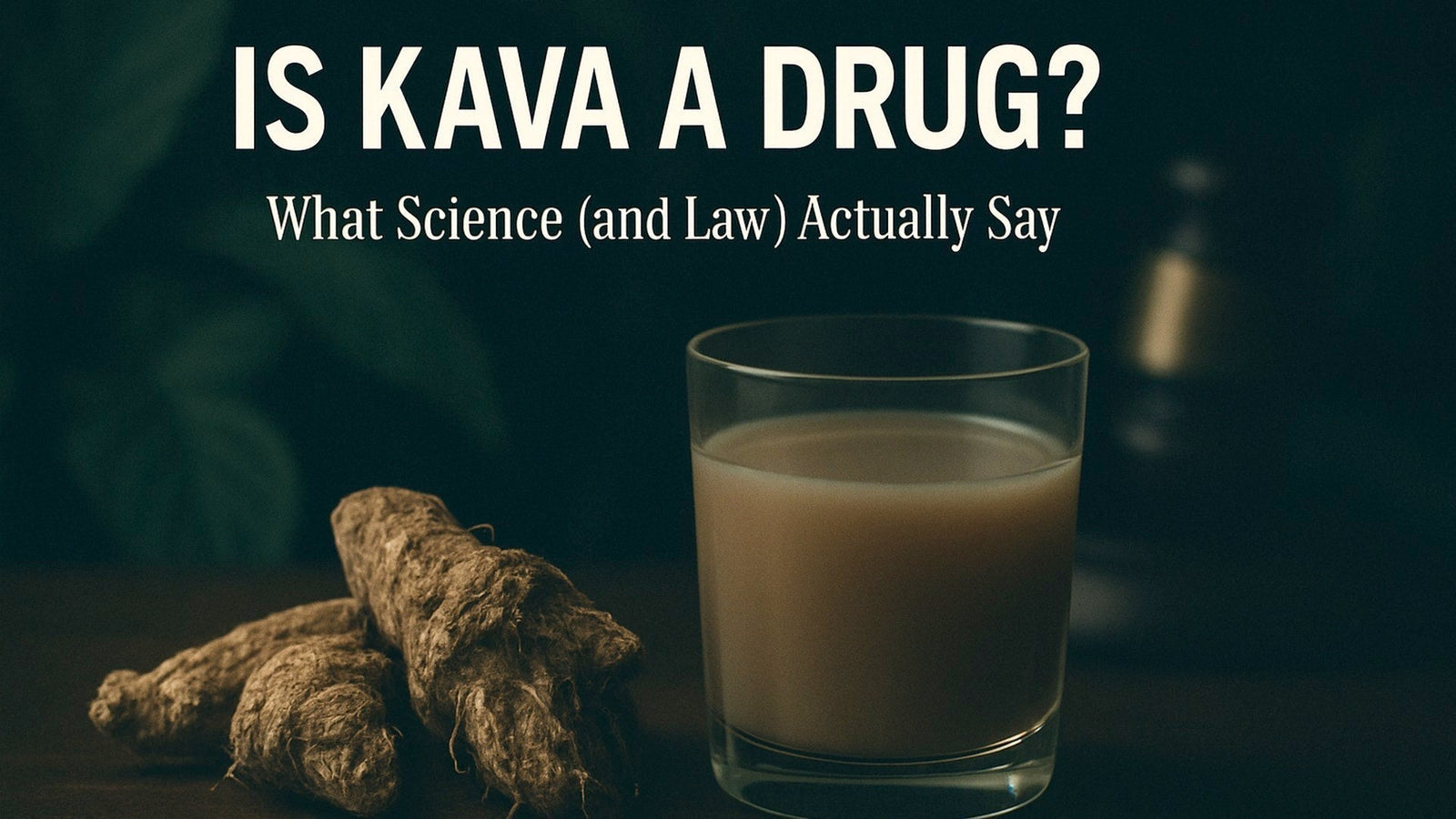
Walk into any kava bar, scroll past the wellness influencers calling it "nature's chill button," or read the FDA's safety advisories from the early 2000s, and you will get three different answers to the same question. Some people call kava a beverage. Some call it a botanical supplement. The DEA's drug-info sheet calls it a "drug of concern." The NIH's National Center for Complementary and Integrative Health classifies it as a herbal product with documented psychoactive effects. Kava sits in an unusual gap between food, supplement, and pharmaceutical.
So is kava a drug? The honest answer is that it depends on which definition of "drug" you are using. Pharmacologically, yes. Legally, in the United States, no. Culturally, it depends on which country you are standing in. This guide walks through the pharmacology, the legal status, the safety considerations, and the scientific consensus, citing the NIH, the DEA, the FDA, and recent peer-reviewed work. By the end you should be able to answer the question with the right qualifiers attached.

Table of Contents
- The Short Answer
- What "Drug" Actually Means
- How Kava Affects the Body
- Is Kava a Controlled Substance?
- Is Kava Addictive?
- Kava Compared to Alcohol and Anti-Anxiety Medications
- Is Kava Safe to Use?
- Where the FDA, NIH, and DEA Stand
- How Kava Is Regulated by Country
- Frequently Asked Questions
- Final Thoughts
TL;DR
- Pharmacologically, kava is a drug. It contains kavalactones, psychoactive compounds that act on GABA receptors and produce muscle relaxation, sedation, and mild euphoria.
- Legally in the United States, kava is not a controlled substance. The DEA lists it as a "drug of concern" for monitoring but has never scheduled it.
- The FDA issued a 2002 consumer advisory linking heavy kava use to liver injury. Subsequent research narrowed the risk to specific extraction methods and pre-existing conditions.
- Kava is not chemically addictive in the opioid or stimulant sense. Heavy daily users can develop psychological dependence and a mild withdrawal pattern.
- The kavalactone profile differs significantly between kava prepared traditionally (water extraction) and kava prepared as concentrated tinctures or capsules.
- Several countries (Germany, Switzerland, Canada at points) have temporarily banned or restricted kava. The U.S., U.K., Australia, and Pacific island nations regulate it as a food or supplement.
- A reasonable daily ceiling is 250 mg of kavalactones. Traditional kava bar servings sit in the 60 to 100 mg range.
- For a clean kava experience without the heavy-extract risk profile, our GÜD Tonics Kava Kratom Extract line uses a measured kavalactone declaration on every bottle.

The Short Answer
If you want a one-sentence answer: kava is a psychoactive plant whose active compounds qualify as drugs by every pharmacological definition, but kava is not classified as a controlled substance in the United States and is sold legally as a food, beverage ingredient, or dietary supplement.
That is a precise answer to a question that gets asked sloppily. The word "drug" in casual conversation usually means "illegal substance," and by that definition kava is not a drug in the U.S. The word "drug" in pharmacology means "any substance that, when introduced into the body, produces a physiological or psychological effect," and by that definition kava obviously qualifies. Coffee is a drug by the second definition too. Aspirin is a drug. So is alcohol. The pharmacological label is broad and morally neutral.
What makes kava interesting is that it sits closer to alcohol and benzodiazepines on the effect spectrum than to caffeine or aspirin. Its psychoactive properties are central, not incidental. People drink kava specifically for the relaxation effect, in the same way people drink alcohol specifically for the disinhibiting effect. That puts kava in a regulatory category that food law was not really designed to handle.
What "Drug" Actually Means
Three definitions of "drug" matter here. Pharmacological, regulatory, and cultural.
Pharmacological definition. The World Health Organization defines a drug as "any substance which, when taken into a living organism, may modify one or more of its functions." By this standard, kava is unambiguously a drug. Its active compounds (kavalactones, primarily kavain, dihydrokavain, methysticin, dihydromethysticin, yangonin, and desmethoxyyangonin) cross the blood-brain barrier and modulate neurotransmitter activity. The pharmacological literature has consistently treated kava as a psychoactive drug since the 1980s.
Regulatory definition. In the United States, the FDA distinguishes between drugs (which require approval and are intended to "diagnose, cure, mitigate, treat, or prevent disease") and dietary supplements (which contain dietary ingredients and are subject to different rules under DSHEA). Kava is sold as a dietary supplement, which means it is regulated under supplement rules, not drug rules. Under European Union law, kava-containing medicinal products were restricted in 2002 but kava as a food ingredient remained legal in most member states. The regulatory classification varies substantially.
Cultural definition. In Vanuatu, Fiji, Tonga, Samoa, and other Pacific island nations where kava has been consumed for at least 3,000 years, it is treated as a ceremonial beverage, social drink, and traditional medicine. The cultural framing is closer to "wine in France" than "drug in modern American usage."
The pharmacology says yes. The U.S. regulatory framework says supplement. The cultural framing varies by country. All three answers are correct simultaneously.

How Kava Affects the Body
Kava's effects come from kavalactones, a family of about 18 related compounds that bind to multiple receptor sites in the central nervous system. The six major kavalactones (kavain, dihydrokavain, methysticin, dihydromethysticin, yangonin, and desmethoxyyangonin) appear in different ratios depending on the kava cultivar and the part of the plant used. The kavalactone profile (often called the "chemotype" by kava chemists) determines whether a given kava feels sedating, euphoric, energizing, or anxiolytic.
The primary mechanism is positive modulation of GABA-A receptors. GABA is the main inhibitory neurotransmitter in the brain, and kavalactones make GABA-A receptors more responsive to GABA, which produces a calming effect similar in mechanism (though milder in magnitude) to benzodiazepines and alcohol. Kavalactones also modulate sodium and calcium ion channels, inhibit monoamine oxidase B, and affect dopamine release.
The subjective effects are well documented. Mild to moderate doses produce muscle relaxation, reduced anxiety, increased sociability, mild numbness of the mouth and throat (a hallmark of fresh kava), and a subtle sense of mental clarity that distinguishes kava from alcohol or benzodiazepines. Higher doses produce noticeable sedation, motor impairment, and in heavy users, sleep within an hour. The onset is typically 15 to 30 minutes for traditional water-extracted kava and 30 to 60 minutes for capsules.
For a deeper read on the active compound chemistry, our kava effects guide breaks down each kavalactone and the role it plays in the overall effect profile.
The pharmacokinetics matter for the drug-classification question. Kava's effect curve, dose-response relationship, and receptor binding pattern are all consistent with what pharmacologists call a "psychoactive drug." Calling it merely a "tea" or "herb" misrepresents the depth of its CNS activity. At the same time, kava's effects are notably less intense than benzodiazepines or alcohol at equivalent intoxication thresholds, and the safety margin (the gap between effective dose and toxic dose) is wider than for most prescription anxiolytics.

Is Kava a Controlled Substance?
In the United States, kava is not a Scheduled drug under the Controlled Substances Act. It does not appear in any of the five DEA schedules (Schedule I through V). The DEA's drug-information sheet on kava classifies it as a "drug of concern," which is a non-binding monitoring category for substances the DEA tracks for emerging abuse patterns but has not formally scheduled.
The "drug of concern" listing is significant for two reasons. First, it acknowledges that kava is psychoactive enough to merit monitoring. Second, it confirms that the DEA has not seen sufficient abuse, dependence, or public health concern to justify scheduling. Substances that get scheduled (kratom briefly was considered for Schedule I in 2016, before public pushback and a stay) typically have stronger evidence of abuse potential and addiction. Kava has not crossed that threshold.
State-level regulation is similarly permissive. As of 2026, no U.S. state bans or schedules kava. Some states regulate kava bars (drinking establishments serving kava-only beverages) under standard food-service rules, but none restrict the sale or possession of kava products. This contrasts with kratom, which is banned at the state level in six states (Alabama, Arkansas, Indiana, Rhode Island, Vermont, Wisconsin).
Internationally, the picture is more complicated. Germany banned kava-containing medicinal products in 2002 after liver-injury reports, then partially lifted the ban in 2014. Switzerland, Canada, France, and the U.K. issued similar restrictions in the early 2000s, most of which have since been relaxed. Australia restricts the import of kava but allows traditional Pacific community use.
The pattern is consistent: countries that initially banned kava based on liver-injury reports have largely walked those bans back as evidence emerged that the risk was tied to specific extraction methods (acetone and ethanol extracts of plant parts other than the root) rather than to traditional kava itself.
Is Kava Addictive?
Kava is not chemically addictive in the way opioids, stimulants, or alcohol are. It does not produce the dopaminergic reward signal that drives compulsive use of those drugs. The peer-reviewed addiction medicine literature has consistently classified kava as having low addiction potential.
That said, the question of "is kava addictive" deserves a more careful answer than "no."
Physical dependence. Heavy daily kava users can develop a mild physical dependence with corresponding withdrawal-like symptoms when use stops. The symptoms are typically restlessness, mild anxiety rebound, and sleep disturbance for two to seven days. This is qualitatively similar to caffeine withdrawal and quantitatively much milder than benzodiazepine or alcohol withdrawal. There are no reports of seizures or other dangerous withdrawal complications.
Psychological dependence. Daily kava users can develop a habit pattern, where the ritual of preparation and consumption becomes part of the daily routine and stopping feels disruptive. This is closer to coffee-habit psychology than to drug addiction.
Tolerance. Tolerance develops with daily use. Most kava users find that 3 to 5 grams of kava root per session continues to produce noticeable effects for weeks or months of daily use, but the relaxation feels less novel over time. Taking a break of 1 to 2 weeks restores baseline sensitivity.
Compulsive use. Reports of compulsive kava use exist in the medical literature but are rare and almost always involve concentrated extracts. The most cited series comes from Aboriginal communities in northern Australia in the 1980s and 1990s, where daily use of 400 to 700 grams of dry root per week (vastly exceeding traditional doses) produced documented health and social problems. Those cases prompted the Australian import restrictions.
The consensus in the addiction medicine literature is that kava has lower abuse potential than alcohol, lower physical dependence potential than benzodiazepines, and lower psychological compulsion potential than tobacco. It is not zero, but the population-level addiction risk is low.

Kava Compared to Alcohol and Anti-Anxiety Medications
The most useful frame for the "is kava a drug" question is to compare it directly to substances people are already familiar with.
Versus alcohol. Both kava and alcohol act on GABA receptors and produce relaxation and disinhibition at moderate doses. Alcohol is more disinhibiting and more impairing of motor coordination at equivalent subjective relaxation. Kava produces the calm without as much loss of mental clarity. Alcohol has well-documented liver toxicity, addiction potential, and acute overdose risk. Kava has documented liver-injury concerns at heavy doses with specific extracts, no acute overdose pattern in traditional preparations, and lower addiction risk.
Versus benzodiazepines (Xanax, Ativan, Valium). Both act on GABA-A receptors. Benzodiazepines bind to a specific allosteric site and produce stronger effects with a narrower safety margin. Kava binds at multiple sites and produces milder effects with a wider safety margin. Benzodiazepines produce significant physical dependence and dangerous withdrawal (seizures, delirium). Kava produces mild dependence and unremarkable withdrawal.
Versus SSRIs and CBD. Different mechanisms entirely. SSRIs work on serotonin reuptake and take 4 to 8 weeks to produce anxiety reduction. CBD works on the endocannabinoid system over days to weeks. Kava works on GABA and acts within 30 minutes. None of the three substitutes for either of the others; they treat anxiety through unrelated pathways. Our kava and alcohol comparison covers the alcohol substitution question in more detail.

Is Kava Safe to Use?
The safety profile of kava is better than the regulatory history would suggest. The 2002 FDA advisory linking kava to severe liver injury triggered a wave of bans and restrictions that subsequent research mostly walked back.
The original concerning case series (about 30 cases of liver injury reported in Europe between 1999 and 2002, including some requiring transplant) prompted the regulatory response. Later analyses of those cases found several patterns:
- Most cases involved acetone or ethanol extracts of kava, not traditional water-extracted kava root. Modern kava products labeled as "noble kava" use water-extracted root and have a much cleaner safety record.
- Some cases involved use of kava plant parts other than the root (stem peelings, leaves), which contain higher concentrations of pipermethystine, an alkaloid with hepatotoxic potential. Traditional preparation uses only the underground rhizome and roots.
- Several cases had pre-existing liver disease, alcohol co-use, or co-administration of hepatotoxic medications.
The current safety guidance, per the NIH National Center for Complementary and Integrative Health, is that kava use is generally well-tolerated when:
- The product is made from noble kava root using water extraction.
- The user does not have pre-existing liver disease.
- The user is not taking other medications metabolized through the same liver pathways (CYP3A4, primarily).
- Daily use is kept below approximately 250 mg of total kavalactones.
- Use is not combined with alcohol or hepatotoxic substances.
A separate safety consideration is sedation and impairment. Kava produces dose-dependent motor impairment and reaction-time slowing. Driving, operating machinery, and tasks requiring quick reflexes are not appropriate after kava use. The impairment profile is similar to one to two standard alcoholic drinks at moderate kava doses.
A heavy-use skin condition called kava dermopathy (dry, scaly skin patches) appears in users consuming very large daily doses (often 400+ grams of dry root per week) for extended periods. The condition is reversible upon dose reduction.

Where the FDA, NIH, and DEA Stand
Three U.S. federal agencies have published positions on kava, and they are not entirely aligned.
FDA. The FDA classifies kava as a dietary supplement under DSHEA. The 2002 consumer advisory warning of potential liver injury remains technically active but has not been updated with the more nuanced evidence base from subsequent research. The FDA does not approve kava as a treatment for any condition and has issued warning letters to companies marketing kava with disease claims. The agency does not regulate the production process beyond standard supplement GMP requirements.
NIH (NCCIH). The National Center for Complementary and Integrative Health publishes a balanced review of kava research, noting that "studies suggest that kava may be helpful for short-term anxiety," while flagging the liver-injury concern and recommending against use by people with liver disease, those taking hepatotoxic medications, or those using alcohol heavily. NCCIH's position is closer to "use with appropriate caution" than to "avoid entirely."
DEA. Lists kava as a "drug of concern" but has never moved to schedule it. The DEA's published drug-info sheet describes the pharmacology, summarizes the abuse potential as low, and notes the cultural significance.
The triangulated position is roughly: kava is a real drug with measurable effects, sold as a supplement, with an acceptable safety profile for most healthy users at moderate doses, abuse potential too low to warrant scheduling, and the FDA's 2002 advisory should be read against the more recent evidence base.
How Kava Is Regulated by Country
The regulatory map varies more than most U.S. consumers realize. The table below summarizes the current status in major markets as of 2026.
| Country / Region | Status | Notes |
|---|---|---|
| United States | Legal as supplement | No state bans; DEA "drug of concern" listing |
| Canada | Legal with NHN approval | Health Canada regulates as a Natural Health Product |
| United Kingdom | Restricted | Medicinal products restricted; food supplements limited |
| European Union | Variable by member state | Germany walked back 2002 ban in 2014; restrictions on extract products |
| Australia | Restricted import | Traditional Pacific community use protected; commercial sale limited |
| New Zealand | Legal | Subject to import controls and labeling rules |
| Vanuatu, Fiji, Tonga, Samoa | Legal and culturally protected | Significant export commodity |
| Japan | Legal as supplement | Subject to standard import inspection |
The trend over the past decade has been gradual liberalization, as evidence has accumulated that the original liver-injury cases reflected specific extraction issues rather than inherent kava toxicity.

Frequently Asked Questions
Will kava show up on a drug test? No. Standard 5-panel and 10-panel drug tests do not screen for kavalactones. Specialized kava panels exist but are rare in employment screening and have to be specifically requested.
Can I drive after drinking kava? No. Kava produces motor impairment and reaction-time slowing similar to one to two alcoholic drinks at moderate doses. Driving after kava is not safe and may be illegal under DUI statutes that cover any impairing substance, not just alcohol.
Is kava legal in all 50 states? Yes, as of 2026. No U.S. state bans or schedules kava. Local regulation of kava bars varies, but kava as a product is legal nationwide.
Can I mix kava with alcohol? Strongly not recommended. Both substances act on GABA receptors and the combination amplifies the sedative effect unpredictably. The combination also stresses the liver more than either substance alone. Most kava bars decline to serve patrons who arrive intoxicated.
Can I mix kava with prescription anxiety medication? Talk to a doctor first. Combining kava with benzodiazepines, sleep medications, or sedating antihistamines can produce additive sedation. Kava also affects liver metabolism through CYP3A4, which can change the blood levels of medications that share that pathway.
How much kava is too much? A reasonable daily ceiling is 250 mg of total kavalactones. Most kava bar servings deliver 60 to 100 mg, so three servings a day stays under that limit. Heavy daily users consuming the equivalent of 400+ grams of dry root per week have shown the dermopathy and (in extreme cases) liver-injury patterns; staying well below that threshold avoids the bulk of the documented risks.
Is kava the same as kratom? No. Kava and kratom are different plants, from different botanical families, with different active compounds and different mechanisms. Kava acts mainly on GABA receptors; kratom acts mainly on opioid receptors. The cultural use overlaps (both are traditional Pacific Island and Southeast Asian beverages, respectively) but the pharmacology is unrelated. Our kava vs kratom comparison covers the differences in detail.
Will kava help me sleep? It can, particularly the more sedating cultivars. Take it 30 to 60 minutes before bed. The sleep is generally good quality without next-day grogginess for most users. Heavy use as a sleep aid risks tolerance and dependence patterns; rotating with other sleep strategies is the standard recommendation.

Final Thoughts
Whether to call kava a drug depends on which definition you are using. The pharmacology is unambiguous: kava is a psychoactive substance with measurable CNS effects from a defined family of active compounds. The U.S. regulatory framework treats it as a supplement, which is legally accurate but leaves the consumer with less safety guidance than a drug-classified product would.
The honest take, for someone deciding whether to try kava: the safety margin is wider than the FDA's 2002 advisory implied, the addiction potential is lower than for alcohol or benzodiazepines, and the effects are mild and short-lived enough that occasional use is unlikely to produce problems for healthy users. The risks scale with dose and concentration; traditional water-extracted kava at moderate doses has the cleanest profile.

If you are considering adding kava to your evening wind-down routine, our GÜD Tonics Kava Kratom Extract line offers a measured-kavalactone format that takes the guesswork out of dosing. Each bottle declares the kavalactone content on the label and the formulation is designed for the predictable, traditional-feel experience rather than the heavy-extract risk profile that drove the early 2000s safety concerns.
For users who want to stay informed beyond a single article, the American Kratom Association (which despite its name advocates for both kava and kratom policy clarity) tracks regulatory developments and the NIH National Center for Complementary and Integrative Health maintains a regularly updated kava safety review. Keeping an eye on those two sources is enough to stay current with how the science and the law evolve.
Treat kava as what it actually is: a psychoactive plant with a long cultural history, a moderate but real pharmacological profile, and a regulatory status that varies by country and year.


