



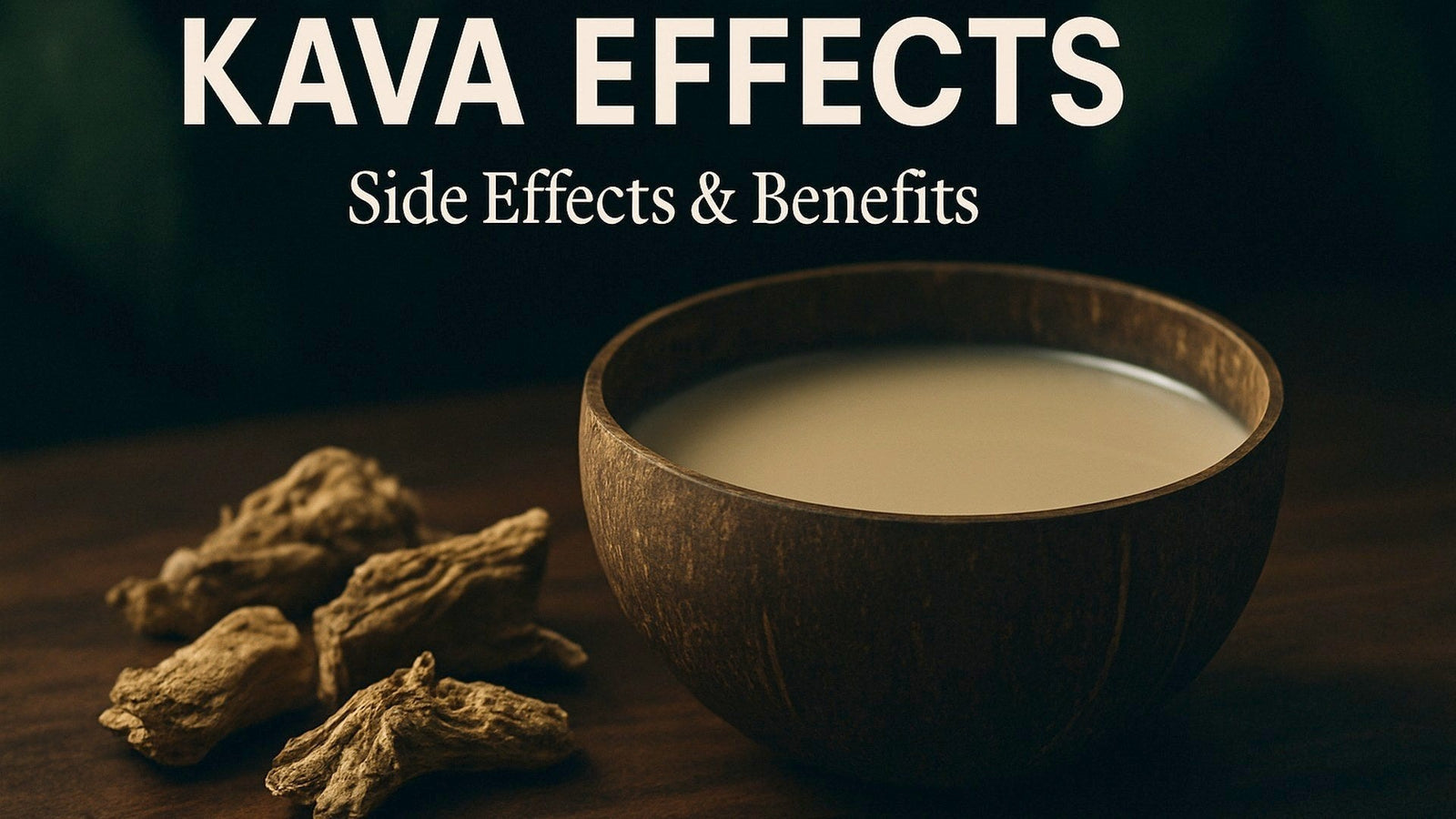
Roughly 1,600 Americans search "kava side effects and benefits" every month, and almost every result they land on either oversells the calm or overstates the risk. The truth on kava side effects and benefits sits in between, and it changes depending on which kind of kava someone is actually drinking. We field this question from customers daily, so we wrote the answer down once.
Kava research has shifted a lot in the past five years. The FDA reclassified kava as a conventional food in April 2025 in addition to its existing dietary-supplement status, the Australian Alcohol and Drug Foundation updated its safety statements in 2024, and a wave of newer reviews has tightened up what we know about the noble root tradition versus the cheaper, riskier preparations that drove most older case reports. If your last read on kava was from a 2010 health blog, a lot of it is out of date.
This guide covers kava side effects and benefits at roughly equal weight. We walk through what kava is, where the calming effects come from, the kava benefits that hold up under research, the side effects that show up at common doses, the kava liver question (honestly), drug interactions worth taking seriously, a dose framework, and a short decision checklist so you can decide whether it is for you.
Table of Contents
- What Kava Actually Is, In One Pass
- Where the Effects Come From: The Six Major Kavalactones
- The Distinction That Decides Everything: Noble vs. Tudei vs. Aerial-Part
- The Kava Anxiety and Stress Case (Where the Evidence Is Strongest)
- Other Kava Benefits the Research Supports (and Some It Doesn't)
- The Common, Short-Term Side Effects Most People Actually Notice
- The Kava Liver Conversation, Honestly
- Drug Interactions and Who Should Skip Kava
- Dose, Frequency, and How to Drink Kava Without Stacking Risk
- Frequently Asked Questions
- Final Thoughts
TL;DR
- Kava is a Pacific root traditionally prepared as a water-based drink (sometimes brewed as a kava tea, sometimes as the stronger traditional grog). The active compounds are called kavalactones, and the noble cultivars are the ones with centuries of safe daily use behind them.
- Two clinical signals consistently show up: meaningful short-term anxiety relief (HAM-A reductions roughly comparable to low-dose benzodiazepines in some trials) and improved subjective sleep onset.
- Most side effects at moderate doses are mild and short-lived: drowsiness, mild gut upset, tongue numbness, and a flushed or relaxed feeling within 15 to 30 minutes.
- The 2002 European liver scare drove most internet caution. The bulk of those case reports involved acetone-extracted, non-noble, or aerial-part kava, not noble root water extract.
- Mixing kava with alcohol, benzodiazepines, sleep medications, or other hepatotoxic drugs raises risk meaningfully. If you take any of those, skip kava or talk to a clinician first.
- Kavalactone dose typically falls between 70 mg and 250 mg per serving. Daily traditional intake in Pacific cultures runs around 250 mg to 1 g of kavalactones, but day-in-day-out use is not recommended for most modern drinkers.
- Kava is not addictive in the classic sense, but heavy daily drinkers can develop kava dermopathy (dry, flaky skin) that resolves once they cycle off.
- The single biggest predictor of a clean kava experience is product quality: noble root, water-prepared or properly extracted, third-party tested, ideally from a brand that publishes its cultivar sourcing.

What Kava Actually Is, In One Pass
Kava (Piper methysticum, sometimes called kava kava) is a perennial shrub native to the Western Pacific. The part people consume is the root, which contains the compounds that produce the drink's signature calm. For about 3,000 years, Pacific Islanders have prepared kava by grating or pounding the root, soaking it in water, straining the slurry through cloth, and drinking the resulting earthy beverage at social and ceremonial gatherings.
What reaches modern shelves looks different. You can find kava as instant powder you mix with water, as traditional micronized grind for the bowl-and-strainer method, as liquid tinctures, as ready-to-drink shots and tonics, and as capsules. The southern-US kava bar scene leans on traditional micronized format. The carrier and prep method matter, because they change which kavalactones end up in your glass and how fast they hit. According to NCCIH, the most consistent traditional and modern uses center on anxiety relief, restful sleep, and a general sense of social ease.
Where the Effects Come From: The Six Major Kavalactones
A noble kava root contains eighteen kavalactones, but six do most of the heavy lifting and produce most of the documented kava root benefits: kavain, dihydrokavain, methysticin, dihydromethysticin, yangonin, and desmethoxyyangonin. Each contributes a slightly different effect, and the ratio between them (often called a chemotype, written as a six-digit code on premium product labels) is a stronger predictor of the experience than the total kavalactone milligrams alone.

Kavain leads with the sharpest anti-anxiety and muscle-relaxing effect. Dihydrokavain layers in physical calm. Methysticin and dihydromethysticin contribute longer-acting sedation, which is part of why some kavas feel uplifting (a "heady" chemotype starting with kavain and yangonin) while others feel more like a slow exhale (a "heavy" chemotype starting with the methysticins). Yangonin and desmethoxyyangonin round out the experience with subtle mood effects. If you have ever had two kavas back-to-back that felt completely different, the chemotype gap is usually why.
The Distinction That Decides Everything: Noble vs. Tudei vs. Aerial-Part
This is the single most important section of this article, and most kava explainers skip it.
Noble kava refers to a small group of cultivars (around twenty named varieties) selected over centuries by Pacific Islanders specifically for daily drinking. They have favorable kavalactone profiles, predictable effects, and a long track record of safe use. Tudei kava (a Tongan word loosely meaning "two days") refers to cultivars high in flavokavains and dihydromethysticin, valued historically for ritual or medicinal preparations but linked in studies to harsher come-downs, longer-lasting heaviness, and a poorer safety profile. Aerial-part kava means leaves and stems, the parts traditional Pacific use specifically excludes. The plant concentrates a chemical called pipermethystine in the aerial parts that does not appear in the root in any meaningful quantity, and it has been implicated in liver-cell stress in lab studies.
| Material | Source | Traditional Use | Modern Risk Profile |
|---|---|---|---|
| Noble root, water-extracted | Selected cultivars, root only | Daily social and ceremonial drinking, centuries of use | Lowest. Most case reports do not involve this material. |
| Tudei root | Non-noble cultivars, root only | Occasional ritual / medicinal | Higher. Harsher come-downs, longer-lasting effects, linked to more reported side effects. |
| Aerial parts (leaves, stems) | Same plant, wrong part | Not traditionally consumed | Highest. Pipermethystine content; flagged in older European hepatotoxicity reports. |
| Acetone or ethanol root extracts | Industrial solvents | Not traditional | Elevated. The bulk of older European case reports trace here. |
A 2020 hepatotoxicity review on PMC re-examined the 2002 European liver case reports and found that the majority involved acetone-extracted product, non-noble cultivars, aerial parts, or some combination. That single finding reframes most of what older articles still warn you about. Noble root water extract sits in a different risk category than the products that drove the regulatory panic.

The Kava Anxiety and Stress Case (Where the Evidence Is Strongest)
If kava has a flagship benefit, kava anxiety relief is it. Multiple randomized controlled trials and several Cochrane and PMC meta-analyses have measured kava against placebo for generalized anxiety. The Hamilton Anxiety Rating Scale (HAM-A) drops produced by standardized kava extract in these trials are typically meaningful, and a few head-to-head trials show kava landing in the same effect-size neighborhood as low-dose buspirone or short-course benzodiazepines, without the cognitive blunting or the dependence trajectory.
That does not mean kava is a clinical substitute for prescribed treatment. It means the kava anxiety signal is real, repeatable, and not just marketing folklore. The Memorial Sloan Kettering kava monograph summarizes the strongest evidence as short-term anxiety relief, with the caveat that long-term daily use studies are still thin and that pre-existing liver conditions remain a hard exclusion.
Why people feel it so quickly: kavain and dihydrokavain interact with GABA receptors (the same family of receptors targeted by benzodiazepines, although through different binding mechanisms), and they appear to dampen norepinephrine reuptake. The result is a soft cognitive smoothness without sedation at low to moderate doses. Most drinkers describe it as the edges coming off, not as feeling drugged.
For context, our kratom vs. kava comparison goes deeper on how the two plants differ in mechanism and use case.
Other Kava Benefits the Research Supports (and Some It Doesn't)
Past kava anxiety relief, four other kava root benefits show up consistently enough in research and traditional use to call them well-supported. A few other kava benefits get attributed to the plant online but do not hold up.
Subjective sleep onset improves, especially for people whose insomnia is anxiety-driven. Heavier methysticin-forward chemotypes are the more reliable choice if sleep is the goal. Muscle relaxation is real and felt physically within twenty minutes, which is why some kava drinkers reach for it after long workdays or workouts. Social ease, the experience that drives "kava bar" culture, is well-documented and one reason kava sits in the alcohol-alternative category for many people. Subjective mood lift shows up modestly in some trials, more reliably in users with mild stress than in users with diagnosed depression.
What does not hold up as well: kava as a treatment for chronic pain (effects are real but mild and short-lived), kava as a focus aid (most users report the opposite), and kava as a libido enhancer (no controlled evidence; the relaxed state may have other explanations). Marketing claims about kava reversing addiction or "detoxing the liver" are not supported by current research; the ADF Australia kava factsheet is a useful cross-check on hype around kava root benefits.
The Common, Short-Term Side Effects Most People Actually Notice
At low to moderate doses, most kava side effects are predictable and short-lived. Knowing what to expect makes the experience less unsettling for first-time drinkers.
| Dose Tier | Typical Kavalactones | Common Effects | Side Effects to Expect |
|---|---|---|---|
| Light (one shell or shot) | 70 to 130 mg | Subtle calm, social ease, tongue numbness | Mild drowsiness, mouth numbness, soft head |
| Moderate (two to three shells) | 130 to 250 mg | Clear anxiety drop, muscle ease, conversational warmth | Stronger drowsiness, mild gut wobble in first-timers, slowed reaction time |
| Heavy (traditional grog session) | 250 mg to 1 g+ | Heavy-body sedation, sleep onset within an hour | Next-day grog (kava hangover), low-energy morning, occasional headache |

Tongue numbness is the most universal short-term effect and is harmless; it is one of the kavalactones briefly anesthetizing the mucosa. Drowsiness scales with dose. Mild gastrointestinal upset shows up most often when kava is taken on a full meal of heavy fats, which can compete with kavalactone absorption and shift the come-up. Daily heavy drinkers (the term in the literature is "habitual kava users," meaning multiple sessions a week for months or longer) sometimes develop kava dermopathy, a temporary dry, flaky skin condition along the arms, shins, and face that resolves within a few weeks of cycling off. It is not dangerous, but it is a signal that the body is asking for a pause.
The Kava Liver Conversation, Honestly
This is the section the internet is loudest about, and the section most articles get sloppy on. People ask "is kava safe for the liver?" more than almost any other kava liver question, and the answer is worth doing carefully.
In 2001 and 2002, around eighty hepatotoxicity case reports in Europe (mostly Germany and Switzerland) prompted regulators to pull kava from sale. The reports were real, but the products behind them were not uniform. When researchers dug into the files later, patterns emerged: many products were acetone- or ethanol-extracted, a meaningful share used non-noble or unspecified cultivars, some used aerial parts, concurrent alcohol or hepatotoxic medication was common, and patient-reported doses were sometimes far above traditional Pacific intake.
The PMC7600512 review is the most thorough modern look at this. It concludes that noble root water extract, the traditional preparation, is not represented in the case-report cluster the way solvent extracts and non-noble or aerial-part products are. The FDA dietary-supplements page still lists kava with general safety considerations, and noble-root advocates do not dispute that liver risk exists when product quality is poor or when kava is stacked with alcohol or hepatotoxic drugs.
The honest 2026 read on the question "is kava safe day-to-day": noble root water-prepared kava at moderate doses, in adults without pre-existing liver disease and not taking liver-stressing medications, sits in a substantially lower risk band than internet warnings suggest. Kava at heavy doses, daily, in combination with alcohol or hepatotoxic drugs, in someone with hepatitis or fatty liver, sits in a meaningfully higher risk band. Both can be true simultaneously, and the difference between them is mostly behavioral and product-quality.
Drug Interactions and Who Should Skip Kava
Kava is metabolized in the liver, primarily by CYP450 enzymes. That fact alone shapes the interaction list. Some combinations are inadvisable for everyone; some are absolute no-go.

Skip kava entirely if you drink alcohol the same evening, if you take benzodiazepines or other sedatives, if you are on prescription sleep medication, if you take an MAOI, if you have any known liver condition (hepatitis, fatty liver, prior hepatotoxicity), if you are pregnant or breastfeeding, if you have surgery scheduled within two weeks, or if you are on a drug with known hepatotoxic potential (some statins, methotrexate, chronic-dose acetaminophen). Talk to a clinician before kava if you are on an SSRI, tricyclic antidepressant, anticonvulsant, levodopa, or any maintenance medication that taxes liver metabolism. The MSKCC monograph is the cleanest clinician-facing reference for the kava side effects and benefits interaction picture.

Kava can also amplify the effects of cannabis when used together, and it can blunt antiparkinsonian medication. Pacific traditional use does not stack kava with other drugs in a session, and the cleanest experiences (and safety records) follow that pattern, which keeps both kava side effects and benefits in their predictable lanes.
Dose, Frequency, and How to Drink Kava Without Stacking Risk
A reasonable framework for someone starting kava, written as a decision checklist:
- Decide what you want from it: short-term anxiety relief in the evening, better sleep onset, social ease at a gathering, or alcohol substitution. The chemotype to look for shifts depending on the answer.
- Buy noble-root product only. The label should name cultivars (Borogu, Boroguru, Melo Melo, Loa Waka, and similar are noble) or at least say "noble kava." If a label only says "kava extract," assume nothing and ask.
- Start at the low end. Around 70 to 130 mg of kavalactones is plenty for a first session. Drink it on a mostly empty stomach; kavalactones absorb better that way, and dose-finding is cleaner.
- Wait 20 to 30 minutes before adding more. Kava onset is slower than alcohol and almost everyone overshoots their first time.
- Stack with nothing. No alcohol, no cannabis, no sleep aids, no benzodiazepines, in the same window. This is the single biggest lever for keeping kava safe.
- Cycle. Most regular kava drinkers find a two-to-four-times-a-week pattern feels better than daily use, both physically and in terms of the experience staying clean. If skin gets dry or flaky, take a longer break.

A traditional Pacific session can deliver 250 mg to 1 g of kavalactones across an evening of slow shells. That is the upper end of common modern use, not a beginner range. For most modern drinkers, two shells of a quality tonic covers the evening. For better sleep onset, a small dose 60 to 90 minutes before bed performs better than a large dose at the door.
If you want a ready-to-drink format that takes the guesswork out, the GÜD Tonics Pink Sunset and GÜD Tonics Baja Bliss are noble-root tonics we keep in rotation. They sit in the light-to-moderate dose tier per bottle, and the flavor masks the earthy edge.

Frequently Asked Questions
Is kava actually safe?
For most healthy adults, noble-root water-extracted kava at moderate doses, used a few times a week and not combined with alcohol or other CNS depressants, has a strong traditional and clinical safety record. The kava side effects and benefits picture gets shakier when product quality drops, when daily heavy use stacks up, or when kava sits alongside hepatotoxic medications. The NCCIH page is a good non-promotional overview.
Does kava damage your liver?
Noble-root water extract has not been clearly linked to the hepatotoxicity case reports that drove the 2002 European bans. Those reports clustered around solvent-extracted, non-noble, or aerial-part products, often with concurrent alcohol or hepatotoxic medications. Liver risk goes up when kava is heavy, daily, low-quality, or stacked with drugs that tax the liver. It is not zero, but it is not what most older internet warnings suggest either.
How does kava feel?
Most first-time drinkers describe a soft, warm sense of calm within 15 to 30 minutes, mild tongue numbness, a quieter mind, and a willingness to sit with conversation without effort. Anxiety drops fairly quickly. At higher doses the calm deepens into sedation. Unlike alcohol, kava does not cloud cognition at light or moderate doses; most people stay sharp.
Can you mix kava and alcohol?
Skip it. Both load the liver and depress the central nervous system. Pacific traditional practice does not mix the two, the clinical literature flags the combination repeatedly, and the cleanest kava experiences come from drinking it on its own.
Is kava addictive?
Kava does not produce the dopaminergic addiction pattern that alcohol, opioids, or stimulants do. Heavy daily drinkers can develop a behavioral routine around it and can experience kava dermopathy as a physical signal of over-use, but classic tolerance, withdrawal, and craving patterns are not characteristic. Cycling off resolves the skin changes within a few weeks.
How long does kava stay in your system?
The acute felt effects fade within two to four hours. The kavalactones themselves clear over a longer window, generally 24 to 72 hours depending on dose, frequency, and individual metabolism. Our primer on kava covers the full picture if you are new to the plant.
What's the difference between noble kava and the cheap stuff?
Noble kava is a small set of cultivars selected over centuries for safe daily use, with kavalactone profiles that produce predictable calm and very low side-effect rates. Cheap or non-noble kava can include tudei cultivars, aerial parts (leaves and stems), or solvent-extracted material. Almost every safety issue tied to kava traces back to the non-noble or non-root category, and labels that do not specify cultivar or part deserve skepticism.
Final Thoughts
Kava is one of those plants where the truth is more interesting than the dominant internet narrative. The kava benefits are real (the kava anxiety signal is the cleanest in herbal medicine, the muscle and social-ease effects show up reliably, and the alcohol-alternative use case is legitimate), and the kava side effects and benefits picture is real on both sides but largely a function of product quality, dose, and what else is on the table. The single most useful question is not "is kava safe" but "is this kava noble root, water-prepared or properly extracted, and am I drinking it on its own."
For most healthy adults who want short-term calm without the hangover or cognitive cost of alcohol, the answer to whether kava belongs in your life is usually yes, in moderation, from a clean source. For people on liver-stressing medications, with existing liver conditions, pregnant or breastfeeding, or who plan to drink alcohol the same evening, the answer is no, or at least not yet. The decision is rarely about kava in the abstract; it is about your specific health context and the specific bottle you reach for.

If you want a place to start without the dose-finding learning curve, the GÜD Tonics line is our noble-root pick. Pink Sunset and Baja Bliss are the easiest entry points.
The last thing worth saying: pay attention to how you feel. If kava lifts your evening, helps you sleep, and you wake up clear, that is a clean signal. If you wake up groggy or your skin starts to flake, your body is asking you to cycle off for a couple of weeks. The plant has been in conversation with humans for three thousand years, and it tends to reward people who treat it as a partner rather than a quick fix.


