



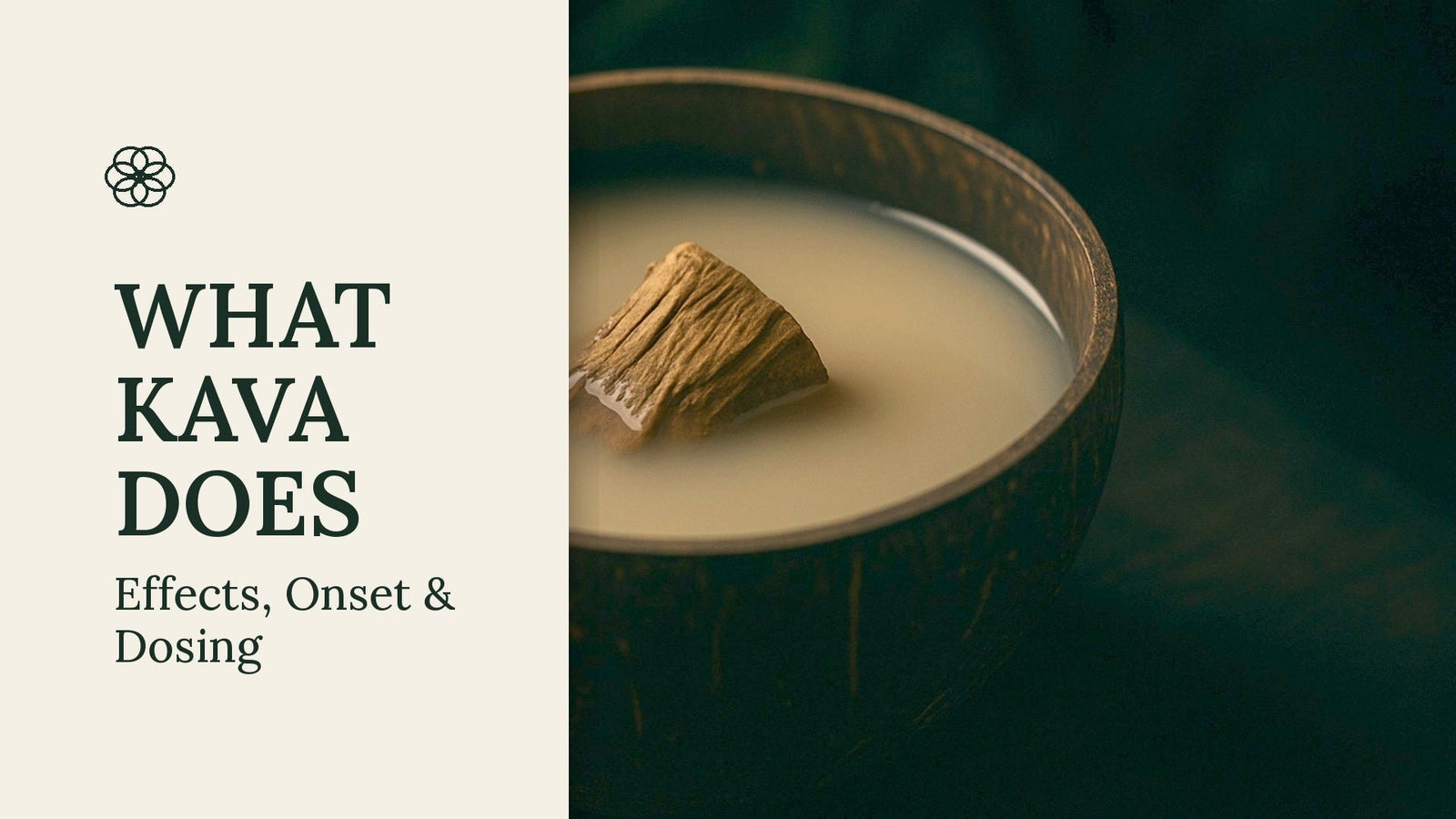
Kava is one of those words people have heard a hundred times before they ever try it. A friend orders it at a kava bar, a yoga teacher mentions it as a wind-down drink, an aunt brings home a bottle of kava nectar from Hawaii. The natural next question is the simple one: what does kava do, actually, when it gets into your body? This guide is the honest answer, written for 2026, with the pharmacology, the felt experience, and the real-world context all in one place.
The plant is Piper methysticum, a shrubby pepper relative from the South Pacific. People have been preparing its root as a ceremonial and social drink for at least 3,000 years across Fiji, Vanuatu, Samoa, Tonga, and Hawaii, according to the Australian Alcohol and Drug Foundation. Modern interest has caught up: kava bars exist in major US cities, US kava imports have climbed year over year, and concentrated kava extracts and kava-kratom blends now sit on the same shelf as energy drinks at many convenience stores.

The short version: kava produces a calm, slightly heavy-limbed body feeling and a clear-headed mental ease. It does this by sending a family of compounds called kavalactones to a specific set of receptors in the brain. It is not alcohol, it is not a benzodiazepine, and it is not a hallucinogen. It sits in its own quiet category. The rest of this primer unpacks the mechanism, the felt experience at different doses, and the practical questions readers usually want answered before their first session.
Table of Contents
- What Kava Actually Is (The Plant and the Drink)
- What Kavalactones Do in the Brain
- What Kava Does to You at Light, Medium, and Traditional Doses
- Onset and Duration: How Long Until You Feel It
- How Kava Differs from Alcohol
- How Kava Differs from Anti-Anxiety Medications
- Why Kava Is a Social Drink in Pacific Cultures
- What Affects How Kava Hits You
- The Safety Conversation (Brief and Honest)
- Who Kava Suits and Who Should Skip It
- Frequently Asked Questions
- Final Thoughts
TL;DR
- Kava is a Pacific Island root drink, made from Piper methysticum, used for relaxation and social bonding for thousands of years.
- What does kava do at the mechanism level: its kavalactones gently modulate GABA-A receptors, the same calming system that benzodiazepines target, but through a different binding site.
- At a light dose, kava feels like a quiet exhale. Shoulders drop, the mental loop slows, social warmth comes up, and you stay clear-headed.
- At a traditional dose, kava feels heavier. Limbs get loose, eyelids get droopy, conversation softens, and many people slide into sleep within an hour or two.
- Kava is not intoxicating in the alcohol sense. It does not impair speech or motor skills the way drinks do, and it leaves no real hangover when used moderately.
- Onset is roughly 15 to 30 minutes from a traditional drink, about 5 to 15 minutes from a concentrated extract, with effects lasting 2 to 4 hours.
- The safety conversation centers on the kava liver story, which a closer read of the literature has largely reframed. We cover it briefly and link to the deeper article.
- Kava suits the reader who wants social ease, evening wind-down, or a quiet alternative to a glass of wine. It does not suit anyone on liver medications, anyone mixing it with alcohol, or anyone looking for a stimulant.

What Kava Actually Is (The Plant and the Drink)
Kava is the root of Piper methysticum, a tall, woody shrub in the pepper family. The plant grows mainly in volcanic soils across the Pacific Islands. Fiji, Vanuatu, Samoa, Tonga, and Hawaii each have their own farming traditions and named cultivars, called noble kava varieties when they have been bred for many generations and are known to be safe for daily consumption.
The drinkable form is a water extraction. Dried root is pounded, kneaded in cold water inside a cloth strainer, and the milky beige liquid is poured into a coconut shell or a wooden bowl called a tanoa. That liquid is what most people picture when they think of kava: cloudy, slightly chalky, with an earthy, peppery taste. Modern formats include kava concentrate drops, kava nectar, kava-leaning shot bottles, instant kava powders, and capsules. The active compounds are the same across these formats, just delivered in different concentrations.
One language note that trips up new readers: kava and kava kava are the same plant. The doubled name shows up on supplement labels and in older botanical references, but it carries no extra meaning. Throughout this guide we will simply say kava.
What Kavalactones Do in the Brain
The active compounds in kava are called kavalactones. Six of them do the heavy lifting: kavain, dihydrokavain, methysticin, dihydromethysticin, yangonin, and desmethoxyyangonin. A good noble kava root is around 5 to 10 percent kavalactones by dry weight, and the felt effect of a kava session is largely a function of how many milligrams of kavalactones you have actually consumed.

What does kava do at the receptor level? The current understanding, summarized in a 2020 review published on PMC NCBI, is that kavalactones gently modulate GABA-A receptors, the same inhibitory system that benzodiazepines and alcohol act on, but at a different binding site and with a much softer effect. Boosting GABA-A activity quiets the racing-mind feeling, lowers muscle tension, and produces the calm body state most people describe after a few shells.
Two things make kava unusual. First, unlike benzodiazepines, kava does not appear to produce the dependence and tolerance pattern that benzo prescriptions cause. Second, kava does not strongly suppress dopamine in the way alcohol can over a long evening. The National Center for Complementary and Integrative Health notes that kava can produce mild euphoria and a slight sociability lift, which is part of why it shows up in Pacific ceremonial settings. The mental ease comes without the steep dopamine rebound the next morning.
What Kava Does to You at Light, Medium, and Traditional Doses
The felt experience of kava is dose-dependent in a way that is unusually clean. The following table summarizes what most people report, drawing on the dose profiles in the Memorial Sloan Kettering integrative medicine database and consumer-reported descriptions.
| Dose tier | Kavalactones | Felt experience | Onset | Duration | Best for |
|---|---|---|---|---|---|
| Light (1 to 2 shells) | roughly 70 to 140 mg | Quiet exhale, shoulders drop, mental loop slows, social warmth comes up, fully clear-headed | 15 to 25 minutes | 1.5 to 2 hours | Casual social settings, an evening tea swap |
| Medium (3 to 4 shells) | roughly 200 to 280 mg | Body softness, mild facial numbness on the lips and tongue, sociable but a touch slower, ideas come more easily | 20 to 30 minutes | 2 to 3 hours | Wind-down at home, a kava bar evening, light insomnia support |
| Traditional (5 plus shells or a strong extract) | roughly 300 to 500 mg or more | Heavy limbs, droopy eyelids, conversation softens, possible mild euphoria, a real urge to lie down within an hour | 15 to 25 minutes | 3 to 4 hours, often into sleep | Ceremonial sessions, ceremonial-style evenings at home with experienced drinkers |
Notice what is not on this list: hallucinations, paranoia, motor impairment severe enough to slur speech, or aggression. Many people report that kava simply makes them quiet, kind, and slow, which is consistent with how it is used socially in the Pacific.
Onset and Duration: How Long Until You Feel It, How Long It Lasts
Kava begins to feel like something around 15 to 30 minutes after the first sip of a traditional drink. The classic early sign is a slight numbness on the tongue and lips, which has earned kavain the nickname natural lidocaine in casual writing. That numbness lasts only a few minutes; the body relaxation builds underneath it.

Concentrated kava extracts, kava nectars, and kava-leaning shot bottles deliver kavalactones in a smaller volume of liquid, so they reach the bloodstream faster. Onset on a concentrated GÜD Tonics Kava Kratom Extract Bundle is often 5 to 15 minutes. The total session length is similar to a traditional drink, roughly 2 to 4 hours, with the heaviest body feeling in the middle hour. The come-down is gentle. Most people simply notice that the calm fades and ordinary mental tempo returns.
How Kava Differs from Alcohol
Alcohol and kava both lean on GABA, which is why they get casually grouped together. The differences matter more than the overlap.
Alcohol pushes dopamine hard at the start of a session and drops it just as hard the next morning. Kava barely moves dopamine at all, which is why kava drinkers describe the experience as quietly social rather than hyped. Alcohol also damages motor coordination at moderate doses, slurs speech, and lowers inhibition in a way that produces the classic drunk profile. Kava produces heavy limbs but leaves speech and motor planning intact at low to medium doses, which is why Pacific ceremonies can run for hours with the participants still speaking carefully and clearly.
Hangovers are the other split. Alcohol leaves a known hangover stack: dehydration, inflammation, dopamine deficit, gut irritation. Moderate kava produces no comparable next-morning state. Heavy kava can leave you slow and a touch puffy the next morning, which is why traditional cultures cap heavy sessions at one or two nights a week.
One overlap that does carry over: never mix kava with alcohol. The combination meaningfully increases pressure on the liver, and it amplifies the sedating side of both substances in a way that is hard to predict. This pairing shows up in nearly every kava safety review, including the FDA dietary supplements guidance page on herbal products that interact with hepatic enzymes.
How Kava Differs from Anti-Anxiety Medications
Prescription anti-anxiety drugs broadly fall into two groups: benzodiazepines and SSRIs. Benzodiazepines act on the same GABA-A receptor that kavalactones do, but they bind tightly, produce strong sedation, and carry significant dependence risk. SSRIs work on serotonin and take weeks to titrate up.
Kava sits in a third place. It modulates GABA-A more gently, has a much shorter half-life (a few hours rather than days), and is taken acutely rather than as a daily prescription. Some people use it situationally for social anxiety, for evening wind-down, or as a calmer substitute for the second or third glass of wine they would otherwise pour. This is the felt-experience reason people search "what does kava feel like" more often than any other secondary phrase.
None of this is a medical claim, and kava is not a substitute for prescribed treatment. The point is that the experience is closer to a slow herbal tea with a clear focal feeling than it is to a pill that hits hard and dulls everything. We cover the benefits side in detail in our kava kava benefits guide.
Why Kava Is a Social Drink in Pacific Cultures
To understand what kava does, it helps to see how it is used at home. In Fiji and Vanuatu, kava sessions are the central frame for evening gatherings, village meetings, conflict-resolution ceremonies, and welcome rituals for visitors. A bowl is prepared by a dedicated server, shells are passed in order of seniority or guest status, and conversation slows over the course of the evening. There is nothing rowdy about it. The drink induces sit-down talking, not stand-up partying.

That social use case maps closely onto how kava bars in the US function. Patrons sit, sip, talk quietly, and stay for hours. The drink is intentionally a tempo regulator, not an accelerator. Many people who have tried both describe a kava evening as the inverse of a bar night out: same length, same volume of conversation, but a calmer body, an earlier bedtime, and a clear next morning.
What Affects How Kava Hits You
A few variables drive how strongly any given kava session lands. Knowing them helps the first-timer titrate.

Empty stomach. Kava on an empty stomach reaches peak effect roughly twice as fast as kava taken with a meal, and the peak feels noticeably stronger. Traditional Pacific drinkers usually wait until well after dinner. Most kava bars suggest food at least 60 minutes before the first shell.
Body weight and tolerance. A 200-pound first-time drinker and a 130-pound regular will feel a similar volume very differently. The kavalactone-per-kilogram rule of thumb is roughly 2 mg per kg for a light session and 4 to 5 mg per kg for a medium one.
Form and concentration. A water-extracted traditional drink delivers kavalactones in a high volume of liquid, with onset around 20 minutes. A concentrated kava extract or kava nectar packs the same kavalactones into a few ounces and feels faster and sharper. Capsules deliver a measured dose but kick in slowly, around 30 to 45 minutes.
Cultivar. Noble kava cultivars (Borogu, Borongoru, Kelai, Mahakea) are bred for evening relaxation. Tudei kava (literally "two-day kava") is stronger and lingers longer, and most Western kava sellers avoid it for daily use.
Here is a starter protocol for a first kava session, written for the reader who is doing this at home and wants a calm, controlled introduction.
- Eat a real meal at least 60 minutes before you start.
- Drink a glass of water alongside your kava, since the root is mildly dehydrating.
- Start with a single low to mid-strength serving. If you are using a traditional kava drink, that is about 8 ounces. If you are using a concentrated extract, follow the bottle's serving size and do not double it.
- Wait 30 minutes before reaching for a second serving. The peak builds slowly, and most people underestimate how much they have already had.
- Stay seated. Read, listen to music, talk with a friend. Avoid driving for the rest of the evening.
- Stop drinking new kava after the second hour. If you want to extend the calm, switch to herbal tea or water.
- Skip alcohol entirely on a kava night, no exceptions.
- Make a quick note the next morning of what you felt, when it peaked, and how you slept. The second session is much easier to dial in with that record.

The Safety Conversation (Brief and Honest)
Any honest answer to "what does kava do" has to mention the safety conversation, which mostly centers on liver health. In the early 2000s a cluster of reported cases led Germany, Switzerland, and a few other countries to restrict kava sales. Later analyses, summarized in our deeper write-up on the kava liver damage myth, looked closely at those cases and found a mix of contributing factors: pre-existing liver disease, alcohol use, multi-drug regimens, and a small number of products that used aerial parts of the plant rather than root.
The modern consensus, reflected by the NCCIH and most integrative-medicine references, is that noble kava root, taken without alcohol and without liver medications, in moderate amounts, is reasonable for most healthy adults. The exceptions are real and worth respecting: avoid kava entirely if you have liver disease, take liver-metabolized medications such as acetaminophen at high daily doses, drink alcohol regularly, are pregnant or nursing, or have a planned surgery within two weeks.
For a broader pass through what kava does positively and where the risk-benefit conversation lands, see our companion article on kava side effects and benefits.
Who Kava Suits and Who Should Skip It
Kava is a useful tool for a specific kind of evening. If the answer to "what does kava do for you" matters, here is the honest fit map.

Kava suits you well if:
- You want a calmer alternative to the second or third drink in a social setting.
- You sleep better after a quiet wind-down ritual.
- You enjoy slow, conversational gatherings rather than high-energy outings.
- You want to experience a Pacific Island tradition with cultural context, not just a buzz.
- You are sober from alcohol and looking for a low-risk, non-addicting evening ritual.
Kava is not the right fit if:
- You have liver disease, take daily liver-metabolized medications, or drink alcohol regularly.
- You are looking for stimulation, focus, or energy. Kava does the opposite.
- You expect a strong, alcohol-like intoxication. Kava is milder and more cerebral.
- You are pregnant, nursing, or under 18.
- You drive for work and your session would overlap with your shift.
Frequently Asked Questions
What is kava and is it safe?
Kava is a root drink made from Piper methysticum, used in the Pacific Islands for thousands of years. For most healthy adults who use noble kava root without alcohol or liver medications, in moderate amounts, the modern consensus from organizations like the NCCIH is that kava is reasonable. The exceptions are people with liver disease, regular alcohol use, pregnancy, and certain medication regimens.
What does kava do to your brain?
Kavalactones modulate GABA-A receptors, the same inhibitory system targeted by benzodiazepines and alcohol, but through a different binding site and at a much lower intensity. The result is a quieter mental tempo, lower muscle tension, mild euphoria, and a slight sociability boost without strong dopamine spikes or impaired motor planning.
Will kava make you feel high?
Not in the way most people use that word. Kava produces a calm, slightly heavy-limbed body feeling and a clear-headed mental ease. It can include a mild euphoria at moderate doses, but it does not produce visual changes, racing thoughts, or alcohol-style intoxication. Many people report the experience as quiet rather than excited.
Does kava show up on a drug test?
Standard workplace drug panels test for substances like THC, cocaine, opioids, amphetamines, and benzodiazepines. Kavalactones are not on any standard panel and do not cross-react with the common assays. That said, specialized testing exists, so anyone in safety-sensitive employment should check their employer policy.
How long does kava take to kick in?
A traditional water-extracted kava drink usually starts to feel noticeable around 15 to 30 minutes in. A concentrated kava extract or kava nectar can feel something within 5 to 15 minutes. Capsules are slower, around 30 to 45 minutes. Empty stomach onset is faster across all forms.
What does kava nectar or kava root extract do compared to a kava drink?
Kava nectar and kava root extracts deliver the same kavalactones as a traditional drink, just concentrated into a smaller serving. The felt effect is the same family of relaxation and social warmth, but onset is faster and the dose is easier to misjudge upward. If you are new to kava, the safer approach is to use the bottle's serving size and wait the full 30 minutes before having more.
Can you mix kava with kratom?
Some products do combine the two for a layered relaxation profile. The combination works because kratom and kava act on different receptor families, so they stack rather than collide. Use a measured, single serving of a tested product and never add alcohol. We cover that combination in more depth in our kava and kratom shot article.
Does kava help with weight loss?
There is no good evidence that kava is a weight-loss tool, and we would not frame it that way. Some people who swap evening alcohol for kava end up consuming fewer total calories, but that is a secondary effect of changing the drink, not a property of kava itself.

Final Thoughts
What does kava do, in one sentence? It quiets the body, slows the mind, warms up social presence, and leaves you clear-headed enough to remember the evening. That has been true for at least 3,000 years across the South Pacific, and modern pharmacology has caught up with the explanation. Kavalactones gently modulate GABA-A receptors, spare dopamine, and produce a calm with a much shorter half-life than any prescription it gets casually compared to.
The reader who wants to try kava for the first time has three easy starting points. A traditional water-extracted drink at a kava bar is the most cultural and the most measurable. A measured serving of a kava extract such as a GÜD Tonics Baja Bliss kava kratom extract bottle is the most convenient. A single capsule from a noble-kava brand is the easiest to dose-control on the first night.

Whichever entry point you pick, the rules are the same: eat first, drink water alongside, skip alcohol, start small, wait 30 minutes before a second serving, and stay seated. A first kava night handled this way is almost always a good one. If you are stocking a starter kit, our GÜD Tonics Bundle is a calm way to compare three flavor profiles in one box without committing to a full case of any single one.
Kava is one of the older social drinks on the planet, and it is one of the calmer ones. Used with respect for what it is and is not, it gives back exactly what it is famous for: a slower evening, a softer conversation, and a clearer next morning.


