



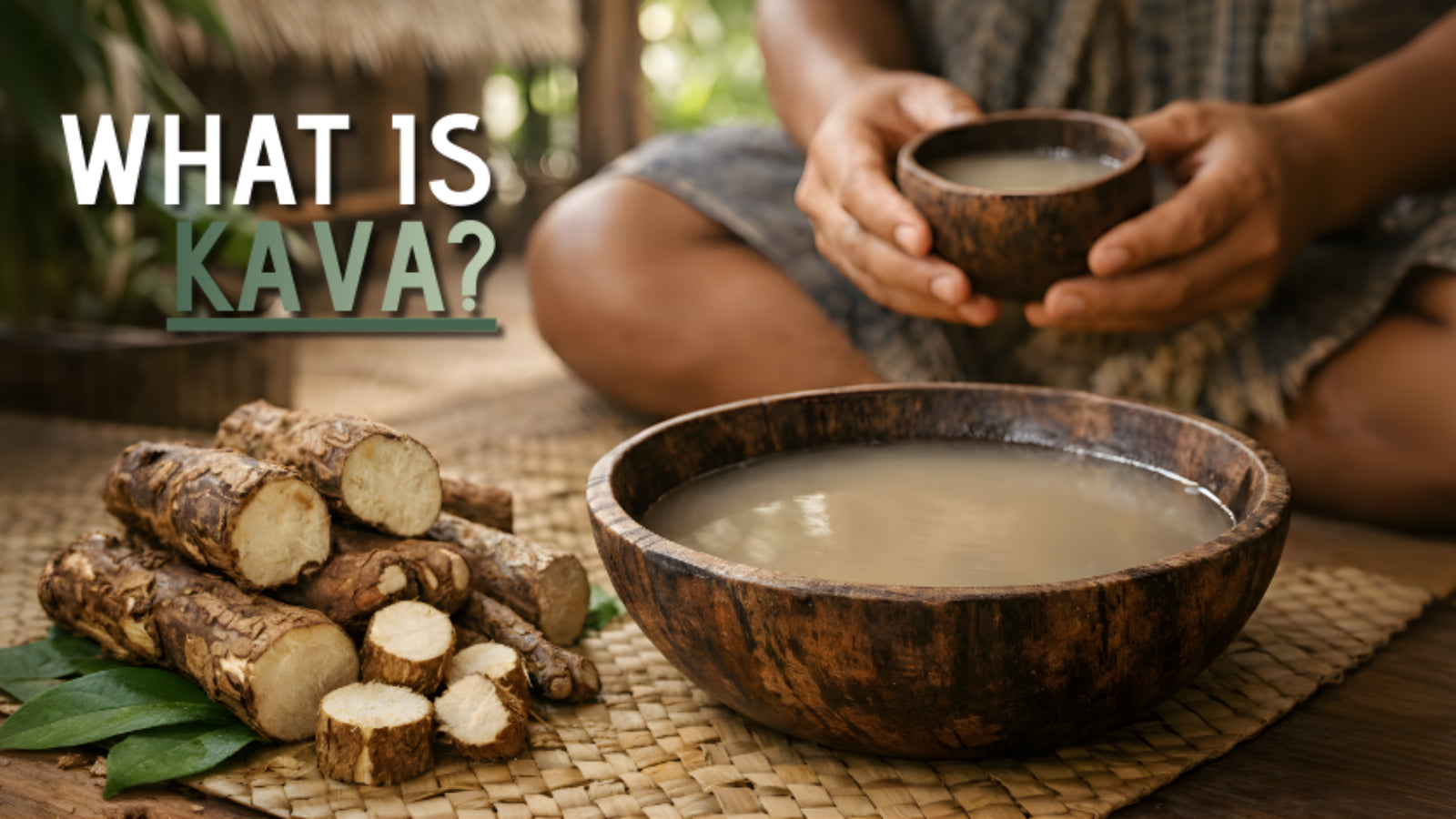
If you have ever walked past a kava bar in a downtown shopping strip and wondered what people were actually drinking, you are not alone. Kava has gone from a Pacific Islands tradition to a quiet but growing wellness category in the United States, and most people still encounter it for the first time without a clear sense of what it is, where it comes from, or what it actually does.
This guide answers the question directly. We will cover what kava is botanically, what the active compounds (kavalactones) actually do, how the root is prepared and consumed, what kava bars are and why they exist, what kava feels like, and how it compares to other relaxation-adjacent botanicals like kratom. By the end you will know enough to walk into a kava bar, read a kava label, or order online without guessing.
Everything here is grounded in published ethnobotany, traditional preparation, and what regular kava drinkers consistently report. No marketing language, no medical claims.
Table of Contents
- What Kava Actually Is
- Where Kava Comes From
- The Active Compounds: Kavalactones
- How Kava Is Prepared and Consumed
- What Kava Bars Are
- What Kava Feels Like
- Noble Kava vs Tudei Kava
- Kava vs Kratom: A Quick Comparison
- Safety, Side Effects, and Interactions
- How to Buy Quality Kava
- Frequently Asked Questions
- Final Thoughts
TL;DR
Kava is a beverage made from the root of Piper methysticum, a Pacific Islands plant traditionally used in social and ceremonial settings. The active compounds are kavalactones, a family of molecules that produce calming, mildly euphoric, and sociability-promoting effects without significant cognitive impairment. Kava is most commonly prepared as a cold-water extract of ground root, served in coconut shells or cups, and consumed at social venues called kava bars. It is legal at the federal level in the United States, sold openly, and used by adults seeking a relaxing alternative to alcohol.
What Kava Actually Is
Kava, in its simplest definition, is a drink made from the root of a Pacific Islands plant. The plant itself is Piper methysticum, which translates roughly to "intoxicating pepper," and it has been cultivated and consumed across Fiji, Vanuatu, Tonga, Samoa, Hawaii, and other Pacific islands for at least 3,000 years.

The drink is prepared by grinding or pounding the root, mixing it with cold water, kneading the slurry to extract the active compounds, then straining out the fibrous material. The resulting liquid is earthy, slightly bitter, has a noticeable numbing effect on the lips and tongue, and produces a calm, sociable, mildly euphoric mental state.
Outside the Pacific, kava has been adopted as a beverage in the United States, Australia, and parts of Europe, mostly served in dedicated kava bars and increasingly available as instant powders and teas for home preparation. It is sometimes described as "the Pacific equivalent of beer or coffee," a social drink that's part of how communities relax together.
Where Kava Comes From
The kava plant is a perennial shrub in the pepper family. It does not produce seeds and is propagated entirely by cuttings, which means every kava plant in cultivation today is genetically related to plants from thousands of years ago. The plant takes three to five years to mature before its roots are harvested.

The Pacific Islands grow the vast majority of the world's kava. Vanuatu, Fiji, and Tonga are the major exporters, with Hawaii producing smaller volumes. Each region has its own preferred cultivars (named varieties of the plant), and experienced kava drinkers often have favorites the way wine drinkers have favorite grapes or regions.
Within these growing regions, kava is more than a commodity. It is woven into governance, hospitality, and ceremony. Important meetings often start with a kava ceremony. Visitors to a village are typically welcomed with a kava drink. The plant has cultural weight that goes far beyond its commercial value.
The Active Compounds: Kavalactones
The reason kava has any effect at all comes down to a family of compounds called kavalactones. There are 18 kavalactones identified in the plant, and six of them account for almost all of the felt effects:

- Kavain
- Dihydrokavain
- Methysticin
- Dihydromethysticin
- Yangonin
- Desmethoxyyangonin
Each kavalactone has a slightly different effect profile. Kavain tends to feel more uplifting and sociable. Dihydromethysticin tends to feel more sedating. Yangonin contributes to mood lift. The specific ratio of these compounds in a given root, sometimes called the kavalactone profile or chemotype, is what makes one kava feel different from another.
Kavalactones work through several mechanisms in the body simultaneously. They modulate GABA-A receptors (the same receptor system that benzodiazepines target, but through a different binding site), inhibit reuptake of certain neurotransmitters, and have mild effects on dopamine pathways. The combined result is calming without sedating, sociable without disorienting, and analgesic without respiratory depression.
The total kavalactone content of a kava product is the single most important quality metric. Premium kava typically tests at 8 to 12 percent kavalactones by dry weight. Lower grades fall into the 4 to 7 percent range. A reputable vendor publishes the kavalactone percentage on the label or product page.
How Kava Is Prepared and Consumed
Traditional kava preparation has not changed much in centuries. The basic steps:

- Ground or pounded kava root is placed in a strainer bag (traditionally a hibiscus fiber bag, modern versions use muslin or fine mesh)
- The bag is submerged in cold or room-temperature water in a large bowl
- The preparer kneads and squeezes the bag underwater for 10 to 15 minutes, releasing the kavalactones into the liquid
- The bag is wrung out and removed
- The resulting brown, earthy-smelling liquid is served, usually in coconut shell cups or small bowls
Cold or room-temperature water is essential. Kavalactones break down with heat, which is why traditional kava is never brewed like tea. Modern instant kava products are designed to dissolve in cold water and skip the kneading step.
Beyond the traditional cold-water preparation, kava is now available in several formats:
- Instant kava powder. A pre-extracted, dried form that mixes directly into water. Faster and less messy than traditional preparation.
- Kava capsules. Encapsulated kava extract or root powder, swallowed like any supplement.
- Kava tincture. Liquid extract drops, usually alcohol-based, taken sublingually or added to a beverage.
- Kava-based functional drinks. Pre-mixed canned or bottled drinks combining kava with other relaxation-adjacent botanicals.
- Kava tea bags. Less effective than cold preparation since some kavalactones degrade in hot water, but easier for casual users.
Each format trades off effectiveness for convenience. Traditional cold-water preparation produces the strongest effects per gram of root. Instant powders are 70 to 80 percent as effective with significantly less effort. Capsules and tinctures vary widely depending on extraction method.
What Kava Bars Are
Kava bars are specialized venues that serve kava the way coffee shops serve coffee or wine bars serve wine. They have grown from a niche curiosity to a full retail category in the United States, with hundreds of kava bars now operating across Florida, California, New York, Texas, and most major metro areas.
A kava bar typically serves kava in coconut shells or small ceramic bowls (called bilos in Fijian). Pricing runs $5 to $10 per shell. A typical kava session involves drinking two to four shells over an hour or two, with conversation in between. The atmosphere is intentionally social, low-lit, and alcohol-free.
Most kava bars also serve adjacent botanicals. Kratom drinks, herbal tonics, mushroom coffees, CBD beverages, and increasingly, blue lotus or damiana-based drinks are common menu items. The shared theme is "social drinking without alcohol," which has driven the category's growth as more adults look for sober-curious alternatives.
For first-time visitors, the etiquette is simple: you order a shell, the bartender shouts "bula!" (a Fijian greeting meaning "to life"), you respond "bula!", drink the shell in one or two gulps, and chase with a piece of fruit, nuts, or a flavored chaser to mask the bitterness. Linger, talk, repeat as desired.
What Kava Feels Like
The experience of drinking kava is distinctive and, for most people, unmistakable once they have felt it. The effects develop in waves over 20 to 40 minutes after the first shell.

Within five minutes, the lips and tongue feel slightly numb. This is a direct effect of the kavalactones contacting the oral mucosa and is the most reliable sign that the kava you're drinking has decent kavalactone content. No numbness usually means weak kava.
Over the next 20 to 30 minutes, a calm spreads through the body. Muscles relax. Anxious mental loops quiet down. Conversation feels easier. There is a mild euphoria, similar in mood to a glass of wine but without the cognitive blur. Most users describe being more sociable, more present, and less self-conscious without feeling impaired.
Higher doses (three to five shells in a session) deepen the relaxation toward mild sedation. Some users feel drowsy or dreamy. Others stay alert but feel the body get heavier. Effects typically last two to three hours and taper gracefully without a hangover.
The mental state is not intoxicating in the way alcohol is. Most users can drive after kava, hold a coherent conversation, and remember the evening clearly the next day. This is why kava has gained traction with people specifically looking to socialize without the cognitive trade-offs of drinking.
Noble Kava vs Tudei Kava
Not all kava is created equal. The kava world distinguishes between noble kava and tudei kava (sometimes called "two-day kava"), and the difference matters for both effects and safety.

Noble kava comes from cultivars selected over centuries for clean, predictable, drinkable effects. The kavalactone profile favors compounds like kavain and methysticin, which produce the social, uplifting, comfortable feel that has made kava popular. Noble cultivars include Borogu, Borongoru, Melomelo, and Kelai, among others.
Tudei kava comes from cultivars with higher concentrations of dihydromethysticin and flavokavain B. The effects are stronger and longer-lasting (hence the "two-day" name) but also rougher: more nausea, more intense sedation, more reports of next-day grogginess, and historically associated with the rare cases of kava-related liver concerns that triggered European bans in the early 2000s.
Reputable Western kava vendors sell only noble cultivars. The International Kava Executive Council and Pacific Islands governments actively discourage tudei kava export. If you are buying kava from a reliable source, you are almost certainly getting noble kava. The label may explicitly say "noble" or list the cultivar by name (Borogu, Borongoru, etc.) as a quality signal.
Kava vs Kratom: A Quick Comparison
Because kava and kratom are often sold side-by-side in kava bars and online, comparisons come up constantly. They are different plants with different active compounds and different effects, but they share enough overlap to confuse first-time users.

| Feature | Kava | Kratom |
|---|---|---|
| Plant | Piper methysticum root | Mitragyna speciosa leaf |
| Origin | Pacific Islands | Southeast Asia |
| Active compounds | Kavalactones | Mitragynine, 7-hydroxymitragynine |
| Mechanism | GABA-A modulation | Mu-opioid partial agonism + adrenergic + serotonergic |
| Felt effect | Calm, sociable, mild euphoria | Variable: stimulating low-dose, sedating high-dose |
| Onset | 15 to 30 minutes | 20 to 45 minutes |
| Duration | 2 to 3 hours | 3 to 6 hours |
| Physical dependence risk | Low | Moderate (with daily use) |
| Federal legal status | Legal | Legal (not scheduled) |
For a deeper look at kratom's pharmacology, see our companion guide on what is mitragynine.
The quick mental model: kava feels like the social half of a relaxing drink, kratom feels like a botanical somewhere between coffee and a mild opioid depending on dose. They are not interchangeable, but many users enjoy both at different times.
Safety, Side Effects, and Interactions
Kava is generally well-tolerated by adults at moderate doses. The most common side effects users report are mild and transient:

- Numbness or tingling in the mouth (an effect, not a problem)
- Mild drowsiness, especially at higher doses
- Occasional gastrointestinal discomfort
- Mild headache for some users
- Skin dryness with daily heavy use (called "kava dermopathy" in chronic Pacific drinkers)
The more serious concern that has shaped kava regulation is liver health. Between 1999 and 2002, several European countries banned kava after reports of severe liver injury in users. Subsequent investigation by researchers including the World Health Organization concluded that the issue was largely attributable to tudei kava, low-quality root sources, and possible interactions with other medications, rather than noble kava itself. (Source) Most countries have since lifted those bans.
Practical safety guidance:
- Start with one shell or one serving and wait 30 minutes to gauge effect
- Avoid combining kava with alcohol, benzodiazepines, opioids, or other CNS depressants
- Do not use kava if you have existing liver disease or are on hepatotoxic medications
- Consult a doctor before using kava if you take prescription medications regularly
- Buy noble kava from vendors who publish kavalactone percentages
The National Center for Complementary and Integrative Health publishes a current overview of what's known and not known about kava, and is a useful starting point for users who want a regulator's perspective alongside what the cultural and user community report.
How to Buy Quality Kava
The kava market in the United States has wide quality variation. Choosing a reliable product comes down to a few specific signals.

Kavalactone percentage published. A reputable vendor lists the kavalactone percentage on the label or product page. Premium products test at 8 to 12 percent. Mid-grade falls between 5 and 7 percent. Anything under 4 percent is poor quality regardless of price.
Cultivar named or labeled "noble." Look for the word "noble" or specific cultivar names (Borogu, Borongoru, Melomelo, Kelai). Generic "kava root" labeling without cultivar information is a yellow flag.
Country of origin disclosed. Vanuatu, Fiji, and Tonga are the major noble kava producers. Hawaiian kava is also high quality. Origins not listed or vague descriptions ("Pacific blend") are worse signals than a clear single-origin label.
Format that matches your preferences. Traditional medium-grind root is best for cold-water preparation. Micronized root is faster to prepare. Instant kava skips most of the prep. Capsules and tinctures are the most convenient but typically less effective per dollar.
Third-party testing for contaminants. The best kava vendors publish testing for heavy metals, microbial contamination, and pesticides similar to what kratom vendors do. This is less universal in the kava market than the kratom market, but the trend is toward more transparency.
GRH Kratom carries kava-adjacent botanical drinks alongside our kratom selection. Browse our Kratom Blends collection for relaxing combinations, our Premium Extracts for higher-potency relaxation options, and our full kratom selection if you're exploring botanical relaxation broadly.
Frequently Asked Questions
Is kava legal in the United States?
Yes. Kava is legal at the federal level and in all 50 states. The FDA has issued a consumer advisory about possible liver effects but has not banned the substance. Some states require kava bars to follow alcohol-licensing-style age restrictions, typically 18 or 21 and up.
Will kava get me drunk?
No, not in the alcohol sense. Kava produces a calm, sociable, mildly euphoric mental state without significant cognitive impairment. Most users can hold conversations clearly, remember the evening, and even drive (where legal and safe to do so).
Is kava addictive?
Kava has very low physical dependence potential. Users do not develop the kind of tolerance or withdrawal seen with alcohol, opioids, or benzodiazepines. Daily heavy use can produce mild psychological dependence and a skin condition called kava dermopathy, but quitting does not produce withdrawal symptoms.
Can I drink kava and kratom together?
Many users do, and they are commonly sold side-by-side. The combination tends to feel deeper-relaxing than either alone. The tradeoff is that combined CNS depression may be more than expected. Start small, and avoid stacking with alcohol or other depressants.
How long does kava take to kick in?
Effects start within 15 to 30 minutes for traditional cold-water preparation, slightly longer for capsules. Peak effects occur around 45 to 60 minutes and last two to three hours.
Does kava show up on a drug test?
No. Kavalactones are not screened by standard 5-panel or 10-panel workplace drug tests, and there is no commercial assay specifically targeting them. Kava use does not produce false positives on standard panels.
What does kava taste like?
Earthy, slightly bitter, with a chalky mouthfeel. Most first-time drinkers describe it as drinkable but not pleasant. Chasing with fruit, juice, or candy is common. Flavored kava products (chocolate, mango, vanilla) exist for users who find the traditional taste off-putting.
Is kava the same as kava kava?
Yes. "Kava kava" is the same plant, same drink, same effects. The doubled name comes from how the word is sometimes repeated in Pacific Island languages for emphasis. Most labels use one or the other interchangeably.

Final Thoughts
Kava is, at its simplest, an old social drink that has found a new audience in modern Western wellness culture. It does what it has done for thousands of years: takes the edge off, makes conversations easier, creates space for connection without the cognitive cost of alcohol. The science behind kavalactones explains the felt experience, but the cultural roots in the Pacific Islands give the drink a social context that is part of its appeal.
If you are considering kava for the first time, the cleanest entry point is a kava bar in your area. The bartender will guide you through your first shell, you'll feel the numbing effect within minutes, and you'll know within 30 minutes whether the experience is for you. If you prefer to start at home, instant kava in a single-serve packet is the lowest-friction option, and a noble kava with 8 to 10 percent kavalactones from a labeled cultivar will give you the closest thing to the traditional experience.
For users curious about the broader landscape of relaxing botanicals, our companion guides on CBD vs kratom and kratom and coffee walk through how different plants compare for different use cases.
Read carefully, start with a single serving from a noble cultivar source, and respect the dose. That approach matches how the Pacific Islands have used kava for three millennia, and it still works today.


