



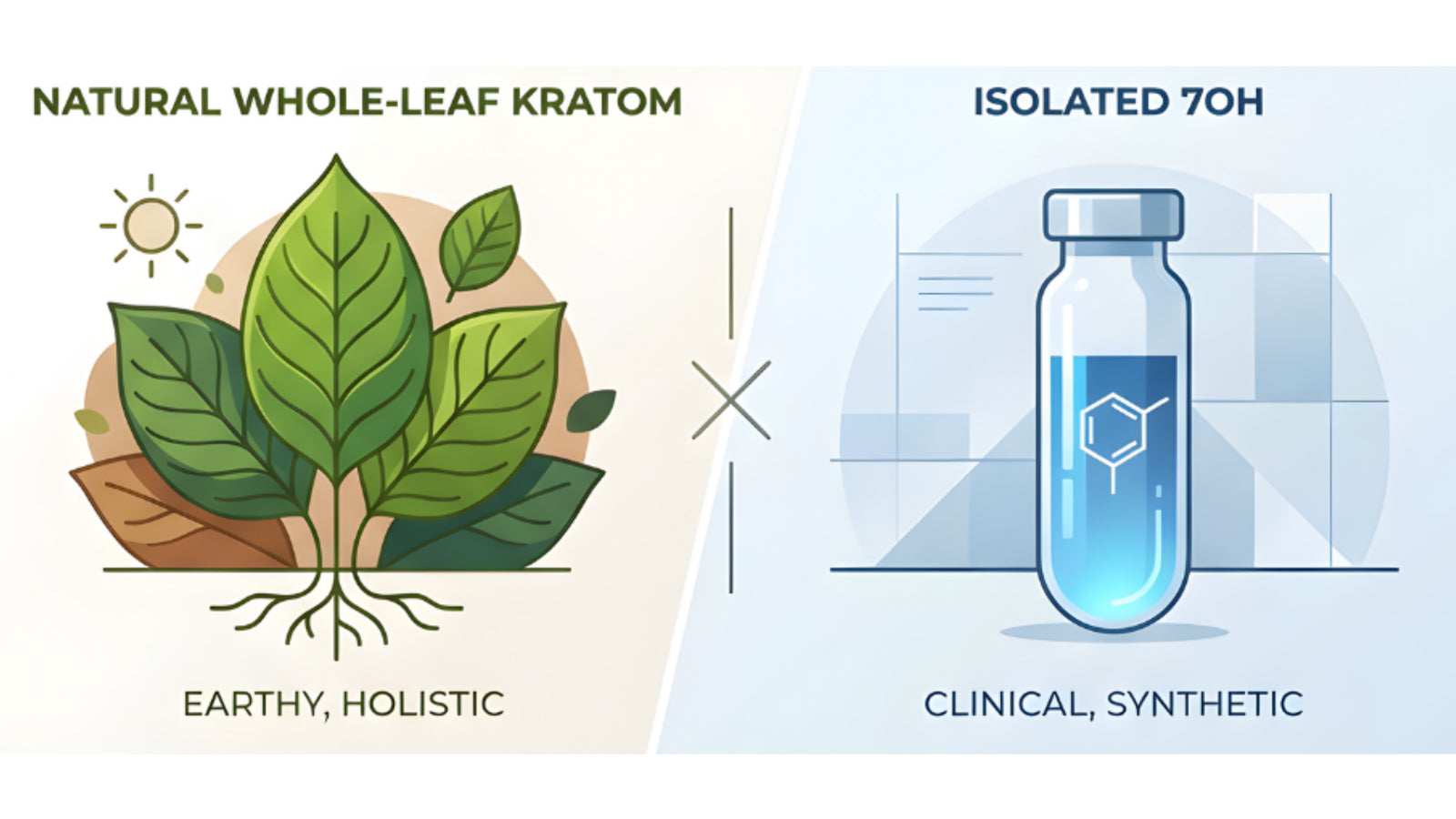
Smoke shops are stocking 7 oh tablets next to traditional kratom powder like they're the same category. Online retailers push concentrated 7-OH as a "stronger alternative." And most people buying 7-oh kratom products have zero idea what they're actually putting in their body. The worldwide kratom market reached $2.56 billion in 2025 and is projected to grow at a CAGR of 17.2% through 2032, reaching nearly $7.79 billion (Maximize Market Research). With that kind of growth, it was inevitable that someone would start pushing the boundaries of what "kratom" even means.
7-hydroxymitragynine, commonly shortened to 7-OH or 7oh, went from an obscure alkaloid in academic papers to a full-blown consumer product category practically overnight. And the marketing made sure it landed right alongside traditional kratom on store shelves, as if they were interchangeable.
They're not. Not even close.

TL;DR
- 7-OH (7-hydroxymitragynine) is a naturally occurring alkaloid in kratom, but only at trace levels (under 0.02%). The products sold as "7-oh kratom" contain concentrated, often semi-synthetic versions.
- 7 hydroxymitragynine is up to 13 times more potent than mitragynine, the primary alkaloid in traditional kratom powder. That potency gap changes the risk profile significantly.
- Multiple states are moving to ban 7oh products while explicitly protecting whole-leaf kratom. The FDA has flagged 7-OH as a concern separate from the kratom plant itself.
- Whole-leaf kratom contains a full spectrum of alkaloids that work together. Isolating one compound strips away those balancing effects.
- If you're a kratom consumer, understanding this distinction protects you from products that could undermine the entire legal framework for kratom.
What Is 7-OH Kratom?
The term "7-oh kratom" gets tossed around casually, and it's misleading every single time. 7-OH refers specifically to 7-hydroxymitragynine, one of over 40 alkaloids naturally present in the kratom leaf (mitragyna speciosa). In whole-leaf kratom, 7 hydroxymitragynine occurs at extremely low concentrations, typically under 0.02% of the total alkaloid content.
What's being sold as "7-oh kratom" in gas stations and online shops? Something different entirely. These products contain concentrated or semi-synthetic 7-OH, manufactured in labs to deliver doses that the natural plant never would on its own. Walk into any smoke shop in a state where 7-OH is still legal and you'll find products sitting on the same shelf as traditional kratom capsules. Same shelf, same price range, completely different compounds. There's no visible distinction for the average consumer, and that's the whole problem.
The Alkaloid Nobody Was Talking About Until Recently
So what is 7oh in the context of kratom research? For decades, it was barely a blip. Kratom research focused on mitragynine, which makes up roughly 66% of the alkaloid content in most kratom strains. 7 hydroxymitragynine was a footnote in pharmacological studies, interesting to researchers but irrelevant to anyone buying whole-leaf products. Then supplement manufacturers figured out how to isolate and concentrate the compound, and suddenly you could buy 7-oh kratom tablets at your local convenience store. The marketing positioned them right alongside traditional kratom powder as if they belonged there.
They don't.

Why the Naming Causes Confusion
Calling these products "7-oh kratom" creates a false association that benefits manufacturers and confuses everyone else. Consumers assume they're getting a stronger form of the same plant they've been using. The reality is that concentrated 7-OH is closer to a pharmaceutical isolate than a botanical product. The full-spectrum alkaloid profile that characterizes whole-leaf kratom is absent. You're getting one compound at magnified doses, stripped from the synergistic context that makes kratom what it is. If you want to understand what the actual plant is and how it works, this breakdown of Mitragyna speciosa is worth your time.
Here's a rough comparison of what you're actually dealing with:
| Feature | Whole-Leaf Kratom | 7-OH Products |
|---|---|---|
| Source | Dried leaves of Mitragyna speciosa | Isolated/semi-synthetic alkaloid |
| Primary Alkaloid | Mitragynine (~66% of alkaloid content) | 7-hydroxymitragynine (concentrated) |
| Natural 7-OH Content | Under 0.02% | 10mg-40mg per dose |
| Alkaloid Profile | Full spectrum (40+ compounds) | Single isolated compound |
| Production Method | Harvesting, drying, grinding | Chemical extraction or synthesis |
| Typical Forms | Powder, capsules, tea | Tablets, shots, gummies |
| Regulatory Status | Legal in most states (with KCPA) | Banned or restricted in growing number of states |
The Biochemistry Behind 7-Hydroxymitragynine
Understanding why 7-OH matters requires a quick look at what's happening at the receptor level. 7 hydroxymitragynine is an indole alkaloid that acts on mu-opioid receptors with higher binding affinity than mitragynine. Research published in the Journal of Medicinal Chemistry showed it's approximately 13 times more potent. But potency alone doesn't tell the whole story.
In antinociception assays, 7-hydroxymitragynine exhibits 40-fold greater potency than mitragynine and approximately 10-fold greater potency than morphine at mu-opioid receptors (Taylor & Francis Online, Pharmacognosy Magazine 2025). Read that again. Ten times more potent than morphine. Those numbers should get your attention.
How 7-OH Interacts with Opioid Receptors
Both mitragynine and hydroxymitragynine interact with mu-opioid receptors, but they do it differently. Mitragynine functions as a partial agonist with a ceiling effect, meaning there's a natural limit to its activity. 7 hydroxymitragynine has a higher intrinsic efficacy at these receptors, and that ceiling effectively disappears.
In animal models, isolated 7-OH produced respiratory depression at higher doses. Whole-leaf kratom hasn't demonstrated that. And if you're wondering why that distinction matters so much, think about what respiratory depression actually means in practical terms. It means breathing slows down. It means risk escalates in ways that traditional kratom users have never had to think about.

The Entourage Effect in Kratom
Whole-leaf kratom contains dozens of alkaloids that modulate each other's effects. Mitragynine, paynantheine, speciogynine, and others work in concert. Some researchers believe this alkaloid interplay is why traditional kratom use doesn't carry the same risk profile as isolated 7-OH. Strip the compound from its natural matrix, concentrate it tenfold, and you're working with something pharmacologically distinct from the plant.
Cannabis research revealed something similar with the "entourage effect," where THC behaves differently when paired with CBD and other cannabinoids versus when isolated. The kratom research community is seeing early indicators of a parallel phenomenon. A 2025 University of Florida study found that whole-leaf kratom extract produced meaningfully different physiological responses than equivalent doses of isolated 7-hydroxymitragynine, suggesting the other alkaloids actively modulate how 7-OH behaves in the body.

Why Isolating Single Compounds Changes Everything
The pharmaceutical industry learned this lesson with opium decades ago. The poppy plant contains codeine, morphine, thebaine, and many other compounds. Isolating morphine created a dramatically different risk profile than traditional poppy tea. The parallel with kratom isn't perfect, but the principle holds. The whole plant behaves differently than its extracted parts, and pretending otherwise is irresponsible.
7-OH vs Kratom: Why They're Not the Same Thing
If you search "7-oh vs kratom" or "what is 7 oh kratom," you'll find a lot of conflicting information. People asking what is 7oh deserve a straight answer, not marketing spin. So here's the short version: they share a botanical origin and absolutely nothing else in terms of how they affect your body at the doses being sold commercially.
Before we get into the specifics, here's a quick way to check what you're actually using:
Quick Self-Check: Are You Using a 7-OH Product?
- Does the label list a specific milligram dose of 7-hydroxymitragynine? (e.g., "20mg 7-OH per tablet")
- Is the product sold as a single-serve tablet, shot, or gummy rather than loose powder or capsules?
- Does the packaging use terms like "enhanced," "7x extract," or "ultra potent"?
- Is there no strain name listed (Red Borneo, Green Malay, etc.)?
- Can you NOT find third-party lab results on the manufacturer's website?
If you answered "yes" to 3 or more, you're likely consuming a concentrated 7-OH product, not traditional kratom.
Composition Differences
Traditional kratom powder contains the full alkaloid spectrum of mitragyna speciosa. A typical serving might have 1-2% mitragynine by weight and trace amounts of 7 hydroxymitragynine (under 0.02%). A 7 oh kratom tablet, on the other hand, might deliver 10mg, 20mg, or even 40mg of concentrated 7-hydroxymitragynine per dose.
That's orders of magnitude beyond what you'd get from the plant. We're talking about a completely different ballgame.

Effects and Duration
Users who've tried both consistently report that 7oh products hit faster, feel more sedating, and produce effects that more closely resemble pharmaceutical opioids than traditional kratom. The duration tends to be shorter but more intense. Whole-leaf kratom users, by comparison, describe a broader, more balanced experience with energizing properties at lower doses and relaxation at higher ones. The 7 oh kratom effects profile is a different animal, and pretending it's just "stronger kratom" does a disservice to consumers.
Dependency and Withdrawal Potential
This is where the conversation gets serious. Anecdotal reports of 7 oh kratom withdrawal symptoms have been emerging across kratom community forums. Users describe withdrawal timelines and severity that are more consistent with strong opioid products than with traditional kratom.
A 2025 case study published in PubMed documented substance use disorder following consumption of a novel synthetic 7-hydroxymitragynine product, marking one of the first peer-reviewed clinical reports linking concentrated 7-OH to dependency (PubMed, 2025). We still don't have large-scale clinical studies. But the pharmacological profile of concentrated 7-OH at these doses makes higher dependency potential a reasonable concern, and the anecdotal evidence keeps piling up.
On Reddit's r/kratom community, a widely discussed thread from early 2026 documented one user's experience transitioning from 7-OH tablets back to whole-leaf kratom. After three months of daily 7-OH use, they reported needing four times their previous kratom dose to achieve any effect, and described a withdrawal period that lasted significantly longer than anything they'd experienced from traditional kratom. The thread collected hundreds of similar stories.

For a deeper look at why this distinction matters to the kratom community, this article on why 7-OH is not kratom breaks it down further.
How 7-OH Kratom Products Are Made
Most 7oh products on the market don't come from simply extracting kratom leaves. The manufacturing process typically involves one of two approaches, and neither looks anything like traditional kratom production.
Semi-Synthetic Production
The most common method involves taking mitragynine (which is abundant in kratom) and chemically converting it to 7-hydroxymitragynine in a lab. This process uses oxidation reactions to transform the molecular structure. The end product is technically derived from a kratom compound, but calling it "kratom" is a stretch. You wouldn't call synthetic codeine a "poppy product."
Concentrated Extraction
Some manufacturers use solvent-based extraction to pull 7 hydroxymitragynine directly from kratom leaves, then concentrate it far beyond natural ratios. While this approach uses the actual plant as the starting material, the final product bears no resemblance to the balanced alkaloid profile of kratom powder or capsules. The resulting 7 oh kratom extract is a wholly different product.
| Production Method | Starting Material | Process | Final Product | Is It "Kratom"? |
|---|---|---|---|---|
| Traditional Kratom | Whole leaves | Dry, grind | Full-spectrum powder | Yes |
| Full-Spectrum Extract | Whole leaves | Water/ethanol extraction | Concentrated alkaloid blend | Yes (concentrated) |
| 7-OH Extraction | Whole leaves | Solvent extraction + isolation | Isolated 7-hydroxymitragynine | No (isolate) |
| Semi-Synthetic 7-OH | Mitragynine isolate | Chemical oxidation in lab | Synthetic 7-hydroxymitragynine | No (lab-made) |

Why This Matters for Product Labels
Here's what should bother you: many 7 oh kratom products don't disclose their manufacturing method. You might be buying a semi-synthetic compound marketed with pictures of green leaves. Without transparency in production methods, consumers can't make informed decisions about what they're putting into their bodies. And manufacturers who hide behind vague labeling know exactly what they're doing.
The Effects Profile: What Users Report
We need to be clear about something. Clinical data on concentrated 7-OH products in humans is extremely limited. What we have is a growing body of anecdotal reports from users, community surveys, and the pharmacological data from animal studies. Here's what the picture looks like so far.
Reported Positive Effects
Users of 7-oh kratom tablets typically report strong pain relief, pronounced sedation, and what many describe as a "warm" euphoria. For people dealing with chronic pain who found regular kratom insufficient, the appeal is obvious. The effects come on faster than traditional kratom, and 7 oh tablets require smaller doses to achieve noticeable results. We get why people are drawn to it (and what is 7oh if not a shortcut to stronger effects?). That doesn't make it safe.
7-OH Kratom Side Effects and Risks
The side effect reports are where things get concerning. Nausea at lower thresholds than traditional kratom, excessive sedation, respiratory changes, and rapid tolerance buildup appear frequently in user reports. The 7-oh kratom side effects profile looks less like a botanical supplement and more like a concentrated pharmaceutical. Some users report difficulty returning to traditional kratom after regular 7-OH use, suggesting cross-tolerance issues that could complicate things for regular kratom consumers.
The Texas Poison Center documented 192 kratom/7-OH exposure cases in 2025, compared with 107 cases in all of 2024. Among cases where 7-OH was the only substance involved, 35% resulted in serious health outcomes and 67% required treatment at a healthcare facility (FDA Assessment Report). Those aren't small numbers.

On Reddit's r/kratom community, a widely discussed thread from early 2026 documented one user's experience transitioning from 7-OH tablets back to whole-leaf kratom. After three months of daily 7-OH use, they reported needing four times their previous kratom dose to achieve any effect. The withdrawal period lasted longer than anything they'd experienced from traditional kratom. Hundreds of other users shared similar stories in the same thread.
The Regulatory Landscape: Bans, Proposed Laws, and the FDA
The legal situation around 7oh is evolving fast, and it's creating a fork in the road for the kratom industry. Several states are moving to treat 7-OH differently from whole-leaf kratom, which is a significant development for both consumers and advocacy groups.
State-Level Action on 7-OH
Texas has introduced legislation that would ban 7-OH products while explicitly protecting whole-leaf kratom under the Kratom Consumer Protection Act framework. Other states are following similar paths. The American Kratom Association has supported these measures, viewing 7-OH as a threat to the regulatory progress the kratom community has fought hard to achieve.
The 7oh ban conversation isn't about restricting kratom. It's about separating a concentrated isolate from the plant it came from. Kansas Governor Laura Kelly signed a bill in April 2026 banning 7-OH alongside dozens of other substances, while Ohio's permanent ban on synthetic kratom sales (including 7-OH) is set to take effect in May 2026 (KCTV5 News). The momentum is real.

The FDA's Position
The FDA has historically been adversarial toward kratom, but their recent communications have specifically singled out 7-hydroxymitragynine products. Their concern centers on the opioid-like pharmacological profile of concentrated 7-OH, which they argue falls under different regulatory considerations than whole-leaf kratom. For kratom advocates, this creates an awkward dynamic: the FDA's criticism of 7-OH might actually strengthen the case for regulating traditional kratom separately. Strange times.
What This Means for Consumers Right Now
If you're searching 7 oh kratom near me through a local shop or online, check your state's current stance. Anyone typing "7 oh kratom near me" into a search bar right now needs to know the ground is shifting fast. Several states have already restricted or banned the sale of 7-OH products. Even in states where it remains legal, the regulatory direction is clear. These products are on borrowed time in many markets, and stockpiling isn't a smart long-term strategy.
Before You Buy: State Legality Quick Check
- Search "[your state] 7-OH kratom laws 2026" for the latest status
- Check if your state has a Kratom Consumer Protection Act (KCPA); these typically protect whole-leaf kratom but may restrict 7-OH
- Verify whether any pending legislation could change the legal status in the coming months
- If purchasing online, confirm the vendor ships to your state and complies with local regulations
- Keep in mind that even legal products may become restricted; plan accordingly
Why the Kratom Industry Is Distancing Itself from 7-OH
Something interesting is happening within the kratom industry itself. Reputable vendors are actively speaking out against 7-OH products, and some have removed them from their catalogs entirely. This isn't moral posturing. It's survival.
Reputation Risk
Every adverse event linked to a "7-oh kratom" product gets attributed to kratom in media coverage. Journalists rarely make the distinction. For companies that have spent years building trust around quality, lab-tested kratom powder and capsules, having their category lumped in with concentrated isolates is a direct threat to their business and to the regulatory framework they've helped build. One bad headline about a "kratom overdose" (that was actually a 7-OH product) can undo years of advocacy work.
The Advocacy Angle
Kratom advocacy organizations have invested significant resources in getting Kratom Consumer Protection Acts passed at the state level. These laws establish quality standards for kratom products, including testing requirements, age restrictions, and labeling rules. 7-OH products that cause harm could give regulators the ammunition they need to roll back those protections. The stakes couldn't be higher.
GRH Kratom has taken a clear public stance on this, removing all 7-OH products and references from their platform. No hedging, no "well, we'll see how it plays out." Their position: 7-OH is not kratom, and selling it under the kratom umbrella puts the entire community at risk. If you're looking for whole-leaf kratom products that are lab-tested and transparent about what's in the bag, GRH Kratom carries powder, capsules, and full-spectrum extracts.
What to Look for When Buying Kratom Products
Whether you've used 7-OH products before or you're trying to avoid them, knowing what to look for when shopping for kratom protects you from making uninformed purchases.
Lab Testing and Transparency
Any reputable kratom vendor should provide third-party lab results for every batch. These results should confirm alkaloid content (specifically mitragynine and 7 hydroxymitragynine levels), verify the absence of contaminants like heavy metals and bacteria, and be easily accessible to customers. If a company can't show you their lab work, that's your cue to keep looking. For a deeper dive on what those results mean and how to interpret them, check out this guide on how to read a kratom lab test.
Understanding Product Labels
Pay attention to what's in the product. Traditional kratom powder will list the strain (e.g., Red Borneo, Green Malay) and the form (powder, capsules, extract). 7-OH products may use language like "enhanced," "7x extract," or list 7-hydroxymitragynine dosages in milligrams. If the label emphasizes milligram doses of a specific alkaloid rather than the plant material itself, you're looking at an isolate product. If you're still wondering what is 7 oh kratom based on the label alone, the answer is: the label probably won't tell you. You need to look beyond the branding.
Red Flags to Watch For
Products sold in single-serve packets at gas stations with flashy branding and no verifiable lab data are the biggest concern. Vague labeling, missing manufacturer information, and unrealistic potency claims all point to products designed to capitalize on the "kratom" name without the quality controls that responsible vendors maintain. Trust vendors who are transparent about their sourcing, testing, and manufacturing processes. A 7 oh kratom review from an unverified source isn't a substitute for verifiable third-party testing.
Final Thoughts
The conversation around 7-oh kratom is really a conversation about transparency, safety, and the future of an entire plant-based wellness category. 7-hydroxymitragynine is a real compound with real pharmacological activity, and concentrated products deserve serious scrutiny rather than impulse purchases.
Traditional kratom, the whole-leaf product that millions use responsibly, is a different thing entirely. Understanding that distinction protects you as a consumer and protects the broader kratom community from regulatory backlash driven by products that never should have carried the kratom name in the first place.
Stay informed. Buy from vendors you trust. And don't let marketing blur the line between a plant and a lab product.


