



Listen to this page
Read by an AI voice. The full article is read aloud, top to bottom. The two tables and the detection-window chart are on the page, and what they show is in the text too.
Table of Contents
- The short answer (and why it surprises people)
- What standard drug tests actually screen for
- The specialized kratom test nobody warns you about
- How long does kratom stay in your system?
- What changes your detection window
- The half-life science, minus the textbook tone
- Employment, probation, and medical settings
- Where 7-OH products complicate everything
- False positives: rare but real
- How to read your employer's testing policy
- Detox myths, rapid-fire
- FAQ
- Final thoughts
TL;DR
- Standard 5-panel and 10-panel drug tests do not screen for kratom. They're looking for opioids, THC, cocaine, amphetamines, and PCP. Mitragynine isn't on the list.
- Specialized kratom drug tests exist, and labs like LabCorp and ARUP run them. Someone has to specifically order one.
- In urine, mitragynine is typically detectable for 1 to 7 days after last use. Heavy daily use can stretch that to 9 days or more.
- Dose, frequency, body fat, hydration, and metabolism all shift your personal window.
- 7-OH tablets and synthetic extract products are a different conversation entirely, and regulators are moving on them right now.
The Short Answer (and Why It Surprises People)
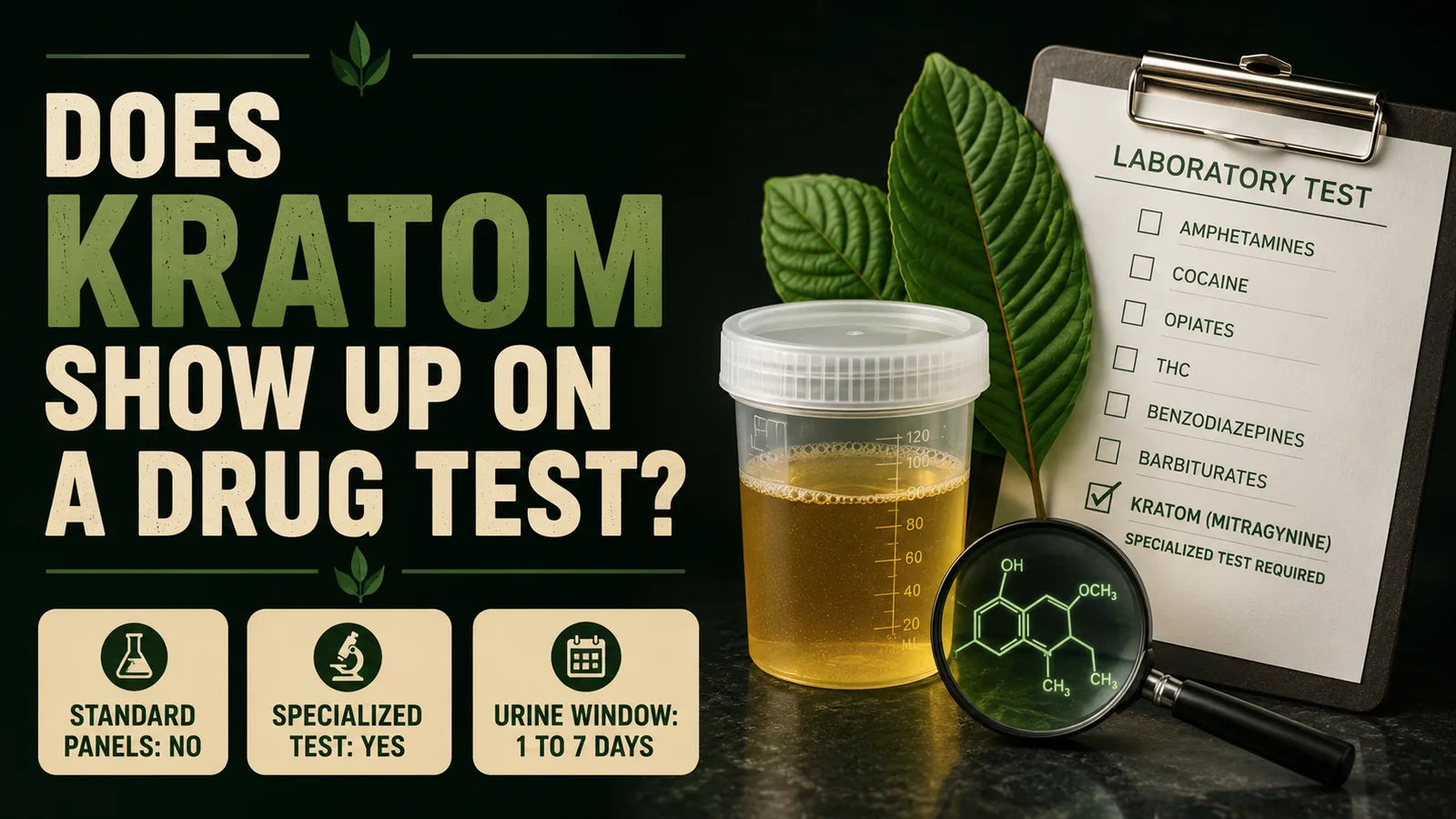
No, kratom won't show up on a standard drug test. Yes, it can absolutely show up on a specialized one.
Both things are true, and the gap between them is where most of the confusion lives. We get this question at the shop more than almost any other (usually in a slightly lowered voice), so this guide lays out exactly how kratom drug testing works, who orders these tests, and how long you'd need to think about it.
One thing before we start: roughly 1.9% of Americans aged 12 and up reported using kratom as of 2024, up from 1.6% in 2021, according to University of Michigan researchers. Millions of people. Most of them have no idea what their workplace testing policy actually covers. You're about to know more than all of them.
What Standard Drug Tests Actually Screen For
The test most people take for a job is a 5-panel urine screen. It checks for five drug classes: amphetamines, cocaine, marijuana, opiates, and PCP.
Kratom isn't any of those.
Here's the part that trips people up. Kratom's main alkaloid, mitragynine, interacts with some of the same receptors as opioids, but chemically it's a completely different molecule. Immunoassay opioid screens are built to catch morphine, codeine, and their relatives. Mitragynine doesn't match the shape they're hunting for, so a standard opiate panel walks right past it.
The bigger 10-panel test? Same story. It adds things like benzodiazepines, barbiturates, and methadone. Still no kratom.
| Test type | Screens for kratom? | Common use |
|---|---|---|
| 5-panel urine | No | Most pre-employment screening |
| 10-panel urine | No | Safety-sensitive jobs, legal settings |
| DOT physical panel | No | Commercial drivers |
| Specialized mitragynine test | Yes | Ordered specifically, often clinical or probation |

So if kratom never shows up on the routine stuff, why does this article exist? Because of the next section.
The Specialized Kratom Test Nobody Warns You About
Kratom-specific tests are real, commercially available, and more common than they were five years ago.
Labcorp runs a mitragynine screen and confirmation urine test. So does ARUP Laboratories. Walk-in chains like Any Lab Test Now will sell one to anybody with a credit card. These tests use liquid chromatography and mass spectrometry, which means they aren't guessing at molecular shapes the way immunoassays do. They look for mitragynine itself, and they find it.
The key word in all of this: deliberate. A kratom drug test never happens by accident. An employer, probation officer, pain clinic, or treatment program has to specifically decide kratom matters to them and pay extra for the panel. Most don't. Some do.
Who actually orders them? In our experience reading policies and talking with customers for years, it clusters in a few places:
- Pain management clinics, which often test for anything that interacts with opioid receptors
- Court-ordered monitoring and probation, especially where a judge has flagged kratom
- Addiction treatment programs, where full transparency is the point
- A small number of safety-critical employers that name kratom in their written policy
If you're subject to testing and you're not sure, read the policy. The substances covered have to be listed somewhere. Boring advice, works every time.
How Long Does Kratom Stay in Your System?
Straight to the numbers.
| Sample type | Typical detection window | Notes |
|---|---|---|
| Urine | 1 to 7 days | The standard for specialized kratom testing |
| Urine (heavy daily use) | Up to 9 days or slightly longer | High doses, multiple times daily |
| Blood | Roughly 1 to 2 days | Rarely used outside hospital settings |
| Saliva | Not standardized | No widely validated commercial test |
| Hair | Theoretically months | Almost never used for kratom in practice |
A single modest serving? Most people clear detectable urine levels in 2 to 3 days. Someone taking large amounts several times a day for months carries metabolites much longer, because mitragynine is fat-soluble and builds up in tissue over time.
Worth repeating: these windows only matter if someone runs the specialized test. On a standard panel, the window is irrelevant because nobody's looking.
What Changes Your Detection Window
Two people take the same product on the same day. One tests clean on day three, the other still shows mitragynine on day eight. Why?
Frequency and dose
The big one. Occasional light use clears fast. Daily heavy use creates a reservoir in fatty tissue that leaks out slowly. No supplement, detox tea, or sauna schedule meaningfully changes that (sorry).
Body composition
Mitragynine likes fat. Higher body fat percentage generally means longer retention, all else equal.
Age and metabolism
Liver enzymes do the heavy lifting when your body processes mitragynine. Slower metabolism, slower clearance. Age, genetics, and liver health all play in.
Hydration and pH
Hydration affects urine concentration a little. It will not rescue anyone from a positive result, and chugging water right before a test mostly produces a diluted sample, which labs flag anyway. They've seen every trick.
The Half-Life Science, Minus the Textbook Tone
Mitragynine's elimination half-life runs somewhere around 24 hours for most people, with studies showing a range from several hours up to 40. That means about half the mitragynine in your system is gone in a day, half of what's left the next day, and so on.
Five half-lives is the rough rule for "effectively gone." At a 24-hour half-life, that's five days, which lines up neatly with the 1-to-7-day urine window you saw above. The math checks out. (We ran a full breakdown in our kratom dosage guide if you want the deeper version.)
7-hydroxymitragynine, the minor alkaloid, clears faster. Its metabolites are part of what confirmation testing looks at, but mitragynine is the primary marker labs report.
Employment, Probation, and Medical Settings
Different settings, different stakes. Quick tour.
Pre-employment screening
Almost always a standard panel. Kratom is legal at the federal level, and most HR departments have never thought about it. Unless the written policy names kratom or mitragynine, a routine screen won't detect it.
Probation and court monitoring
This is where specialized tests show up most. If a court order lists kratom, assume testing is on the table and act accordingly. Guessing wrong here has consequences that make everything else in this article look trivial.
Pain clinics and medication contracts
Many pain management agreements require disclosing everything you take, kratom included. Clinics order mitragynine panels precisely because patients don't mention it. Honesty is the smart play; getting dismissed from a pain practice over a surprise result is a bad trade.
The military
Policies vary by branch and have been tightening. Several bases have named kratom in prohibited-substance lists. Service members should treat kratom as testable and restricted, full stop.
Where 7-OH Products Complicate Everything
The kratom aisle changed fast in the last two years. Concentrated 7-hydroxymitragynine tablets, sometimes called 7-OH products, are chemically boosted way past anything found in natural leaf. Regulators noticed.
On July 1, 2026, the DEA announced its intent to temporarily schedule 7-OH and related synthetic compounds, targeting products with elevated concentrations. Natural leaf kratom below the threshold isn't the target. Concentrated synthetic products are.
Why does this matter for drug testing? Scheduled substances get added to testing panels. Once a compound lands in Schedule I, the testing industry follows quickly. If you use concentrated 7-OH products, the testing question stops being theoretical, and honestly, the safety questions were already piling up. Poison control cases involving kratom products surged 1,200% over the past decade, and synthetic concentrates drove a disturbing share of the recent spike.
Plain leaf powder and 7-OH tablets get lumped together in headlines. They shouldn't be. Different chemistry, different risk, and soon, different legal status.
False Positives: Rare but Real
Can kratom trigger a false positive for something else on a standard panel? It's uncommon, but case reports exist of kratom flagging immunoassay screens for methadone or other substances at very high doses. The fix is built into the system: every positive screen goes to confirmation testing by mass spectrometry, and confirmation distinguishes mitragynine from actual methadone every time.
If you ever get a screening result you know is wrong, request the confirmation. That's what it's for.
One more angle people forget: product purity. Adulterated kratom can contain things you'd never knowingly take, and those things absolutely show up on tests. Buying lab-tested product isn't paranoia, it's how you know what's in the bag. We wrote a full walkthrough on how to read a kratom lab test because so few vendors explain their own paperwork.
How to Read Your Employer's Testing Policy
Most people have never actually read the drug policy they signed. It's usually three pages, and the answer to this entire article hides in one paragraph. Here's the five-minute version.
- Find the substance list. Look for a section titled "Prohibited Substances" or "Substances Tested." A 5-panel or 10-panel policy will name the classes. If kratom or mitragynine isn't written there, a routine screen won't look for it.
- Check the catch-all language. Some policies add phrases like "any substance that impairs performance" or "legal intoxicants." That wording doesn't make a lab test detect kratom, but it can justify discipline if use becomes a workplace issue. Different risk, worth knowing.
- Look for the testing vendor. Policies often name the lab or the panel code. A quick search on that code tells you exactly which substances it covers.
- Note the reasonable-suspicion clause. Post-accident and for-cause testing sometimes uses expanded panels. Ask HR which panel applies in those situations; they're required to tell you.
- Get changes in writing. Policies update. The version you signed in 2022 may not be the version in force today.
Awkward conversation? Maybe slightly. Far less awkward than guessing wrong.
Detox Myths, Rapid-Fire
The internet sells a lot of confident nonsense about beating kratom tests. Quick reality check on the greatest hits.
- Detox drinks: they dilute urine, which labs detect and flag. A flagged sample usually means a retest, not a pass.
- Cranberry juice, niacin, activated charcoal: no evidence any of them meaningfully accelerate mitragynine clearance. Your liver sets the pace, and it doesn't take requests.
- Sauna sweating: you'll lose water weight. The fat-stored alkaloids stay put.
- Exercise before a test: can briefly raise metabolite release from fat tissue, which is the opposite of what you want.
- Time: the only method that works. Five half-lives, hydrate normally, done.
If a test matters, the honest options are time or disclosure. Everything else is a coin flip you paid $40 for.
FAQ
Does kratom show up on a 10-panel drug test?
No. The 10-panel adds benzodiazepines, barbiturates, methadone, and a few others to the standard five classes. Mitragynine isn't included in any of them.
How long does kratom stay in your system for a urine test?
For a specialized mitragynine urine test, 1 to 7 days for typical use, and up to 9 days or a bit longer for heavy daily use. Standard urine panels don't detect it at all.
Does kratom show up as an opiate?
Generally no. Mitragynine is structurally different from morphine and codeine, so opiate immunoassays miss it. Rare high-dose cross-reactions have been reported, and confirmation testing sorts those out.
Can my employer test for kratom specifically?
Yes, if they choose to order a mitragynine panel and their policy covers it. It costs them extra and most don't bother. Read your company's written testing policy to know for sure.
Does kratom tea leave your system faster than powder?
Not meaningfully. The alkaloid is the same regardless of preparation. Dose and frequency matter far more than format.
Final Thoughts
- Standard workplace panels don't look for kratom, and never have.
- Specialized mitragynine tests are real, deliberate, and increasingly common in clinical and legal settings.
- Your personal detection window depends on dose, frequency, and body composition more than anything else.
- Concentrated 7-OH products are heading toward scheduled status, which changes the testing conversation for those products entirely.
- Know what's in your product. Lab paperwork exists for a reason.
Transparency runs both directions. You deserve to know what a test screens for, and you deserve to know exactly what's in the kratom you buy. Every batch we sell at GRH Kratom ships with third-party lab results you can check yourself, because guessing isn't good enough for something you put in your body. Browse our lab-tested kratom powders and see the difference documentation makes.
This article is for educational purposes only and isn't medical or legal advice. These statements have not been evaluated by the FDA.


