



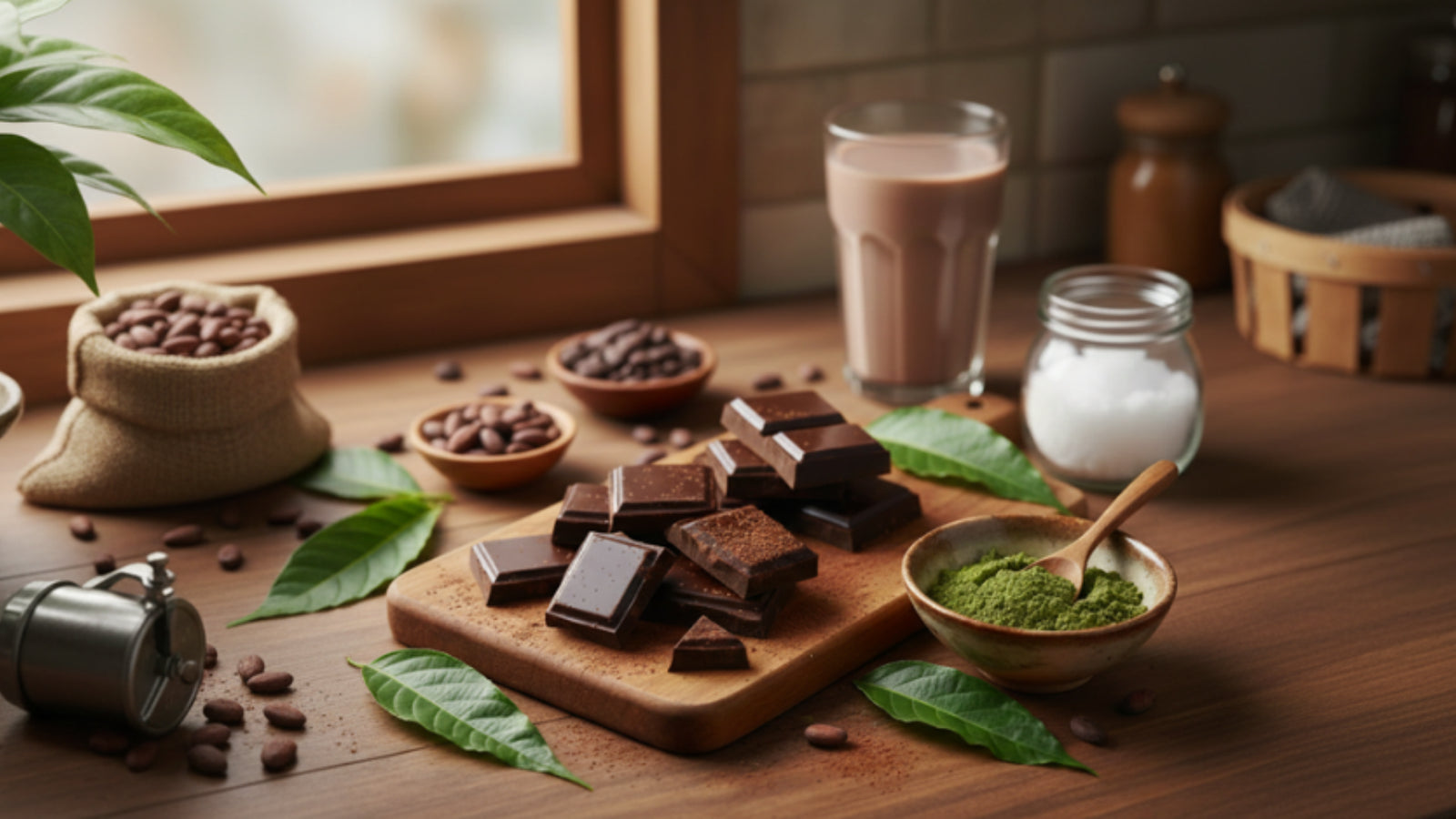
If you've ever tried plain kratom, you already know the taste is the worst part of the experience. The leaf is bitter in a way that lingers, and the toss-and-wash method most users start with does nothing to fix that. Kratom chocolate solves the problem by delivering the same alkaloids inside one of the few foods on earth that's specifically engineered to taste good. Cocoa fat masks bitterness better than almost anything else, the texture turns a one-second gulp into a normal eating experience, and the dose is portion-controlled by the size of each square. With nearly 20 million Americans now using kratom regularly, home recipes like this one have become a meaningful share of how people actually take it.
This guide walks through everything you need to make a clean, lab-tested batch of kratom chocolate in your own kitchen. We'll cover the chemistry of why chocolate works, the equipment you actually need, the exact ratios that experienced home recipe builders use, the dose math, the storage rules, and the mistakes that ruin a batch. We'll also point you to the right kind of leaf to start with so the result tastes like chocolate first and kratom second.
Table of Contents
- Why Kratom Chocolate Works (The Bitterness Science)
- What You'll Need: Ingredients and Equipment
- Choosing the Right Kratom for Chocolate
- The Master Recipe: 12 Squares, 24 Servings
- Step-by-Step: Making the Batch
- Dose Math: How Many Squares Equal One Serving
- Storage and Shelf Life
- Variations: Dark, Milk, White, and Vegan
- Common Mistakes That Ruin a Batch
- Troubleshooting: Bloom, Grit, and Bitter Notes
- Frequently Asked Questions
- Final Thoughts
TL;DR
- Kratom chocolate works because cocoa fat and sugar mask the leaf's natural bitterness; the texture also smooths out the dosing experience compared to toss-and-wash.
- For a 12-square bar, the standard ratio is 8 oz tempered chocolate to 4 to 6 grams of finely sifted leaf powder, yielding 24 half-square servings of about 0.17 to 0.25 grams each.
- Use green vein or white vein leaf for milder flavor; red vein adds extra earthy notes that can fight the cocoa.
- Buy lab-tested, lot-traceable leaf; alkaloid content varies by source, and chocolate locks the dose in for the life of the bar.
- Temper the chocolate properly (heating to 115F, cooling to 82F, rewarming to 88F for dark) so the bar snaps cleanly and stores at room temperature.
- Store in an airtight container in a cool dark spot at 60 to 68F; expect a 6 to 8 week shelf life before alkaloid potency starts to decline.
- Start with one half-square the first time. Wait 45 minutes before deciding whether to eat another.
- Avoid sweetened condensed milk fillings and water-based caramels; moisture seizes the chocolate and creates inconsistent dosing pockets.

Why Kratom Chocolate Works (The Bitterness Science)
Plain kratom powder tastes the way it does because of a class of compounds called alkaloids, the same compounds responsible for its effects. According to the Association of State and Territorial Health Officials, kratom contains around 40 distinct alkaloids, with mitragynine and 7-hydroxymitragynine doing most of the work. Mitragynine, the dominant alkaloid, is intensely bitter on the tongue. Without something to balance it, the brain reads the taste as a warning sign and the gag reflex kicks in.
Chocolate solves three problems at once. First, the cocoa butter coats the tongue in fat, which physically blocks the bitter compounds from reaching most of your taste buds. Second, the sugar in chocolate triggers a sweet response that competes with the bitter signal. Third, the natural cocoa flavor compounds (themselves slightly bitter) blend with the kratom's earthy notes instead of clashing.
Worth noting: kratom alkaloids are not fat-soluble in the way that, say, THC or vitamin D are. The cocoa butter doesn't dramatically increase absorption. What it does do is buy you the time and pleasure of actually eating the dose without holding your breath. Compared to a kava bar drink or a powder slurry, chocolate is the most palatable carrier most home cooks have access to. The kratom edibles category overall is one of the fastest-growing segments inside the broader kratom market, which reached $2.19 billion in 2024 and is projected to grow to $7.80 billion by 2032.
The other thing chocolate does well is dose lock-in. Once a batch is mixed and set, the leaf is distributed roughly evenly across the bar (assuming you tempered properly and stirred well). Each square delivers a predictable amount, which is the opposite of trying to scoop teaspoons of powder.

What You'll Need: Ingredients and Equipment
You don't need a chocolatier's kitchen, but you do need a few specific pieces of gear. Skipping any of these makes the result worse, not just less convenient.
Ingredients:
- 8 oz (227 g) high-quality couverture chocolate, 60 to 70% cacao for dark, or quality milk chocolate for milk variants
- 4 to 6 grams of finely sifted lab-tested kratom leaf powder (green or white vein for first batch)
- Optional: 1 to 2 tsp neutral cocoa butter to improve flow
- Optional: a pinch of fine sea salt to round out flavor
- Optional: 1/4 tsp pure vanilla extract (alcohol-based, used sparingly)
Equipment:
- Heavy-bottomed double boiler or a glass bowl set over a saucepan with simmering water
- Digital instant-read thermometer (the single most important tool, and the most-skipped one)
- Fine-mesh sifter for the kratom powder
- Silicone spatula
- Silicone chocolate bar mold (12-cavity is standard, square or rectangle work)
- Baking sheet to hold the mold flat
- Airtight storage container or wax paper for finished bars
- A scale that reads to 0.1 g for the kratom (kitchen scales that only read whole grams will not work)
The single most-skipped item is the digital thermometer. Tempering chocolate is a temperature-window process, and eyeballing it produces grainy, dull bars that bloom within days. Buy the thermometer.

Choosing the Right Kratom for Chocolate
Vein color and strain matter more in chocolate than they do in tea, because the chocolate amplifies whatever profile the leaf already has.
Green vein is the safest first choice. Green Maeng Da, Green Malay, and Super Green (Borneo blend) all blend cleanly with cocoa and tend to lean a little more "tea-like" in flavor, which complements milk chocolate especially well.
White vein is the second-best option. White Maeng Da and similar white-vein leaves are typically slightly milder in earthy notes and can carry a brighter top note that pairs nicely with dark chocolate at 70%.
Red vein is harder to work with. Red Bali, Red Maeng Da, and similar strains have heavier earth-and-soil flavor compounds that can cut through cocoa and dominate the bar. If you want to use red, drop the dose 25% and pair with a deeper dark chocolate (75% or higher).
Yellow vein is rare but well-suited; it's typically a fermented leaf with mellower character.
Whatever vein you choose, the most important factor is sourcing. Alkaloid content varies meaningfully across vendors and lots, and once the leaf is mixed into chocolate, you're stuck with that potency for the entire batch. Buy from a vendor that publishes a certificate of analysis showing alkaloid content, heavy-metal screening, and microbial testing. If you want to keep your sourcing simple, our team at GRH Kratom keeps lab-tested, lot-traceable leaf available across all the standard vein colors at grhkratom.com.
For a deeper read on which strains are most potent and what they're commonly used for, our breakdown on the strongest kratom strains covers the ones most home recipe builders gravitate toward.

The Master Recipe: 12 Squares, 24 Servings
This is the recipe to use the first time. It scales cleanly up or down, and the ratios are tuned to produce a bar that tastes like chocolate first and kratom second.
| Ingredient | Quantity | Notes |
|---|---|---|
| Couverture chocolate (60 to 70% cacao) | 8 oz (227 g) | Use real couverture, not chocolate chips |
| Kratom leaf powder (sifted) | 4 to 6 g | Green or white vein, lab-tested |
| Cocoa butter (optional) | 1 to 2 tsp | Improves pour and snap |
| Sea salt (optional) | Pinch | Rounds out flavor |
| Vanilla extract (optional) | 1/4 tsp | Use sparingly |
Yield: 12 squares per bar, with each bar split into halves for 24 servings.
Serving size: Half-square = roughly 0.17 to 0.25 g of leaf equivalent (depends on whether you used 4 or 6 g in the batch).
This is intentionally a low-dose bar by kratom standards. It exists to give you a way to take small, predictable doses with a pleasant eating experience, not to deliver a stronger experience than you'd get from a teaspoon of powder.
Step-by-Step: Making the Batch
This sequence is the difference between a glossy, snappy bar and a chalky one. Follow it without improvising the first time.
- Sift the kratom powder. Run all 4 to 6 grams through a fine-mesh sieve. Any clumps will create grit pockets in the finished bar. Set the sifted powder aside in a small bowl.
- Chop the chocolate. If your couverture is in larger pieces, chop it to roughly almond size. Smaller pieces melt more evenly. Reserve about 1.5 oz (40 g) of unmelted chocolate; you'll need it later for tempering.
- Set up the double boiler. Bring a small saucepan of water to a bare simmer. The bottom of your bowl should not touch the water.
- Melt and heat to 115F. Add the chopped chocolate (minus the reserved 1.5 oz) and the optional cocoa butter to the bowl. Stir gently. Use the thermometer to bring the chocolate to 115F (46C) for dark, or 110F (43C) for milk. Do not exceed.
- Cool to 82F by adding the reserved chocolate. Remove the bowl from the heat. Add the reserved 1.5 oz of unmelted chocolate and stir constantly. The temperature will drop. Bring it down to 82F (28C) for dark, or 80F (27C) for milk. This step is called seeding and is what forms the right cocoa butter crystals.
- Rewarm to 88F. Briefly return the bowl to the simmering water for 5 to 10 seconds at a time, stirring, until the chocolate hits 88F (31C) for dark, or 85F (29C) for milk. This is your working temperature.
- Stir in the kratom powder. Add the sifted kratom in three additions, folding it in with a silicone spatula. Stir thoroughly between additions to keep the dose evenly distributed. Add the optional salt and vanilla now if you're using them.
- Pour into the mold. Pour the tempered, kratom-laced chocolate into the silicone bar mold. Tap the mold firmly on the counter five or six times to release air bubbles.
- Cool on the counter, then refrigerate. Let the bar sit at room temperature for 10 minutes, then transfer to the refrigerator (40 to 45F) for 30 to 45 minutes to set fully.
- Unmold and store. Pop the bars out of the silicone mold. Wrap each bar in wax paper or store in an airtight container.

Dose Math: How Many Squares Equal One Serving
This is where most home cooks get into trouble. Walk through the math once and you'll never have to think about it again.
If you used 4 grams of kratom powder across one 12-square bar, each square contains 4 / 12 = 0.33 g. A half-square is 0.17 g. To equal a 1-gram threshold dose, you'd need 3 full squares (or 6 half-squares).
If you used 6 grams of kratom powder across the same bar, each square contains 0.5 g, and a half-square is 0.25 g. A 1-gram threshold dose is 2 full squares (or 4 half-squares).
The simple table:
| Batch dose | Per square | Per half-square | Squares for 1 g | Squares for 2 g |
|---|---|---|---|---|
| 4 g per bar | 0.33 g | 0.17 g | 3 | 6 |
| 5 g per bar | 0.42 g | 0.21 g | 2.4 | 4.8 |
| 6 g per bar | 0.50 g | 0.25 g | 2 | 4 |
The 45-minute rule applies the same way it does at a kratom bar: eat one half-square first, wait 45 minutes, then decide whether to eat another. Most regulars settle around 1 to 2 grams of leaf equivalent per session, which is 4 to 8 half-squares depending on your batch ratio. If you want a structured way to dial in your range before you start eating multi-gram doses, our kratom dosage guide covers the tier-by-tier approach we recommend for any first-time user.

Storage and Shelf Life
Tempered chocolate is shelf-stable at room temperature, and so are kratom alkaloids, but heat, light, and moisture all shorten the shelf life of both. Treat the bars like premium chocolate, not like leftovers.
Keep the bars in an airtight container at 60 to 68F (15 to 20C). A pantry shelf or wine cabinet works. Refrigerator storage is fine for short stretches but causes condensation when you take bars in and out, which leads to surface bloom (the white film) and slightly faster alkaloid degradation. The freezer is for batches you don't plan to eat within two months and should be vacuum-sealed before going in.
Expected shelf life: 6 to 8 weeks at room temperature for full potency, up to 12 weeks if you can keep the storage cool and lightless. After that the bar is still safe to eat, but the alkaloid content declines and your effective dose-per-square shifts downward.

Variations: Dark, Milk, White, and Vegan
Once you've nailed the master recipe, the variations are straightforward.
Dark chocolate (70% cacao or higher): Use the master ratios as written. The deeper cocoa profile pairs especially well with white vein kratom. This is the most forgiving variation.
Milk chocolate: Drop the tempering temperatures by 5F at each step (110F initial, 80F seed, 85F working). The added sugar makes milk chocolate slightly more sensitive to overheating. Pair with green vein for the cleanest flavor.
White chocolate: Use 75F seed and 82F working temperatures. White chocolate is the most fragile to temper but masks bitterness more aggressively because of the higher sugar load. Pair with white or yellow vein. Keep the dose on the lower end (4 g per batch).
Vegan dark chocolate: Substitute the chocolate with a high-cacao vegan couverture made with cocoa butter and no dairy. Most premium dark chocolates are already vegan; check the label.
Sugar-free option: Use a stevia or monk-fruit-sweetened chocolate base. The alcohol sugars in some brands cause loose stools at higher servings, so test with a single half-square the first time.

Common Mistakes That Ruin a Batch
A short list of the most common ways home batches go sideways.
Overheating the chocolate. Once chocolate goes above 120F for dark or 115F for milk, the cocoa butter crystals lose their structure and you cannot recover the temper. The bar will set chalky and bloom within days. Use the thermometer.
Adding water-based ingredients. Vanilla extract used sparingly is fine because the alcohol evaporates. Adding fruit juice, condensed milk fillings, or non-fat liquids causes the chocolate to seize. The mixture turns from a smooth flow into a stiff, lumpy paste, and the kratom distribution becomes uneven.
Skipping the sieve on the kratom. Unsifted leaf creates clumps that look fine when wet but become hard, gritty pockets in the finished bar. They also create dose-distribution problems where one square has 1 g and another has 0.05 g.
Not tapping out air bubbles. Tapping the mold matters. Air pockets in the finished bar leave shallow craters on the bottom and can hide kratom clumps that didn't get folded in fully.
Storing the bars in the fridge by default. Cold storage causes condensation each time you open the container, which produces surface bloom and shortens shelf life. Store at room temperature unless your kitchen runs above 75F.
Eyeballing the kratom dose. Use a 0.1 g scale. The difference between 4 g and 6 g per bar is the difference between "I felt nothing" and "I overdid it" on a per-square basis.

Troubleshooting: Bloom, Grit, and Bitter Notes
A few specific failure modes and how to fix them.
White surface bloom (fat bloom): The chocolate was either overheated, cooled too fast, or stored in a fluctuating temperature. The bar is still safe to eat but the texture is off. Re-temper to fix, or eat as is and adjust temp control next time.
Sugar bloom (grainy white grit): Moisture got into the chocolate at some point, often from refrigeration. Re-tempering will not fix it; the next batch needs better moisture control.
Gritty mouthfeel: Either the kratom wasn't sifted finely enough, or the chocolate wasn't fully melted before adding it. Sift more aggressively next time and double-check the chocolate is smooth before adding the leaf.
Bitter overpowers cocoa: Either the dose is too high for the chocolate type (try 70% dark instead of 60%), or you used red vein when the recipe was tuned for green/white. Drop dose 25%, switch vein color, or move to a darker chocolate base.
Bar snaps soft instead of clean: The chocolate was not tempered correctly. The cocoa butter crystals are in the wrong form. Re-temper from scratch, paying close attention to the seed and rewarming temperatures.

Frequently Asked Questions
Can I use chocolate chips instead of couverture?
Not recommended. Chocolate chips contain stabilizers that prevent them from melting and re-tempering cleanly. They produce dull bars with poor snap and faster bloom. Couverture is worth the extra few dollars.
How long does kratom chocolate take to kick in?
Typically 30 to 60 minutes from your first half-square, with peak effects around 90 minutes and a tail of two to four hours. Eating it on a partial stomach (light snack 30 minutes before) is gentler than fasting.
Is it stronger than the same dose of powder?
No. Cocoa butter doesn't meaningfully increase kratom absorption because the alkaloids are not fat-soluble. The dose-per-square is roughly equivalent to the same amount of powder, just easier to ingest.
Can I use this recipe with kratom extract instead of leaf powder?
You can, but the dose math changes drastically. Extracts are 10x to 25x more concentrated than leaf, so a half-gram of extract is closer to 5 to 12 grams of leaf. We don't recommend extracts for first-time recipe builders. Stick to leaf powder until you're experienced.
What's the difference between this and a kratom edible from a bar?
Bar-made kratom edibles use commercial-grade equipment and standardized dosing procedures, often with more aggressive flavor masking. Home-made kratom chocolate gives you control over the leaf source, dose, and ingredients, but requires more diligence to keep doses consistent.
Can I drink alcohol with kratom chocolate?
No. Kratom and alcohol interact in unpredictable ways. The standard rule from harm-reduction literature, and from every reputable kratom bar operator, is to not stack the two on the same evening.
Is kratom legal where I live?
Federal law is permissive, and more than 18 states have adopted Kratom Consumer Protection Act laws that regulate (rather than prohibit) kratom. Alabama, Arkansas, Connecticut, Indiana, Louisiana, Vermont, and Wisconsin currently ban it outright. Rhode Island legalized it on April 1, 2026, the first state to reverse a ban. For more recipe variations and other ways to enjoy the leaf at home, see our six best kratom recipes guide.
Final Thoughts
Kratom chocolate is one of the few ways to take a daily kratom dose that doesn't feel like work. Done right, it's a 30-second ritual you actually look forward to: unwrap a bar, snap off a square, eat half of it with a glass of water. The chocolate handles the bitterness, the math handles the dose, and the storage handles the rest.
The two pieces that matter most are sourcing the leaf well and tempering the chocolate correctly. Skimping on either one produces a batch that tastes okay but doses unpredictably or stores poorly. Spend the extra $5 on couverture, buy the digital thermometer, and source your leaf from a vendor that publishes lab results.
If your first batch is good, you'll find yourself making bars in advance the same way some people batch-cook on Sundays. If it's bad, the troubleshooting section above will get you to a clean second batch fast. Either way, you'll have a much more enjoyable way to take kratom than the toss-and-wash you started with.


