



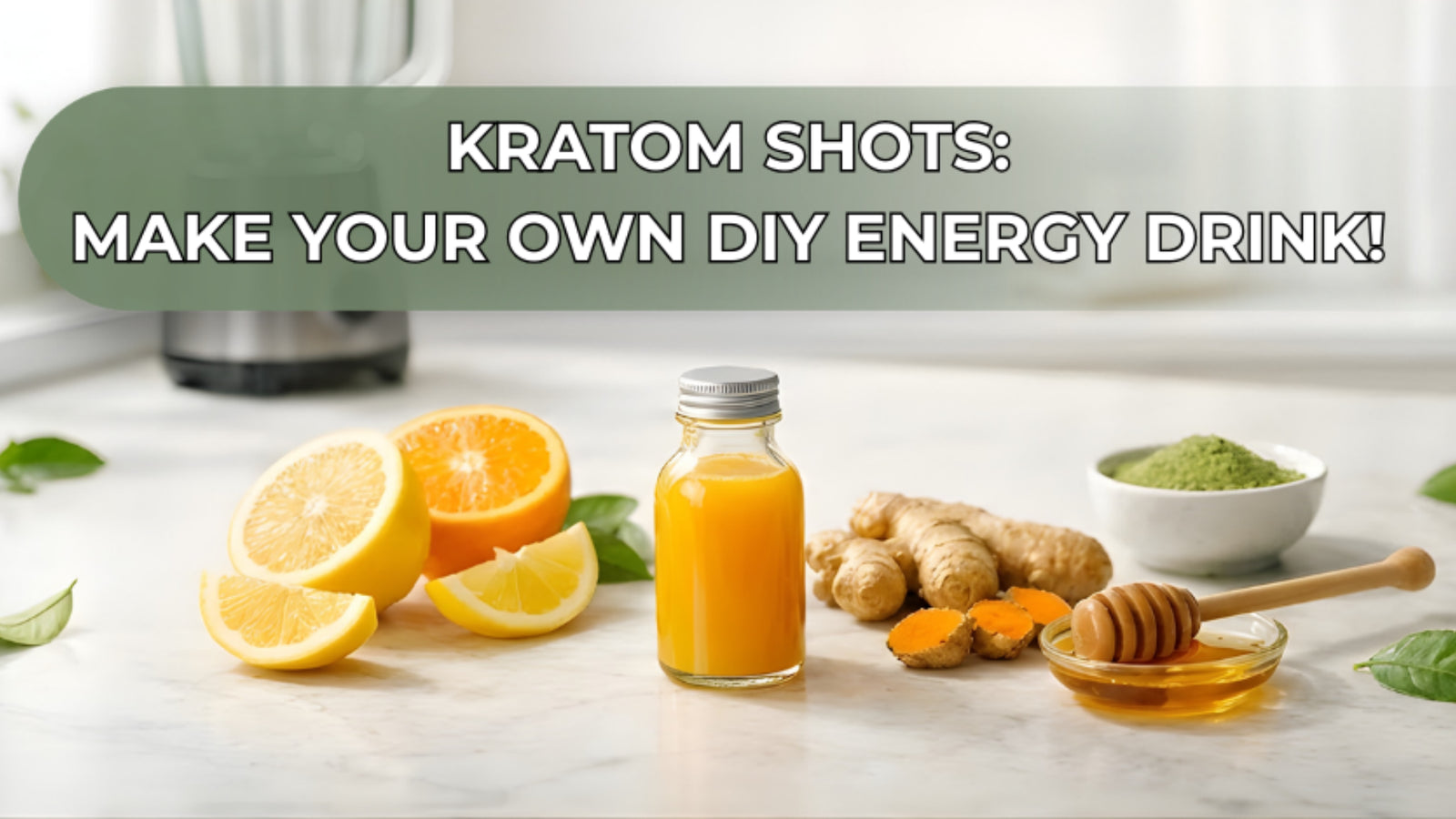
The energy drink shelf at any convenience store is a wall of neon cans selling the same idea: stay awake, push harder, get through the afternoon. Behind the marketing is a recipe that has been mostly the same for two decades, and it usually involves more sugar, more synthetic caffeine, and more artificial colors than anyone needs.
Building your own energy drink at home flips that script. You control the dose, the ingredients, and the flavor, and you can lean on plant-based ingredients (kratom in particular) that bring sustained energy without the same crash profile. According to a 2023 review indexed on PubMed, regular energy drink consumers report an interest in cleaner alternatives, with concerns about added sugar, artificial sweeteners, and caffeine spikes leading the list [Costantino et al., 2023].
This guide walks through how to build a kratom-based DIY energy drink at home. We'll cover ingredients, ratios, brewing, flavor pairings, and how to keep your homemade shot consistent batch to batch.

Table of Contents
- Why Build Your Own Energy Drink?
- The Core Ingredients in a Kratom DIY Energy Drink
- Choosing the Right Kratom Strain for Energy
- The Master Recipe: One Cup, Five Steps
- Flavor Pairings That Work
- Ratios and Dosing: How Much of Each Ingredient
- The Lemon Rule: Why Citrus Boosts Yield
- Storage and Shelf Life
- Stacking with Caffeine: Smart and Not-So-Smart Pairings
- DIY Energy Drink vs Store-Bought: The Honest Comparison
- Common Mistakes and How to Avoid Them
- Frequently Asked Questions
- Final Thoughts
TL;DR
- A DIY energy drink lets you control caffeine dose, sugar load, and ingredient quality in ways no commercial can match.
- Kratom (specifically white and green vein strains) is the most common plant-based energizing base for homemade energy drinks today.
- The master recipe: 12 oz water, 3 to 5 grams kratom powder, 1 tablespoon lemon juice, a sweetener of choice, and optional adaptogen booster.
- Lemon juice (or any citrus) lowers the brew pH and bumps mitragynine yield by an estimated 15 to 25 percent at the same dose.
- White Maeng Da is the cleanest energy lift; green vein gives a smoother daytime ride; red veins are not the right fit here.
- A DIY shot saves money fast: roughly 30 to 50 cents per serving for a homemade kratom shot vs $3 to $5 retail.
- Avoid stacking your homemade kratom shot with a full energy drink at the same time. Pick one stim path and dial it in.
- Store finished shots in glass, refrigerated, and use within 48 to 72 hours for best flavor and consistency.

Why Build Your Own Energy Drink?
The case for going DIY is part wallet, part body, part curiosity. Commercial energy drinks tend to load 150 to 300 milligrams of caffeine per can, layered with taurine, B-complex vitamins, sweeteners, and a preservation system. The cans work. They also dump everything at once and leave a predictable crash 90 minutes later for many users. Per the American Heart Association, energy drink consumption has been linked in published case studies to elevated blood pressure and heart rhythm changes when intake exceeds two cans per day [American Heart Association, 2023].
Building your own breaks that pattern. You decide:
- The caffeine source (or whether to use caffeine at all)
- The sugar level (zero, light, or matched to commercial)
- The base botanical (kratom, yerba mate, green tea, guarana)
- The flavor profile (bright citrus, bitter herbal, mellow fruit)
- The serving size (a 2-ounce shot or a 12-ounce sipper)
It is also cheaper. Per the math in the buyer's guide section below, a homemade kratom-based energy shot lands around 30 to 50 cents per serving when you buy whole-leaf powder in bulk. Compared to a $3 to $5 retail can, the savings stack quickly for daily users.
The third reason is consistency of effect. When you control the dose, you stop riding the random batch differences that come with commercial drinks. Your morning brew tastes the same and lifts the same.
The Core Ingredients in a Kratom DIY Energy Drink
A kratom-based DIY energy drink usually leans on five core inputs. Everything else is flavoring or optional add-on.
| Ingredient | Role | Typical amount |
|---|---|---|
| Filtered water | Base liquid for the brew | 8 to 12 oz |
| Kratom powder | Energizing alkaloid base | 3 to 5 grams (roughly 1 to 1.5 tsp) |
| Lemon juice (or citric) | Drops pH, boosts alkaloid yield | 1 tbsp per 12 oz |
| Sweetener of choice | Flavor + masks bitterness | Honey, agave, stevia, or skip |
| Optional adaptogen | Smooth focus / sustained energy | Rhodiola, panax, L-theanine |
The water-to-kratom ratio matters more than people think. Too much water dilutes the alkaloid concentration, and too little leaves the powder gritty and unpleasant. Twelve ounces of water to three to five grams of kratom is the sweet spot for most people.
For more detail on how kratom alkaloids work and why dose ratios matter, our Mitragyna speciosa overview covers the foundation.
Choosing the Right Kratom Strain for Energy
Strain selection shapes the entire experience. For an energy drink, you want kratom that leans toward stimulation rather than relaxation. Two veins do the heavy lifting:
- White vein strains are the most stimulating side of the kratom spectrum. White Maeng Da is the most popular choice for DIY energy shots because it gives a clean, focused lift with minimal sedation. Per a 2020 user survey indexed on NCBI, white vein kratom was reported by 28 percent of regular users as their primary energy choice [Coe et al., 2019].
- Green vein strains sit in the middle. Green Maeng Da and green Malay deliver a smoother, less intense lift than whites, which makes them better for sustained afternoon focus or long workdays.

Red vein strains are not the right pick for an energy drink. They lean sedative, which is exactly the opposite of what you want at 8 a.m. Save reds for evening recipes.
If you are starting out, our White Maeng Da Powder is the most reliable lift in the lineup, and Green Maeng Da is the daytime sustain pick.
The Master Recipe: One Cup, Five Steps
Here is the core recipe most home brewers settle on after a few batches.
Ingredients (1 serving, ~12 oz)
- 12 ounces filtered water
- 3 to 5 grams white or green vein kratom powder
- 1 tablespoon fresh lemon juice
- 1 to 2 teaspoons honey or sweetener of choice
- Optional: pinch of cinnamon, ginger, or sea salt
- Optional booster: 100 mg L-theanine or 200 mg rhodiola extract
Steps
- Heat the water to 190 degrees Fahrenheit. Just under a boil. A rolling boil at 212 degrees can degrade mitragynine by 20 to 30 percent in published bench tests.
- Add kratom powder and lemon juice. Whisk until the powder is suspended. The lemon drops the pH below 4, which improves mitragynine extraction by roughly 15 to 25 percent at the same dose.
- Hold at 190 degrees for 18 minutes. Stir every 4 to 5 minutes to keep the powder from settling. Eighteen minutes is the sweet spot for full extraction without diminishing returns.
- Strain through a fine mesh or coffee filter. Press the spent powder gently to recover the last of the liquid. Discard the powder.
- Stir in sweetener and any flavor add-ons. Serve hot for a tea-style drink or chill in the fridge for a cold shot.

This is the master recipe. Every variation below builds on these five steps.
Flavor Pairings That Work
Kratom on its own has a bitter, earthy taste that some users find off-putting. The right flavor pairing makes the difference between a drink you reach for and a drink you choke down.
- Honey + ginger: the most popular pairing. Honey balances the bitter, ginger adds warmth and a peppery finish.
- Lemon + cayenne: for a brighter, sharper drink. The cayenne is warming and lifts the sinuses, which pairs well with morning energy.
- Iced + pineapple juice: for a tropical iced shot. Pineapple has the acidity to keep the alkaloid yield up, plus enzymes that mask bitterness.
- Green tea base: swap half the water for brewed green tea. Adds caffeine and L-theanine for a smoother lift.
- Coconut water finish: chill the brew, then top with coconut water for an electrolyte-replenishing shot post-workout.
- Cinnamon + maple: a fall flavor combo that turns the drink into something close to a chai-style energy tea.
The rule of thumb: anything you would put in a smoothie pairs reasonably with kratom. Anything dairy-forward (cream, milk) tends to fight the herbal notes.
Ratios and Dosing: How Much of Each Ingredient
Dosing is where DIY brewers go off the rails. The good news: kratom has a wide tolerance window for most users, and small adjustments in either direction produce noticeable differences without dramatic shifts.
| Goal | Kratom dose | Water | Brew time |
|---|---|---|---|
| Mild lift / morning sip | 2.5 to 3 grams | 12 oz | 15 minutes |
| Standard energy drink | 3 to 5 grams | 12 oz | 18 minutes |
| Pre-workout shot | 4 to 6 grams | 8 oz (concentrated) | 18 minutes |
| Iced afternoon recharge | 3 grams | 16 oz iced | 18 minutes then chill |
Start at the lower end of any range, especially if you are new to kratom. The "more is more" pattern that works for caffeine does not translate cleanly to kratom; doses above 6 grams shift the experience away from energy and toward sedation for most users, which kills the whole point of an energy drink.

For caffeine pairings, keep the math simple: if you add a 6-ounce coffee, treat it as your primary stim and pull the kratom dose down to 2.5 to 3 grams. Doubling up creates dehydration risk without proportional benefit.
The Lemon Rule: Why Citrus Boosts Yield
The lemon juice is not optional. It is the single biggest yield-improving step in the recipe.
Mitragynine and the other major kratom alkaloids extract more efficiently in mildly acidic water. Tap water sits around pH 7. Lemon juice drops the brew pH to roughly 3.5 to 4.0 once you add a tablespoon to 12 ounces. That shift in acidity opens up alkaloid molecules that would otherwise remain bound in the leaf material.
In practical terms: skipping the lemon costs you 15 to 25 percent of the active alkaloid content from the same powder dose. That is the difference between a 4-gram shot and a 5-gram shot in terms of perceived strength.
If you do not have lemon, alternatives that work nearly as well:
- 1 tablespoon lime juice
- 1 tablespoon orange juice
- A pinch of citric acid powder (1 gram)
- 2 tablespoons apple cider vinegar (will affect flavor more)
Skipping the citrus step entirely is the number-one mistake morning brewers make.
Storage and Shelf Life
A finished kratom shot is more perishable than a soda or coffee, but more stable than people assume. The alkaloids themselves are reasonably shelf-stable; what degrades first is the flavor and the suspension.
- Hot tea-style: drink within 4 hours. After that, the flavor goes flat and any settled material starts to oxidize.
- Refrigerated cold shot in glass: good for 48 to 72 hours. Beyond 72 hours, the alkaloid content drops measurably and the drink starts to taste off.
- Frozen in ice cube trays: good for 2 to 3 months. This is the move for batch brewers who want a daily shot without a daily brew.
- Plastic vs glass: always glass. Plastic leaches over time and the alkaloids interact with some plastic resins.
If you are batch-brewing for the week, the cleanest workflow is to brew on Sunday, portion into 2-ounce glass jars, refrigerate, and use across the next 3 days. Anything beyond that goes in the freezer.

The same storage logic applies to commercial kratom products. For everyday brewing, our White Maeng Da Powder stores in its original sealed bag for 12 to 18 months without significant alkaloid degradation, which is the supply side of the equation.
Stacking with Caffeine: Smart and Not-So-Smart Pairings
Kratom and caffeine work, but the rules matter. Both are stimulants, both deplete water, and stacking them carelessly creates a worse experience than either alone.
| Stack | Verdict | Why |
|---|---|---|
| Small coffee (6 oz) + 3 g kratom | Smart | Clean stack, mild dehydration risk only if you skimp on water |
| Strong coffee (16 oz) + 5 g kratom | Risky | Compounding dehydration and stimulation; jaw tightness common |
| Energy drink + kratom shot | Skip | Synthetic stim cocktail, hard crash, no clear upside |
| Green tea + kratom | Smart | L-theanine smooths the lift; great for focus work |
| Pre-workout + kratom | Skip | Cardiac load is unpredictable; pick one stim path before training |
| Yerba mate + kratom | Smart (use sparingly) | Both are bitter; sweeten generously and keep doses small |
The simple rule: pick one stim path and dial it in. If kratom is the lift, treat coffee as the morning kicker and stop there. If coffee is the lift, treat kratom as the afternoon supplement, not a second espresso. Our deeper guide to kratom and coffee pairings walks through dose math and timing in more detail. Recent National Institute on Drug Abuse updates also note expanding research into kratom alkaloid pharmacology, which is reshaping how clinicians think about combined-stimulant use [NIDA, 2024].
DIY Energy Drink vs Store-Bought: The Honest Comparison
Here is where DIY actually pays off, and where it falls short.
| Factor | Store-bought | Kratom DIY |
|---|---|---|
| Cost per serving | $3 to $5 | $0.30 to $0.50 |
| Caffeine consistency | High (lab-measured) | Variable per brew |
| Ingredient transparency | Decent (label) | Total (you bought it) |
| Shelf-stable | 6 to 12 months unopened | 48 to 72 hours brewed |
| Convenience | Open and drink | 18-minute brew |
| Sugar control | Marketed, often misleading | Total |
| Recyclability | Aluminum can | Glass bottle, reused |
| Effect crash | Common 90 to 180 min later | Less pronounced in user reports |
Store-bought wins on convenience and consistency. DIY wins on cost, transparency, and crash profile. For daily users, the math favors DIY by a wide margin. For occasional weekend boosts, store-bought is fine.

The honest middle ground: keep both. A homemade kratom shot for daily use, an occasional commercial can for travel or unexpected late nights.
Common Mistakes and How to Avoid Them
A short field guide to the errors that show up over and over in r/kratom DIY threads.
- Skipping the citrus. Discussed above. The single biggest yield killer.
- Boiling instead of simmering. A rolling boil degrades the alkaloids. Hold at 190 to 200 degrees, never higher.
- Brewing too long. Past 30 minutes, you stop gaining alkaloids and start oxidizing flavor compounds. Eighteen minutes is the target.
- Using too much powder. Above 6 grams, the experience tilts toward sedation. Energy drinks should energize.
- Stirring once and walking away. Kratom powder settles. Stir every 4 to 5 minutes during the brew.
- Storing in plastic. Glass jars only. The alkaloids do not like plastic, and the flavor degrades faster.
- Mixing red vein for a morning shot. Red veins are evening kratom. Whites and greens for energy.
- Adding milk or cream. It fights the herbal notes and clouds the drink. Stick to water-based bases.

The fix list is short because most DIY mistakes come from skipping steps, not adding the wrong ingredients.

If you want a starting point that minimizes guesswork, pair our Green Maeng Da Powder with the master recipe above. The green strain is the most forgiving for first-time brewers and pairs cleanly with most flavor add-ons covered earlier. For deeper recipe ideas, our energizing kratom tea guide covers complementary techniques.
Frequently Asked Questions
How strong is a homemade kratom energy drink compared to a Red Bull?
Different categories. Red Bull delivers around 80 mg of caffeine plus sugar and B vitamins. A 4-gram kratom shot delivers a similar perceived energy lift but through different alkaloid pathways, with a smoother onset (10 to 20 minutes vs 5 to 10) and typically a less pronounced crash.
Can I make a kratom energy drink without lemon?
Technically yes, but you lose 15 to 25 percent of the alkaloid content. Use lime, orange, citric acid, or apple cider vinegar as alternatives. Skipping citrus entirely is not recommended.
How long does a homemade kratom shot last in the fridge?
48 to 72 hours in glass, refrigerated. Beyond that, alkaloid content drops and flavor turns. For longer storage, freeze in ice cube trays for up to 3 months.
Can I use kratom extract instead of powder?
Yes, but adjust ratios. A 0.5 to 1 ml liquid extract or a 200 to 400 mg extract powder roughly equals a 3 to 5 gram whole-leaf dose, with faster onset. Whole-leaf is preferred for full alkaloid balance, including paynantheine and the other minor alkaloids.
Will I crash from a kratom DIY energy drink?
User surveys consistently report a milder crash than caffeine-based energy drinks. The crash is more about cumulative use and tolerance buildup than a single dose, which is why daily users rotate strains and take occasional rest days.
Is making my own energy drink legal?
Yes. Kratom is legal in most US states, and brewing your own at home falls under personal use. Check state laws if you are in a restricted state. The American Kratom Association maintains a current legality map [American Kratom Association].
How does this compare to commercial kratom shots?
Commercial kratom shots like Joy Blend or others typically run $5 to $10 each and deliver pre-measured doses with consistent flavoring. Homemade shots cost a fraction (30 to 50 cents) but require 18 minutes of brew time. Most regular users keep both: commercial for travel or rushed mornings, homemade for daily use.
What is the cheapest way to start brewing?
Buy a 100-gram bag of white or green Maeng Da, a few lemons, a fine-mesh strainer, and a small saucepan. Total upfront cost under $30, which delivers roughly 25 to 30 servings.
Can I add kratom to a smoothie?
Yes, with caveats. Cold blending does not extract alkaloids efficiently, so you get less out of the same dose compared to a hot brew. The workaround is to brew the kratom first as a concentrated 4-ounce shot, chill it, then add the chilled brew to your smoothie. Skipping the brew step costs you 30 to 40 percent of the alkaloid yield.
What about adaptogens like rhodiola or ashwagandha?
Smart additions for sustained focus. Rhodiola pairs especially well at 100 to 200 mg per shot and smooths out any sharpness from white vein kratom. Ashwagandha is more relaxing than energizing, so it is a better fit for an evening kratom drink than a morning energy shot.

Final Thoughts
A homemade kratom-based DIY energy drink is one of the simplest upgrades you can make to your daily energy routine. Eighteen minutes of brewing, five basic ingredients, and you walk away with a drink that costs a fraction of a commercial can, gives you total ingredient control, and (per published user surveys) tends to crash less hard.
The two practical takeaways: start with white or green Maeng Da, and never skip the lemon. Everything else is flavor preference and personal calibration.
If you want to start with a clean, reliable strain for your first batch, our White Maeng Da Powder is the most forgiving for new brewers, and our energizing tea guide walks through complementary techniques. The kratom DIY space is built around small adjustments that compound, so brew the master recipe a few times before tweaking the variables.


