



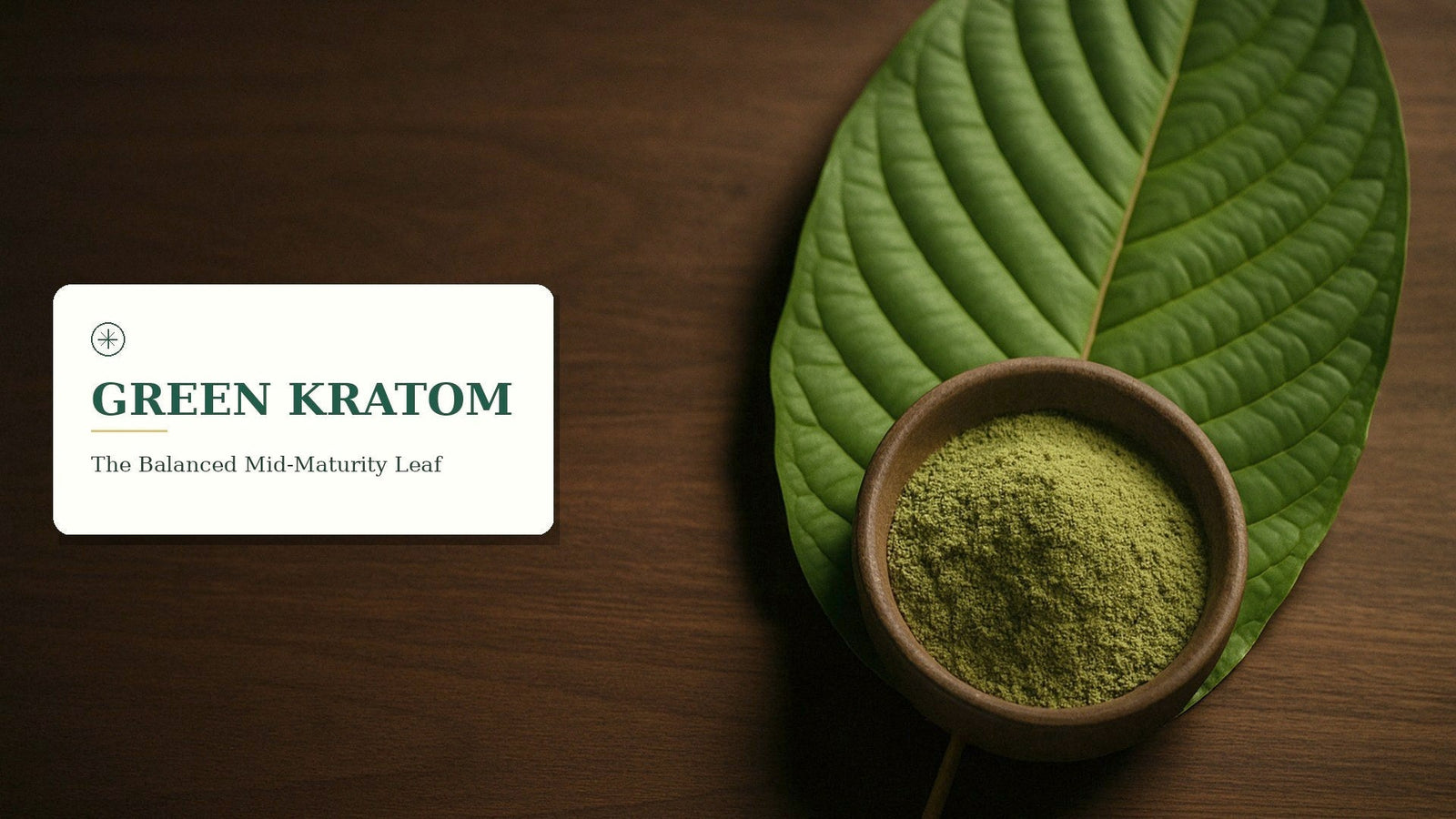
Walk into any kratom shop or scroll any vendor site and "green kratom" is the catalog word doing the heaviest lifting. The label sells balance, daytime calm, and a soft mood lift, and people reach for it expecting exactly that. What the label glosses over is what's actually different about a green-vein leaf, why it sits the way it does between white and red, and which of the major green strains actually fit which kind of day.
The American Kratom Association estimates that more than 15 million Americans use kratom regularly, and surveys of vetted vendors consistently show that green-vein products top the in-house bestseller lists. Greens are the workhorse of the category. That's why "green kratom" is the first search most newcomers run.

This guide treats green kratom as a category rather than a single product. We cover what the term actually means in the field, how the alkaloid signature differs from white and red, the typical effect profile, the major green strains by region, recommended dose ranges, and the people who tend to do well on greens versus the ones who don't. By the end you should know whether a green sits right for your day and which of the strains under the green umbrella is worth your first pour.
Table of Contents
- What "green kratom" actually means
- How green differs from white and red
- The alkaloid profile of a green vein leaf
- The typical effect profile (balanced energy and mood)
- The major green strains, by region
- Comparing Green Maeng Da, Bali, and Borneo head to head
- Recommended doses for green vein kratom
- Who green kratom suits, and who it doesn't
- Quality vetting before you buy
- Safe daily-use practices
- Frequently Asked Questions
- Final Thoughts
TL;DR
- "Green kratom" is the mid-maturity vein color. Leaves harvested between the white (youngest) and red (oldest) stages carry a balanced alkaloid signature.
- The effect profile sits between white and red. Most people describe greens as gently energizing, mood-lifting, and socially comfortable.
- The major green strains are Green Maeng Da, Green Bali, Green Borneo, Green Malay, and Green Thai. Each carries a slightly different bias.
- Typical doses run 2 to 4 grams for newcomers and 4 to 6 grams for regular users. Past 7 grams, greens trade their balanced feel for sedation.
- Green kratom suits daytime users who want a lift without the edge of white veins or the heaviness of reds.
- It's a poor pick for sleep, heavy stimulation seekers, or anyone sensitive to even mild kratom effects.
- Quality vetting beats strain name. Lab tests, batch numbers, and AKA GMP qualification matter more than marketing copy.
- Rotate strains and take breaks. Daily single-strain use builds tolerance faster than rotation across two or three veins.

What "green kratom" actually means
Mitragyna speciosa, the kratom tree, grows leaves whose central vein shifts color as the leaf ages on the branch. Young leaves carry a whitish vein. Mid-maturity leaves carry a green vein. Fully mature leaves carry a red vein. Farmers across Indonesia, Borneo, Malaysia, and Thailand have built their harvest schedules around that color cycle for generations.
A green kratom product is one made from mid-maturity leaves. The leaf is picked during a specific window when chlorophyll levels are high, the alkaloid panel has finished its main developmental shift, and the secondary alkaloids have started to round out the profile. The result is a leaf that doesn't lean as far toward stimulation as a younger white-vein leaf, and doesn't lean as far toward sedation as an older red-vein leaf.
For the full biology of vein color and how alkaloid ratios shift through the harvest window, our deeper companion piece on green vein kratom walks the chemistry in detail. This guide stays at the category level: what greens are good for, which strains to look at first, and how to start.
How green differs from white and red
The three vein colors line up on a spectrum, not as three unrelated products. Same tree, same farm, same processing in most cases. The only meaningful difference is when the leaf is picked.
White vein. Youngest leaves, brightest and most stimulating. People reach for whites in the morning, before workouts, or when they need a clean push of energy without coffee jitters. The trade-off is a sharper edge for some people. Our flagship white kratom primer covers that side of the spectrum.
Green vein. Mid-maturity. The leaf has finished most of its alkaloid maturation but hasn't yet shifted toward the heavier red-vein profile. Effect feels balanced: light energy, mood lift, and a calm presence rather than a wired one.
Red vein. Oldest leaves, deepest sedation lean, lowest stimulation. Reds are the relaxation-and-evening pick. Some users find them too heavy for daytime work.
The practical takeaway: a single farm can produce three very different products by changing nothing but the harvest window. That's why green kratom is a category and not a single strain.

The alkaloid profile of a green vein leaf
Kratom contains more than 40 identified alkaloids. Three of them carry most of the conversation, and a green vein leaf's signature comes from where it lands on the gradient of all three.
Mitragynine is the dominant alkaloid by mass in every vein color, typically 60 to 70 percent of total alkaloid content. It carries most of the energetic and mood-supportive feel of kratom. Green veins keep mitragynine high.
7-hydroxymitragynine is the alkaloid most associated with sedation. In green leaves it sits in roughly the 0.5 to 2 percent range, lower than reds but slightly higher than whites. The mid-band position is part of why greens feel relaxed rather than wired.
Speciogynine, speciociliatine, paynantheine, and corynantheidine round out the secondary alkaloid set. These compounds modulate how the dominant alkaloids hit. A balanced secondary panel is one reason greens feel smoother on the front end than whites.
Peer-reviewed work indexed in PMC NCBI on mitragynine and leaf-maturity biology documents how those ratios shift through the harvest window. A separate PubMed-indexed pharmacology review on Mitragyna speciosa alkaloids walks the secondary alkaloid panel in more depth. The science backs up what experienced kratom users describe anecdotally: greens are not just whites with the volume turned down. They have their own signature.
The typical effect profile (balanced energy and mood)
Most regular green-vein users describe the same arc. A smooth lift in mood and focus comes on within 20 to 40 minutes of a moderate dose. The cognitive feel is alert without the wired edge that some whites can produce. The physical feel is relaxed but functional. Conversation gets easier, mid-morning tasks feel less heavy, and there's no crash on the back end when the effect tapers.
Duration runs 4 to 6 hours from a single moderate dose, slightly longer for Green Malay. Most people find one well-timed serving carries them through a productive block of work or a social afternoon.
What people use greens for, in practice: morning productivity blocks, social ease at lunch or coffee meetings, mid-day resets after the post-lunch dip, light-load workouts, post-workout recovery where sedation isn't wanted, and creative or writing sessions where focus matters more than raw energy. Greens are the kratom category most often described as "the one I can build a routine around."

The major green strains, by region
Strain names on kratom labels are a mix of geography, harvest method, and vendor branding. The five greens below are the ones you'll find on virtually every reputable U.S. vendor's menu. Each carries a recognizable bias inside the broader green profile.
Green Maeng Da. Indonesian heritage strain, often the slightly more energetic green on a vendor's shelf. "Maeng Da" translates loosely as "pimp grade" in Thai slang, originally a marketing claim about top-tier leaf. Today the name signals consistent potency. Onset tends to be quick, top tends to be bright.
Green Bali. Sourced from the Bali region, runs a slower onset and a smoother body feel than Maeng Da. People who find Maeng Da a touch sharp often settle on Bali.
Green Borneo. From Borneo island, the classic balanced reference strain. If you walked into a shop and asked for "a typical green," a vendor would steer you here. Mid-onset, mid-duration, mid-everything in the best sense.
Green Malay. Reputation for high mitragynine content and long duration, often 6 to 8 hours from a single dose. Popular for sustained focus days where the wearer doesn't want to redose at lunch.
Green Thai. Brighter and slightly more energetic than the other greens, often described as closer to the white end of the green spectrum. Good for mornings.
| Strain | Alkaloid lean | Typical effect | Dose range | Best for |
|---|---|---|---|---|
| Green Maeng Da | High mitragynine, balanced 7-OH | Quick onset, bright top, smooth taper | 2 to 5 g | Morning productivity, social settings |
| Green Bali | Balanced, slightly relaxed lean | Slower onset, smoother body feel | 2 to 5 g | Mid-day reset, easy afternoons |
| Green Borneo | Classic balanced green ratio | Mid-onset, mid-duration reference | 2 to 5 g | First green for newcomers |
| Green Malay | High mitragynine, long-acting | Sustained focus, 6 to 8 hours | 2 to 4 g | Long workdays, single-dose days |
| Green Thai | Slightly white-leaning | Brighter, more energetic | 2 to 4 g | Early morning, pre-workout |

Comparing Green Maeng Da, Bali, and Borneo head to head
These three are the most commonly stocked greens and the easiest to compare back to back if you're putting together a starter rotation. They share enough overlap that the differences come out in side-by-side use rather than in any single session.
Green Maeng Da has the fastest onset, often noticeable by minute 15. The top of the curve sits brighter and slightly more energetic than the other two. Duration runs 4 to 5 hours. People who want their kratom to feel like a clear "turn on" reach for Maeng Da.
Green Bali has a slower onset, with the lift more often arriving around minute 30 to 40. The body feel is smoother and slightly more relaxed. Duration runs 5 to 6 hours. Bali is the one most users settle into as their "default green" after a few rotations.
Green Borneo sits between the two. Mid-onset, mid-energy, mid-duration. It's the strain a thoughtful vendor will suggest when a customer cannot describe what they're looking for. Borneo also tends to be the most consistent batch-to-batch, since the harvest area is large and well-documented.
For people building a first green rotation, our Green Maeng Da Kratom Powder covers the brighter end, Super Green Kratom Powder sits on the balanced-Borneo end, and Boost Blend Kratom Powder stretches a green base toward the energetic side with a white-vein assist.

Recommended doses for green vein kratom
The full dose framework lives in our kratom dosage guide. The short version for greens looks like this.
- Threshold (1 to 2 g). First-time users start here. Light effect, mostly mood, no real physical signal. Wait 60 minutes before judging whether to add more.
- Standard (2 to 4 g). The bread and butter of green kratom use. Clear lift, balanced feel, 4 to 6 hours of effect. Most regular users land in this band.
- Moderate (4 to 6 g). Stronger physical feel, edges toward relaxed at the upper end. Some users prefer this band for afternoon sessions.
- Heavy (7 g and above). Sedating territory. Greens lose their balanced character past this point and start to behave more like reds. Not the profile most green users are after.
Capsule math: a typical size 00 kratom capsule holds about 0.5 grams of powder. Eight capsules is roughly 4 grams, a common standard dose. Most people find timing 30 to 60 minutes after a small meal softens the onset and reduces the chance of stomach noise.
Body weight, individual sensitivity, and tolerance all move these numbers. A 200-pound regular user and a 130-pound first-timer should not start at the same gram count. Lean light, wait, and step up only after a full hour of observation.
Who green kratom suits, and who it doesn't
Green vein kratom is the broadest-appeal vein color, but it isn't right for every situation. The honest version of "who it works for" reads like this.
Good fit for greens: daytime users who want a lift without coffee jitters, people who use kratom socially at lunch or in early-afternoon gatherings, mid-day reset users between a long morning and a long evening, light-load workouts and stretching sessions, and creative work where focus and mood matter together.
Poor fit for greens: people looking for sleep support, who should reach for red veins instead; people who want maximum stimulation, who tend to prefer whites; people who are sensitive to even mild kratom effects and should consider a smaller starting dose or a different supplement entirely.
Always consult a clinician first: if you have cardiovascular conditions, are pregnant or nursing, are on prescription medications (especially serotonergic, opioid, or sedative classes), or have a history of substance-use issues. The FDA dietary supplements guidance and the American Kratom Association consumer pages both stress that kratom is not regulated as a medicine and shouldn't be combined with other psychoactives without professional input.

Quality vetting before you buy
Strain name is roughly the last thing that should drive a kratom purchase. Quality and sourcing matter far more. The vetting checklist most experienced users converge on:
AKA GMP qualification. The American Kratom Association runs a Good Manufacturing Practices standard. Vendors who clear it post the logo and the certificate. It's the cleanest single signal that a vendor invests in proper handling.
Third-party lab tests. Real ones. The vendor should publish recent certificates of analysis covering alkaloid content, heavy metals, salmonella, and yeast/mold. If the COA is missing or older than six months, walk away.
Batch numbers and dated packaging. Kratom is plant material, not a perpetual stock item. Batch and pack date should be on the label or available on request.
Independent reviews. Vendor review aggregators, Reddit threads, and AKA member directories let you cross-reference what other long-time users say about a given source. Watch for paid placements and look for repeat positive notes from established users.
Reasonable pricing. Too cheap usually means old leaf or under-tested product. Too expensive does not always mean better. A 100g bag of well-tested green-vein powder typically lands in the $25 to $40 range at U.S. vetted vendors. NIDA's research overview on kratom walks the regulatory backdrop if you want to understand why testing varies so much across vendors.
Safe daily-use practices
For anyone planning to use green kratom more than once or twice a month, a few habits keep the experience stable over the long run.
Hydration. Kratom is mildly diuretic. A full glass of water with each dose and a habit of sipping through the effect window prevents most of the dry-mouth and mild-headache reports newcomers post about.
Food. A small meal 30 to 60 minutes before the dose softens onset and reduces stomach upset. Heavy meals will dampen the effect noticeably; light meals are the sweet spot.
Rotation. Avoid daily single-strain use. Two or three greens in rotation, or a green-white-red rotation across the week, slows tolerance build. Same dose stays effective for longer.
Tolerance breaks. One or two days a week off kratom entirely keeps the dose-response curve steep. People who skip breaks find themselves climbing through dose ranges within a few months.
Tracking. A short log of dose, time, strain, and outcome for the first month surfaces patterns much faster than memory alone. Most regular users find their own optimal band inside a few weeks of notes.


Frequently Asked Questions
Is green kratom stronger than white or red?
"Stronger" depends on what you're measuring. Greens carry a balanced alkaloid signature that most users describe as smoother and longer than whites and lighter than reds. Gram-for-gram total alkaloid content tends to be similar across vein colors from the same farm. What differs is the ratio, not the total.
What is the best green kratom strain for a first-time user?
Green Borneo and Green Maeng Da are the most common starting points. Borneo for a classic balanced reference, Maeng Da for someone who wants a slightly brighter introduction. Start at 2 to 3 grams, wait the full hour, and judge from there.
How long do green kratom effects last?
Typical duration is 4 to 6 hours for a standard dose, slightly longer (6 to 8 hours) for Green Malay specifically. Onset runs 20 to 40 minutes depending on whether you took it with food.
Can I take green kratom every day?
Some people do, but daily single-strain use builds tolerance faster than rotation. The more sustainable habit is two or three greens in rotation with one or two days off each week. That keeps the dose-response curve steep and prevents creeping dose escalation.
Will green kratom show up on a drug test?
Standard SAMHSA 5-panel and 10-panel employment drug tests do not screen for mitragynine or 7-hydroxymitragynine. Specialized kratom panels do exist and are sometimes used in legal or clinical contexts. If a specific test is a concern, check with the testing party in advance.
Is green kratom legal in the United States?
Kratom is federally legal in the United States. A handful of states (Alabama, Arkansas, Indiana, Rhode Island, Vermont, Wisconsin) and several cities have local bans or restrictions. The AKA's Kratom Consumer Protection Act has passed in a growing list of states. Check the current map for your state before ordering.
How is green kratom different from green vein kratom?
They're the same thing in plain language. "Green kratom" is the catalog shorthand vendors use; "green vein kratom" is the more precise term that names the leaf's central vein color at harvest. Both describe products made from mid-maturity Mitragyna speciosa leaves.
Can I mix green kratom with caffeine?
Some users combine a small cup of coffee with a low green dose for a sharper morning lift. The pairing is generally well-tolerated at small amounts, but two stimulants together can amplify anxiety, jitters, and heart rate. Start with a smaller dose of each and pay attention to how the combination feels. Avoid combining kratom with energy drinks, pre-workouts, or other concentrated stimulants.
Final Thoughts
Green kratom isn't a magic strain. It's a leaf harvested at a specific point in its life cycle, with an alkaloid signature that lands between the brightness of a white vein and the heaviness of a red vein. That middle position is exactly what makes greens the workhorse of the category. Daytime users, social users, and people building a sustainable kratom routine almost always end up with a green in the rotation.
If you're starting from scratch, the GRH lineup gives you three honest places to begin. Green Maeng Da Kratom Powder is the bright reference green. Super Green Kratom Powder is the balanced Borneo-style option. Focus Blend Kratom Powder stretches a green base toward sustained-attention work with a white-vein assist. Pick one, run it for a week, and let your notes do the deciding.

If you came here for the broad category overview and want to go deeper, the green vein kratom companion guide walks the vein-color biology in detail. Our white kratom primer covers the other end of the spectrum. Read them in order if you want the full picture of how vein color drives the kratom shopping decision.
The best green is the one that earns its place in your week. Buy small the first time, track honestly, rotate, take days off, and let the leaf do what it does without asking it to do everything. That's the whole game.


