



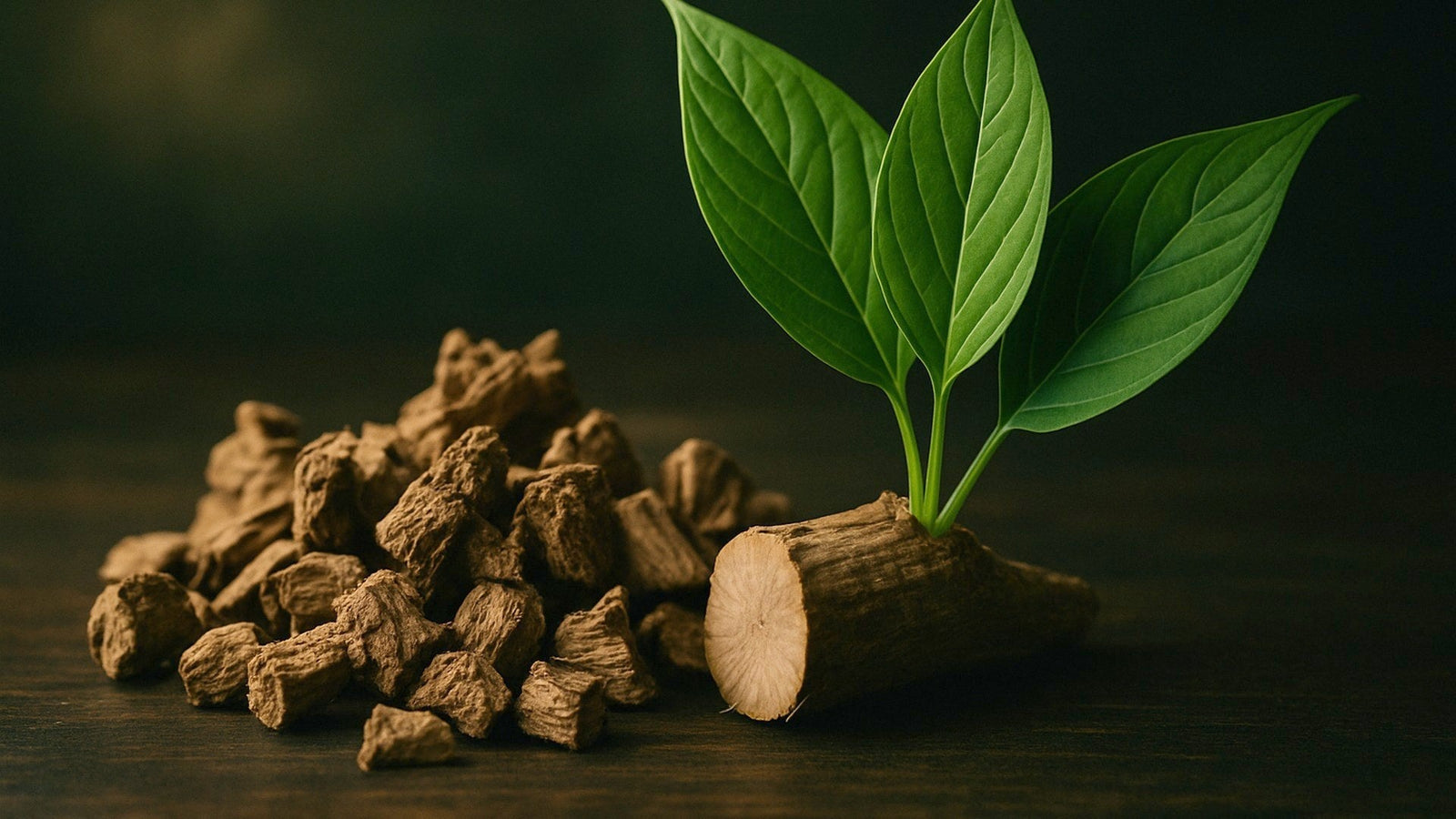
Piper methysticum is the proper botanical name for the plant most people know as kava. It belongs to the pepper family, grows as a leafy shrub across the South Pacific, and has been chewed, soaked, and pounded into ceremonial drinks for somewhere between 1,500 and 3,000 years depending on which archaeology you trust. The pharmacology lives in the underground stems and roots, where a family of fat-soluble compounds called kavalactones produce the calm, mildly euphoric, socially loosening effect that drives both ritual use in Fiji and the modern kava-bar boom in Florida.
If you have come across this plant on a supplement label, a Pacific-themed cocktail menu, or in a study on anxiety, you are looking at different commercial faces of the same species. The Latin binomial is the botanist's way of saying "this exact plant, no substitutes." That precision matters, because material sold under the broader name "kava" can sometimes include closely related Piper species or chemotypes that have different effect profiles and safety records.
According to the National Center for Complementary and Integrative Health, several published reviews including Cochrane analyses have concluded that kava extract is more effective than placebo for short-term symptomatic treatment of generalized anxiety, which has driven a steady modern resurgence of interest in this Pacific plant beyond its ceremonial home.
Table of Contents
- What Piper Methysticum Really Is
- Botanical Profile and Where the Kava Plant Piper Methysticum Grows
- The Six Kavalactones That Drive the Effect
- Noble vs Tudei: The Chemotype Distinction
- How the Root Is Harvested and Prepared
- Traditional Use Across the Pacific
- Modern Forms and Piper Methysticum Uses Today
- What the Research Says About Anxiety and Sleep
- Safety, Liver Considerations, and Sensible Use
- Sourcing Quality Piper Methysticum
- Frequently Asked Questions
- Final Thoughts
TL;DR
- Piper methysticum is the botanical name for kava, a perennial shrub in the pepper family native to the western Pacific.
- The plant's psychoactive value lives in the underground stump and lateral roots, not the leaves or aerial stems.
- Six kavalactones (kavain, dihydrokavain, methysticin, dihydromethysticin, yangonin, demethoxyyangonin) account for roughly 96% of the pharmacological activity.
- Noble cultivars are the safer, daily-drinking varieties; tudei cultivars hit harder and are linked to most of the older safety concerns in the literature.
- Traditional preparation uses cold water extraction of fresh or dried root, then straining through cloth, which keeps fat-soluble compounds available.
- Modern product forms include water-based tea, alcohol or acetone extracts, dried root capsules, and ready-to-drink kava and kava-blend tonics.
- Peer-reviewed research from NIH and Cochrane supports a modest but consistent anti-anxiety effect when the extract is taken at the right dose for short courses.
- The species is generally well tolerated when sourced as noble root and used responsibly, with the FDA still maintaining a consumer advisory rooted in early-2000s case data.

What Piper Methysticum Really Is
Piper methysticum is a flowering plant in the pepper family Piperaceae. The genus name comes from the Latin word for pepper. The species name derives from the Greek methustikos, meaning "intoxicating." Linnaeus's student Georg Forster gave the plant its formal binomial in the late 1700s after the Cook voyages brought European naturalists to the South Pacific, where they observed ceremonial drinking across what is now Fiji, Vanuatu, Tonga, and Hawaii.
The species is a perennial shrub that grows two to three meters tall under cultivation, with thick jointed green stems and heart-shaped leaves that look nearly identical to those of black pepper. What sets it apart is the underground portion: a swollen rootstock that can weigh several kilograms after four to five years, plus a network of lateral roots radiating from the base.

Almost everything pharmacologically interesting sits below the soil line. The leaves contain only trace kavalactones and have been linked to dermatitis when handled by farmworkers. Aerial stems are sometimes used in lower-grade extracts and are implicated in older safety concerns. Quality traders work primarily with the root and basal stump, where kavalactone concentration peaks.
Why the Latin Name Matters on a Label
A supplement that lists "kava extract" without further detail might contain piper methysticum, a related Piper species, a blend, or a standardized fraction. The Latin binomial is the only label term that locks in species identity. Look for it on capsule bottles, tea bags, and tonic labels with a stated kavalactone percentage.
Botanical Profile and Where the Kava Plant Piper Methysticum Grows
The species is a sterile cultigen, meaning it does not produce viable seeds in nature and is propagated entirely by stem cuttings. Every plant alive today is a clone of an ancestor that almost certainly originated on the island of Vanuatu, where genetic studies place the deepest pool of cultivar diversity. From there, propagation cuttings moved with seafarers across the central Pacific over several thousand years, which is why the kava plant piper methysticum now appears across roughly two dozen island groups.
The species prefers warm, humid, partially shaded conditions with consistent rainfall above 2,000 millimeters per year. Most commercial farms sit between sea level and about 800 meters in elevation. Harvest age ranges from three years for daily-drinking grades up to seven or eight years for premium ceremonial cultivars, with kavalactone concentration generally increasing through the fifth year.
Vanuatu, Fiji, and Tonga together account for the majority of global production. A 2020 ethnopharmacology review covering kava safety and pharmacology places these three countries as the dominant exporters, with Vanuatu alone producing over 17,000 metric tons in peak years.
Ni-Vanuatu and Fijian farmers know dozens of cultivars by sight, leaf shape, stem color, and by the way the drink feels, a level of cultivar literacy that botanists are still catching up with.
The Six Kavalactones That Drive the Effect
The kava root produces a family of compounds called kavalactones (sometimes labeled kavapyrones in older literature). Eighteen kavalactones have been identified in total. Six of them account for roughly 96% of the lipid extract by mass, and those six are responsible for almost all of the pharmacological action.
The six major kavalactones are:
| Kavalactone | Standard Code | Typical Share | Primary Effect Note |
|---|---|---|---|
| Demethoxyyangonin | DMY | 5 to 15 percent | Mood lift, modulates dopamine signaling |
| Dihydrokavain | DHK | 10 to 20 percent | Mildly sedating, body calm |
| Yangonin | Y | 10 to 20 percent | Acts on CB1 receptor, social warmth |
| Kavain | K | 15 to 30 percent | Anxiety relief, mental clarity, signature noble feel |
| Dihydromethysticin | DHM | 5 to 15 percent | Stronger sedation, GABA-A activity |
| Methysticin | M | 5 to 15 percent | Muscle relaxation, longer duration |
Convention chemotype codes list these six in order from most to least abundant. The code "4-2-6-3-5-1" places kavain dominant. Borogu, the most widely cultivated noble variety in Vanuatu, runs kavain and yangonin at the top, which is exactly the profile farmers describe as clean, social, and clear-headed. Kavalactones modulate GABA-A receptors, block voltage-gated sodium channels, and inhibit norepinephrine reuptake, which together account for the anxiolytic, mildly sedating, and mood-elevating profile.

Noble vs Tudei: The Chemotype Distinction
Not all kava is created equal. The two-category split that drives both safety and effect is the noble versus tudei distinction.
Noble cultivars are the daily-drinking varieties Pacific Island communities have selected over generations for clean onset, manageable duration, and no next-day fog. The chemotype is typically heavy in kavain and yangonin, low in dihydromethysticin, and the drink wears off in two to four hours.
Tudei cultivars (the name literally means "two-day" in Bislama, the lingua franca of Vanuatu) hit harder, last 24 to 48 hours, and tend to leave drinkers groggy or nauseated. The chemotype is heavy in dihydromethysticin and dihydrokavain. Pacific Islanders generally avoid tudei for social drinking and reserve it for medicinal or ceremonial contexts. Most of the high-profile liver concerns in the European literature from the early 2000s have since been re-analyzed and linked to tudei material, leaves, or stems making it into export shipments.
A buyer's checklist for distinguishing noble from tudei:
- The label or certificate names the cultivar by Pacific term (Borogu, Borongoru, Melo Melo, Mahakea, Loa Waka). If it just says "kava" with no cultivar, ask the brand for more detail.
- The chemotype code starts with 4 or 2 in the first position (kavain or dihydrokavain dominant). Codes starting with 5 or 6 lean tudei or sedating.
- The product description mentions "noble" explicitly and references a known kava-exporting country (Vanuatu, Fiji, Tonga, Hawaii, Samoa).
- The plant material is root or basal stump only, not aerial stems or leaves.
- The certificate of analysis lists flavokavain B under 1,000 ppm. Higher flavokavain B is associated with the historical hepatotoxicity literature.

In April 2025, the Pacific Community trade body, summarized through the Alcohol and Drug Foundation kava page, recommended noble-only sourcing for kava sold to Western consumers.
How the Root Is Harvested and Prepared
The plant is harvested in the morning when sap pressure is lowest. Farmers cut at the base of the stem, lift the swollen rootstock with a digging stick, wash everything, separate the central stump from the lateral roots, then either keep the root fresh or slice and sun-dry for export.
Traditional preparation across the Pacific follows a recognizable arc:
- The root is pounded or grated to expose surface area.
- The pulp is wrapped in a cloth bag or fiber strainer.
- Cold water is poured over the bag and worked through by hand for 10 to 20 minutes.
- The cloudy beverage is strained into a wooden bowl (tanoa in Fiji, kumete in Samoa, sero in Vanuatu).
- Servings are ladled into half-coconut-shell cups (bilo, ipu, apo) and drunk in a single swallow.
Kavalactones are fat-soluble but emulsify reasonably well in water once the root has been pulped and worked through cloth. Hot water destroys some of the kavalactones, which is why the traditional preparation is consistently cold. Coconut milk or cream is sometimes added to boost delivery, since fat-soluble compounds partition better into a lipid-rich drink. That trick is also why some modern kava tonics include MCT oil or coconut cream in the ingredient list.

Traditional Use Across the Pacific
Kava has been central to social and ceremonial life across the Pacific for at least 1,500 years. Each island culture has developed its own protocol, vessels, and etiquette, but a few patterns recur.
In Fiji, kava (yaqona in Fijian) is the formal drink of welcome. A visitor of any significance is greeted with a sevusevu, a presentation of dried root to the village chief. The chief accepts, the root is mixed in a tanoa, and rounds of bilo cups are served by social rank. The first bilo is drained in one motion, then the gathered villagers clap three times in unison after the cup is handed back.
In Vanuatu, drinking happens in a nakamal, a thatched-roof structure where the community gathers at sunset. Tongan ceremonies center on a faikava, an evening gathering that can run several hours. In Hawaii, the plant is called awa and is welcomed with a coconut-shell cup passed between host and guest. The first sip is often described as tasting "like dirt and pepper" before the calm sets in.

Captain Cook's expedition diaries from 1777 contain the earliest European descriptions of awa preparation in Tahiti and Hawaii, and those notes match the protocols still used today.
Modern Forms and Piper Methysticum Uses Today
The plant reaches Western consumers in a handful of standard product forms, each with its own dosing logic.
Traditional cold-water grog is still the gold standard for effect quality. You buy dried root powder, mix it with cold water, knead it through a cloth bag for 10 minutes, and drink the cloudy result. A session dose is typically 30 to 50 grams of dried powder, which yields roughly 250 to 400 mg of total kavalactones.
Kava tea, sold as tea bags or loose herb, is the most accessible form for first-time users. Hot water destroys some kavalactones and the typical dose runs 50 to 120 mg per cup, so the effect is mild. Kavalactone-standardized capsules concentrate the active compounds: a 250 mg capsule of 30% extract delivers 75 mg of kavalactones, and most anxiety-relief studies have used daily doses of 150 to 300 mg split across two or three administrations. This is the format that drove most of the formal piper methysticum extract literature in the 1990s and 2000s.
Liquid extracts and ready-to-drink tonics make up a growing share of the market. Ethanol and CO2 extracts concentrate kavalactones into a liquid that gets dropped into beverages or formulated into cans. The kava and kava-kratom blend tonic category sits here. If you want a plant-based way to unwind that does not involve alcohol, GUD Tonics Pink Sunset is a kava-and-kratom blend designed for an evening wind-down, delivering a measured kavalactone dose alongside a modest kratom contribution.

What the Research Says About Anxiety and Sleep
This is one of the better-studied botanicals for anxiety. Multiple randomized controlled trials and meta-analyses have looked at standardized kava extract against placebo and against benzodiazepines, and the pattern is consistent: a modest but real anti-anxiety effect that holds up across trials of four to eight weeks.
According to the National Center for Complementary and Integrative Health information page on kava, several reviews including Cochrane analyses have concluded that kava extract is more effective than placebo for short-term symptomatic treatment of generalized anxiety, with effect sizes in the small-to-moderate range. Sleep research is sparser but suggests the plant helps with anxiety-driven sleep difficulty more than with primary insomnia.
The mechanism research has converged on three pathways. Kavalactones bind weakly to GABA-A receptors, the same family targeted by benzodiazepines but with different binding behavior. They inhibit voltage-gated sodium and calcium channels, which damps down neuronal hyperexcitability. And several kavalactones (yangonin especially) interact with the endocannabinoid system through CB1 receptors, which likely accounts for the social warmth users describe.
A meta-analysis of 11 randomized controlled trials, summarized on the Memorial Sloan Kettering Cancer Center kava monograph, found a statistically significant reduction in anxiety scores compared with placebo, with an average Hamilton Anxiety Scale reduction of around 5 points across the pooled studies. In 2025, an extended follow-up from the University of Queensland on noble cultivar use for generalized anxiety reported sustained relief over a 12-week period without measurable liver function changes.
The research is clearest on short-term, moderate-anxiety use. There is much less evidence for the plant as a long-term daily anti-anxiety regimen, which is consistent with how Pacific Island communities use it: occasional, social, contextual, not a daily pharmacological habit.
Safety, Liver Considerations, and Sensible Use
The liver concern around this species has a history that deserves to be told accurately, because the public messaging has lagged the science.
In the early 2000s, regulators in Germany, the United Kingdom, and Switzerland received case reports of hepatitis associated with kava extract use. Several products were withdrawn and the U.S. Food and Drug Administration issued a consumer advisory. Subsequent re-analysis of those case reports identified a cluster of problems: use of aerial stem and leaf material rather than root, use of tudei cultivars in the European extracts, acetone extraction that concentrated flavokavains alongside kavalactones, and patient confounders including alcohol use and concurrent prescription medications.
According to the FDA's dietary supplements consumer information page, which still references the kava advisory, the agency continues to caution consumers about potential liver concerns with kava products. That advisory has not been withdrawn, but the underlying case data is now understood to reflect specific failure modes rather than a generalized property of noble root used responsibly.
The safer-use practices that emerged from that decade of research and re-analysis are simple. Source noble cultivars from Pacific Island origins (Vanuatu, Fiji, Tonga, Hawaii, Samoa). Use root and basal stump material only. Prefer water-based extraction over acetone or ethanol concentrates. Keep daily kavalactone intake under 250 mg for any continuous-use period. Avoid combining kava with alcohol, sedatives, or hepatotoxic medications. Cycle off after several weeks of daily use rather than running it indefinitely. For a closer look at the brand's kava-blend products that follow these sourcing principles, our GÜD Tonics overview walks through what is in each bottle and how the blend was formulated.
A daily drinker in Brisbane participating in an Australian cohort study would typically drink one to two bilo cups of noble grog (70 to 150 mg kavalactones per cup), three to four nights per week, with kava-free nights in between. That pattern matches both the traditional Pacific rhythm and modern harm-reduction guidance.

Sourcing Quality Piper Methysticum
Quality starts with the cultivar choice and ends with how the brand handles the chain of custody from the Pacific Island farm to the consumer.
Look for these signals on a brand or product page. The cultivar is named (Borogu, Borongoru, Melo Melo, Mahakea, Loa Waka are well-known noble cultivars). The country of origin is specific (the label should name Vanuatu, Fiji, Tonga, Hawaii, or Samoa). A certificate of analysis is available with kavalactone percentage by HPLC, flavokavain B levels under 1,000 ppm, and contamination screens. The brand discloses extraction method (cold water and food-grade ethanol are the most defensible). A ready-to-drink tonic from a Vanuatu-sourced noble cultivar with stated kavalactone content per can is more credible than a generic "kava extract" capsule with no detail.
For convenience-format kava blends, GUD Tonics Baja Bliss is built around noble-cultivar piper methysticum sourced from Pacific Island farms, paired with a low-dose kratom blend for the social-warmth profile traditional drinkers describe.
Frequently Asked Questions
Is piper methysticum the same thing as kava?
Yes. The Latin name is the formal scientific term for the kava plant. When you see "kava" on a tea label, "kava extract" in a supplement, "yaqona" on a Fijian menu, "awa" in Hawaii, or "sakau" in the Federated States of Micronesia, you are looking at different cultural or commercial names for the same species.
How long has the plant been used?
Archaeological and linguistic evidence places kava cultivation and ceremonial use across the Pacific at somewhere between 1,500 and 3,000 years. The centerpiece role in Fijian, Vanuatuan, Tongan, Samoan, and Hawaiian cultures suggests the relationship predates written records by a considerable margin.
Does kava show up on drug tests?
Standard workplace drug panels (SAMHSA 5-panel and 10-panel) do not test for kavalactones. Kava and its active compounds are not currently flagged by routine urine screens. Custom forensic panels or athletic-doping panels with extensive secondary screens could in theory detect kavalactones, but this is uncommon in standard employment testing.
Is piper methysticum legal in the United States?
Yes. The plant is legal at the federal level and sold openly as a dietary supplement, tea, and beverage ingredient. A small number of state and local jurisdictions have specific restrictions or labeling requirements, particularly around kava bars serving prepared drinks. Check local rules if you plan to open a kava bar commercially.
What does kava feel like?
Most users describe a clean, calm, social warmth that comes on within 15 to 30 minutes of drinking. Mild numbness on the tongue is a normal property of the kavalactones. The effect peaks around 60 to 90 minutes and tapers off over two to four hours. Higher doses or tudei cultivars can produce sedation, body heaviness, and next-day grogginess that drinkers generally try to avoid.
Does kava interact with medications?
Kava can interact with sedatives, sleep medications, alcohol, certain antidepressants, and medications metabolized through the CYP450 enzyme system. Anyone taking prescription medications, particularly anti-anxiety drugs, sleep aids, or anti-seizure medications, should consult a healthcare provider before adding kava to a routine.
What are the most common piper methysticum side effects?
The most reported side effects are gastrointestinal upset, drowsiness, and mild numbness of the mouth and throat. Long-term heavy users can develop a reversible, scaly skin condition called kava dermopathy that resolves once the drinking pause begins. Higher doses or tudei material can produce nausea and next-day fog.
Final Thoughts
Piper methysticum is one of the most well-traveled botanicals on the planet and one of the most misunderstood at the same time. The plant is a perennial pepper-family shrub from the Pacific, the active compounds are kavalactones in the root, and the safer-use picture has come into much sharper focus since the early-2000s liver-concern era.
The botanical name matters because it locks in species identity. A product labeled with the Latin binomial and sourced from a named noble cultivar in a named Pacific Island country, with a chemotype code and a kavalactone certificate of analysis, gives you the plant the Pacific tradition built around. A vague "kava extract" with no provenance does not. If you want to explore the plant, GUD Tonics Pink Sunset and Baja Bliss are noble-cultivar kava-and-kratom blends formatted for ready-to-drink convenience, and they sit alongside the broader what is kava primer on our blog.

Use noble root, start with a smaller dose, drink it on a relaxed evening rather than as a daily medication, and pay attention to how your body responds. For a side-by-side on where this species fits versus the other botanical we cover most often, our kratom vs kava guide walks through the practical differences.


