



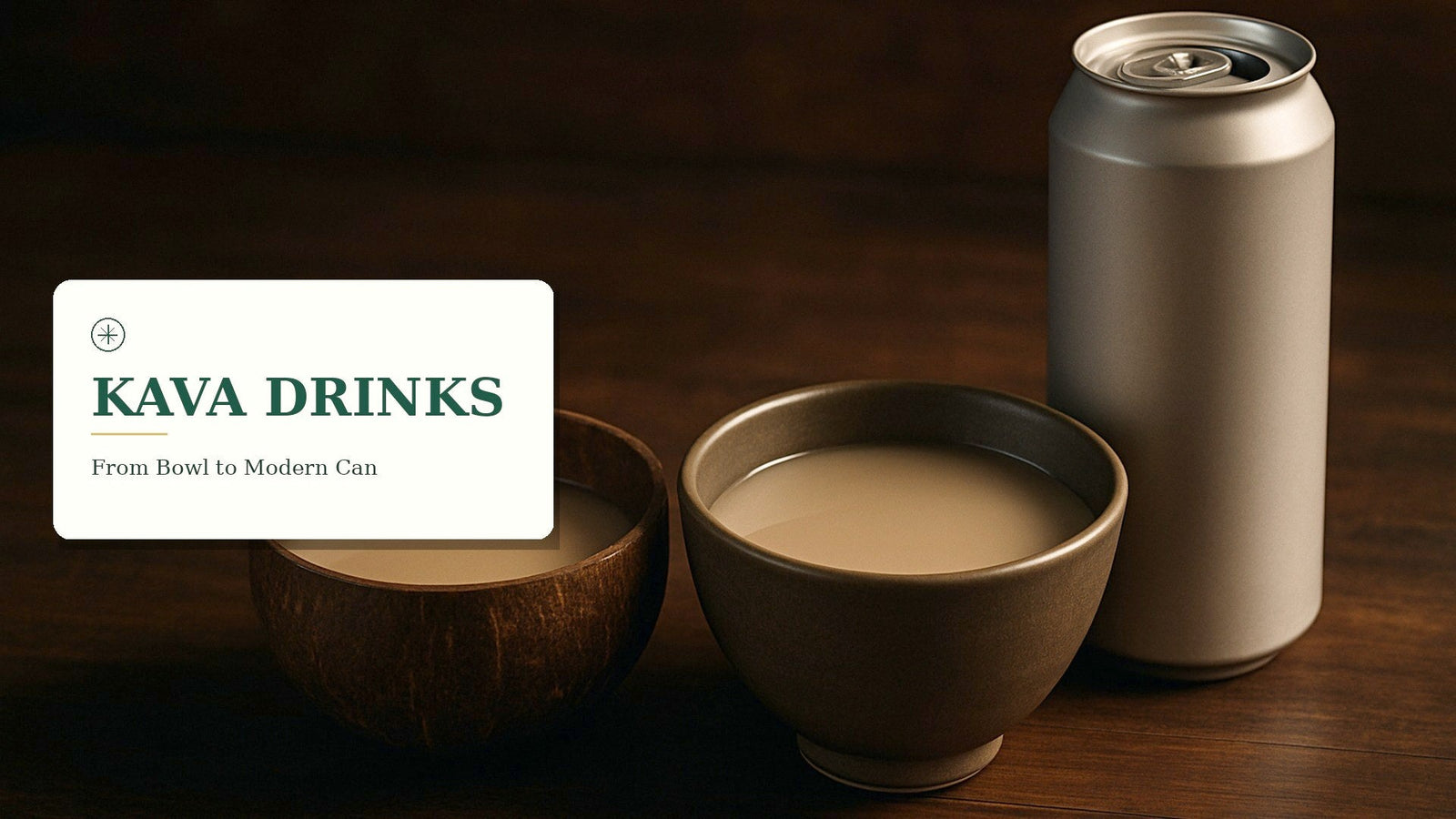
Kava drinks have moved a long way from the woven mats of Vanuatu and Fiji. Today, the same root that Pacific Islanders have ground and steeped for centuries shows up in airy taprooms, vacuum-sealed cans, single-serve powder sachets, and amber dropper bottles. The lineup can feel confusing if you walked in expecting one thing called a kava drink and instead found six.
That sprawl is real, and it is part of what makes kava interesting right now. The plant ("Piper methysticum," meaning "intoxicating pepper") still does what it has always done: deliver a mix of compounds called kavalactones that relax muscles and ease social tension. What changes from one kava drink to the next is the delivery vehicle, the kavalactone yield, the taste profile, and the social setting. The National Center for Complementary and Integrative Health notes that kava beverages have been part of Pacific Island ceremonial life for at least 3,000 years.

This guide walks through every kava drink format you are likely to encounter, from the traditional bowl that started it all to the modern ready-to-drink can on the gas station cooler shelf. We will look at how each one tastes, how each one feels, how much kavalactone you actually get per serving, and how to dose across formats without guessing. By the end, you should be able to walk into any kava bar, any health food store, or any online catalog and know exactly what you are buying.
Table of Contents
- What Counts as a "Kava Drink"
- The Traditional Kava Bowl: Roots, Water, and Pacific Ceremony
- The Modern Kava Bar Pour
- Ready-to-Drink Kava Cans, Bottles, and Seltzers
- Instant Mix and Micronized Powder Drinks
- Extract-Based and Drop-Diluted Kava Drinks
- How Each Format Tastes
- How Each Format Feels: Onset and Kavalactone Delivery
- How to Dose Across Different Kava Drink Formats
- How to Pair Kava Drinks
- Frequently Asked Questions
- Final Thoughts
TL;DR
- "Kava drink" is an umbrella term, not one specific product. It covers anything that delivers kavalactones from the kava root in liquid form, from a traditional bowl pour to a canned seltzer.
- The six common formats are: traditional bowl, kava bar pour, ready-to-drink can or bottle, instant mix sachet, micronized powder drink, and extract-diluted drink.
- All kava drinks share a numbing tongue effect and a peppery, earthy taste. The intensity varies by format and concentration.
- Traditional bowl pours and kava bar shells deliver the highest kavalactone yield per serving. Cans and instant mixes deliver lower, more predictable doses.
- Most adults feel kava within 15 to 30 minutes on an empty stomach. Effects last roughly 1 to 3 hours depending on format and serving size.
- Traditional kava drinks are non-alcoholic, calorie-light, and sober-curious friendly. Many kava bar regulars use them as evening wind-down or social alternatives to beer or wine.
- Dosing is measured in kavalactones (mg), not in ounces of liquid. A typical "shell" or serving runs 50 to 250 mg of kavalactones.
- Kava is generally considered safe for short-term, occasional use in healthy adults, per Memorial Sloan Kettering, but liver concerns mean people on hepatotoxic medications should consult a clinician.

What Counts as a "Kava Drink"
At the simplest level, a kava drink is any beverage that delivers kavalactones, the active compounds in the kava root, in a form you actually drink. That definition sounds almost too broad on purpose: the category really is that wide. A muddy brown ladleful from a coconut shell in a Pacific village counts. A clear, fizzy can with a fruit label on the front counts. A travel sachet you stir into a cup of warm water counts.
What does not count: pure kava extract drops taken sublingually under the tongue (those are a tincture, not a drink, even though they share the same plant). Kava capsules also fall outside the kava drink category, since you swallow them rather than drink them. And kratom shots, which sometimes share shelf space with kava products at convenience stores, are a different plant entirely and should not be confused with kava drinks (see our kratom and kava shot guide for the difference).
So the working definition stays simple: if you sip it, swallow it without chewing, and it has kavalactones from "Piper methysticum" in it, you are drinking a kava drink. Everything else in this guide is about which version of that drink fits which situation.
The Traditional Kava Bowl: Roots, Water, and Pacific Ceremony
The original kava drink is also the simplest one. Take dried kava root, grind it down, mix it with cool water, knead it through a cloth strainer to release the kavalactones, and pour the resulting muddy liquid into a coconut shell or wooden bowl. That preparation, called "nakamal" preparation in Vanuatu or "tanoa" preparation in Fiji and Samoa, has not changed in thousands of years.
The Alcohol and Drug Foundation describes kava as the social and ceremonial drink of choice across Vanuatu, Fiji, Samoa, Tonga, and Hawaii, often poured at weddings, peace negotiations, welcome ceremonies, and evening community gatherings. The drink is shared from a communal bowl, with each person receiving a shell-sized pour, called a "shell" or a "bilo," and drinking it in one go.

The traditional bowl carries the highest kavalactone load of any kava drink format. A single Pacific shell typically delivers 150 to 300 mg of kavalactones, sometimes more depending on the strain and grind quality. The flavor is unmistakable: earthy, peppery, slightly bitter, with a numbing sensation on the tongue and lips that kicks in within seconds.
The Modern Kava Bar Pour
A kava bar takes the traditional preparation and moves it into a Western retail setting. The room usually feels like a coffee shop with low lighting, communal tables, and a chalkboard menu. Behind the counter, a kava bartender follows the same root-and-water recipe, scaled up for service: large batches of micronized or finely ground kava root steeped in cool water and pressed through fine mesh.
What you order is still called a "shell," and the pour size mirrors a Pacific bilo: roughly 4 to 8 fluid ounces, served in a coconut shell or ceramic cup. Most kava bars price each shell at $4 to $8, and many regulars work their way through 2 to 4 shells in an evening visit. Strong-strain shells (sometimes labeled "heavy" or "isa kava") deliver up to 250 mg of kavalactones per pour; mellower "daytime" or "noble" pours land closer to 80 to 150 mg.
The bar setting is where most Americans first encounter a real kava drink. The taste is identical to the traditional bowl: muddy, earthy, peppery, with the signature tongue numb. Kava bars almost always offer chasers (pineapple slices, ginger candy, fruit juice) because the flavor is a learned taste for most newcomers.

Ready-to-Drink Kava Cans, Bottles, and Seltzers
The fastest-growing slice of the kava drink market is the ready-to-drink, or RTD, segment. These are sealed cans, bottles, or seltzers you can buy at a gas station, smoke shop, natural grocer, or online catalog. The format trades the kava bar atmosphere for convenience: shake the can, pop the tab, drink it in 5 minutes, and you are done.
RTD kava drinks blend brewed kava water with carbonation, flavoring (usually tropical fruit), and sometimes other relaxation-leaning botanicals like passionflower, L-theanine, or hemp-derived cannabinoids. The kavalactone load per can typically runs 30 to 150 mg, lower than a traditional bar shell but more predictable batch to batch. Brands like our GÜD Tonics Bundle pair small-batch kava with a kratom extract for a layered effect, which puts them at the higher end of that range.

The flavor profile here is the most beginner-friendly of any kava drink. The earthiness gets dialed back by carbonation and fruit notes, and the tongue numb is usually a soft tingle rather than the full Pacific-bowl experience. If you have never tried kava before and want a low-commitment first taste, a single RTD can is the easiest entry point.
Instant Mix and Micronized Powder Drinks
Instant kava drinks split into two flavors of "just add water." The first is the instant mix sachet: a single-serve packet of micronized or freeze-dried kava root powder that you tip into 4 to 8 ounces of cool water, stir, and drink. The second is the loose micronized powder format, where you scoop a teaspoon-sized portion from a tub or jar into water yourself.
"Micronized" kava root powder is finely milled enough that the entire grind goes into your drink instead of getting strained out, which means you swallow plant fiber along with the kavalactones. This pushes the kavalactone yield higher than RTD cans (typically 100 to 200 mg per serving) but trades the smooth mouthfeel for a thicker, sometimes grittier drink. The FDA's dietary supplement framework classifies most micronized kava products as supplements rather than beverages, which means label claims and ingredient disclosure standards apply.

This format suits people who want kava bar potency without the kava bar drive. Travel-friendly, shelf-stable, and quick to prepare, instant mixes have become a kava staple for hikers, business travelers, and remote workers who want a wind-down drink without leaving home. The taste runs closer to the traditional bowl than to an RTD can: still earthy, still peppery, still tongue-numbing.
Extract-Based and Drop-Diluted Kava Drinks
The most concentrated kava drinks start as liquid extracts, then get diluted into a regular beverage at the point of pour. A typical kava extract delivers 30 to 80 mg of kavalactones per milliliter of fluid, which makes a full dose only a few drops to a quarter-teaspoon. Mix that into water, juice, coconut water, or tea, and you have a custom-built kava drink with whatever flavor base you prefer.
This category overlaps with sublingual kava drops, which deserve their own format breakdown. The key difference: drops taken under the tongue absorb partially through the oral mucosa for faster onset; drops swirled into a beverage behave like any oral kava and hit roughly the same way as a bar shell, just at a smaller volume. Our GÜD Tonics Raw Kava Extract Powder is a dry-powder version of the extract family, suitable for mixing into a custom drink at the strength you want.
Concentrated drinks are the format of choice for kava regulars who want precise dosing and minimal volume. Newcomers tend to skip extracts at first because the small serving size makes it easy to over-pour and end up with a stronger drink than expected. Start with half a dropper, wait the onset window, and add more if needed.

How Each Format Tastes
Every kava drink shares two non-negotiable flavor notes: an earthy, peppery base and a fast-acting tongue numb. Beyond that, the formats sit on a sliding scale of how strongly those notes hit. The traditional bowl and kava bar shell run the strongest: muddy, mineral-heavy, with a sharp tingle that spreads from tongue tip to throat in seconds. Some first-timers compare the mouthfeel to swallowing a teaspoon of root tea sweetened with dirt, which sounds harsher than it actually is.
Instant mixes and micronized powder drinks land in the middle. The earthy notes survive, but the smaller volume and faster preparation soften the experience. RTD cans and bottles sit on the easiest end: carbonation, fruit flavoring, and lower kavalactone loads turn the bowl-shell experience into something closer to a herbal soda with a numbing aftertaste. Extract-based drinks vary wildly depending on the base you mix into; in fruit juice or coconut water, they can taste almost mild, and in plain water they taste like a concentrated bar shell.
How Each Format Feels: Onset and Kavalactone Delivery
The way a kava drink feels depends almost entirely on how much kavalactone you consume and how quickly your body absorbs it. The National Library of Medicine review on kava pharmacology and hepatotoxicity notes that peak kavalactone plasma concentration typically hits 1 to 2 hours after oral consumption, with felt effects starting earlier (15 to 45 minutes) and tapering over 2 to 3 hours.
For a deeper breakdown of how kavalactones actually act on the body and brain, see our what does kava do primer. The short version: kavalactones bind to GABA-A receptors in a manner that resembles a benzodiazepine effect but without the same dependency profile, which produces the muscle-relaxed, socially open, mildly euphoric state most kava drinkers describe.
| Format | Kavalactones per Serving | Typical Onset | Flavor Intensity | Typical Setting |
|---|---|---|---|---|
| Traditional bowl | 150 to 300 mg per shell | 15 to 30 min | Strongest, full earthy | Ceremony, Pacific home |
| Kava bar pour | 80 to 250 mg per shell | 15 to 30 min | Strong, full earthy | Kava bar, retail |
| Ready-to-drink can | 30 to 150 mg per can | 20 to 45 min | Mild, fruit-forward | Gas station, on the go |
| Instant mix sachet | 100 to 200 mg per packet | 20 to 35 min | Moderate, earthy | Travel, home, office |
| Micronized powder drink | 100 to 250 mg per scoop | 20 to 35 min | Moderate to strong | Home preparation |
| Extract-based drink | 50 to 200 mg per pour (variable) | 15 to 30 min | Depends on base liquid | Home, custom mix |
How to Dose Across Different Kava Drink Formats
The cleanest way to dose kava across formats is to think in milligrams of kavalactones, not in ounces of liquid. Most healthy adults feel a mild relaxation effect at 70 to 100 mg, a moderate effect at 100 to 200 mg, and a strong effect at 200 to 300 mg or above. Above 300 mg in a single session, most drinkers describe the "heavy" or sedative end of the spectrum, which is fine if you are home and ready to settle in but inappropriate if you still need to drive or work.

If you are new to kava drinks, the first-session protocol is straightforward. Start with one serving in the 80 to 150 mg range, on a relatively empty stomach, in a setting where you can stay put for 2 to 3 hours. Wait at least 45 minutes before adding a second serving. Most beginners discover their personal "sweet spot" somewhere between 100 and 200 mg total over a 60 to 90 minute window.
A simple kit for your first traditional-style kava drink at home:
- Set out a clean ceramic bowl or coconut shell and a fine-mesh strainer or cheesecloth bag.
- Measure 2 tablespoons of medium-grind kava root powder per cup of cool water.
- Combine root and water in the strainer over the bowl and knead for 8 to 10 minutes until the water turns muddy brown.
- Squeeze the strainer hard at the end to release the last of the kavalactones.
- Pour the strained kava into a small cup and drink in one go on an empty stomach.
- Sit back for 15 to 30 minutes and let the effects build before deciding on a second shell.
How to Pair Kava Drinks
Kava drinks pair well with the right setting more than the right food. A traditional bowl or kava bar shell is best drunk on a near-empty stomach for fastest onset, then followed by a light meal (fruit, rice, fish, light pasta) once the effects have settled in. Heavy or fatty meals slow kavalactone absorption and dull the experience. Avoid pairing kava with alcohol; the two combine in unpredictable ways and load the liver doubly.
Socially, kava drinks shine in the same spaces beer and wine do: small-group conversation, board game nights, unwind hours after work, weekend gatherings where everyone wants to relax without the next-morning fog. Kava's tongue numb is a built-in conversation starter at gatherings where someone has never tried it. Many kava bar regulars cycle kava with water (half-shell, full glass of water, half-shell again) to stay hydrated through an evening.
Frequently Asked Questions
Are kava drinks alcoholic?
No. Kava drinks contain no alcohol. The active compounds are kavalactones, which produce a relaxed, socially open feel through a non-alcoholic pathway. This is why kava bars can serve to all adults regardless of state alcohol licensing rules.
How quickly will I feel a kava drink?
Most healthy adults feel the first wave of effects within 15 to 30 minutes of drinking. Onset is faster on an empty stomach and with stronger-format drinks (traditional bowl, kava bar shell, instant mix). Onset is slower (30 to 45 minutes) with carbonated cans on a full stomach.
Are ready-to-drink kava cans as strong as a bar shell?
Usually not. A typical RTD can delivers 30 to 150 mg of kavalactones; a kava bar shell delivers 80 to 250 mg. To match one bar shell, you would typically need 2 to 3 cans of a standard RTD product, or a single high-kavalactone can paired with a smaller chaser.
What does a kava drink taste like?
Earthy, peppery, slightly bitter, with a numbing tingle that hits the tongue within seconds. The intensity scales with how concentrated the drink is. Traditional bowls and bar shells taste the strongest; RTD cans with fruit flavoring taste the mildest.
Can I drive after a kava drink?
Driving after kava is not recommended, especially after stronger formats. Kava is not legally classified as an impairing substance in most U.S. states, but the muscle-relaxed, mildly sedated feel can affect reaction time. Plan to stay put until the felt effects have cleared, usually 2 to 3 hours after a single serving.
How is a kava drink different from a kava shot?
A kava drink is a beverage-volume serving (4 to 12 ounces typically) meant to be sipped or drunk in one or two passes. A kava shot is a concentrated 1 to 2 ounce serving, often combined with kratom or other botanicals, designed for fast onset.
Is it safe to drink kava every day?
Most clinical guidance suggests using kava for short-term, occasional relaxation rather than as a daily habit. Long-term daily kava use has been associated with rare liver concerns and a skin condition called kava dermopathy. Cycle your use, take days off, and check in with a clinician if you are on prescription medications.

Final Thoughts
Kava drinks are one of the rare wellness categories where the original 3,000-year-old version of the product still outperforms most of the modern remixes on potency. The traditional bowl and the kava bar shell remain the gold standard for full-bodied kava experience; cans, instant mixes, and extract drinks all trade some of that intensity for convenience, flavor, or precision.
Where you fit on that tradeoff depends on what you are looking for. If you want the cultural arc of the drink, the social ritual, and the strongest possible effect, find a kava bar in your city and order a shell. If you want a portable, predictable wind-down for after work or before bed, an RTD can or an instant mix will get you there.

For drinkers who want to experiment with format and flavor in one purchase, our GÜD Tonics Bundle packages three RTD kava drinks in a single bundle so you can taste-test across flavor profiles before committing to a case. Whatever direction you take, the same advice applies to every kava drink format: start low, give it time, and respect the plant that has been quietly running Pacific Island evenings for thousands of years.
If the felt experience of kava is what brought you here, the next read in our kava library is the deeper pharmacology primer linked above. From there, the rest of the kava-facts collection covers strain-by-strain effects, side effects, drug interactions, and a handful of dosing protocols you can apply to whichever kava drink you end up reaching for.


