



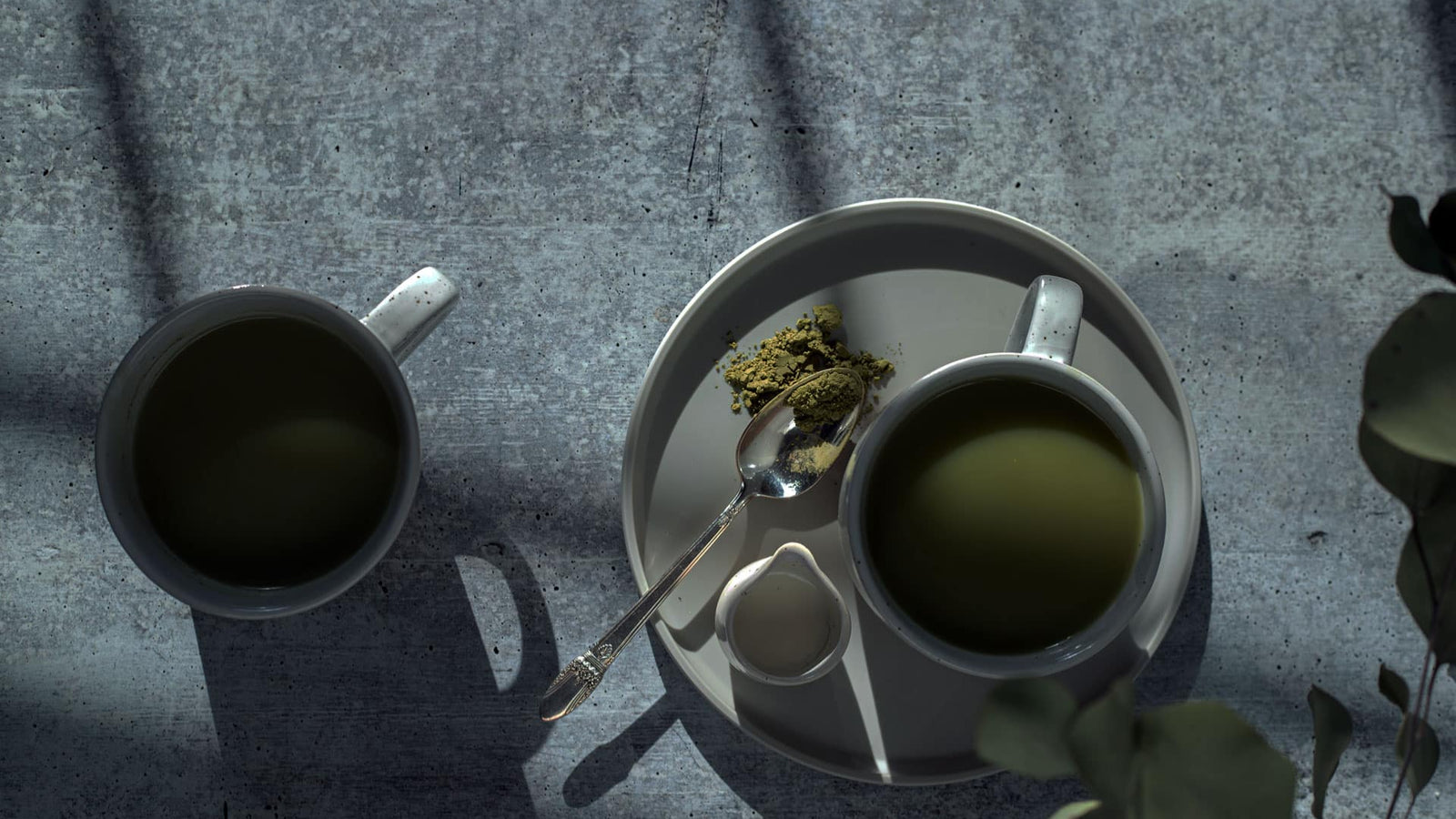
The first time most people try kratom, they grab a spoonful of powder, mix it into a glass of water, and grimace through the toss-and-wash. It works, but it's not the experience the leaf is built for. Kratom tea is. Brewed properly, it's smoother, faster-acting, easier on the stomach, and significantly more pleasant than choking down dry powder.
This guide walks through the complete kratom tea process: the basic recipe, the science behind why brewing matters, the variations worth knowing, and the small mistakes that keep most home brewers from getting consistent results. With nearly 20 million Americans now using kratom regularly, tea has quietly become the format that long-term users settle on once they're ready to take the leaf seriously.

Table of Contents
- The Basic Kratom Tea Recipe
- Why Brewing Beats Toss-and-Wash
- The Science Behind a Good Brew
- Equipment You Actually Need
- Step-by-Step Method
- Five Kratom Tea Variations
- Common Mistakes That Ruin a Brew
- Storage and Make-Ahead Tips
- Frequently Asked Questions
- Final Thoughts
TL;DR
- Kratom tea is the most reliable way to take kratom: smoother taste, faster onset, gentler on the stomach.
- The basic recipe is 2 to 5 grams of kratom powder simmered in 12 oz of water with a tablespoon of lemon juice for 15 to 20 minutes.
- Lemon juice or any acid extracts more alkaloids by lowering the pH, which is why traditional kratom tea recipes always include citrus.
- Never boil kratom hard; degradation of mitragynine accelerates above 200 degrees Fahrenheit. A simmer is the target.
- Strain through cheesecloth or a fine mesh strainer. Drink warm or chill it for an iced version.
- A large-batch brew (1 liter at a time) refrigerates for up to 5 days and stretches the leaf further per gram.
- Pair with honey, ginger, or chamomile to soften the bitter notes.
- The right strain matters: red veins for relax-leaning teas, green for daytime, white for energy.

The Basic Kratom Tea Recipe
Here's the recipe most experienced kratom users converge on. It's simple, repeatable, and delivers a clean experience the first time.
Ingredients:
- 2 to 5 grams kratom powder (start at 2g if you're new)
- 12 oz (350 mL) filtered water
- 1 tablespoon fresh lemon juice (or any acid: lime, apple cider vinegar)
- Optional: 1 teaspoon honey or maple syrup, sliced ginger, fresh mint
Method:
- Bring the water to a near-boil, then reduce heat to a gentle simmer
- Whisk in the kratom powder and lemon juice
- Simmer (do not boil) for 15 to 20 minutes, stirring occasionally
- Strain through cheesecloth, a fine mesh strainer, or a paper coffee filter
- Add honey or sweetener to taste, drink warm or pour over ice
Yield: 1 cup, 1 dose, ready in about 25 minutes total.
That's the foundation. Everything else in this guide is variation, optimization, or troubleshooting.

Why Brewing Beats Toss-and-Wash
Toss-and-wash works. It's fast, it requires zero equipment, and it gets the kratom into your system. So why bother brewing?
Three reasons.
Onset and absorption. Brewing extracts the alkaloids into solution, which means they're already dissolved when they hit your stomach. Toss-and-wash relies on your digestive system to do that extraction itself, which takes longer and is less complete. A 2020 review of kratom pharmacokinetics in PMC documents how mitragynine bioavailability shifts with preparation method, with brewed forms generally producing more consistent plasma levels.
Stomach comfort. Dry kratom powder is hard on the GI tract. The cellulose in the leaf doesn't digest, so toss-and-wash users often report nausea, especially at higher doses. Tea sidesteps this entirely because the cellulose stays in the strainer.
Taste and routine. This sounds minor but it's not. People who toss-and-wash often start skipping doses or dropping kratom because they hate the experience. People who brew tea integrate it into their evening or morning routine and stick with it for years.
The cost is 25 minutes of prep time once or twice a week (if you batch brew). The return is a more reliable, gentler, sustainable experience.
The Science Behind a Good Brew
Three things drive the quality of a kratom tea brew: temperature, time, and pH.
Temperature. Mitragynine, the primary active alkaloid in kratom, starts to degrade above 200 degrees Fahrenheit. Hard boiling for an extended time can reduce the potency of your finished tea by 20 to 30%. The fix is simple: bring water to a near-boil to dissolve and disperse the powder, then drop heat to a gentle simmer (around 190 F). The University of Mississippi's National Center for Natural Products Research has published extensive characterization of mitragynine thermal stability which is the foundation for the "simmer, don't boil" rule.
Time. A 15 to 20 minute simmer extracts roughly 80 to 90% of the available alkaloids. Going past 30 minutes adds little extraction but risks degradation. Going under 10 minutes leaves alkaloids locked in the leaf material that ends up in your strainer. The sweet spot for a single brew is 15 to 20 minutes; for a strong concentrated brew, 25 minutes max.
pH (the lemon juice trick). Mitragynine is more soluble in slightly acidic water. Adding 1 tablespoon of lemon juice (or any acid) per 12 oz of water lowers the pH enough to meaningfully improve extraction. Traditional Southeast Asian kratom tea recipes always include citrus for this reason. Without acid, you're leaving 15 to 25% of the alkaloid content on the table.

Equipment You Actually Need
Don't over-buy. Here's the minimum kit that produces consistently good kratom tea:
| Item | Purpose | Estimated Cost |
|---|---|---|
| Small saucepan (1 to 2 quart) | Brewing | $15-30 |
| Digital kitchen scale (0.1g precision) | Dose accuracy | $15-25 |
| Fine mesh strainer or cheesecloth | Filtering | $5-15 |
| Whisk | Powder dispersal | $5-10 |
| Glass measuring cup | Water measurement | $5-10 |
| Mason jar (32 oz) | Batch storage | $3-5 |
That's it. You probably already own most of this. The two non-negotiables are the digital scale (eyeballing kratom doses leads to inconsistent experiences) and the strainer (residue is the #1 reason people quit kratom tea).
Step-by-Step Method
Here's the long-form version of the basic recipe with all the small details that separate a mediocre brew from a great one.
Step 1: Measure your dose. Use a digital scale, not a measuring spoon. Powder density varies between strains, so volumetric measurements drift. 3 grams is a typical mid-range starting dose. New users should start at 2 grams. Tolerance varies; for a more thorough breakdown, see our kratom dosage guide.
Step 2: Heat the water. Bring 12 oz of filtered water to a near-boil in a small saucepan. Hard tap water can affect taste; if your tap water tastes bad, your tea will too.
Step 3: Add the acid. Once you see the first wisps of steam, drop the heat to medium-low and add 1 tablespoon of lemon juice. Stir.
Step 4: Add the kratom. Whisk the powder into the water vigorously. The goal is full dispersal, no clumps. Lower clumping = better extraction.
Step 5: Simmer. Maintain a gentle simmer (small bubbles, not a rolling boil) for 15 to 20 minutes. Stir every 5 minutes to prevent settling. Cover loosely with a lid to retain volatile compounds and reduce evaporation.
Step 6: Strain. Pour through a fine mesh strainer or cheesecloth into a mug. Press the leaf material with the back of a spoon to extract the last of the liquid. Discard the spent leaf.
Step 7: Sweeten and serve. Add 1 teaspoon of honey or maple syrup if you want. The sweetness softens the bitterness without changing the alkaloid profile. Drink warm, or chill in the fridge for an iced version.
The whole process takes about 25 minutes from cold start to cup-in-hand. After your second or third brew it becomes muscle memory.

Five Kratom Tea Variations
Once you have the basic recipe down, these variations cover most of the ways experienced kratom users adapt the brew to their preferences.
1. Iced Citrus Kratom Tea (Summer Pick)
Brew the basic recipe with 8 oz of water instead of 12. Strain into a mason jar with 4 oz of ice and a generous squeeze of lemon and lime. Add 1 teaspoon of honey or agave. Stir, drink cold. This is the variant most users gravitate toward in summer; the cold dampens bitterness significantly.
2. Honey-Ginger Kratom Tea (Wind-Down Version)
Add 1 inch of fresh ginger (sliced thin) and 1 tablespoon of honey to the basic recipe. Simmer with the kratom for the full 15 to 20 minutes. The ginger adds warmth and complements red vein strains particularly well for evening use. Pairs nicely with Red Maeng Da Kratom Powder for a relaxation-leaning brew.

3. Chamomile-Kratom Bedtime Blend
Add 1 chamomile tea bag (or 1 tablespoon dried chamomile flowers) to the saucepan with the kratom. The chamomile mellows the bitterness and the combined effect is more relaxing than kratom alone. Use red vein strains for the strongest wind-down profile.
4. Large-Batch Refrigerator Brew
Scale the recipe to 32 oz of water, 8 to 12 grams of kratom, and 3 tablespoons of lemon juice. Simmer for 25 minutes. Strain into a mason jar and refrigerate. Yield: 4 servings of cold-brew kratom tea, ready to drink straight from the fridge. Keeps for 5 days. This is the highest-leverage recipe for daily users; it cuts prep time per dose from 25 minutes down to 30 seconds.
5. Spiced Kratom Chai
Add 1 cinnamon stick, 3 cardamom pods, 2 cloves, and a slice of fresh ginger to the brew. Simmer for the full 20 minutes. Strain, add 2 oz of warm milk (dairy or oat), and 1 teaspoon of honey. The spices mask the bitterness almost completely and the milk softens the body load. Best with green vein strains for a balanced afternoon mood.

Common Mistakes That Ruin a Brew
The mistakes that show up across kratom tea forums are repetitive and easily avoidable.
Boiling instead of simmering. This is the single most common mistake. Hard boiling degrades mitragynine and produces a weaker, more bitter tea. If you see a rolling boil, your heat is too high. Drop it to medium-low.
Skipping the lemon juice. Without acid, you extract 15 to 25% less alkaloid content from the same dose of leaf. Always add citrus.
Not straining well. Floating leaf particles in your finished tea cause the same nausea and stomach discomfort as toss-and-wash. Strain twice if needed; cheesecloth folded double works well.
Eyeballing the dose. Spoon-measured kratom drifts wildly batch over batch. Use a digital scale.
Skipping non-use days. Tea is so easy to integrate into a daily routine that tolerance creeps faster than people realize. Take 2 non-use days a week to keep the brew working at the same dose.
Stacking with alcohol. Don't. The combination is unpredictable, especially when you've made it pleasant to drink. For more on this, see our kratom and alcohol guide.
Forgetting hydration. Kratom tea is hydrating in the cup, but the daily diuretic effect of kratom still applies. Add a glass of water alongside each cup.

Storage and Make-Ahead Tips
Brewed kratom tea stores well, which is the main reason batch brewing makes sense for daily users.
Refrigerator storage: 5 days in a sealed mason jar. The flavor stays consistent for the first 3 days; days 4 and 5 develop a slightly more bitter edge. Alkaloid content stays stable for the full 5 days.
Freezer storage: Up to 3 months if you freeze the strained tea in ice cube trays. Each cube is roughly 1 oz, so you can dose precisely by adding cubes to hot water. Recent shelf-life testing summarized in Frontiers in Pharmacology's 2025 review on kratom preparation methods suggests that frozen aqueous extracts retain mitragynine activity well past the 90-day mark.
Room-temperature storage: Don't. Kratom tea is an aqueous extract; bacterial growth is a concern past 24 hours unprotected.
Reheating: Microwave gently or warm in a saucepan over low heat. Do not bring it back to a boil; the simmer rule still applies.
For users who travel and want their brew ready, freezing portions is the most reliable approach. A small thermos plus a frozen kratom tea cube produces a fresh-tasting brew once thawed.

Frequently Asked Questions
How much kratom should I use per cup of tea?
For most adults, 2 to 5 grams of kratom powder per 12 oz cup. New users should start at 2g. Daily users typically settle in the 3 to 4g range. Above 5g per cup, the bitterness becomes hard to mask.
Can I make kratom tea without lemon juice?
Yes, but you'll extract less. Any acid works: lime juice, apple cider vinegar, or even orange juice. The pH shift is what matters, not the citrus flavor specifically.
Does kratom tea taste bad?
It's bitter and earthy. Most users describe it as similar to very strong green tea with a hint of grass. Honey, ginger, and the variations above mask the bitterness considerably. The chai version is the most palatable for new drinkers.
How long does kratom tea take to kick in?
Onset is typically 15 to 30 minutes, faster than toss-and-wash because the alkaloids are already in solution. Peak effects hit around 60 to 90 minutes and last 3 to 5 hours depending on strain and dose.
Can I drink kratom tea every day?
Yes, with two caveats: take two non-use days a week to manage tolerance, and stay hydrated since kratom has a mild diuretic effect. Our guide on whether kratom dehydrates you walks through the hydration math.
What's the best kratom strain for tea?
It depends on your goal. Red veins (Red Maeng Da, Red Bali) make the most relaxing teas. Green veins (Green Maeng Da, Super Green) make balanced daytime teas. White veins lean energy-forward and brew well for morning routines. The American Kratom Association's GMP program lists vetted vendors that publish per-strain alkaloid content.
Can I reuse the strained leaf?
Once. A second simmer at 20 minutes extracts maybe 30 to 40% of the remaining alkaloids. After that, the leaf is spent. Most users skip the second brew because the yield-to-effort ratio drops significantly.
Is kratom tea legal everywhere in the US?
Kratom is legal at the federal level and in most US states. A small number of states have restrictions. If you're traveling or relocating, check the destination state's status before brewing or transporting.

Final Thoughts
Kratom tea is the format that long-term users settle on once they're ready to take the leaf seriously. It's gentler, more reliable, more pleasant, and significantly more sustainable as a daily routine than toss-and-wash. The 25 minutes of brewing is a feature, not a bug; it builds the routine into something you actually look forward to.
The fundamentals stay the same regardless of which variation you settle on:
- Simmer, don't boil
- Always include an acid (lemon juice is fine)
- Use a scale for dose precision
- Strain twice if needed
- Batch brew if you're a daily user
- Take non-use days
- Hydrate alongside
If you want to start with a strain that brews exceptionally well into tea, our team at GRH Kratom keeps lab-tested leaf across all standard vein colors. The Joy Blend Kratom Powder makes a warm, mood-leaning afternoon brew that's the most-recommended starter for new tea drinkers. For an evening wind-down version, Red Maeng Da Kratom Powder pairs especially well with the honey-ginger variation. And if you'd rather skip the brewing entirely on busy days, our Joy Blend Kratom Capsules deliver the same blend in a pre-measured format.
Brew slow, dose smart, hydrate well. The right cup of kratom tea is one of the cleanest experiences you can have with the leaf.


