



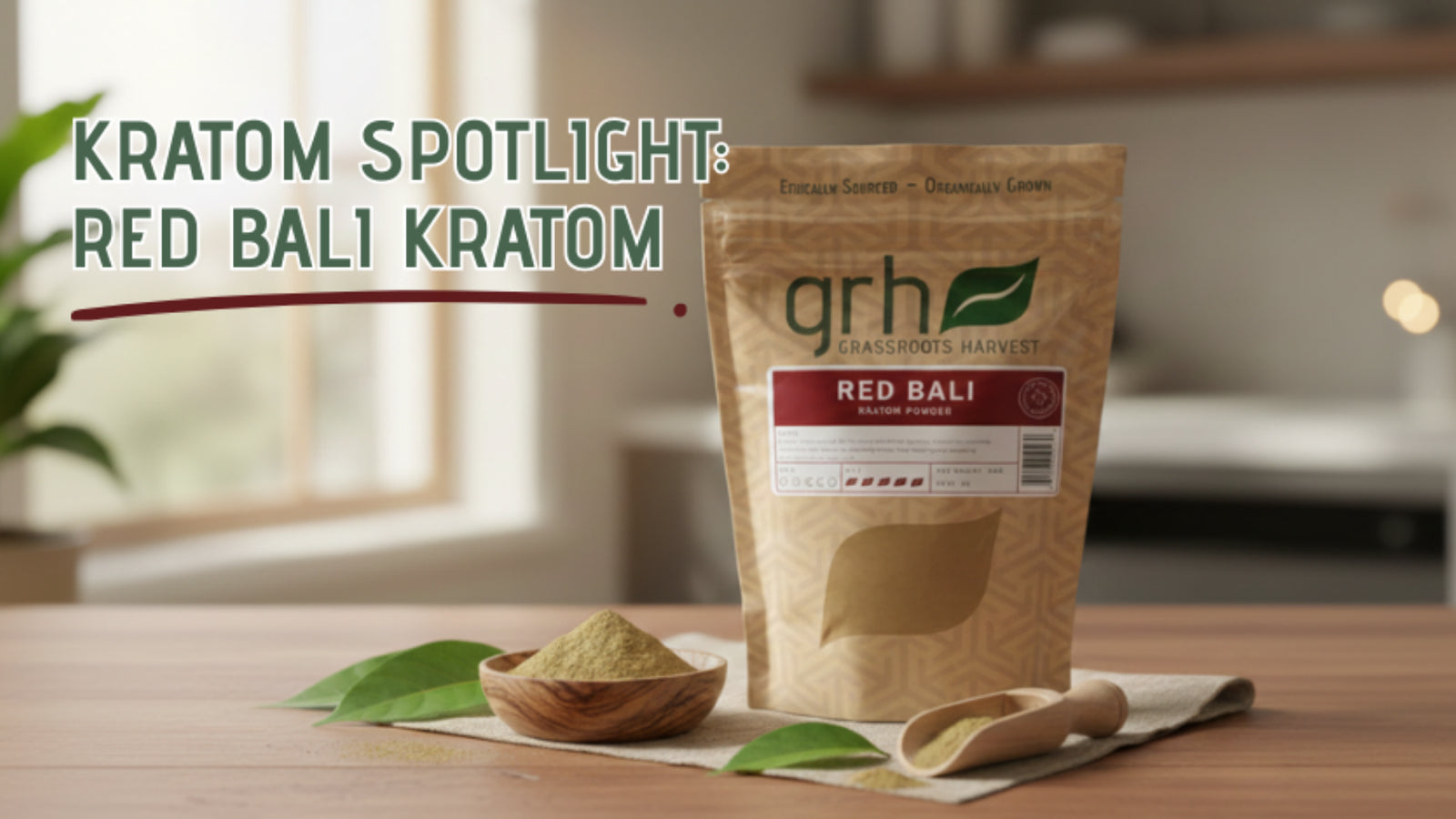
Red Bali kratom is the strain people reach for when the day needs to end softer. Of every red vein in the Bali / Borneo region, this one earns the most "evening" labels, the most "wind down" reviews, and the most "I sleep better on it" reports. The reason is the leaf chemistry, not the marketing.
Red Bali leaves get more days drying in indirect sun than greens or whites, which oxidizes a portion of the mitragynine in the leaf into 7-hydroxymitragynine and a handful of related alkaloids. A 2020 peer-reviewed analysis in Frontiers in Pharmacology mapped how leaf maturity and post-harvest processing shape the mitragynine-to-7-OH ratio, which is the chemistry behind the calmer, more sedating effect category of red veins. That oxidation curve is what turns a stimulating tropical tree into a sedating powder. The American Kratom Association estimates more than 15 million Americans use kratom regularly, and red veins are consistently the top category inside that group.
This 2026 listicle walks through 18 specific Red Bali kratom effects across cognitive, mood, physical, sedation, dose-dependent, and side-effect categories, plus a comparison against Red Maeng Da and Red Borneo so you know which red lane you're actually picking.

Table of Contents
- Cognitive Effects of Red Bali Kratom
- Physical Effects on the Body
- Mood Effects
- Sedation and Wind-Down Effects
- Dose-Dependent Effects (Low, Mid, High)
- Side Effects to Know
- Red Bali vs. Red Maeng Da vs. Red Borneo
- First-Time Red Bali Starter Protocol
- Frequently Asked Questions
- Final Thoughts
TL;DR
- Red Bali kratom effects lean evening, slow, and body-heavy thanks to higher 7-hydroxymitragynine concentration in mature red-vein leaves.
- Cognitive effects show up as quieter mental chatter and easier disengagement from work, not a stimulant push.
- Physical effects center on muscle release, joint relief, and a warm body-heaviness most users feel within 35 to 50 minutes.
- Mood effects are a settled calm with a soft lift around the edges, not euphoria.
- Sedation kicks in harder above 4 grams, so dosing is what determines whether you stay productive or get a nap.
- Low (1 to 2 g), mid (2 to 4 g), and high (4 to 6+ g) doses each produce a distinct profile, with mid being the daily sweet spot.
- Side effects to know: nausea on an empty stomach, mild constipation on daily use, and morning grogginess from late high doses.
- Among reds, Red Bali sits between Red Maeng Da (more potent, more analgesic) and Red Borneo (similar calm, milder body load).

Cognitive Effects of Red Bali Kratom
Cognitive shifts on Red Bali are the quietest part of the experience, but they are the first thing most users feel. You don't get sharper. You get less noisy. The mental running commentary slows down, which sounds small until you've had it happen on a Tuesday after a long meeting block.

1. Mental Slowdown Without Brain Fog
Around 30 to 50 minutes after a 2 to 3 gram serving, the internal mental tempo drops. Sentences in your head finish before the next one starts. Thoughts feel less stacked. Importantly, this is not the muddled fog of an antihistamine or a glass of wine on top of poor sleep, since Red Bali doesn't blunt working memory in the same way. You can still hold a phone call. You just don't feel pushed to start one.
2. Easier Decision Fatigue at End of Day
End-of-day choices (what to eat, what to watch, which laundry to fold) get easier on Red Bali. The bottleneck on tired evenings isn't usually energy, it's the weight of small decisions piling up. Red Bali's mitragynine-driven mu-opioid receptor partial agonism takes the urgency off those choices. NIDA describes mitragynine and 7-hydroxymitragynine binding at opioid receptors as the mechanism behind kratom's sedating and calming effects at higher doses.
3. Background Anxiety Quiets Down
If you live with a persistent low-grade hum of work anxiety, Red Bali tends to drop the volume on that hum without removing your ability to think about it. The 2 to 3 gram range is where most users notice the shift first. This is one of the most reported reasons people pick Red Bali over a faster red like Red Maeng Da, which can feel more clinical and less of a "soft landing" strain.
Physical Effects on the Body
Physical effects are where Red Bali earns the "body strain" label. The leaf's red-vein alkaloid mix produces a warmth and weight that show up from the shoulders down and stay there for two to four hours.
4. Muscle Relaxation From the Shoulders Down
The first physical signature of Red Bali is a shoulder drop. Trapezius tension you didn't realize you were holding releases first, usually within 40 minutes. Lower back and hip flexors follow. People who train hard or sit at a desk for eight hours describe this as the "I finally exhaled" feeling. It's the most consistent effect across users, and it shows up at doses as low as 1.5 grams.
5. Joint and Back Discomfort Softens
Mid-range doses (2 to 4 g) take the sharp edge off chronic joint and lower-back discomfort for most users. Red Bali isn't a pharmaceutical analgesic and shouldn't be used as one, but the partial mu-opioid receptor agonism produces a mild antinociceptive effect that pairs well with rest. A 2020 PMC review notes that red-vein kratom preparations are the strain category most often cited for pain self-management in survey research.
6. Body Warmth and a Pleasant Heaviness
Roughly 45 minutes after dose, a low warmth spreads through the torso and arms. Not flushed-skin warmth. More like the sensation of a heated blanket. Some users feel a heaviness in the limbs that makes movement deliberate instead of effortful. It pairs well with stillness. It does not pair well with cardio.
7. Slowed Breath and Lower Resting Tension
Resting respiration slows by a few breaths per minute on a mid-range dose, and resting muscle tension drops alongside it. This is part of why Red Bali pairs well with low-stimulation activities (reading, slow stretching, a film) and badly with anything requiring sustained physical output. Driving on Red Bali is a bad idea at any dose above the low range; the FDA reminds users that kratom can cause sedation and impair driving.

Mood Effects
Mood effects on Red Bali are subtle. There's no "lift" the way users describe White Maeng Da, and no "warmth" the way greens are sometimes pitched. What you get is a settled baseline. The mood floor rises by a small amount and stays there for a few hours.
8. A Settled Calm, Not a Buzz
The hallmark Red Bali mood signature is a calm that doesn't announce itself. You notice it about 20 minutes after the body effects start, usually as a sense that the small things bothering you an hour ago aren't pulling at your attention anymore. Most users describe this as feeling "more like myself, but at the end of a good day."
9. Slight Mood Lift Around the Edges
Around the 90-minute mark on a 2 to 3 gram dose, some users notice a small uplift, a soft positive mood drift. It's nothing like a stimulant or a euphoriant. The effect is closer to the warmth you feel after a hot shower at the end of a long day. It does not last past the four-hour window. You won't be talkative at a dinner party because of it.
10. Easier Patience With Small Annoyances
Patience returns. Slow checkout lines, repeating yourself to family, traffic going home, all of those friction points lose their grip. This is the most "useful" mood effect for daily users and the reason Red Bali shows up so often in evening rotations for parents and people who manage teams.
Sedation and Wind-Down Effects
Sedation is the dose-dependent character of Red Bali. Below 3 grams, it's calming. Above 4 grams, it's actively sleepy. Picking the right level is the difference between a productive evening and an unscheduled nap.

11. Drift Toward Sleep on Higher Doses
Above 4 grams, Red Bali produces a steady drift toward sleep that's hard to resist if you're already tired. The drift is gentle, not a knockout. Most users on this dose are asleep within 90 minutes if they're horizontal. People using Red Bali specifically for sleep usually take it about 60 to 75 minutes before bed.
12. Less Restless Lying in Bed
The "tossing and turning" pattern many users describe before falling asleep tends to soften on Red Bali. The reduction in resting muscle tension (effect #7 above) carries into the bed. Restless legs feel less restless. Mid-range doses (2.5 to 3.5 g) work for this if you don't want the heavier sedation of a 4+ gram dose.
13. Smoother Transition From Awake to Drowsy
The handoff from alert to sleepy is gradual on Red Bali, not abrupt. You don't crash. You drift. Users who hate the "fall off a cliff" sensation of strong sleep aids often prefer this softer slope. It also makes Red Bali a poor fit for anyone who needs to drive 45 minutes after taking it; you'll get sleepier as the dose develops, not less.
Dose-Dependent Effects (Low, Mid, High)
Dose is the single biggest variable in Red Bali effects, more than batch or vendor. The same 4-gram dose that puts one user to sleep at 9 pm will produce a relaxed evening of reading for someone with built-up tolerance. Effects #14 to #16 describe the three dose tiers most users land in.

14. Low Dose (1 to 2 g): Quiet Focus and Soft Calm
At 1 to 2 grams, Red Bali produces a noticeable calm without much sedation. Cognitive function stays intact, mild muscle relaxation arrives, and the mood floor rises a touch. This is the dose range for daytime calm during an unusually stressful week, not for sleep. Onset is 25 to 35 minutes, total duration around 3 hours.
15. Mid Dose (2 to 4 g): The Daily Sweet Spot
The 2 to 4 gram range is where most experienced Red Bali users live. You get the full body-heaviness, the calm cognitive slowdown, the muscle release, and a moderate mood lift. Sedation is present but manageable. Duration is 4 to 5 hours. This is also where most kratom-evaluating researchers focus their dose-response data, since the side-effect profile remains low while subjective effects are reliable.
16. High Dose (4 to 6+ g): Heavy Sedation
Above 4 grams, Red Bali tilts sharply toward sleep. Body heaviness becomes hard to push through. Nausea risk rises. Duration extends to 5 or 6 hours. Daily high-dose use is also where tolerance builds fastest, and rotating with another strain (or a Relax Blend) is the simplest way to avoid that creep.

Side Effects to Know
Red Bali's side-effect profile is mild compared to most reds, but two issues come up reliably and a third shows up if you take it too late at night. None are unusual within the kratom category, but knowing the pattern helps you avoid them.

17. Nausea on an Empty Stomach
Roughly 1 in 5 first-time Red Bali users report mild nausea when they dose on a completely empty stomach. Toast and tea solves it almost every time. Capsule format softens it further compared to toss-and-wash powder, since the powder hits the gut faster. Stay below 3 grams on the first attempt to keep this risk near zero.
18. Constipation and Day-After Grogginess on Heavy Use
Daily Red Bali use, especially in the 3 to 5 gram range every night, tends to slow gut motility (a common red-vein side effect). Hydration, fiber, and a 2-night-per-week off-pattern keeps it manageable. The other heavy-use issue is morning grogginess if your evening dose lands within four hours of bedtime, since the longer half-life of 7-hydroxymitragynine can carry over.
Red Bali vs. Red Maeng Da vs. Red Borneo
Red Bali, Red Maeng Da, and Red Borneo are the three reds most users compare. The differences are real, not marketing, and they line up with the alkaloid lean of each strain. If you've read our Red Maeng Da Kratom Effects Guide, you already know Red Maeng Da pushes harder and faster than Red Bali. Red Borneo sits closer to Red Bali but with a lighter body load.
| Strain | Alkaloid Lean | Typical Effect | Dose Range | Best For |
|---|---|---|---|---|
| Red Bali | Balanced mitragynine, moderate 7-OH | Calm, heavy body, mild mood lift | 2 to 4 g | Evening wind-down, sleep onset |
| Red Maeng Da | Higher mitragynine, higher 7-OH | Faster onset, stronger relief, more potent | 2 to 3.5 g | Discomfort relief, intense end-of-day |
| Red Borneo | Lower 7-OH, smoother mitragynine | Quiet calm, less body weight | 2.5 to 4 g | Daytime calm, anxiety blunting |
The practical pick: if your goal is sleep onset or full evening shutdown, Red Bali is the default. If your goal is heavier discomfort relief or you've built tolerance, swap to Red Maeng Da. If you want calm without the heavy body load, Red Borneo is your strain. For a broader red-vein primer, see our Red Vein Kratom Benefits guide, which covers the biology of how red-vein leaves develop their alkaloid profile during drying.
First-Time Red Bali Starter Protocol
If this is your first run with Red Bali, the protocol below keeps the experience predictable and the side-effect risk low. It maps to the standard kratom dose-response curve described across red, green, and white strain profiles.
- Eat a small carb-and-protein snack first. Toast with peanut butter, a small bowl of rice, or a banana with yogurt. Empty-stomach nausea drops by roughly half.
- Start at 2 grams. Lower if you're under 130 lb or sensitive to other supplements. Higher (3 g) only if you've already used another red strain comfortably.
- Wait 60 minutes before re-dosing. Onset is 30 to 50 minutes. Re-dosing before 60 means stacking, which is how most overdoses of side effects (not of toxicity) happen.
- If you need more, add 0.5 to 1 gram. Never jump straight from 2 to 4 on the first night. Tolerance builds over weeks, not hours.
- Don't drive afterward. Plan the dose for an evening when you're staying in.
- Hydrate. 16 oz water with the dose and another 16 oz over the next two hours. Kratom is gently dehydrating at every dose.
- Log what you took and when. A simple note in your phone (gram amount, time, food, results) sets you up to refine the dose over the next two or three sessions.

Frequently Asked Questions
How long do Red Bali kratom effects last?
Most users feel the full Red Bali profile for 3 to 5 hours, with peak effects between 60 and 150 minutes after dose. Higher doses (4+ g) extend duration to 5 to 6 hours, sometimes with residual drowsiness the next morning if taken close to bedtime.
How long does it take Red Bali to kick in?
Onset is typically 30 to 50 minutes on an empty stomach and 45 to 75 minutes after food. Capsules add another 15 minutes versus powder because of dissolution time. If you haven't felt anything by 90 minutes, your dose was likely too low or the batch was weak.
Is Red Bali stronger than Red Maeng Da?
No. Red Maeng Da is the more potent of the two on a gram-for-gram basis. Red Bali leans calmer and heavier on the body, while Red Maeng Da hits faster and harder. If you've built tolerance on Red Bali and stopped feeling effects below 4 grams, Red Maeng Da is the usual next step.
Can Red Bali help with sleep?
Yes, at mid to higher doses (3 to 5 g) taken 60 to 75 minutes before bed. Red Bali's sedation curve makes it one of the most-cited red veins for sleep onset. It's not an FDA-approved sleep aid and shouldn't replace one if you've been prescribed something.
What dose of Red Bali is too much?
For most adults, doses above 6 grams in a single session put you well into heavy-sedation territory with rising nausea risk. Above 8 grams is where most adverse reports cluster. Stay under 6 g per session and under 12 g across a full day if you're using it more than once.
Does Red Bali cause withdrawal?
Daily high-dose use over many weeks can produce mild physical dependence and dose-tapering symptoms, similar to other red-vein strains. Two-night-per-week rest days and capping daily totals below 8 g keeps risk low for most users.
Is Red Bali safe to mix with alcohol?
No. Mixing Red Bali (or any kratom) with alcohol amplifies sedation and respiratory slowdown, and is consistently flagged in adverse-event data. Skip alcohol on Red Bali days, especially at mid to high doses.
What's the difference between Red Bali powder and capsules?
The alkaloid profile is the same. The differences are onset (powder hits 15 minutes faster), gut comfort (capsules are gentler on an empty stomach), and dose flexibility (powder lets you tune in 0.25-gram increments). Daily users tend to settle on capsules for convenience and powder for fine-tuning.
How should I store Red Bali kratom?
Sealed container, dark cupboard, room temperature. Heat and humidity degrade the alkaloid profile within a few months. A vacuum-sealed bag inside a tin lasts up to a year. Avoid windowsills, glove compartments, and the top of a refrigerator (warmer than you'd think).
Final Thoughts
Red Bali is the red-vein strain you reach for when the day is finished and you want it to stay finished. The effects line up with that intent: cognitive slowdown without fog, muscle release from the shoulders down, a settled mood floor, and a sedation curve that's gentle below 3 grams and serious above 4. It's not the strongest red. That's Red Maeng Da. It's not the calmest. That's Red Borneo. It's the most evenly weighted of the three, which is why it stays in so many evening rotations.
If you're stepping into Red Bali for the first time, our Red Maeng Da Kratom Powder is the closest red-vein analog currently in stock at GRH (Red Bali rotates seasonally), and most first-time-red users find the same dose curve applies. For a softer blended pull-back, our Relax Blend Kratom Powder mixes red and green vein in a single jar and is the closest "evening default" to Red Bali we stock year-round.

The strain rewards a small dose well first. Two grams, food in the stomach, an evening you don't need to drive through. From there you can tune up by half-gram increments over a few sessions until you hit the dose that feels right for your body, your tolerance, and the kind of evening you want.
For long-term users, the most important rule is rotation. Switching between Red Bali, Red Maeng Da Kratom Capsules, and a green blend on different nights keeps tolerance low, side effects mild, and the calm reliable. That rotation is what separates users who get five-plus years of consistent results from users who burn through a strain in six months and have to keep climbing the dose ladder.


