



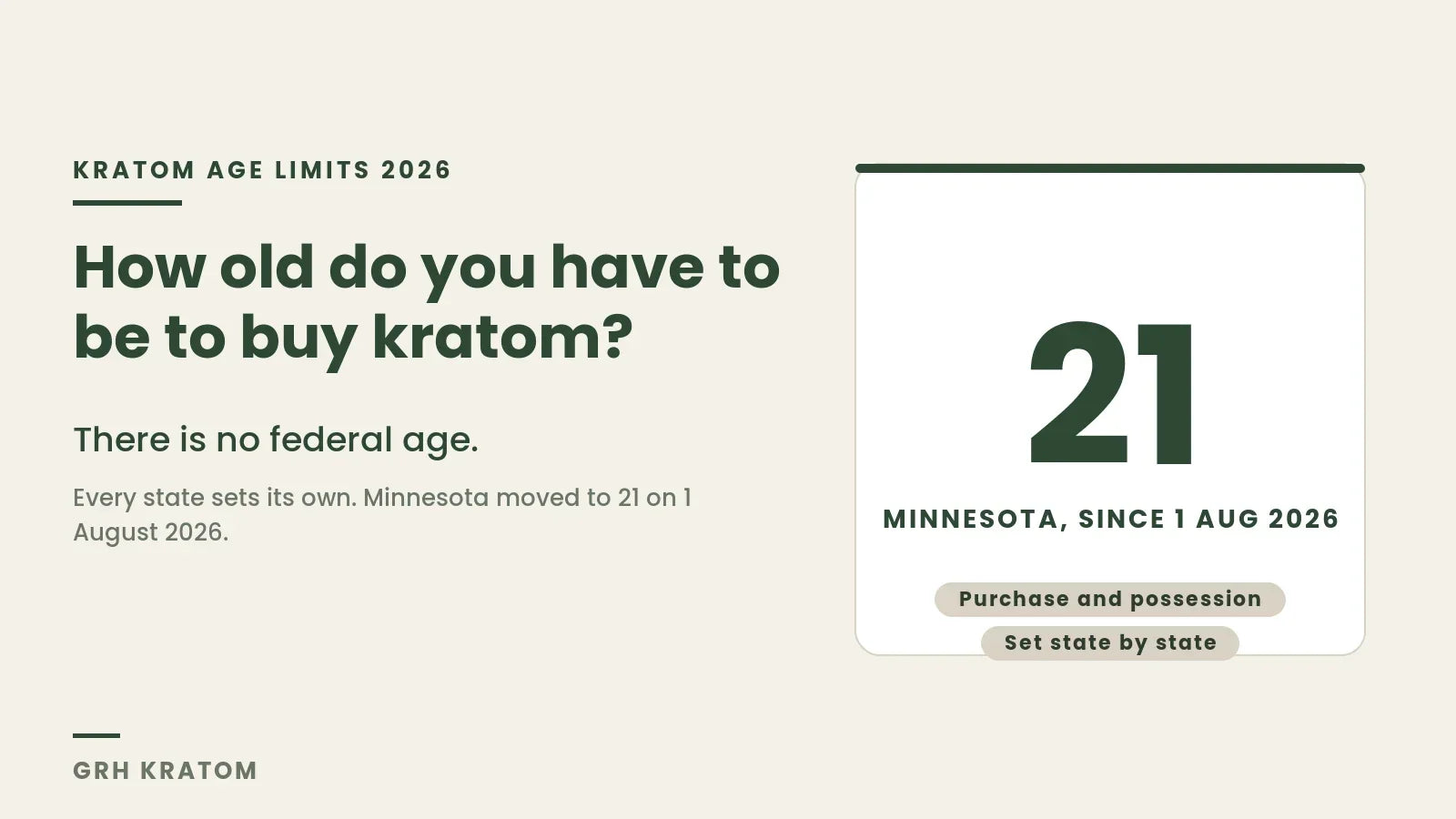
How old do you have to be to buy kratom? It depends on which state you are standing in. There is no national minimum, because Congress has never set one and kratom is not a federally scheduled controlled substance. States filled that gap on their own schedule and in their own way. Some picked 18. Some picked 21. A few have written nothing at all, which leaves a shop's own policy as the only gate on the door. Minnesota is the newest concrete example, and since 1 August 2026 the number there is 21.
This guide walks through why the answer changes at the state line, exactly what Minnesota did, what it means for an 18, 19 or 20 year old in that state now, and how to check your own state without relying on a tracker that may be out of date.
How old do you have to be to buy kratom in the United States
Nothing in federal law sets a minimum age. The FDA has not approved kratom for any use and says it cannot legally be sold in this country as a drug, a dietary supplement or a food additive, but that is a labeling and marketing position rather than an age rule, and it does not tell a cashier in Duluth or Dallas what number to check an ID against. Kratom is also not federally scheduled. So there is no national floor to fall back on.
That leaves fifty separate answers, plus the District of Columbia, plus whatever your city or county has decided. Most age restricted things feel nationally uniform by the time they reach the register, which is why the question surprises people. Kratom does not work that way. The gap between two neighboring states can be the difference between buying legally at 18 in one and committing a misdemeanor by holding the same bag at 20 in the other.
In practice, every state sits in one of four groups.
- A specific kratom purchase age written into law. Usually 18 or 21. Minnesota is now in this group at 21.
- A consumer protection act that bundles an age in with other rules. These laws pair a minimum age with labeling requirements, disclosure of alkaloid content and limits on adulterated product, so the age is one clause among many and easy to miss if you only skim the headline.
- No kratom specific age at all. The legislature simply has not acted. The only gate is the retailer's own policy, and a serious retailer will still card you.
- Prohibition. Sale or possession is not allowed at any age, so the age question never comes up. North Dakota moved into this group on 5 August 2026, though it did so through a temporary executive order that runs 30 days and lapses around 4 September 2026 unless a special legislative session, called for 2 September 2026, replaces it.
Local rules sit on top of all four. The Minnesota Department of Health makes the point plainly on its own kratom page: in the absence of federal or state regulation, local communities may consider policies of their own. That is true well past Minnesota. A state level answer is not always the final answer for the street you live on.

Why the kratom age limit keeps moving
Two states moved in opposite directions inside the same month, which tells you most of what you need to know about how unsettled this area is. Minnesota regulated. North Dakota prohibited. Executive Order 2026-04 took effect at 5 p.m. on 5 August 2026 and banned sale, purchase and possession outright, with no bill and no floor vote in front of it, which is why almost nobody in that state had any warning. Read the order itself, though, and it is temporary on its face. It runs 30 days and lapses around 4 September 2026 unless something replaces it, and Governor Armstrong has called a special legislative session for 2 September 2026 to decide whether prohibition goes into statute. So North Dakota does get a vote. The prohibition simply took effect before the vote rather than after it, which is the reverse of the Minnesota sequence, where the bills passed in May and the rule started in August. One more piece belongs with all of that, because it outlasts the order by months. The state Board of Pharmacy issued a separate emergency rule scheduling 7-OH as a controlled substance for about 180 days. We covered all of it in our explainer on the North Dakota kratom ban.
Rhode Island went the other way earlier in the year. It repealed its own kratom ban in April 2026 and reopened under a regulated framework with four license classes, a minimum age of 21, per serving caps of 150 mg of mitragynine and 1 mg of 7-OH, heavy metal limits and packaging rules. A state that had prohibited kratom outright now permits it to adults with numbers attached to the permission, which is a genuinely different model from either a flat ban or a bare age line.
The pattern across all three states is the same even though the outcomes are not. Legislators are reacting to concentrated products rather than to leaf powder, and when they write an age rule now they tend to write 21. That is worth understanding before you assume the number where you live is the number you remember.
What Minnesota changed on 1 August 2026
Two bills carried the change. HF 3453 in the House, sponsored by Rep. Jessica Hanson, DFL-Burnsville, and SF 3704 in the Senate. Both passed, and Gov. Tim Walz signed them on 5 May 2026. The new age took effect on 1 August 2026, which is roughly three months of lead time for retailers, and shorter notice than most people who buy kratom in the state ever heard about.
The rule lives in the Minnesota Statutes section on other controlled substance offenses, Minn. Stat. Sec. 152.027, at subdivision 7. Read that subdivision closely and you will notice something that matters more than the number itself. It does not only say kratom. It reaches "kratom or a substance that contains mitragynine or 7-hydroxymitragynine," which means a product that never uses the word kratom on the front of the bottle is still covered if those compounds are in it.
One honest caveat, because it will confuse anyone who clicks through. The version published on the Revisor site is the 2025 edition of the statutes, and as of 10 August 2026 it still prints 18. The compilation is republished on an annual cycle and has not caught up with the 2026 session yet. The amendment is in force regardless of what the online edition currently shows, and the Minnesota Department of Health has confirmed the change and the 1 August 2026 effective date on its kratom page. If you are checking this yourself, look at the effective date, not the printing date.
Here is the before and after, side by side.
| Before 1 August 2026 | From 1 August 2026 | |
|---|---|---|
| Minimum age to buy | 18 | 21 |
| Minimum age to possess | 18 | 21 |
| Selling below that age | Gross misdemeanor | Gross misdemeanor |
| Possession below that age | Misdemeanor | Misdemeanor |
| Status for adults at or above the age | Legal to buy and possess | Legal to buy and possess |
| State licensing, testing or labeling regime | None | None |
Notice what did not change, because this is the part most of the coverage got wrong. The offense levels are identical on both sides of that table. Selling below the age was a gross misdemeanor before 1 August 2026 and it is a gross misdemeanor now. Under-age possession was a misdemeanor then and it is a misdemeanor now. Chapter 63 did exactly one thing to subdivision 7: it struck 18 and wrote 21. No penalty was raised and no new offense was created, so if you have read that punishments went up alongside the age, that reporting is wrong. Kratom is also still legal in Minnesota. This was not a ban and it was not a scheduling action, so kratom remains a non controlled substance in the state and remains legal to sell to adults who are 21 or over. The Department of Health is equally clear that it does not regulate the sale or possession of kratom, so no licensing, testing or labeling system arrived alongside the age change. The state raised the age and left everything else where it was.

What happens if you are under 21 in Minnesota now
Both sides of the counter carry a consequence, which is not how every age rule works and is worth stating plainly. Selling any amount of kratom, or of a product containing mitragynine or 7-OH, to someone under the age is a gross misdemeanor for the seller. Possession by someone under the age is a misdemeanor for the person holding it. That second half is the part people miss, because with a lot of age restricted goods the legal exposure sits entirely with the retailer and the buyer is treated as the protected party rather than as an offender.
If you are 18, 19 or 20 in Minnesota and you were buying legally in July 2026, we have not seen anything from the state describing an exception for people who were already of age under the old rule. Treat 21 as the number. The shops will card you, the number on their register prompt has changed, and a clerk is not going to relitigate it at the till.
And to be direct about it, because this article is not going to pretend otherwise: if you are under 21 in Minnesota, the answer is to wait until you are 21. There is no version of this guide that helps you around a state law, and no shop worth buying from is going to sell to you anyway. Age gating is the industry's own stated position, ours included. A category that wants to be treated as legitimate does not get to argue with the one rule everybody agrees on.
Why states are landing on 21 rather than 18
The short version is 7-OH. The longer version is worth having, because it explains why the newer laws are drafted the way they are.
Kratom is Mitragyna speciosa, a tree from Southeast Asia. Its two psychoactive compounds are mitragynine and 7-hydroxymitragynine, usually shortened to 7-OH. Mitragynine is the main one and makes up about two thirds of the plant's alkaloid content. 7-OH is a breakdown product of mitragynine, and the plant itself produces very little of it, usually under 0.05 percent by weight, though the body converts some mitragynine into 7-OH in the liver after use. Both act on opioid receptors.
The problem is not the leaf. It is what can be done to the leaf. Companies can extract and concentrate 7-OH, and research cited by the Minnesota Department of Health suggests 7-OH may be roughly 13 times more potent than morphine. Those concentrated products reach shelves as liquids, gummies, tablets and shots, and they are sometimes marketed as natural, safe or mild. Someone who believes they are buying a low potency botanical can be buying something considerably stronger, and nothing on the front of the package necessarily tells them so.
Effects diverge by compound and by dose. Low doses of mitragynine tend toward stimulant like effects such as increased alertness, low doses of 7-OH tend toward opioid like effects, and high doses of either tend toward sedative effects. Reported harms run from nausea, vomiting, constipation, headache, dizziness, drowsiness, tremor, raised heart rate and blood pressure and anxiety at the milder end, up to seizures, psychosis, liver toxicity and dependence at the serious end. Minnesota poison center calls involving kratom have been rising.
For scale, in 2021 about 1.7 million people in the United States aged 12 and over used kratom in the past year. That is a large enough population that legislators treat it as a consumer question rather than a fringe one.
One thing has to be said clearly, and it is the reason MDH devotes a section of its own page to it. Kratom is not proven safe or effective for treating any medical condition, including managing opioid withdrawal. The FDA has approved three medications for opioid use disorder: buprenorphine, methadone and naltrexone. If that is the situation you are in, those are the options to discuss with a licensed clinician, and kratom is not a substitute for them.
If you want a plain language walk through of how all of this fits together in one state, the Public Health Law Center publishes a Kratom in Minnesota fact sheet written as a set of frequently asked questions, and MDH points readers to it directly.
How to check the kratom age limit in your own state
Five steps, in the order that actually works.
- Go to your state's own statutes site first. Every state publishes its code online. That is the primary source, and a national tracker is a summary of it at best.
- Search for two words, not one. Search kratom, then search mitragynine. Minnesota's statute reaches products containing mitragynine or 7-OH by name, and a state that legislates the compound rather than the plant will not turn up if you only search for kratom.
- Read the operative verb exactly. A law that restricts sale is a different law from one that restricts sale, purchase and possession, and the difference decides whether you personally are exposed or only the shop is.
- Check the effective date, not the signing date. Minnesota was signed on 5 May 2026 and took effect on 1 August 2026. For almost three months the correct answer to the age question was still 18, and anyone who read the signing coverage and stopped there had the wrong number.
- Then check your city and county. Local ordinances can be stricter than the state and they rarely make the news.
The fifty state table, and what we are doing about it
You came here for a table, and that is a fair thing to want. The reason there is not one printed below is not that the question is wrong, it is that most of the tables already published are wrong in ways a reader cannot see from the outside. National trackers listed Rhode Island as a prohibition state for months after Rhode Island repealed its ban in April 2026 and reopened with a licensing framework, so anyone who trusted them was told a state was closed while it was open.
Minnesota is the same trap pointing the other way. Any table built before 1 August 2026 says 18, and it is wrong now. So here is a commitment rather than a complaint. We are building a fifty state age table with a visible last-checked date on every row, verified against each state's own statutes rather than against somebody else's summary, and reviewed again after each legislature adjourns. It goes up on this blog once the first full pass is finished and dated. We are not linking you to a grid before that, because an undated grid pushed out early is precisely what went wrong for the Rhode Island readers. In the meantime the five steps above will get you a correct answer for your own state in about ten minutes, which is faster than waiting for us.
Two answers we will state now, because they are current and specific. Minnesota is 21 as of 1 August 2026. North Dakota is prohibited under an executive order that took effect on 5 August 2026, so no age applies there at all for the moment, but that order lapses around 4 September 2026 and the special legislative session on 2 September 2026 decides what follows it. Check North Dakota again after those two dates rather than trusting this paragraph. If you want the deeper treatment of the first one, including how it sits next to a neighboring state with no kratom age law of its own, that is in our guide to kratom legality in Minnesota and Montana.
What this means when you buy online
Ordering online does not move you into a friendlier jurisdiction. The law that applies is the law where the package lands, and a vendor shipping into a state where you are under the local age is not doing you a favor. Neither is one that ships into a prohibition state.
A few things separate a vendor who takes this seriously from one who does not.
- An age gate on the site, and verification that goes past it. A click through box asking you to confirm you are 21 is the floor rather than the ceiling, and ours is one of those boxes too, so the question worth asking any vendor is what else they check and at what point in the order they check it.
- A shipping policy that names restricted states. If a vendor will not tell you where they refuse to ship, they probably do not refuse to ship anywhere. Put that test to us as well, and read the policy rather than assuming your state is named in it.
- Published lab results. Alkaloid content should be a number you can read, not an adjective on the label.
- A label that names the compounds. Since the newer laws are written around mitragynine and 7-OH rather than around the word kratom, a label that hides the compounds is a label that makes it harder for you to comply.
Our own gate is set to 21 everywhere, including the states where the law would still let us sell at 18 and the states that have written no rule at all. That costs us buyers who are legally entitled to shop with us, and we are fine with the trade. On state level shipping we are going to under-claim on purpose. We are not telling you our restricted-state blocking is verified, because we have not finished auditing how it behaves at checkout, and an airtight filter is exactly the sort of claim a buyer has no way to check from outside. Twenty one is the number the category has settled on, and running one policy in Minnesota and a looser one two states over is exactly how a business ends up on the wrong side of a rule it did not notice had changed. If you are 21 or over and you want to see what we carry, everything sits in our kratom collection.
The short version
How old do you have to be to buy kratom? Twenty one in Minnesota since 1 August 2026, and it depends everywhere else, because there is no federal age and never has been. Check your own state's statutes rather than a table. Search for mitragynine as well as kratom. Read the effective date. Then check your city.
If you are in Minnesota and you are 21 or over, nothing about your buying has changed except that you may get carded where you did not before. Carry the ID. If you are under 21 there, the law is the law, and waiting is the only correct answer to it.
This article is general information, not legal or medical advice. Kratom laws differ by state and by locality, they change between legislative sessions, and city or county rules can be stricter than state law, so verify current law for your own location or consult a qualified attorney before you buy, ship or carry kratom. These statements have not been evaluated by the Food and Drug Administration. This product is not intended to diagnose, treat, cure or prevent any disease.


