



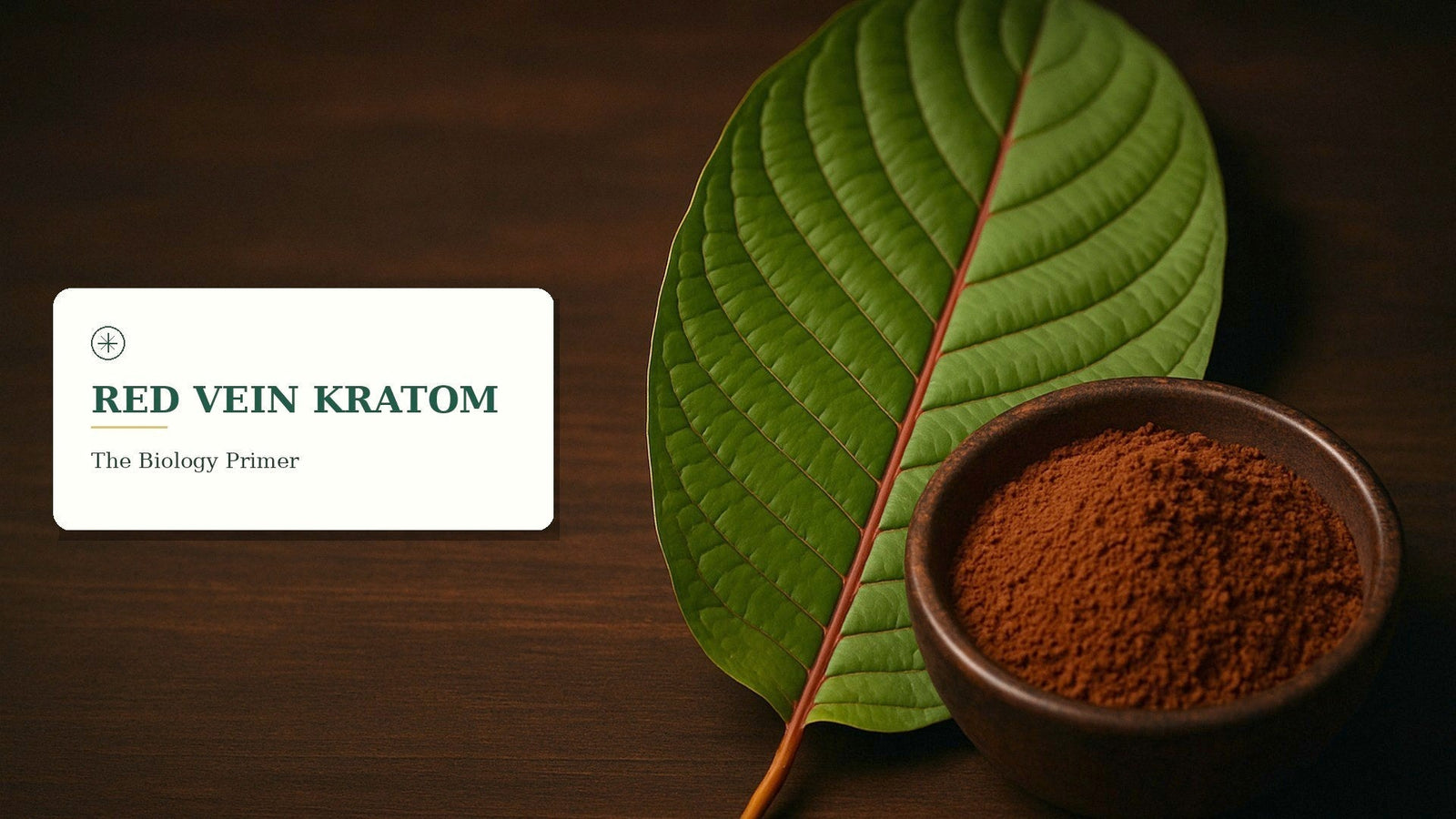
The "red vein" label on a kratom product is a biology claim, not a marketing word. It tells you the leaf was harvested at peak maturity, when the central vein has turned a deep red, and that post-harvest drying then pushed the alkaloid profile toward the calmer side of the kratom spectrum. Everything else about red kratom, the evening reputation, the body-leaning effect, the slow taper, traces back to that single biological moment.
This guide goes inside that moment. We look at why the vein turns red, what oxidation does to the alkaloid mix during drying, how to tell a true red-vein leaf from a powder that was simply over-dried, and what the biology means in practice for dose and product selection. If you have already read our companion primer on red kratom as a regional strain family, this is the science underneath it.

According to the American Kratom Association, roughly 15 million adults in the United States use kratom, and many of them rotate among red, green, and white veins by time of day. Red owns the evening lane for a reason rooted in leaf chemistry.
Table of Contents
- What "Red Vein" Means at the Leaf
- The Leaf-Maturity Timeline: White, Green, Red
- Why Mature Leaves Develop a Red Central Vein
- Post-Harvest Oxidation: Mitragynine to 7-Hydroxymitragynine
- The Alkaloid Concentration Curve Across Maturity
- How to Identify True Red-Vein Leaf
- True Red vs Post-Processing Red
- The Typical Effect Profile of a 7-OH Lean
- Recommended Doses for Red-Vein Use
- How Vein-Color Biology Maps to Regional Strain Names
- Vetting a Red-Vein Product
- Frequently Asked Questions
- Final Thoughts
TL;DR
- Red vein kratom is defined biologically: the central vein of the leaf has turned deep red because the leaf is fully mature at the time of harvest.
- The red color comes from the natural breakdown of chlorophyll and the build-up of anthocyanin-style pigments in the older vein tissue as the leaf ages on the tree.
- Post-harvest drying causes mitragynine, the dominant fresh-leaf alkaloid, to partially oxidize into 7-hydroxymitragynine, which is many times more potent on a per-milligram basis.
- Red-vein material carries a higher relative share of 7-hydroxymitragynine than green or white veins from the same tree, and that nudge is what produces the calmer, body-leaning feel.
- "True" red vein comes from mature leaves dried slowly under indirect light. "Post-processing" red comes from younger leaves that were oxidized aggressively after harvest. Both can be labeled red, and they do not behave the same.
- A typical starter dose for red-vein powder sits at 2 to 3 grams, with a daily ceiling of roughly 8 grams across the day for most users.
- Vein-color biology cuts across regional strain names. A red-vein leaf from Borneo and a red-vein leaf from Sumatra share the same maturity story, with regional differences layered on top.
- A trustworthy red-vein product carries a recent third-party certificate of analysis showing alkaloid percentages, heavy-metal limits, and microbial safety.

What "Red Vein" Means at the Leaf
Every Mitragyna speciosa leaf has a central rib running from petiole to tip, plus smaller veins branching off to either side. The "vein" in "red vein kratom" refers to the color of that central rib at the moment of harvest. A young leaf has a green or pale-green vein. As the leaf ages, the vein darkens. By the time the vein is a clear deep red, the leaf has spent the most time on the tree and has accumulated the highest total alkaloid load it will ever carry.
This is a different concept from regional strain identity. "Red Bali" tells you where the leaf came from. "Red vein" tells you what stage of maturity the leaf was at when a farmer cut it. The two are related, because farmers harvest a single tree multiple times, taking younger leaves earlier in the season for white and green products and saving mature leaves for red. The biology, though, lives at the vein.
This matters for buyers. Two products labeled "red" can come from leaves at meaningfully different maturity points if one farm sources older leaves and another farm tries to mimic red through aggressive post-harvest drying. The label looks identical. The chemistry does not.
The Leaf-Maturity Timeline: White, Green, Red
Picture a single kratom tree on a Borneo plantation. Across a growing season the same tree produces leaves at every stage of maturity. Farmers harvest in waves rather than stripping the tree at once, and each wave targets a different leaf age.
The youngest harvest takes leaves whose central vein is still pale green or white. These carry the highest relative share of mitragynine, the dominant fresh-leaf alkaloid, and become white-vein products. Our companion guide on white kratom covers that end of the spectrum. The middle harvest takes leaves at intermediate maturity, when the vein has begun to darken but still reads green. These carry a balanced alkaloid mix and become green-vein products. The latest harvest takes the most mature leaves, those whose veins have turned red. The maturity progression is the same biological clock whether the leaf grew on Borneo, Sumatra, Thailand, or Indonesia.

Why Mature Leaves Develop a Red Central Vein
The red color is a pigment story. As a kratom leaf ages on the tree, chlorophyll in the vein tissue breaks down, and other pigments present in lower concentrations, including anthocyanin-style compounds, become more visible. That is the same general mechanism behind autumn leaf color, although for tropical evergreen Mitragyna speciosa the change happens at the individual-leaf level rather than across a whole canopy.
The pigment change is not the alkaloid change, but the two are correlated. The same metabolic shifts that drive the vein from green to red also influence which alkaloids accumulate in the tissue. Mature leaves synthesize alkaloids on a different curve than young leaves, with mitragynine still dominant at every stage but secondary-alkaloid ratios shifting. Peer-reviewed work on kratom pharmacology and alkaloid composition, and the broader Mitragyna speciosa botanical and cultivation research, cover the broad strokes of this biology.
That is why farmers look at the vein when they decide which leaves to pick. The vein color is the cheapest, most reliable visual proxy for leaf maturity, which is itself a proxy for the alkaloid profile after drying. A faintly pink vein is almost there. A deep wine-red vein has crossed into classic red-vein territory.

Post-Harvest Oxidation: Mitragynine to 7-Hydroxymitragynine
Vein color tells you the leaf was mature at harvest, but drying is what finishes the alkaloid lean that gives red-vein its reputation. Mitragyna speciosa leaves contain more than 40 known alkaloids. The two that matter most are mitragynine and 7-hydroxymitragynine. Mitragynine sits at roughly 60 to 70 percent of total alkaloid content in fresh leaves; 7-hydroxymitragynine usually sits well under 2 percent. The National Institute on Drug Abuse covers both alkaloids in its kratom research summary.
During drying, a portion of the mitragynine oxidizes into 7-hydroxymitragynine. This is a chemical conversion, not a separate compound being added. The slower and more controlled the drying, and the more indirect light during it, the more conversion happens. Red-vein material almost always gets the longest, slowest dry. Farmers spread mature leaves on bamboo racks indoors for several days, then finish them in open-air shade. By the time the leaf is ground, a measurable portion of the mitragynine has shifted into 7-hydroxymitragynine, and that nudge defines the red-vein lane.
The conversion is small in absolute terms; even in a strongly processed red, the 7-hydroxymitragynine concentration usually stays well under 2 percent of total alkaloid mass. The reason that small percentage moves the needle is that 7-hydroxymitragynine is many times more potent than mitragynine on a per-milligram basis at the receptors most associated with body-leaning effects.

The Alkaloid Concentration Curve Across Maturity
If you sampled leaves from the same tree at multiple points across a growing season, you would see two curves moving in opposite directions. Mitragynine sits at its highest relative share in the youngest leaves and slowly gives ground as the leaf matures. 7-hydroxymitragynine, present in trace amounts in fresh leaves, rises post-harvest as drying oxidizes a portion of the mitragynine. Other secondary alkaloids, including paynantheine, speciogynine, and speciociliatine, ride their own smaller curves on top.
This is why the three vein categories are not arbitrary labels. White vein, harvested early, finishes with the highest relative share of mitragynine and the lowest 7-hydroxymitragynine. Green vein, harvested at mid-maturity, sits in the middle. Red vein, harvested late and dried slowly, finishes with the lowest relative mitragynine share and the highest relative 7-hydroxymitragynine share. Mitragynine is still the most abundant alkaloid in a red by a wide margin; what changes is the supporting cast and the ratio.

How to Identify True Red-Vein Leaf
If you can inspect whole-leaf kratom (less common in the US than ground powder), three visual cues confirm a true red-vein product. First, the central vein. On a mature red leaf, the central rib reads as a clear deep red running from the petiole at least two-thirds of the way to the tip. A faint pink line is not enough; secondary veins should also carry red tones, although lighter than the central vein.
Second, leaf size and structure. Mature kratom leaves run 15 to 20 centimeters long, with thicker tissue and a more pronounced waxy surface than young leaves. Third, the petiole. On a mature red leaf, the petiole often carries a reddish hue at its base; a green petiole on a leaf with a red-looking vein hints that the red is post-processing, not biological.
For ground powder, none of these cues are available. You are relying on vendor representation and third-party lab work, which we come back to in the vetting section.
True Red vs Post-Processing Red
The industry has multiple paths to a product labeled "red," and knowing the difference helps you read a label. The honest path starts with mature red-vein leaves and finishes with slow indirect-light drying that allows partial oxidation. Leaf was at peak maturity, drying did its work, alkaloid profile reflects both inputs.
A second path starts with mid-maturity or older green leaves and pushes the drying step harder, with more sunlight or a longer fermentation-style cure. The product comes out darker than green, leans more 7-hydroxy than its starting leaves would naturally produce, and gets labeled red. The chemistry sits in the red lane, but the leaf was not biologically mature when picked. A third path is purely cosmetic: younger leaves dried in ways that produce a darker powder, sold as red despite the alkaloid profile sitting closer to green or white. That third path is what produces disappointing reds, the ones that feel sharp and stimulating despite the label.
The only reliable way to tell which path produced a given powder is a recent third-party certificate of analysis showing alkaloid percentages. A true red typically reports mitragynine in the 1.0 to 1.5 percent range of total powder weight and measurable 7-hydroxymitragynine, often in the 0.02 to 0.05 percent range. A green-pretending-to-be-red shows a sharper mitragynine peak and 7-hydroxymitragynine barely above baseline.

The Typical Effect Profile of a 7-OH Lean
Once you understand what is happening at the leaf and during the dry, the effect profile of red-vein kratom stops feeling random. Onset typically arrives 25 to 45 minutes after dosing a standard amount of powder on a relatively empty stomach. The peak window sits between 1 and 2 hours. Total duration runs 4 to 6 hours, with a long soft taper rather than the sharper drop that white vein produces.
Qualitative descriptions cluster around a few themes. Body comfort and physical ease come up almost universally. A quieter, less anxious head state is the second most common report. A subtle settled mood lift, less elated than red's reputation sometimes suggests, shows up in many accounts. Mild drowsiness is common at higher doses, exactly the response you would expect from a 7-OH-leaning profile, and it is why red-vein is the standard pick for evening rather than morning use. Body weight, food intake, hydration, and individual differences in liver enzyme activity all shift the experience of a given dose, so treat your first session with a new red as data collection rather than a prediction.
Recommended Doses for Red-Vein Use
Dosing for red-vein kratom follows the same general framework as other vein types, with a few specific considerations baked in for the 7-OH lean. The table below summarizes typical starting points. Treat these as community-reported defaults rather than medical recommendations.
| Leaf maturity | Vein color | Harvest timing | Drying style | Alkaloid lean | Typical starter dose |
|---|---|---|---|---|---|
| Young | White / pale green | Earliest in season | Fast indoor dry, minimal light | Highest relative mitragynine, lowest 7-OH | 1.5 to 2.5 g |
| Mid | Green | Mid-season | Moderate dry, indirect light | Balanced mitragynine and 7-OH | 2 to 3 g |
| Mature | Red | Latest in season | Slow indoor dry plus shade finishing | Lower relative mitragynine, highest 7-OH | 2 to 3 g |
For adults new to red-vein kratom, 2 to 3 grams of powder on a relatively empty stomach is a reasonable starting point. Experienced users often settle into 3 to 5 grams per serving for evening use. The community ceiling for a single serving sits around 5 grams; the daily ceiling sits around 8 grams across all servings. Going above those numbers tends to produce more drowsiness, more nausea, and more next-day grogginess, not better effects.
Capsules typically carry 500 milligrams of powder, so a 2-gram dose is 4 capsules. Our Red Maeng Da kratom powder is a popular red-vein starting point for people working from the table above, and the same logic applies whether you are using powder or another red-vein format.
How Vein-Color Biology Maps to Regional Strain Names
The market labels products by region as well as by vein. Once you know what vein color is telling you, the regional names start to make more sense. A red-vein leaf from Borneo and a red-vein leaf from Sumatra share the same maturity story. Both were harvested at peak ripeness, both went through extended slow drying, and both finished with a 7-OH-leaning profile. They still feel slightly different in user reports because of soil, climate, and farming tradition. Different islands carry different mineral profiles and rainfall patterns, and historical drying and storage habits add a small but real layer.
Red Bali tends to read as the classic "heavy" red, deeply body-leaning and good for sleep onset. Red Maeng Da reads as a higher-potency red with mitragynine still well represented, which is why it produces strong effects without quite as much sedation. Red Borneo and Red Sumatra both sit in the smooth, steady, body-calm lane. For a full side-by-side, our red kratom regional summary walks through Bali, Maeng Da, Borneo, Sumatra, and Thai. The biology you just read explains why those strains have a family resemblance even though their regional fingerprints differ.

Vetting a Red-Vein Product
The biology gives you the framework. Here is how to apply it when looking at an actual bag or bottle. The checklist is the same one experienced users run through, made explicit.
- Confirm the product is sold as red vein, not just "red." The vein-color claim is the biology claim. Generic "red kratom" without a vein specification is a softer claim and may include post-processing red material.
- Look for a recent batch-specific certificate of analysis. A reputable vendor publishes a third-party COA for the exact batch, dated within the past year, showing mitragynine and 7-hydroxymitragynine as separate line items.
- Check the alkaloid numbers against the red-vein expectation. A true red typically reports mitragynine in the 1.0 to 1.5 percent range and measurable 7-hydroxymitragynine in the 0.02 to 0.05 percent range. A mitragynine number well above 1.5 percent with negligible 7-OH suggests green chemistry despite the label.
- Verify heavy-metal and microbial panels. Lead, cadmium, arsenic, and mercury at safe levels per FDA dietary-supplement guidance, plus negative results for salmonella, E. coli, and yeast/mold above action levels.
- Read the country and region of origin. A product that lists "Indonesia" plus a regional descriptor (Borneo, Sumatra, Java) gives you more traceability than "Southeast Asian sourced."
- Confirm the harvest-to-pack window. Kratom alkaloids degrade over time, especially with light and air exposure. A vendor who tells you the harvest and pack dates is one step ahead of one who cannot.
- Match the product to your use case. Classic evening unwind fits Red Bali or Red Borneo. A stronger red with less sedation matches Red Maeng Da. Sleep onset sits at the heavier end of Red Bali.
None of these steps require chemistry knowledge beyond what you already have. They just require a few minutes of attention before you buy.

Frequently Asked Questions
Is red vein kratom stronger than green or white?
Not stronger in a single-number sense. Red carries a different alkaloid lean, with relatively more 7-hydroxymitragynine, which is what produces the body-leaning calming feel. A given weight of red is not "more potent" than the same weight of green or white; it is potent in a different direction.
Can a green-vein leaf be processed into a red-vein product?
Not really. The drying step shifts the alkaloid balance, but it cannot convert a young green leaf into a fully red-vein alkaloid profile. The leaf had to mature on the tree to carry the precursor mix that drying then nudges toward 7-OH. Aggressive post-processing of green leaves can produce something sold as red, but the chemistry will not match a real red on a lab panel.
Why does red vein make people drowsy at higher doses?
The 7-hydroxymitragynine share is the main reason. 7-OH engages body-leaning receptor activity more strongly than mitragynine does, and at higher concentrations that activity produces the sedation red is known for. Lower doses still feel relaxing without crossing into sleepy territory.
How long after harvest is the alkaloid profile stable?
Once drying is complete and the powder is sealed in light-resistant packaging, the profile holds reasonably steady for several months. Heat, light, and air exposure all accelerate degradation. The best red-vein products are stored sealed in opaque packaging at room temperature and used within about 12 months of harvest.
Are all red kratom products actually red-vein?
No. Some products labeled "red" come from younger leaves processed to mimic the red color. The only way to be confident is a recent batch-specific certificate of analysis showing the alkaloid percentages match what a true red would produce.
What dose should a beginner start with?
2 to 3 grams of powder on a relatively empty stomach is a reasonable first experience for most adults. Wait a full hour before considering a top-up. Many beginners find a 2 to 2.5-gram serving gives them all the information they need about how a given red-vein product feels.
Does red vein help with sleep?
Many users take red vein, particularly Red Bali, 30 to 60 minutes before bed for sleep onset. The 7-OH lean and the natural mild sedation of red at moderate-to-higher doses lend themselves to that use. Sleep response varies, so treat the first few nights as testing rather than a settled protocol.
What is the difference between red vein and red Maeng Da specifically?
Red Maeng Da is a regional and selection-based label inside the red-vein family. The leaves used are red-vein mature leaves, often selectively picked from preferred trees, with mitragynine still well represented. All Red Maeng Da is red vein, but not all red vein is Red Maeng Da. Our deep-dive on red Maeng Da kratom covers the sub-variant in detail.
Final Thoughts
The "red vein" label is biological shorthand. It tells you the leaf was at peak maturity when a farmer cut it, that drying pushed its alkaloid mix toward a higher relative share of 7-hydroxymitragynine, and that the finished powder will lean toward the calming, body-rooted, evening end of the spectrum. Once you know what the label is actually claiming, the buying process gets easier.
The companion guides walk you through the family from different angles. Our red kratom strain summary covers Bali, Maeng Da, Borneo, Sumatra, and Thai at the regional level. Our white kratom primer sits at the other end of the maturity timeline.

When you are ready to try a red-vein product, our Red Bali kratom powder is one of our most popular starting points, with batch-specific third-party lab work that you can verify against the alkaloid expectations covered above. If you prefer a pre-dosed format, our Boost blend kratom shot works for occasional use.
The biology behind red-vein kratom is straightforward once you see it laid out. A mature leaf, picked at the right time, dried with patience, finishes with a chemistry that produces a specific kind of evening feeling. Everything else, the strain names, the regional reputations, the price differences, is layered on top of that single piece of botany.


