



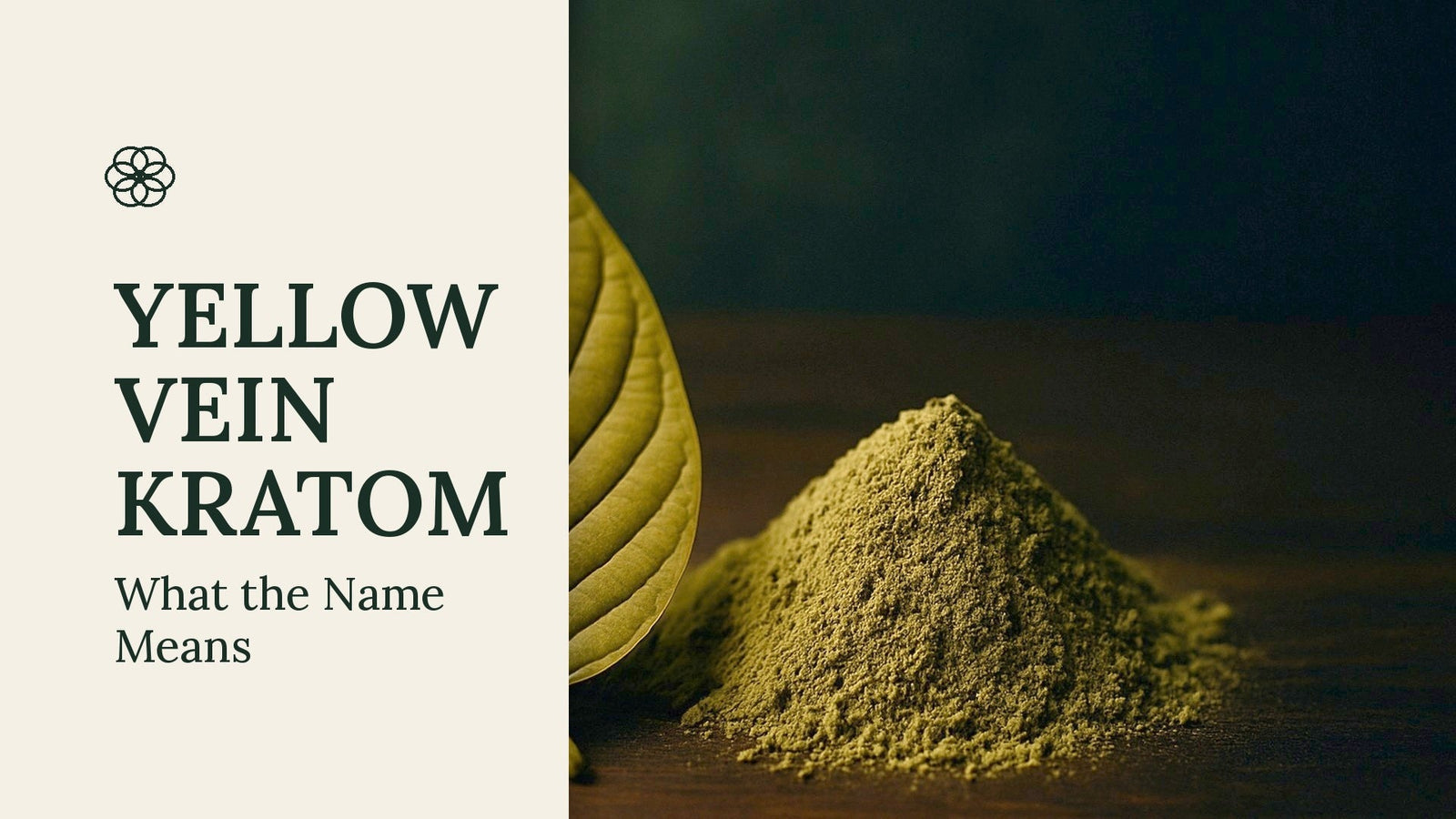
If you searched for "yellow vein kratom" hoping to learn about a fourth true vein color, the most honest answer is that it does not exist as a botanical category. Real kratom leaves have three vein colors: red, white, and green. "Yellow vein" is a marketing label applied to leaves that have been processed (typically extended drying, blending, or light fermentation) after harvest, not a vein you would ever see in a fresh kratom tree.
That distinction matters because an estimated 20 million Americans use kratom regularly in 2026 per the American Kratom Association, and a meaningful slice of those buyers are paying premium prices for "yellow vein" products without realizing they are buying a processed version of white or green leaf. The yellow label can describe a legitimately interesting product, but only if the vendor is transparent about which vein the source leaf came from and what processing was applied to get the yellow result.
This guide is for the buyer who typed "yellow vein" specifically. We will walk through why the term is a misnomer, what is actually in the bag when you buy a yellow vein product, how to read a Certificate of Analysis, and how to vet sellers so you do not end up paying extra for a label that means nothing. For the broader yellow-processing primer (including regional variants like Vietnamese, Borneo, and Sumatra), our yellow kratom guide goes deeper on the processing science itself.
Table of Contents
- TL;DR
- Why "Yellow Vein" Is Technically a Misnomer
- How Yellow Kratom Is Actually Produced
- Vein of Origin Still Matters More Than the "Yellow" Label
- The Alkaloid Shift: White-to-Yellow vs Green-to-Yellow
- The Effect Profile of Yellow Vein Strains
- Who Yellow Vein Suits Best
- Popular Strain Names Sold as "Yellow Vein"
- Quality Red Flags to Watch For
- How to Verify a Yellow Vein Product Before You Buy
- A Sensible Dosing Approach for Yellow Vein
- FAQ
- Final Thoughts
TL;DR

- Kratom leaves have three vein colors in nature: red, white, and green. There is no fresh "yellow vein" tree, only yellow-processed leaf.
- A bag labeled "yellow vein kratom" is almost always white or green leaf that has been dried longer, dried again under sun, fermented lightly, or blended to shift the alkaloid balance toward a more balanced profile.
- The vein color the leaf STARTED as still matters more than the "yellow" label. Yellow-from-white tends to lean energetic; yellow-from-green tends to lean balanced; yellow-from-red tends to lean mellow.
- Effects sit between the source vein and a typical red profile: smoother peak than the original vein, slightly longer taper, less of the "edge" some users get from raw white.
- Most buyers shopping yellow vein are actually looking for a balanced, sustained experience without the sedation of red or the sharpness of white. A green leaf, or a careful white-to-yellow process, often delivers that better than a marketing label alone.
- Lab transparency is the only way to verify a yellow vein product. A real Certificate of Analysis lists the mitragynine and 7-hydroxymitragynine percentages, the heavy metals panel, and the microbial panel. No COA, no purchase.
- A yellow vein strain that is honestly labeled (source vein disclosed, COA published, processing described) is a legitimate product. A "yellow vein" bag with no provenance is a vendor red flag.
- Start at 2 grams for a first dose, wait the full 45-minute onset, and adjust upward in 0.5 gram increments on later sessions before assuming the strain "doesn't work."
Why "Yellow Vein" Is Technically a Misnomer
Walk through a healthy Mitragyna speciosa grove in West Kalimantan or Sulawesi and look at the underside of a freshly picked leaf. You will see a central vein that is one of three colors: a deep crimson on mature leaves, a chalky white on younger growth, or a soft green on leaves harvested between those windows. You will not see a yellow vein. Yellow leaves in nature are senescent (dying or stressed) leaves, and those are not what reaches a kratom vendor.

The "yellow vein" label took hold in the kratom retail market around 2014 to 2016, when vendors began experimenting with extended drying, blending, and light fermentation to produce a strain that felt more balanced than a single-color leaf. The processed product had a noticeably warmer, more golden tone than fresh-dried white or green powder, and marketers used the visual difference to coin a new "color." The label stuck because customers liked the resulting effect profile, even though the underlying botany never changed.
The takeaway is not that yellow vein products are fake. The takeaway is that "yellow" describes what happened to the leaf after harvest, not where on the tree it grew. Asking a vendor "what vein was the source leaf?" is the question that separates serious sellers from those repackaging miscellaneous powder with a premium label.
How Yellow Kratom Is Actually Produced
Four common processing paths produce a "yellow vein" final product. Each leaves a different alkaloid fingerprint.
Extended drying of white leaf. White leaves typically dry indoors away from direct sunlight to preserve mitragynine. Drying under partial sun for 24 to 36 hours instead partially oxidizes the mitragynine into pseudoindoxyl and other secondary alkaloids. The result keeps some white-leaf energy but with a softer peak and longer taper. This is the most common origin of commercial "yellow vein."
Light fermentation of green leaf. Green leaves dried in sealed bags or under tarps for 24 to 48 hours undergo a mild fermentation as residual moisture converts some mitragynine into 7-hydroxymitragynine. The resulting powder has a golden hue and a profile that sits between green and red. A peer-reviewed PMC review of kratom pharmacology and post-harvest chemistry documents the relevant oxidation pathways.
Blending of white and red. Some vendors produce "yellow" by physically mixing white and red powders. This is the least transparent path because the blend ratio is rarely disclosed. A 70/30 blend behaves differently than a 50/50 blend, and neither is technically yellow leaf.
Sun-dried twice. Borneo and Sulawesi producers sometimes dry leaves twice: indoors after harvest, then a short direct-sun exposure before milling. The double-drying step produces the warmest gold tone and longest taper, often labeled "gold" or "yellow gold."
Vein of Origin Still Matters More Than the "Yellow" Label
A yellow vein product made from white leaf is not the same as one made from green leaf. The source vein sets the alkaloid ceiling; yellow processing only shifts the balance within it.

Yellow-from-white retains the higher mitragynine concentration of white leaves, with the energy edge softened by oxidation. Users who like white for morning focus but find the peak too sharp often prefer this as a steadier alternative. Our white maeng da powder is a high-mitragynine white some users self-process to a yellow profile by leaving the powder in a half-sealed jar for a week.
Yellow-from-green keeps the balanced spread of green, shifted slightly toward longer duration. This is what most buyers actually expect when they search "yellow vein." Our green maeng da powder serves as a typical source vein for that profile.
Yellow-from-red is rare because red already runs long and mellow. When it appears, it tends to be deeply sedating and longer-lasting than a typical red, which is not what the average yellow-vein buyer is shopping for.
The Alkaloid Shift: White-to-Yellow vs Green-to-Yellow
The two main alkaloids in kratom, mitragynine and 7-hydroxymitragynine, are what drive every effect users report. The National Institute on Drug Abuse fact sheet on kratom covers the receptor pharmacology and why the ratio of these two alkaloids changes the felt experience more than the gross total alkaloid percentage does.

White-to-yellow processing. Fresh white leaf typically tests around 1.4 to 1.8 percent mitragynine with a low 7-hydroxymitragynine fraction (under 0.05 percent). After extended drying, the mitragynine drops slightly (often to 1.2 to 1.5 percent) while minor alkaloids like speciogynine, paynantheine, and mitragynine pseudoindoxyl rise. The net effect: a softer onset, less of the white-vein "buzz," and a longer plateau.
Green-to-yellow processing. Fresh green leaf tests around 1.2 to 1.6 percent mitragynine. Light fermentation shifts a measurable fraction of mitragynine into 7-hydroxymitragynine, often doubling the 7-OH percentage from 0.02 to 0.04 or higher. A 2025 Frontiers in Pharmacology review of acute kratom alkaloid behavior documents how the 7-OH ratio drives the felt experience independent of the total alkaloid load. The shift moves the profile toward the red-leaf end of the spectrum without losing the daytime usability of green.
The visible color difference. The golden tone in yellow powders comes from polyphenol oxidation, the same chemistry that browns a cut apple. It is a marker of processing, not a marker of potency. A powder that is bright yellow with no source-vein disclosure is more likely to be heavily processed (and weaker) than a slightly tan powder from a careful drying step.
The practical implication for buyers: a vendor who publishes the source vein, the processing method, and the alkaloid percentages on the COA is giving you everything you need to predict the experience. A vendor who skips any of those is asking you to trust a marketing label.
The Effect Profile of Yellow Vein Strains
What most users actually feel after a typical 3 to 4 gram dose of a well-made yellow vein product:
- Onset takes 25 to 45 minutes, slightly slower than fresh white but faster than red.
- The peak is rounded rather than sharp, with mood lift and gentle energy that does not feel "wired."
- The plateau runs 2 to 3 hours, longer than fresh white and shorter than red.
- The taper is the gentlest of any vein category, often softening to baseline over a full hour.
- Total duration sits between 5 and 7 hours for most users at typical doses.
Regular yellow vein users describe the profile as "the steady half of green with the lift of white, minus the edges." That is a real and useful profile when source leaf and processing actually deliver it. When it is just a marketing label on randomly processed powder, the felt experience ranges from "mild green" to "weak red" with no consistency between bags.
Who Yellow Vein Suits Best

Yellow vein products tend to fit a specific set of users well.
Long-shift workers who want sustained focus. A 4-gram dose at the start of an 8-hour shift, no re-dosing. The slow taper covers the third and fourth hours without a top-up.
Users sensitive to white-vein edge. Buyers who like the energetic side of white but find the peak too sharp often migrate to yellow-from-white for a smoother version.
Daytime users who find green "flat." Yellow-from-green adds a small lift without crossing into red sedation.
Buyers building a rotation. Yellow slots in well between a white-vein morning and a red-vein evening pattern, helping reduce tolerance drift.
Yellow vein is generally NOT a fit for first-time kratom users (start with green), evening relaxation seekers (red works better), or buyers on a tight budget (yellow typically carries a 15 to 30 percent premium).
Popular Strain Names Sold as "Yellow Vein"
Most "yellow vein" SKUs fall into one of these named subcategories. Knowing the regional shorthand helps decode what is in the bag.

Yellow Vietnam. Typically a fermented green leaf with slightly higher 7-hydroxymitragynine than other yellows. Balanced energy and calm.
Yellow Borneo. Often a white or green Borneo source with extended drying. Smooth, rounded character; one of the more consistent yellow profiles.
Yellow Sumatra. Long-duration profile because Sumatra leaves themselves run longer. Often the closest yellow profile to a light red.
Yellow Indo. Broad category. Source vein varies by vendor, so check the COA before assuming consistency between batches.
Yellow Maeng Da. Maeng Da is itself a selection label, so this doubles up the processing claim. Honest versions are extended-dried high-alkaloid leaf; dishonest versions are generic powder with a premium sticker.
Yellow Bali and Yellow Thai. Less common. Bali is usually a slow-fermented green; Thai is usually a processed white. Both vary widely in quality between vendors.
Quality Red Flags to Watch For
Before any "yellow vein" purchase, scan the product page and the seller's site for these patterns. Any one is a reason to keep shopping.

- No published Certificate of Analysis, or a COA that lists only "kratom" without the alkaloid breakdown.
- No disclosure of source vein. The seller cannot say whether it started as white, green, or red leaf.
- No processing description (extended-dried, fermented, blended, sun-dried twice). If the seller cannot answer, batch consistency is unlikely.
- Yellow-only product line with no fresh white, green, or red SKUs from the same farm. Honest yellow producers usually also sell the source vein.
- Heavy reliance on stock photos or AI-generated leaf images. Real growers show actual harvest and drying photography.
- Prices significantly below market average for verified-COA yellow vein, often a sign of old or repackaged inventory.
- Vague effect claims like "the most powerful yellow ever." Real producers list alkaloid percentages and let buyers draw conclusions.
- No batch number or expiration date on the packaging. The FDA dietary supplements guidance recommends batch traceability for any ingestible product, and quality kratom vendors follow it.
How to Verify a Yellow Vein Product Before You Buy
A reliable yellow vein purchase is a short checklist of steps. Run it in order.
- Find the Certificate of Analysis. Reputable vendors link it from the product page or the FAQ. The COA should be from a third-party lab, dated within the last 12 months, and signed by the lab analyst.
- Check the mitragynine percentage. Quality yellow vein products list 1.0 to 1.6 percent mitragynine. Lower than 1.0 percent is a weak or stale batch. Higher than 2.0 percent on a yellow vein product is unusual and worth questioning (it may be mislabeled white).
- Check the 7-hydroxymitragynine percentage. Yellow vein products typically show 0.02 to 0.06 percent 7-OH. Significantly higher than that suggests heavy fermentation or possible adulteration.
- Confirm the heavy metals panel. Lead, cadmium, arsenic, and mercury should all read below the AKA Good Manufacturing Practices thresholds. The numbers should appear directly on the COA, not just a "pass" stamp.
- Confirm the microbial panel. Total aerobic plate count, yeast, mold, E. coli, and salmonella should all be within AKA limits. Salmonella in particular should read "not detected."
- Identify the source vein on the product page. "White-source yellow," "green-source yellow," or "double-dried green Borneo" tells you what to expect. Generic "yellow vein" without context is a yellow flag.
- Look for batch date or lot number. Anything within the last 6 months is fresh. Beyond 12 months, alkaloid drift may have softened the profile.
- Read 3 to 5 recent customer reviews. Look for descriptions of the actual felt experience, not just "great seller." Consistency between reviews suggests consistent batches.
Our green maeng da kratom capsules are a useful baseline to compare yellow vein products against because the green-leaf alkaloid profile is the most common source for yellow processing. If a yellow vein vendor cannot describe how their product differs from a careful green like that, the "yellow" label is doing more marketing work than chemistry.
A Sensible Dosing Approach for Yellow Vein
Yellow vein products sit close enough to green and white that the standard dosing tiers apply, with a small adjustment for the longer taper. Our kratom strain chart covers per-vein dosing in more detail.
First-time dose (2.0 to 2.5 grams). Take on an empty stomach with water, wait the full 45 minutes for onset, then assess. Yellow vein has a slower onset than fresh white; many first-time users assume the dose is too low at 30 minutes and re-dose, then feel the stacked effect 30 minutes later.

Sustained-energy dose (3.0 to 4.0 grams). The most common single-dose range for daytime use. Pairs well with a small fat-containing breakfast for the longest steady curve.
Heavy day dose (4.5 to 5.5 grams). Used for long shifts. Side effects (dry mouth, slight jitter) climb at this range. Hydrate aggressively.
Avoid stacking yellow vein. Because the taper is so soft, users often re-dose at the 4-hour mark when the prior dose has not fully cleared. Wait a full 6 hours between yellow vein doses, or rotate to a different vein.
FAQ
Is yellow vein kratom stronger than green vein?
Not categorically. Yellow vein typically has a slightly softer peak than green but a longer taper. Total alkaloid load is usually similar or slightly lower than the source vein. "Stronger" depends on what you mean: longer duration, yes; sharper peak, no.
Can I make yellow vein kratom at home?
A close approximation, yes. Place fresh-dried white or green powder in a half-sealed glass jar in a warm, dim spot for 5 to 10 days. The slow oxidation produces a yellow-leaning profile. The result will not match a commercial yellow vein exactly, but it is a useful experiment if you want to understand the process before paying yellow-vein prices.
Why does yellow vein cost more than white or green?
Two reasons. First, the processing step adds labor and inventory time. Second, market positioning: yellow vein products are sold to buyers who already know they want something specific, and vendors price accordingly. A 15 to 30 percent premium over the source vein is typical; more than 50 percent suggests pure marketing markup.
Is yellow vein kratom legal?
In the US, kratom legality is regulated at the state and county level, not federally. Yellow vein kratom carries the same legal status as any other kratom product in the buyer's jurisdiction. Check current state and local rules before purchase. The American Kratom Association maintains a state-by-state legal map.
How long does yellow vein kratom last on the shelf?
About 12 to 18 months in a sealed, opaque container away from heat and light. Yellow vein alkaloid profiles drift slightly faster than fresh-dried green or white because they have already undergone oxidation. Use within 12 months of the batch date for the most consistent experience.
What is the difference between yellow vein and gold vein?
Often nothing. The two labels are used interchangeably by many vendors. When a difference exists, "gold" refers to the double-dried path while "yellow" refers to extended-drying or fermentation. The effect profiles are similar enough that most users will not notice a meaningful distinction.
Why does my yellow vein feel different between bags?
Batch variation. Yellow vein production has more variables than fresh-dried single-vein kratom, so consistency depends heavily on the vendor's process controls. Stick to vendors who publish COAs per batch.
Final Thoughts
Yellow vein kratom is a real product with a useful effect profile when it is honestly made and clearly labeled. The problem is that the label itself does not tell you what is in the bag. The same "yellow vein" SKU from two different vendors can describe an extended-dried white, a lightly fermented green, a white-and-red blend, or a sun-finished gold. Each of those produces a different experience.
The path forward for buyers is to treat "yellow vein" as a starting filter, not a final answer. Ask the vendor what vein the leaf started as. Look for the Certificate of Analysis with named alkaloid percentages. Read the processing description. If the answers add up to a coherent product story, the yellow label is doing its job. If they do not, your money is better spent on a verified white, green, or red from a transparent producer, or on our green maeng da powder as a reliable green baseline.

For the wider picture on yellow processing, including how Vietnamese, Borneo, and Sumatra variants differ in practice, the yellow kratom guide is the companion piece to this one. That guide covers the processing science in more depth; this one is about the "yellow vein" label specifically.
A final note for anyone new to the category: a yellow vein product is not a stronger version of green or a milder version of red. It is a third option with its own profile, useful when you want sustained, balanced effects with a soft taper. Buy one bag from a transparent vendor, run the dose tiers across a few sessions, and decide for yourself whether it earns a place in your rotation. The buying habits that produce a good kratom experience are the same regardless of vein color: lab-verified product, honest sourcing, and a methodical first dose.


