



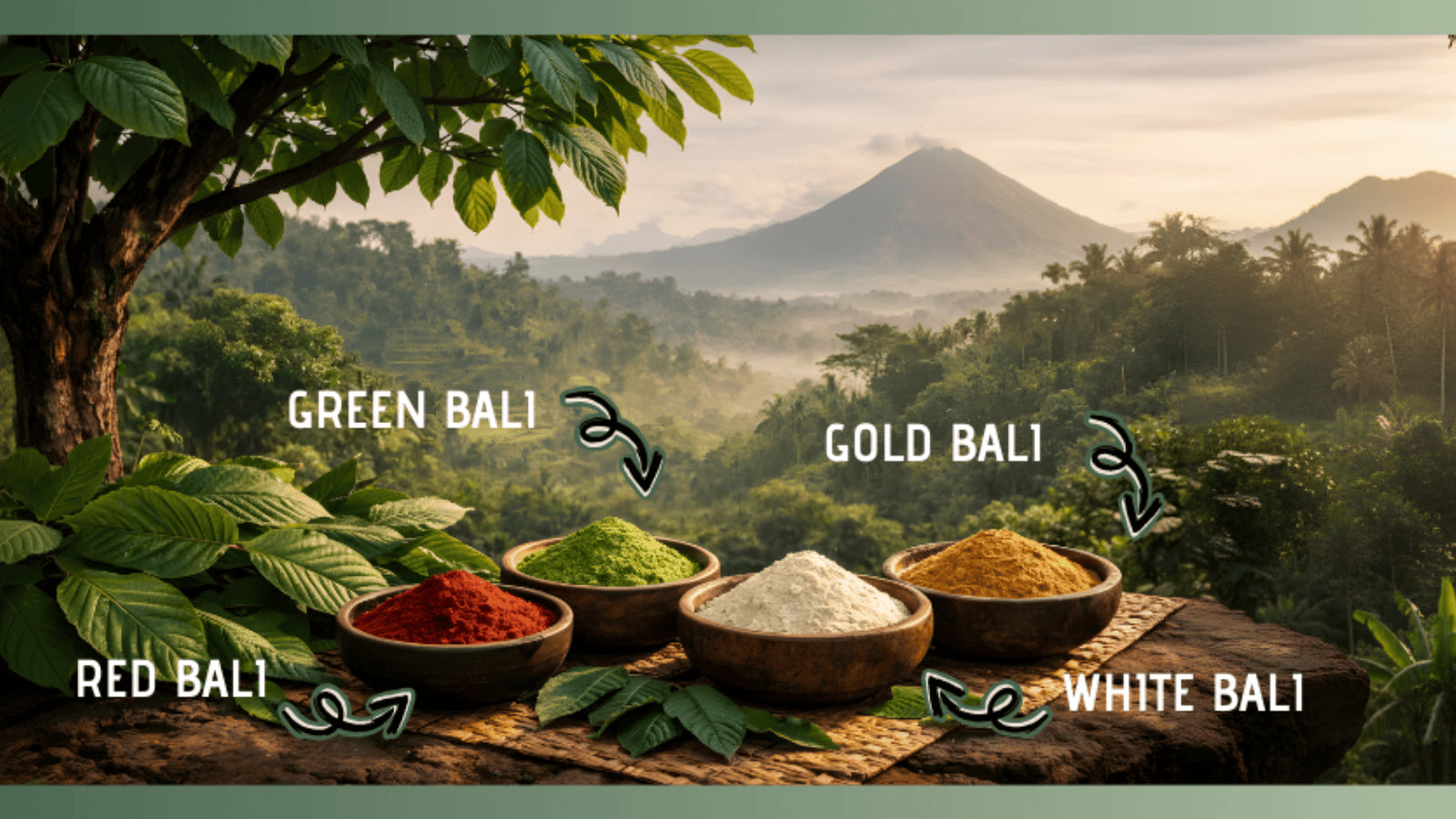
Bali kratom is one of the most recognized names on any kratom shelf, and the strain has held that status since kratom first hit the U.S. market in the 2000s. Around 1.7 million Americans use kratom products today, according to the American Kratom Association, and "Bali" is consistently one of the top three strain names searched online in 2026. Yet for a name that sells this much volume, the strain itself is surrounded by surprising amounts of confusion, including the origin of the name.
The short version: Bali kratom is a popular family of Mitragyna speciosa products named after the Indonesian island of Bali, even though most of what gets sold as "Bali" is grown several hundred miles north on the island of Borneo. The Bali label refers more to the export tradition than the literal growing region, and that one fact alone clears up a lot of the chatter you will see in kratom forums.
This guide walks through what Bali kratom is, where it really comes from, how the three vein colors differ, what effects each one tends to produce, and how to tell a clean Bali product from a sloppy one. The intent is to give you a single reference page that answers nearly every question a new buyer has, plus enough technical detail to be useful to people who have already tried two or three strains.
Table of Contents
- What Bali Kratom Actually Is
- A Quick History of the Bali Name
- The Three Bali Vein Variants
- Alkaloid Profile and Why Bali Is Distinctive
- Typical Bali Effects by Vein Color
- Bali Kratom Dosage and What to Expect
- Who Bali Kratom Suits Best
- Bali vs. Maeng Da, an Honest Comparison
- How to Spot a Quality Bali Kratom Product
- Popular Bali Variants on the Market
- Frequently Asked Questions
- Final Thoughts
TL;DR
- Bali kratom is a popular strain family of Mitragyna speciosa, named after the Indonesian island even though most leaves are actually grown in Borneo.
- It comes in three vein colors: red Bali (relaxing), green Bali (balanced), and white Bali (energizing).
- The strain is known for being mellow, sociable, and well-tolerated, which is why it gets recommended so often for newcomers.
- Mitragynine and 7-hydroxymitragynine are the two key alkaloids in Bali, with a slightly higher 7-OH lean in red Bali compared to many other strains.
- Typical dose ranges run 2 to 4 grams for a light experience and 4 to 6 grams for a stronger one, with effects starting in 20 to 45 minutes.
- Bali tends to last 4 to 6 hours per dose, on the longer side of common strains.
- Quality Bali products carry a current Certificate of Analysis (COA), disclose vein color clearly, and never make medical claims.
- GRH Kratom does not currently sell a SKU labeled Bali, but our Maeng Da and Super Green lines come from the same Borneo growing region and produce a very similar effect profile.

What Bali Kratom Actually Is
Bali kratom is dried, ground leaf from the Mitragyna speciosa tree, processed and sold under the Bali strain name. The plant itself is a tropical evergreen in the coffee family. The species grows wild across Southeast Asia, especially in Indonesia, Malaysia, Thailand, and parts of Borneo. The U.S. kratom industry, including products tracked in NIDA research on kratom use patterns, sources most of its supply from Indonesian farms.

Here is the part most articles get wrong. The name "Bali" does not mean the kratom was grown on the island of Bali. Bali is a small, densely populated tourist island with very little native kratom cultivation. What it does have is a long history as a trading port. Decades ago, kratom from the larger islands of Borneo and Sumatra was shipped through Bali on its way to international buyers, and the label stuck. Today, when you buy Bali kratom, you are almost always buying Borneo leaf that follows the original Bali processing tradition. The species itself, Mitragyna speciosa, is catalogued in the U.S. National Library of Medicine's PubChem compound database alongside its primary alkaloid.
That matters for two reasons. First, calling it a misnomer is technically correct but also misses the point. The Bali label still refers to a real product category with a recognizable effect profile. Second, anyone trying to upsell you on "wild Bali leaves harvested on the island of Bali" is either misinformed or hoping you are. There is no major commercial Bali-island kratom farming.
A Quick History of the Bali Name
The Bali strain became the gateway product for many American kratom users in the late 2000s and early 2010s. Vendors at the time imported large lots of unsorted leaf from Borneo, processed it through Bali ports, and marketed it under the simple, recognizable Bali name. Because it was cheap to ship at scale and produced reliable, even effects, Bali quickly became the default strain that new shops stocked.

Maeng Da, Borneo, Indo, and Malay names came later, often as marketing differentiation. In many cases they describe leaf from the same general region with slightly different sourcing or processing. Bali stayed iconic because it was first to market, easy to remember, and the effect profile genuinely is on the milder, more crowd-pleasing end of the kratom spectrum.
The Three Bali Vein Variants
All Mitragyna speciosa leaves develop a colored stem and central vein as they mature. The vein color is the single biggest clue to what the leaf will feel like, and farmers usually harvest at different points to bring out different effects. Bali, like most kratom strain families, comes in three vein colors.

Red Bali. Harvested from mature leaves with a deep red vein. This is the variant most people picture when they hear "Bali." It leans toward calming, mood-softening effects and is often the default choice for evening use.
Green Bali. Harvested at mid-maturity. The green-veined leaf sits in the middle of the energy-to-relaxation spectrum and tends to produce a balanced, gently uplifting result. Green is the most versatile Bali option for daytime use.
White Bali. Harvested earlier from younger leaves. White Bali is the lightest and most energizing of the three, though it is generally considered milder than a typical white Maeng Da. For a daytime equivalent on our shelves, see the White Maeng Da Kratom Powder line, sourced from neighboring Borneo groves. For the deep-dive on the white-vein variant specifically, see our white Bali kratom vs white Borneo comparison.
A short note on yellow and gold Bali. These exist on the market but are not separate veins. They are usually red Bali that has been re-dried or fermented for a slightly different aroma profile. Treat any yellow or gold Bali as a red Bali variant for dosing purposes.
Alkaloid Profile and Why Bali Is Distinctive
Kratom leaf contains more than 40 active alkaloids. Two of them carry most of the weight, and Bali sits in an interesting place on both. The peer-reviewed pharmacology work catalogued in PMC reviews on mitragynine is the cleanest place to read the underlying chemistry.

Mitragynine. The most abundant alkaloid in any kratom leaf, usually 1 to 2 percent of total dry weight. Bali leaf tends to fall in the upper-mid range of this band, which is part of why Bali feels reliable rather than weak.
7-hydroxymitragynine. A trace alkaloid present at roughly 0.02 percent or less in raw leaf. Red Bali typically carries a slightly higher 7-OH percentage than the average green or white strain, which is part of why the red variant feels more sedating.
Bali's signature is that the two alkaloids stay in close proportion to one another. There is no extreme spike, just a steady, even profile. Maeng Da, by contrast, is often a deliberately stronger leaf with a higher mitragynine percentage. That difference is why Bali is described as smooth and Maeng Da is described as punchy, even when both come from the same general region.
Typical Bali Effects by Vein Color
Effects depend on body chemistry, tolerance, dose, and whether the leaf is fresh. Treat everything below as a generalization rather than a promise.
| Vein | Alkaloid Lean | Typical Effect | Common Dose | Best For |
|---|---|---|---|---|
| Red Bali | Higher 7-OH ratio | Calming, mood-softening, mildly sedating | 3 to 5 g | Evening, post-work, social wind-down |
| Green Bali | Balanced mitragynine | Gently uplifting, sociable, mild focus | 2 to 4 g | Daytime, social settings, light productivity |
| White Bali | Lower 7-OH, lighter alkaloid load | Energizing, clear-headed, sociable | 2 to 3.5 g | Morning, mid-afternoon, easy workdays |
Most users who try all three vein colors describe Bali as a strain that "stays in its lane." It does not produce the buzzy edge that some white Maeng Da products do, and it does not produce the heavy sedation associated with red Borneo or red Sumatra. That moderate behavior is the entire reason Bali has stayed popular for so long.
Bali Kratom Dosage and What to Expect
Dosing is where most new users go wrong, and not in the direction you might think. The most common mistake is taking too much too soon. Bali is forgiving compared to a high-mitragynine strain, but every kratom dose should be approached the same way: start low, wait, observe.

Onset is usually 20 to 45 minutes for powder taken on a mostly empty stomach. Capsules can take 45 to 60 minutes. Duration runs 4 to 6 hours per dose, which is on the longer end of common strains.
A reasonable starting protocol for an adult with no prior tolerance:
- Begin with 1.5 to 2 grams of any color Bali, measured by a scale and not a spoon.
- Wait a full 60 minutes before considering more.
- If the first dose is too light, add another 1 to 1.5 grams.
- Do not redose more than twice in a single day.
- Hydrate, eat a light meal beforehand, and avoid stacking with alcohol or other depressants.
Above 6 grams in a single sitting, side effects (nausea, dizziness, jitteriness) become much more common, and the additional alkaloid load brings sharply diminishing returns. The general guidance in the FDA dietary supplements framework applies here. Kratom is sold as a botanical product, not a regulated drug, so user-side caution does most of the work.
For a full per-vein dose breakdown across strain families, our basic kratom dosing guide is the better long-form reference.
Who Bali Kratom Suits Best
Bali tends to be a fit for three groups of people in particular.
New kratom users. Bali's mild, even profile makes it a forgiving first strain. A red Bali in the early evening or a green Bali on a relaxed Saturday is a low-risk way to learn what kratom feels like before stepping into stronger Maeng Da territory.
Users looking for evening calm without heavy sedation. Red Bali is one of the most-recommended strains for after-work wind-down. It is mellow without flattening you.
Users sensitive to stimulant effects. White and green Bali are noticeably gentler than their Maeng Da or Borneo white counterparts. People who get jittery on a higher-mitragynine white usually do better on white Bali.
Bali is generally not the best fit for users chasing maximum stimulation. If you want a strong, energizing daytime strain, white Maeng Da or a focus blend will outperform white Bali.
Bali vs. Maeng Da, an Honest Comparison
Both Bali and Maeng Da are Indonesian strain families, often grown in the same Borneo region. The differences come down to processing and alkaloid concentration, not geography.
Maeng Da, which translates roughly to "pimp grade," is leaf selected for higher alkaloid content. The label originated as a marketing term for the most potent kratom a vendor offered, and over time it became its own strain category. Maeng Da typically has 15 to 30 percent more mitragynine per gram than a standard Bali.
Practically, that means Maeng Da effects come on faster and feel stronger at the same dose, while Bali rolls in slower and feels smoother. Many regular users keep both on hand: Maeng Da for productive workdays, Bali for evenings and weekends. If you want the technical comparison across both strain families, our Maeng Da guide pairs cleanly with this one.
A reasonable rule of thumb: if a 3-gram Bali dose feels right, a 2.5-gram Maeng Da dose of the same vein color will hit roughly the same intensity.
How to Spot a Quality Bali Kratom Product
Most quality problems with kratom come from sourcing, not the leaf itself. The plant is forgiving. The supply chain is not. Use the checklist below to vet any Bali product before you buy.

- Look for a current Certificate of Analysis (COA). A reputable vendor will publish a recent batch lab test showing alkaloid content, plus screens for heavy metals (lead, cadmium, mercury, arsenic) and Salmonella / E. coli. No COA, no purchase. The American Kratom Association also maintains a Good Manufacturing Practice (GMP) qualified vendor program that is a useful baseline filter.
- Confirm the vein color is disclosed. A bag that just says "Bali" without specifying red, green, or white is almost always blended dust. Reject it.
- Check the grind. Quality Bali powder is fine, uniform, and faintly green or red-tinged depending on vein. Brown, dull, or unevenly ground powder is usually older stock.
- Smell test. Fresh Bali smells earthy and slightly bitter, never musty, sour, or chemical.
- Verify the brand exists outside of one Shopify listing. Real kratom brands have a return policy, customer service, and a track record. Drop-ship listings rarely do.
- Watch for medical claims. Any vendor claiming Bali "treats" depression, anxiety, or addiction is violating FDA marketing rules and should be avoided on credibility grounds alone.
The checklist above also applies to capsules, extracts, and any other Bali format. Form factor changes the convenience, not the underlying quality requirements.
Popular Bali Variants on the Market
Beyond the three vein colors, you will see a few common sub-labels in the wild.
Premium Bali / Super Bali. Usually red Bali harvested from older leaves with a slightly higher alkaloid yield. The Super label is loose. Treat it as a slightly stronger red Bali rather than its own thing.
Bali Gold / Yellow Bali. Red Bali post-processed with a longer drying or fermentation step. Effects sit slightly above red Bali on the sedation scale.
Bali Capsules. Same powder, packed into vegetable cellulose capsules. Each capsule typically holds 500 milligrams of leaf, so a 2-gram dose is four capsules. Capsules are slower-acting but easier on the palate.
Bali Extracts. Concentrated liquid or powder where the alkaloids have been pulled out of multiple grams of leaf and reduced. Extracts hit harder, last shorter, and build tolerance faster. They are not where most users should start with Bali.
GRH Kratom does not currently stock a SKU explicitly labeled Bali, but our Borneo-region Super Green Kratom Powder comes from the same geographic source and produces a very similar profile to a green Bali. Our Red Maeng Da line, sourced from neighboring growing areas, is a reasonable substitute for a red Bali in evening use.

Frequently Asked Questions
Is Bali kratom legal in the U.S.?
Kratom is federally legal in the United States and legal in most states. A handful of states (including Wisconsin, Indiana, Vermont, Rhode Island, and Arkansas) ban the plant outright, and several cities have local restrictions. Bali kratom carries the same legal status as any other strain. Always check your state and city before ordering.
Is Bali stronger than Maeng Da?
No. Maeng Da is consistently stronger gram-for-gram because it is selected for higher mitragynine content. Bali is milder and smoother. People often confuse "longer lasting" with "stronger," and Bali does tend to last slightly longer per dose, but Maeng Da delivers more intensity.
How long do Bali kratom effects last?
Most users report 4 to 6 hours of noticeable effect, with peak intensity in the second and third hour. Capsules and a full stomach can stretch that to 6 to 7 hours.
Can I mix red, green, and white Bali?
You can, but most users find that mixing colors just averages out the effects. If you want a balanced result, start with green Bali at 3 grams rather than trying to blend reds and whites.
What is the best Bali kratom for sleep?
Red Bali at 4 to 5 grams, taken 60 to 90 minutes before bed, is the most common protocol. It tends to soften racing thoughts without producing a hangover the next morning. Avoid stacking with alcohol or sleep aids.
Is Bali kratom safe?
When sourced responsibly, dosed conservatively, and not combined with depressants, kratom carries a side-effect profile most users tolerate well. The most common issues are nausea, constipation, and dependence with daily heavy use. Pregnant or nursing people, people on prescription medications, and people with liver conditions should not use kratom without speaking to a clinician first.
Why does my Bali kratom feel weaker than it used to?
The two usual culprits are tolerance and old stock. Tolerance builds with daily use. The fix is rotating strains and taking 2 to 3 days off per week. Old stock loses potency after roughly 12 months even when sealed. If a Bali bag feels weak after sitting for a year, that is normal.
Are there side effects I should watch for?
Mild nausea, dizziness, dry mouth, constipation, and headaches are the most reported short-term effects. Heavy daily use can produce dependence and withdrawal that resembles a mild opioid pattern. Most users avoid those outcomes by capping daily use, taking days off, and not combining kratom with other depressants.
Final Thoughts
Bali kratom earned its iconic status the same way most reliable products do. It was simple, available, and consistent for long enough that an entire generation of kratom users built their preferences around it. The strain still deserves the recommendation it gets, especially for newer users and for anyone who wants a calmer, longer-lasting profile than what Maeng Da typically delivers.
If you are getting started, a red Bali in the 2 to 4 gram range during a relaxed evening is the most representative way to feel what the strain is about. Green Bali at a similar dose in mid-afternoon will show you the balanced middle of the family. White Bali on a slow morning shows you the light end. You can sample all three for the cost of a few hundred grams of powder.
For shoppers comparing across the GRH catalog, our Borneo-sourced Super Green Kratom Powder and Red Maeng Da Kratom Powder are the cleanest analogues to a green and red Bali respectively. Both lines carry current COAs and ship from the same region the original Bali trade pulled from.

Last housekeeping point: any kratom purchase is only as good as the vendor backing it. The leaf is the easy part. Documentation, lab tests, and a real customer-service line are what separates a reliable Bali order from a coin-flip. Use the vetting checklist above on any vendor, not just on us.
The Bali tradition has held up for two decades because it is mellow, predictable, and friendly to new users. Treat it that way, dose conservatively, and rotate strains rather than chasing a stronger effect, and Bali will keep doing what it has always done.


