



Listen to this page
Read by an AI voice. The full article is read aloud, top to bottom. The table and the two cards are on the page, and what they show is in the text too.
A different order did publish. On 26 August 2026 the DEA placed three 7-OH-related substances, mitragynine pseudoindoxyl, MGM-15 and MGM-16, into Schedule I on a temporary basis in a temporary order effective 26 August 2026 until 26 August 2028. Those three are not kratom leaf, not mitragynine and not 7-OH. They are controlled federally. 7-OH is not.
If you have read that gas station kratom is dangerous and you are looking at a package on your kitchen counter wondering whether it is the thing you were warned about, here is the honest answer. The shop is not the variable. What matters is whether the label tells you what is inside, and whether you can check that claim against a lab result for that batch. A convenience store shelf can hold plain leaf, and a specialist website can ship you a concentrate nobody has characterized. The question is disclosure.
Gas station kratom is a location, not a product
The phrase describes where something was sold. It does not describe what the something is. The DEA's own notice of intent says these products are sold "on the internet and in retail outlets, such as gas stations and smoke shops," and lists the forms as powders, tablets, gummies and sublingual films, and the FDA's July 2025 announcement uses almost the same geography, naming gas stations, corner stores and vape shops. Both are describing a distribution channel that carries several different chemistries, not a single product with a single risk profile. Christopher McCurdy, a University of Florida medicinal chemist who has studied kratom for more than twenty years, put the concentrate end of that channel to Stateline as "akin to having morphine or oxycodone for sale at a smoke shop or a gas station."
That distinction matters practically. If you decide the danger lives at the counter, you will feel safe the moment you order online and stop reading labels. That is the wrong lesson. The habit that works in both places is the same one: read the panel, then check the panel.
One aside, because the phrase follows this topic everywhere. If you arrived from a story using the nickname gas station heroin, the FDA's own formal use of it is the title of a May 2025 letter to health care providers about tianeptine, a different compound that is not in the kratom leaf at all. Reporters extended it to concentrated 7-OH products later. It is a headline, not a label, and it will not tell you which of the things below you are holding.
What is actually on that counter
Three broadly different things get sold under one word. They look similar in a display case. They are not similar in the body.
| What it is | What that means chemically | What the label should give you |
|---|---|---|
| Leaf powder or capsules | Dried, ground Mitragyna speciosa leaf. Mitragynine is the dominant alkaloid and 7-OH occurs in trace amounts | Grams per serving, milligrams of mitragynine per serving, a lot number, and a certificate of analysis for that lot |
| Leaf extract | Leaf concentrated by water or solvent. Alkaloids rise together, and how far they rise depends entirely on the process | Everything above, plus milligrams of 7-OH per serving and the concentration ratio or standardization claim |
| Concentrated or synthetic 7-OH | A single alkaloid isolated or synthesized and dosed on its own, frequently sold under an extract name | Milligrams of 7-OH per serving, stated plainly on the front. This is the disclosure that agencies and chemists keep finding missing |
The DEA notice puts a number on how wide that third category runs. Citing one investigation of products sold between September 2024 and February 2025, it records 7-OH content "ranging from 1 mg to 700 mg in a single dose or serving," at an average cost of about $3.97 per dose. Two packages can sit next to each other on the same shelf, both described as kratom, and differ by a factor of seven hundred in the thing that actually drives the effect. No other consumable category tolerates that.
The same notice, citing the same work, records that chewable and sublingual tablets were the most common formulation among the products identified. Read that as a count of products, not of sales. Neither the DEA nor the study behind it measured volume, so the honest version is that tablets are what an audit of this shelf keeps turning up.
The one question that sorts the whole category
Does this product tell you its 7-OH content, and can you check it? Everything else is commentary.
Both federal agencies have said, in their own words, that this is where the failure is. The FDA's July 2025 announcement states that these products "may not be clearly or accurately labeled as to their 7-OH content and are sometimes disguised or marketed as kratom." The DEA notice of intent is blunter still, describing products "often characterized by ambiguous dosages and misleading marketing, frequently being labeled as 'natural M. speciosa extracts,'" and concluding that "essential information regarding their purity, identity, quantity and long-term safety remain unknown."
Independent chemistry has since measured the gap. A laboratory analysis published in the Journal of AOAC International in January 2026 ran commercial products labelled as kratom extracts against authentic leaf using a validated method. The mitragynine came back at 2.0 to 6.0 milligrams per gram, far below what real leaf or a real leaf extract carries. The 7-OH came back at 22 to 75 milligrams per gram, which the authors put at 5 to 28 percent higher than the label claimed. Their conclusion was that the chromatographic profiles were inconsistent with kratom leaf and that the products were "not kratom extracts, as labeled, but rather synthetic derivatives." One disclosure belongs with it, because the finding helps sellers of leaf, ourselves included: two of the paper's four authors state that they serve as scientific experts and regulatory consultants on botanical dietary ingredients, kratom among them.
Texas puts the ceiling on this. In a health alert dated 2 September 2025, the state health department reported that while kratom products typically carry low 7-OH concentrations, semi-synthetic or synthetic 7-OH products reach up to 98 percent 7-OH, and added the line that should change how you shop: concentrated 7-OH is often added to kratom products. Texas also notes, attributing it to the research literature, that 7-OH shows up to 13 times the potency of morphine. That number is not the state's own. It traces to a 2004 paper by Matsumoto and colleagues and appears in the FDA's own scientific report, where it describes one in vitro assay on isolated guinea pig tissue rather than the drug in general. The DEA notice does not use it. FDA Commissioner Marty Makary put the comparison more loosely, saying 7-OH "is an opioid that can be more potent than morphine."
How to read the panel in about thirty seconds
You do not need a chemistry degree. You need three numbers, a lot code, and a way to reach the lab result.
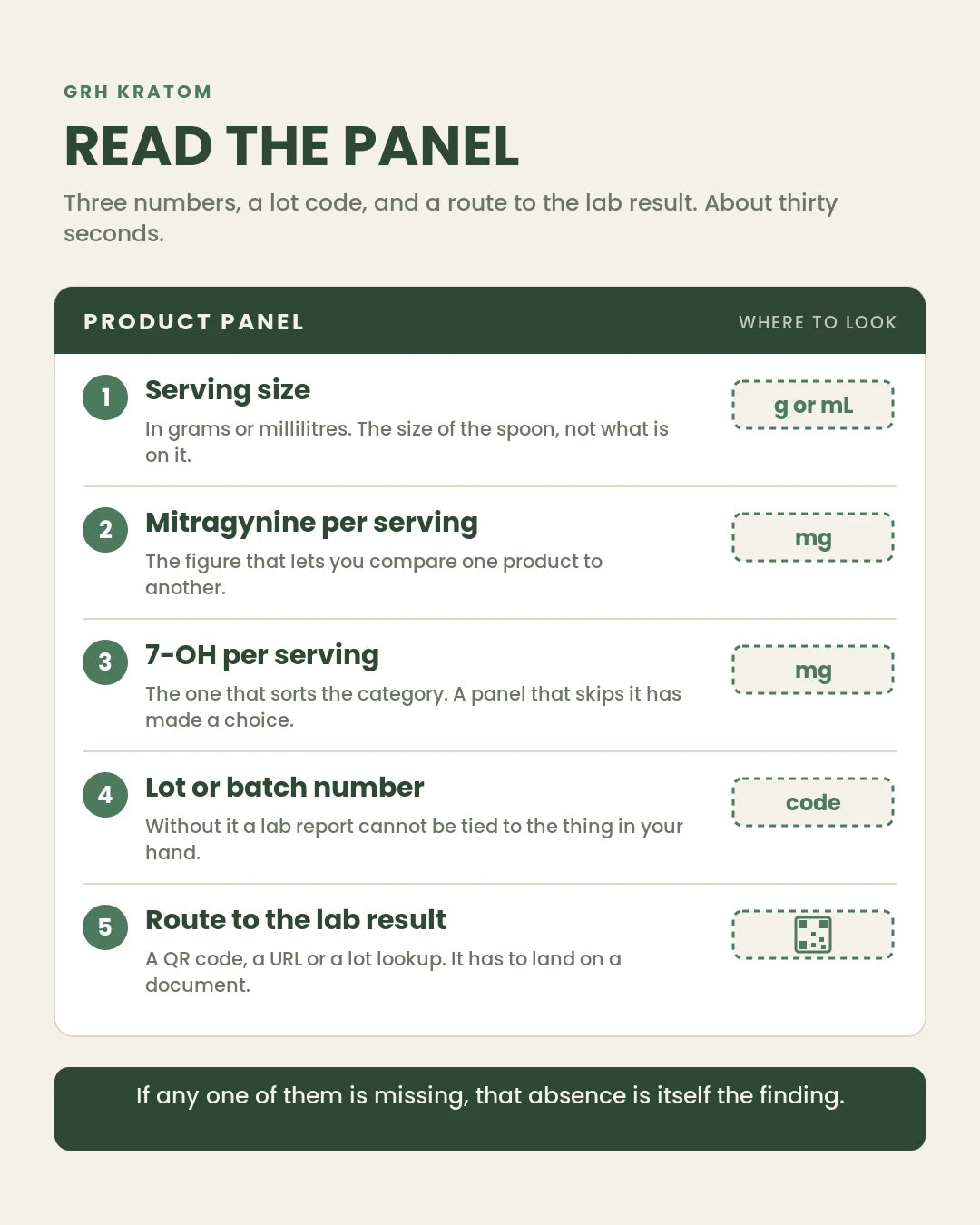
- Serving size, in grams or milliliters. A product that gives you a serving size but no alkaloid figures has told you the size of the spoon and nothing about what is on it.
- Milligrams of mitragynine per serving. This is the number that lets you compare anything to anything. Percentages by weight are marketing until you multiply them out.
- Milligrams of 7-OH per serving. The one that sorts the category. A panel that names every other alkaloid and skips this one has made a choice.
- A lot or batch number. Without it, a certificate of analysis proves nothing, because it cannot be tied to the thing in your hand.
- A route to the lab result. A QR code, a URL, a lot lookup. It has to land on a document, not on a homepage.
Two failure patterns are worth naming, because both pass a casual glance. The first is the panel that gives a big percentage with no serving weight, so "50 percent mitragynine extract" tells you nothing until you know whether the serving is 50 milligrams or a gram. The second is the front label that leans on words like premium, potent, full spectrum or lab tested while the back gives no analyte figures at all. Lab tested is a claim about a document. Ask for the document.
How to read the COA, which is where the panel gets checked
A certificate of analysis is a lab's report on a specific batch. It is the only thing that converts a label claim into a checkable fact, and the easiest place to spot a seller who is bluffing, because a COA is either present and specific or it is not.
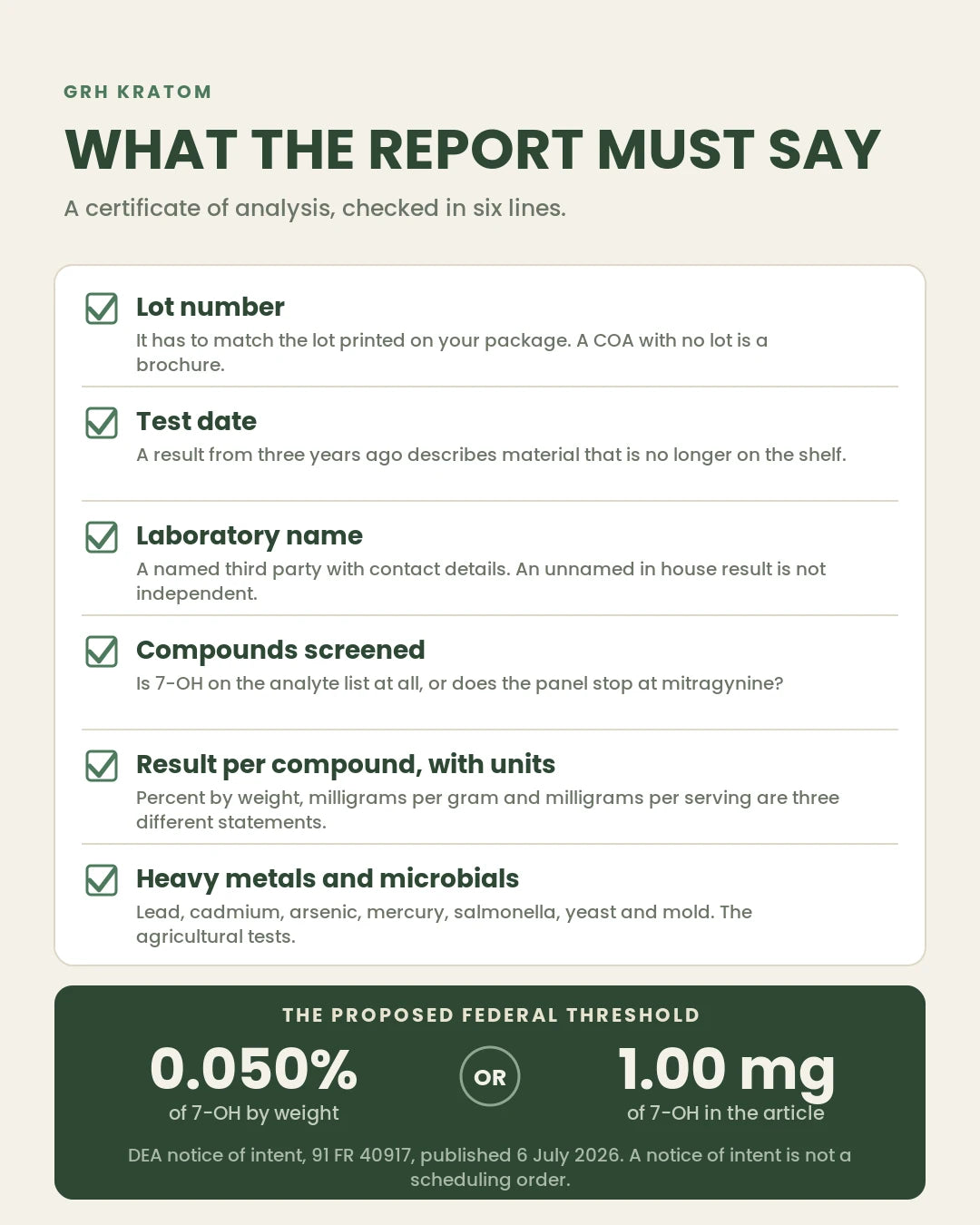
Work down it in this order.
- Does the lot number on the COA match the lot number on the package? This is the whole ballgame. A generic COA for a product line, with no lot, is a brochure.
- How old is the test date? A result from three years ago describes material that is no longer on the shelf.
- Who ran it? A named third party laboratory, with contact details. An unnamed in house result is not independent.
- Is 7-OH on the analyte list at all? A panel that reports mitragynine and stops has answered the easy question and skipped the hard one.
- What are the units? Percentage by weight, milligrams per gram and milligrams per serving are three different things, and vendors move between them in ways that flatter the result.
- Are contaminants covered? Heavy metals, salmonella, yeast and mold. These are the tests that catch the agricultural problems rather than the chemical ones.
If you want the long version with worked examples, we wrote it years ago and it still holds: how to read a kratom lab test.
What 0.050 percent and 1.00 milligram actually mean
Two numbers are about to become the vocabulary of this category, so it is worth knowing what they refer to before anyone sells you a claim built on them.
The DEA notice of intent proposes to capture botanical material containing more than 0.050 percent 7-OH on a dry weight basis. It separately proposes to capture material resulting from synthetic methods, and material derived from Mitragyna speciosa and "further processed to manufacture alternative dosage forms such as extracts, concentrates, processed edibles, or pressed pills," where 7-OH exceeds 0.050 percent by weight or exceeds 1.00 milligram in the article.
Three consequences follow, and they are not the ones the marketing will draw.
First, the proposal is written around content, not around product category. A tablet is not captured because it is a tablet. It would be captured because of how much 7-OH is in it. Second, it names extracts and pressed pills explicitly, which means an ordinary leaf extract is inside the scope of the question rather than automatically outside it. Third, and this is the claim to watch for, the notice pre-empts the natural versus synthetic argument in writing: "the chemical structures of synthetic and naturally occurring 7-hydroxymitragynine are identical," and therefore "the intrinsic pharmacological profile, receptor affinity, and mechanism of action of 7-hydroxymitragynine molecule remain unchanged regardless of its source." Any vendor telling you their concentrate is fine because it is plant derived is making a claim the DEA has already answered.
What the harm numbers do and do not tell you
The large figures quoted in coverage of this topic are real. In March 2026 the CDC published an analysis of National Poison Data System records showing 14,449 kratom exposure reports between 2015 and 2025, a record 3,434 of them in 2025, up roughly 1,200 percent on the 258 reported in 2015. Across the period there were 233 kratom-associated deaths, of which 184, or 79 percent, involved more than one substance, with opioids reported in 62 percent. Melissa Weimer, an addiction medicine specialist at Yale, told Yale Medicine that about two weeks of consistent use is enough to put a person at risk of opioid withdrawal and dependence.
Now the part that almost never travels with the headline. The authors state their own limitation plainly: the data "do not include information about whether the kratom use involved traditional leaf products or semisynthetic or concentrated formulations, such as 7-hydroxymitragynine." Nobody can currently split that total between leaf and concentrate. The DEA notice adds a second complication: because 7-OH is a known metabolite of mitragynine, it is "difficult to distinguish between the ingestion of M. speciosa and other isolated 7-hydroxymitragynine products." So even a blood test does not always settle which product a person took.
So the harm data does not let a leaf seller push those numbers onto somebody else. It also does not let anyone claim the concentrates are responsible for all of it. What it does support is the narrower and better documented claim: the failures cluster where the label does not match the contents, and where the person taking the product had no way to know the dose.
The one clean finding on the other side of the ledger is worth stating precisely. An analysis funded by the National Institute on Drug Abuse and published in Drug Testing and Analysis examined 341 products actually used by 357 US consumers. The samples were primarily whole leaf products rather than extracts, closely matched the fingerprint expected for Mitragyna speciosa leaf material, and the authors found no evidence of adulteration with illicit or prescription drugs. That is a real result, and it is about composition. It is not a safety clearance, and it does not describe the concentrate end of the market.
Where we sit, and what we are not going to claim
GRH Kratom sells kratom: leaf powder, capsules and extracts. Read the next few sentences with that in mind, and hold us to them.
We are not going to tell you that our products are outside the proposed rule. The threshold in the DEA notice is measured by 7-OH content, and it names extracts, concentrates and pressed pills. Any retailer selling an extract is inside the scope of that question until the numbers say otherwise, and that includes us. The only responsible answer about a specific package is its batch number and the lab result for that batch, which is why our lab results page exists.
We are also not going to tell you that leaf is safe because the FDA said its action targets concentrates. The FDA did say the action is "not focused on natural kratom leaf products". That is a statement about the scope of one scheduling recommendation, not a clearance on the plant, and the CDC report cited above notes FDA's Import Alert 54-15, covering detention of kratom dietary supplements without physical examination. If you have read something on this site that implied otherwise, tell us and we will correct it.
What we will say is the thing the evidence actually supports. The category's problem is disclosure. A seller who publishes the 7-OH number for the batch you bought has given you the one fact that decides whether you are holding leaf, an extract, or something that was never leaf at all.
If something goes wrong
Take this seriously even if the product came from a shop you trust. Concentrated 7-OH acts on opioid receptors, and Texas health officials instruct clinicians to administer naloxone for reversal of respiratory depression associated with it.
- Call 911 if someone is difficult to wake, is not breathing normally, or is unresponsive. Do not wait to see whether it passes.
- Poison Control: 1-800-222-1222. Free, 24 hours, and they will talk you through what to watch for. Their online triage tool is available too.
- Naloxone reverses opioid respiratory depression. Most US pharmacies now stock a nasal form over the counter. Having it in the house is not an admission of anything.
- SAMHSA National Helpline: 1-800-662-4357. Free, confidential and staffed around the clock, in English and Spanish, for treatment referrals. Their national helpline page has the text option as well.
One thing needs saying without hedging, because the marketing in this category often implies the opposite. Kratom is not a treatment for opioid use disorder or for opioid withdrawal. The medicines with an evidence base are buprenorphine, methadone and naltrexone, and a clinician prescribes them. If that is what you are reaching for a product to solve, the helpline above is a better call than another purchase.
Two more notes for households. The FDA has said it is "particularly concerned with the growing market of 7-OH products that may be especially appealing to children and teenagers, such as fruit-flavored gummies and ice cream cones", so if a package in your house looks like candy, store it out of reach. And Texas advises keeping these products away from children and pets, whatever the label says. There is no federal age floor on any of this, only a patchwork of state ones. Ours is 21 and over, everywhere, and a counter that does not ask is telling you something about the rest of its process.
Frequently Asked Questions
Is gas station kratom the same thing as the kratom sold online?
Sometimes yes and sometimes no, because the counter is a location rather than a product category. Both channels carry leaf powder, leaf extracts and concentrated 7-OH products. What separates them is what the label discloses and whether a batch certificate of analysis exists to check it.
How can I tell if a product contains 7-OH?
Look for a milligram figure for 7-hydroxymitragynine per serving on the panel, then confirm that figure on a certificate of analysis whose lot number matches the package. If the panel gives no 7-OH figure and the seller cannot produce a matching COA, you cannot tell, and the FDA has said these products are sometimes disguised or marketed as kratom.
What does 0.050 percent 7-OH actually mean on a label?
It is the threshold in the DEA notice of intent that published on 6 July 2026. Material at or below 0.050 percent 7-OH by weight would sit under the proposed line, and material above it, or above 1.00 milligram of 7-OH in the article, would sit over it. A percentage alone is not enough for a consumer, because a small percentage of a large serving can still be a large milligram dose.
Is whole leaf kratom safe because it is not concentrated?
No. Leaf is chemically different from a concentrate, and independent analysis of 341 products used by US consumers found them consistent with leaf and free of adulteration, but that is a statement about composition rather than a clearance on safety. The FDA continues to hold concerns about kratom products more broadly, and the CDC data cannot separate leaf from concentrate.
What should I do if someone reacts badly to a product?
Call 911 if the person is difficult to wake, is not breathing normally or is unresponsive. Naloxone reverses the respiratory depression that 7-OH can cause and Texas health officials tell clinicians to give it. Poison Control is 1-800-222-1222 and the SAMHSA National Helpline is 1-800-662-4357.
What to do with the package on your counter
Go and look at it. Find the serving size, the mitragynine figure, the 7-OH figure and the lot code, and see how many of the four are actually printed. If the 7-OH figure is missing and there is no lot code to chase, you are holding a product that has declined to tell you the one thing that matters, and the shop it came from is beside the point.
If what you want next is the channel comparison rather than the chemistry, our older piece on buying kratom from a gas station versus buying online covers convenience, price and freshness. Just do not let the channel stand in for the label. The lab results page linked above shows what a published batch record looks like, before you trust anybody's, including ours. And if you would rather buy from a shelf you can audit, start with our kratom range and hold it to the same five checks.
Read the panel. Then check the panel. That habit works in a convenience store, on a website, and in whatever the market looks like after the federal rules land.
This article is general information, not legal or medical advice. Kratom law varies by state, county and city and changes without much notice, so confirm the rules where you live before you buy, carry or ship anything. Nothing here is a claim that any product treats, cures or prevents a disease, and these statements have not been evaluated by the Food and Drug Administration. If you are pregnant, nursing, taking prescription medication or managing a health condition, speak to a clinician first.


