



Listen to this page
Read by an AI voice. The full article is read aloud, top to bottom.
If you have been using one of the products this page is about, read this box first.
If someone is difficult to wake, is not breathing normally, or is unresponsive, call 911.
1-800-222-1222. Poison Control, 24 hours, for a question about a product you are holding.
988. The crisis lifeline, anywhere in the United States, by call or text.
Treatment. The federal locator is findtreatment.gov. New Jersey's announcement carries no helpline of its own, so these are the numbers.
Two things stated once. Kratom is not a treatment for opioid use disorder or for opioid or kratom withdrawal; the medicines with an evidence base are buprenorphine, methadone and naltrexone. And every clinical or legal question this page raises belongs with a clinician or a lawyer rather than with us.

Checked 28 September 2026. In New Jersey, three synthetic kratom-related compounds, mitragynine pseudoindoxyl, MGM-15 and MGM-16, have been Schedule I controlled dangerous substances since 25 September 2026. Natural kratom leaf and its own alkaloids are not scheduled in New Jersey or federally. Two state bills, S301 and S1384 with its companion A4222, are in committee and are not law.
The date. The Attorney General's release is dated 25 September and says "starting today". Some coverage says the 26th. The release governs.
Disclosure. We sell kratom leaf powders and capsules, liquid kratom extracts, and kava and kratom drinks, some of them made by other brands. We do not add any of the three compounds to anything. Our certificates of analysis show what each lot was tested for, and most were issued before these compounds were scheduled; the section on what we sell says what that means.
Next review 28 October 2026, or the day either bill moves or the Federal Register publishes anything on the plant's own alkaloids.
No, there is not a New Jersey kratom ban. What happened on 25 September 2026 is narrower than the headlines and worth getting exactly right if you live in the state. Three synthetic compounds that are chemically related to kratom, mitragynine pseudoindoxyl, MGM-15 and MGM-16, became Schedule I controlled dangerous substances in New Jersey. Natural kratom did not. The Attorney General's own announcement says so in one sentence, quoted below, and every claim on this page links to its primary source.
If you buy leaf powder, capsules or a leaf extract, this page tells you what the change does and does not reach. If you have been buying flavored chewable tablets or shots that list any of those three names, or the words "pseudo" or "MGM" on the label, this page tells you what those products are and why they are the ones the state named. Either way, the honest version is shorter than the alarming one.
What New Jersey actually did on 25 September
On 25 September 2026 Attorney General Jennifer Davenport and the Division of Consumer Affairs issued a public alert headed "Three Types of Synthetic Kratom To Be Listed as Controlled Dangerous Substances in New Jersey". Its first sentence: the state is "alerting the public that starting today certain synthetic compounds related to the substance "kratom" will be illegal to possess and sell in New Jersey under a temporary order issued by the federal government."
The compounds are named further down: "in August 2026, the U.S. Drug Enforcement Administration (DEA) temporarily classified three synthetic compounds related to synthetic kratom, mitragynine pseudoindoxyl, MGM-15, and MGM-16, as Schedule I drugs." And the sentence that answers the question in this page's title:
Natural kratom and other synthetic kratom-related compounds not scheduled will not be illegal in New Jersey as a result of this change in federal law. However, no forms of kratom or related synthetic compounds have been shown to be safe or effective to treat any medical condition.
Read both halves. The state did not ban the plant, and the state also took the opportunity to say it does not think any of this is medicine. Acting Director Christopher Peterson's line in the same release: "Consumers should utilize utmost caution with all kratom and related products." That is the tone of the whole document, and it is a fair summary of the state's position: leaf is legal, the state is not endorsing it, and three synthetic derivatives are now Schedule I.
The Attorney General's own framing was blunt about that last part: "We are issuing this alert to make the public aware that these substances will join heroin, LSD, bath salts, and other dangerous drugs on the list of Schedule I drugs banned in New Jersey," and "Any individual or business found violating this ban could face criminal charges."
Why it happened on the 25th, and why nobody in Trenton voted on it
This was not a New Jersey decision in the ordinary sense. No bill passed, no hearing was held, no findings were published. The release explains the mechanism in one sentence: "Under New Jersey law, if the federal government schedules a drug and the Director of the Division of Consumer Affairs does not object, which he did not in this case, that drug automatically becomes scheduled in New Jersey too."
The law behind that sentence is section 24:21-3(c) of the state's Controlled Dangerous Substances Act. When a substance is scheduled federally, the Director "shall similarly control the substance" after "the expiration of 30 days from publication in the Federal Register of a final order", unless within those 30 days the Director objects. The federal temporary scheduling order for the three compounds published on 26 August 2026. Thirty days later is 25 September. The Director did not object, the clock ran out, and the compounds were scheduled. That is why the Attorney General's release, dated 25 September, says "starting today". Some summaries count the thirty days differently and land on the 26th; we follow the release.

How long it lasts is tied to the federal order. The order is "effective August 26, 2026, until August 26, 2028", and it explains that temporary placement runs "for two years, with a possible extension of one year, pending completion of the regular (permanent) scheduling process." New Jersey's release puts it as: "The DEA's temporary scheduling order will remain in effect until at least August 26, 2028, unless the Division changes it."
What the three compounds are, in plain terms
They are not in the leaf. The DEA's order is explicit: unlike the alkaloids that occur naturally in the plant, the three compounds "are produced through synthetic modifications of purified mitragynine isolates" or of another purified kratom alkaloid. In other words, someone takes a purified kratom alkaloid and chemically alters it in a laboratory. The result is a different molecule, and the DEA describes all three as "potent opioids".
The potency figures get quoted loosely, so here they are with their context. The DEA states that "mitragynine pseudoindoxyl is about 100 times more potent than mitragynine at the MOR", the mu-opioid receptor, in preclinical data, and that "MGM-15 and MGM-16 are about 50 and 240 times more potent than morphine in animal models, respectively." Those are receptor and animal figures for purified compounds. They are not a statement that a tablet is 100 times stronger than a cup of kratom tea, and anyone who tells you that has dropped the assay.
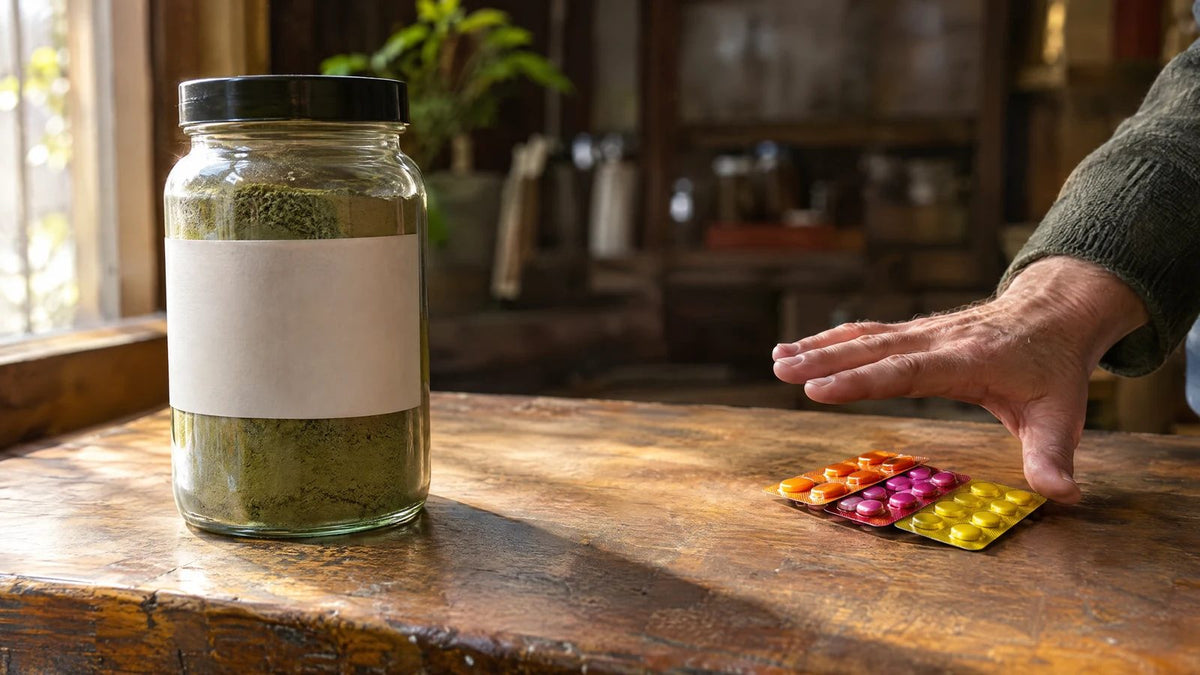
What the products look like matters more for a New Jersey reader than the pharmacology. The DEA's July notice of intent describes products sold under several brand names it lists in the notice, "easily purchased on the internet, as well as in gas stations, corner shops, and vape shops." A study the notice cites looked at 51 products sold online: "Seventy-six percent (39 of 51) of these products were chewable tablets, 18 percent were liquids (9 of 51), and the remaining three were either dried ice cream cones with ice cream (two products) or a chocolate bar (one product)." The tablets "are sold in varying fruit flavors and in bright colors, and prices vary from about $2-4 per tablet or $34.99 per pack".
The DEA also says the market for these things is new: "The first confirmed appearance of mitragynine pseudoindoxyl in consumer products was reported in 2024. The emergence of MGM-15 in commercially available products was in September 2025." And that MGM-16 was included with no evidence it is on the market: "no evidence supports the presence of MGM-16 on the Mitragyna speciosa consumer market", but it was included because leaving it out "would create a regulatory loophole that manufacturers are already poised to exploit."
What stays legal in New Jersey
Natural kratom: leaf powder, capsules made from leaf, teas, and extracts that contain only the plant's own alkaloids. New Jersey has not scheduled the plant, it did not do so on 25 September, and the release says in terms that natural kratom "will not be illegal in New Jersey as a result of this change in federal law." Our standing page on whether kratom is legal in New Jersey covers the background; this page covers the one thing that actually changed.
There is still no state age limit, no labeling rule and no testing rule for kratom in New Jersey statute. Two kratom bills are pending, both are stuck, and only one of them would change that. S301 would add a second kratom alkaloid to the state's Schedule I; the Senate health committee advanced it on 16 March 2026 and it was referred to the Budget and Appropriations Committee the same day, where it has sat since. New Jersey Monitor's account of that hearing records Senator Joe Vitale calling the compound "a dangerous drug" that is "highly addictive", and a colleague, Senator Raj Mukherji, saying "I still have some trauma about Schedule I, just from cannabis," in a committee that advanced the bill unanimously.
The other bill would regulate the plant rather than schedule anything. S1384, with Assembly companion A4222, would create a "New Jersey Kratom Consumer Protection Act". It would ban sales to anyone under 21, require the sign "SALE OF KRATOM TO PERSONS UNDER 21 YEARS OF AGE IS PROHIBITED BY LAW.", ban "any kratom product containing any synthetic alkaloids", require labels to state alkaloid content, and set civil penalties of "up to $500 for the first offense and up to $1,000 for a second offense". It was referred to the Senate Commerce Committee on 13 January 2026 and no further action is recorded. A version of it died in the last session. So the rules a responsible New Jersey shop follows on age and labeling are, for now, the shop's own.
How to tell whether a product you have is covered
Turn it over and read the ingredient panel and the product name. The three scheduled compounds are sold under their own names and nicknames. The DEA's July notice lists products labeled with "MGM-15" by name and milligram amount, and others sold as "Pseudo" blends. If the label says pseudoindoxyl, pseudo, MGM-15 or MGM-16, it is being sold as one of the compounds New Jersey scheduled on 25 September. If it names only kratom leaf, Mitragyna speciosa or mitragynine, it does not name a scheduled compound, but a label is the seller's claim, not proof: the DEA found pseudoindoxyl products marketed "with claims that the products are "kratom."" The document that settles it is a certificate for that lot whose panel names all three compounds.

The federal order says possession is unlawful in any amount: "Possession of any quantity of mitragynine pseudoindoxyl, MGM-15, or MGM-16 in a manner not authorized by the CSA on or after August 26, 2026 is unlawful". New Jersey's release says the compounds are illegal "to possess and sell" and says nothing about quantity. There is one difference worth knowing. The Department of Justice announcement of the federal order says federal prosecutors "will exercise enforcement discretion when only incidental trace amounts of MGPI are confirmed in a product otherwise consistent with botanical kratom", while adding that this "does not create a legal exemption". The same announcement says the policy does not apply to MGM-15 or MGM-16, "or products containing manufactured, concentrated, fortified or intentionally added MGPI." New Jersey's release contains no equivalent statement. We are not going to tell you what that means for a particular bottle in a particular county, because that is a question for a lawyer, and we would rather say so than guess in print.
A word on the word "extract", because it confuses people in both directions. A kratom extract is a concentrated preparation of the leaf's own alkaloids. It is not one of the three scheduled compounds, and New Jersey did not schedule it. What the DEA is describing when it writes about "synthetic modifications of purified mitragynine isolates" is a different thing: a molecule the plant does not make. A certificate that names the three compounds sorts the two. Our general explainer on whether kratom is a controlled substance covers the leaf's own federal status, which this change did not alter.
What this means for what we sell
We sell kratom leaf powders and capsules, liquid kratom extracts, and kava and kratom drinks, including some made by other brands. The certificates on our lab results page are the most recent we hold for each product, and each one shows exactly what that lot was tested for. Most were issued before these compounds were scheduled and report the plant's main alkaloids only, which means they were not looking for the three. The laboratory that tests our current GRH, King K and GUD Tonics lots has since added a panel that names all three, and newer certificates carry it; read the one for the lot you are considering rather than our summary of it. If a certificate for a product you are considering, ours or anyone's, does not name the three compounds, that is the question to ask before buying it in New Jersey now.
Our kratom range is unchanged in New Jersey. We would rather put that sentence at the end of a page that explained the law than at the top of one that did not, and nothing on this page is a reason to buy more of anything than you would have bought before 25 September.
If you have been taking one of the scheduled products
This is the part the state's release does not cover, and it is the part that matters most to some readers. The DEA reports that pseudoindoxyl produced signs of physical dependence in rodents, and its order carries one human case that is worth reading closely. A 34-year-old man moved from kratom powder to concentrated tablets and then to mitragynine pseudoindoxyl tablets, eventually taking it many times a day, including at night. He "attempted to reduce dose and frequency of use but was unsuccessful due to withdrawal characterized as "crawling out of skin symptom."" He presented "with a clinical opiate withdrawal scale score of 31 (categorized as severe)".
If any of that is familiar, the products you have been using are now Schedule I in New Jersey, and a supply that has become illegal is not one to plan around. That is exactly the situation in which stopping abruptly and alone is the wrong plan. The numbers in the red box at the top of this page are the ones to call. A clinician can prescribe the medicines that have evidence behind them for opioid withdrawal, and kratom leaf is not one of them; using leaf to come off a pseudoindoxyl tablet is the substitution this page will not recommend. KYW Newsradio, reporting the change on 25 September, described them as "some kratom products commonly sold in gas stations"; nobody at the gas station is going to tell you any of this, which is why it is here.
Questions people are asking
Is kratom illegal in New Jersey now?
No. On 25 September 2026 New Jersey's Attorney General announced that three synthetic kratom-related compounds, mitragynine pseudoindoxyl, MGM-15 and MGM-16, are Schedule I controlled dangerous substances in the state. The same announcement says natural kratom and other unscheduled compounds will not be illegal as a result. Leaf kratom, capsules and extracts that contain only the plant's own alkaloids are not affected.
When did the New Jersey change take effect?
25 September 2026. The Attorney General's release is dated that day and says starting today. Some coverage and search summaries say 26 September; the release does not. The date follows from New Jersey's controlled dangerous substances statute, which makes a federally scheduled substance controlled in the state 30 days after the Federal Register order unless the Director of the Division of Consumer Affairs objects. The federal order published on 26 August 2026 and the Director did not object.
How long does the New Jersey scheduling last?
The federal temporary order runs from 26 August 2026 until 26 August 2028, with a possible one year extension while permanent scheduling is considered. New Jersey's release says the DEA's temporary order will remain in effect until at least 26 August 2028 unless the Division changes it.
Are there other New Jersey kratom bills?
Two, and neither is law as of 28 September 2026. S301 would add a second kratom alkaloid to the state's Schedule I; a Senate committee advanced it on 16 March 2026 and it has sat in the Budget and Appropriations Committee since. S1384 and its Assembly companion A4222 would create a New Jersey Kratom Consumer Protection Act with a 21 and over rule, a ban on synthetic alkaloids and labeling requirements; it was referred to the Senate Commerce Committee on 13 January 2026 and no further action is recorded.
If a bill moves, or the Federal Register publishes anything about the plant's own alkaloids, the box at the top of this page changes first and the rest follows. If you find a sentence here that its source no longer supports, tell us through the contact page and it gets corrected with the date on it.
Disclaimer: this page summarizes publicly available material as of 28 September 2026 and links to primary sources so you can check them. It is general information, not legal or medical advice, and no substitute for counsel in New Jersey or for a clinician. Statements about botanical products have not been evaluated by the Food and Drug Administration, and no product is intended to diagnose, treat, cure or prevent any disease.


