



Federal position, verified 26 August 2026. DEA's notice of intent of 6 July 2026, at 91 FR 40917, is titled "Schedules of Controlled Substance: Temporary Placement of 7-Hydroxymitragynine Above a Specified Threshold in Schedule I." It is still a proposal. No order has published under it, and the comment period on the threshold was extended to 10 September 2026. A separate temporary scheduling order took effect on 26 August 2026, at 91 FR 54948, and reaches three named derivatives, mitragynine pseudoindoxyl, MGM-15 and MGM-16. That one sets no threshold and no minimum quantity.
Reviewed 26 August 2026. Next review 8 September 2026, or the day North Dakota's special session concludes, whichever comes first.
Ask what a legal kratom market would look like and you usually get an argument about one threshold. Ask what it looks like on a shelf, in your hand, on the back of a package, and the argument runs out of road fast. There is one worked answer in the United States. It is twenty-five pages long, it lives in Rhode Island, and almost nobody selling kratom has held their own inventory up against it.
This guide does that translation. Just the numbers, turned into things a buyer can look for on a panel and check against a lab result. It is a checklist, not legal advice: outside Rhode Island none of it binds anybody.
Rhode Island is the only place a regulated kratom market is written down
Every other state conversation about kratom is a conversation about whether to allow it. Rhode Island had that conversation, closed its market, then reopened it on terms, and the terms are the interesting part. The reopening did not happen because the industry made a persuasive case. It happened on the second attempt, after a veto, and the version that finally moved was longer and stricter than the one that failed. Others have written kratom rules without closing a market first. Surveying the 2025-26 sessions, the Rockefeller Institute of Government found three state approaches: ban it, schedule it, or build a commercial market with limits. KFF Health News reported in March 2025 that industry-backed consumer protection bills had passed in fourteen states.
If what you actually came here for is the plain legal question, whether you can buy, carry and ship kratom in Rhode Island right now and what the age rule is, we have a separate and much fuller answer to that: our Rhode Island kratom legality guide. Go there for legality. Stay here for the shelf.
The operative section is R.I. Gen. Laws section 21-28.12-3, "Kratom and kratom product limitations." It opens broader than most product rules: a person shall not prepare, distribute, sell, possess, or advertise any of the things that follow. Then it lists twelve.
Four numbers decide whether a product is legal
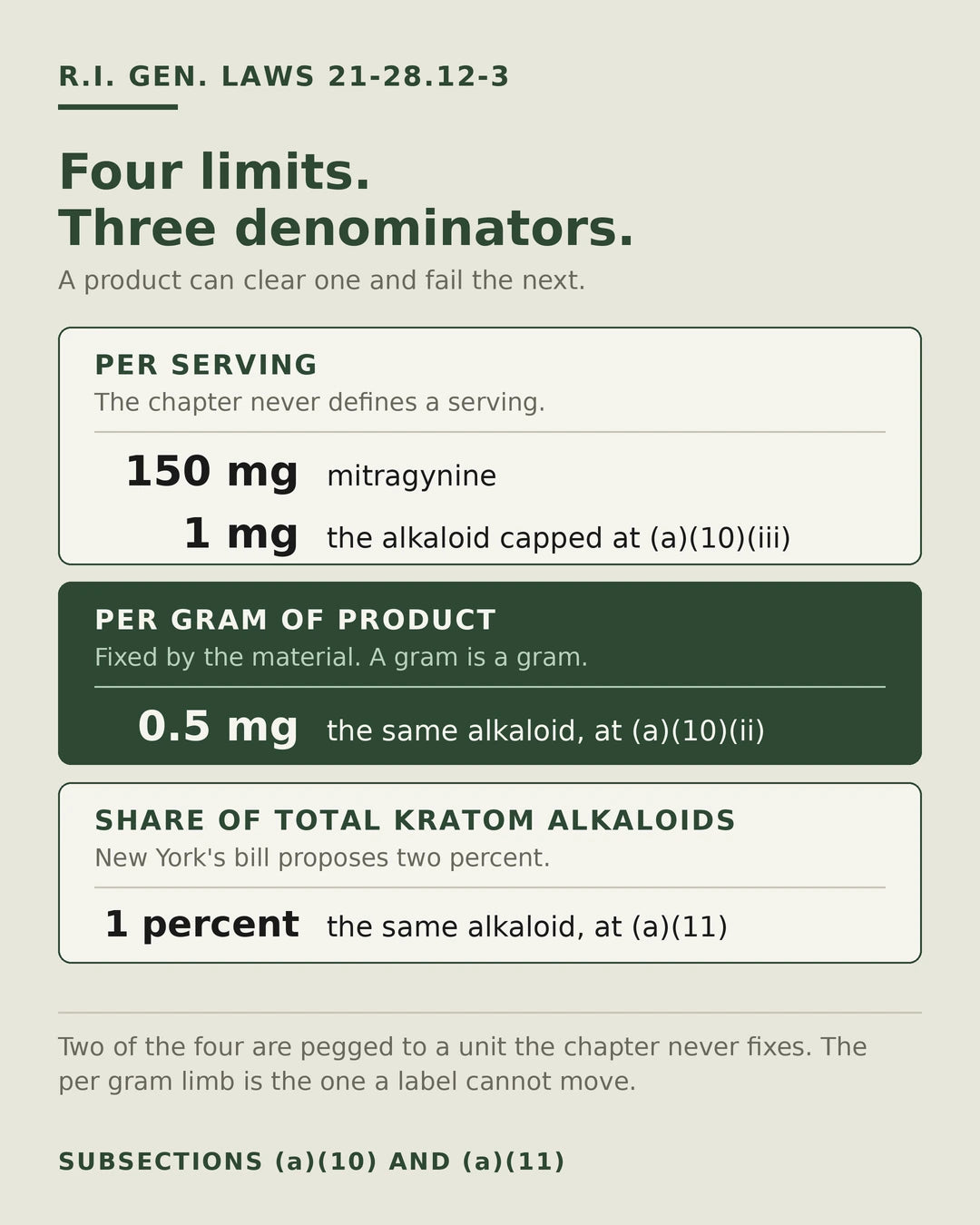
Subsections (a)(10) and (a)(11) carry the concentration rules. These are the ones a buyer can actually verify from a certificate of analysis, so here they are without the statutory throat-clearing. Three of the four turn on one alkaloid, the one named in the federal notice quoted in the status box. Call it the named alkaloid.
- No more than 150 mg of mitragynine per serving.
- No more than 0.5 mg of the named alkaloid per gram.
- No more than 1 mg of the named alkaloid per serving.
- No more than one percent of it as a share of total kratom alkaloids.
Two of those four are stated per serving. One is stated per gram. One is stated as a ratio inside the alkaloid fraction. That is not sloppiness, it is three genuinely different questions about the same powder, and a product can pass one and fail another without anything about it changing.
Notice what the one percent figure does. It is not a rule about how much of the named alkaloid is in the package. It is a rule about what fraction of the alkaloids it makes up, which describes the character of the material rather than the size of the dose. New York's proposed threshold uses the same denominator and sets it at two percent. Rhode Island halved that and made it law.
The word the statute never defines
Here is the part that has gone unremarked, and it changes how much weight to put on each of those four numbers.
The definitions section, section 21-28.12-2, defines fourteen terms: contraband kratom products, department, distributor, importer, kratom, kratom extract, kratom product, licensed, manufacturer, person, place of business, retailer, sale or sell, and synthesized material. Read that list again and see what is missing. "Serving" is not on it.
So two of the four limits, the 150 mg of mitragynine and the 1 mg of the named alkaloid, are pegged to a unit the chapter never fixes. The manufacturer sets it on the label, and a per-serving limit becomes partly self-defined. Split a tablet's stated serving in half on the panel and the arithmetic moves. Nothing in the jar changes.
The limb that cannot be moved that way is the per-gram one. A gram is a gram. Whatever a company decides to call a serving, the amount of the named alkaloid sitting in every gram of the material is fixed by the material itself, which is exactly why 0.5 mg per gram is the number worth memorising if you only memorise one. It bites on a concentrate, and the commentary has mostly walked past it.
Three rulebooks, three denominators, one product
This is the most useful thing to understand before reading any vendor's compliance claim. When a seller says a product is "under the limit," the honest follow-up is: under which limit, divided by what?
| Rule | The threshold | What it divides by |
|---|---|---|
| Federal DEA notice of intent. A notice of intent is not a scheduling order; see the status box above | More than 0.050 percent of the named alkaloid by weight, or more than 1.00 mg of it in the article | The weight of the whole article. The second limb divides by nothing: it is an absolute amount |
| New York Senate bill S8925A. A bill, see the status box above | More than 2 percent of total alkaloids, or more than 1 mg of the named alkaloid per serving | The alkaloid fraction, or a serving |
| Rhode Island, section 21-28.12-3(a)(10)(ii) | More than 0.5 mg of the named alkaloid per gram | A gram of product. Fixed, and not relabellable |
| Rhode Island, section 21-28.12-3(a)(11) | More than one percent of total kratom alkaloids | The alkaloid fraction, at half New York's proposed figure |
Four rows, no two asking the same question. A percentage by total weight, an absolute milligram count in the article, a percentage of the alkaloid fraction, a count per gram, a count per serving. Hand one certificate to all four and you can get four different verdicts. The disagreement is arithmetic, not chemistry. Nobody is measuring anything different. They are dividing by different things, which is why a compliance claim with no denominator attached is not a claim at all. If a vendor page says "meets all applicable limits," ask which jurisdiction, which subsection, which unit.
Synthetics: a ban with no threshold at all
Subsection (a)(5) is short and does not negotiate. It prohibits any kratom product containing "any synthetic alkaloids including synthetic mitragynine, synthetic 7-hydroxymitragynine, or any other synthetically derived compounds of the kratom plant." There is no permitted level. Zero is the number.
And Rhode Island's definition of synthetic is wider than the federal one, which matters more than it sounds. The chapter's "synthesized material" reaches any alkaloid or derivative created by chemical synthesis or biosynthetic means, naming fermentation, recombinant techniques, yeast derived material and enzymatic techniques as examples rather than the whole list, and reaches separately any alkaloid in kratom exposed to chemicals or processes that would confer a structural change. The federal notice of intent instead reaches material further processed to manufacture alternative dosage forms. Not the same test, and not interchangeable, because a product can sit outside one and inside the other.
The consequence for a shopper is unglamorous. On the synthetics question a milligram figure does not help you. You need to know how the material was made, and the only people who know are upstream of the shop.
What is allowed to be in it, and what the format cannot be
Contaminants get their own subsection. Under (a)(6), a kratom product may not exceed these heavy metal limits, in parts per million: arsenic under 2, cadmium under 0.82, lead under 1.2, mercury under 0.4. Those four should already be on any competent certificate of analysis, which makes this the easiest limb to check yourself. Pull the COA, find the metals panel, compare four numbers. Done.
Subsection (a)(4) covers extracts: residual solvents may not exceed what is allowed in U.S. Pharmacopeia 467. A solvent-extracted concentrate whose certificate has no residual solvent panel is a gap you can see from across the room.
Then rules about format rather than content, catching products before any number is measured.
- (a)(1) prohibits a kratom product that is a conventional food or beverage, or is labelled as one. An entire product category disappears on that sentence alone.
- (a)(7) prohibits anything combustible or intended for vaporization, aerosolization or injection.
- (a)(8) prohibits anything that mimics a candy product, or is packaged or advertised in a way that can reasonably be considered to appeal to people under twenty-one.
- (a)(2) and (a)(3) prohibit anything poisonous, harmful or injurious to health, and anything containing a substance other than a non-psychoactive substance needed to make the product.
Know which kind you are up against. A content rule you can answer with a lab result. A format rule you cannot answer at all. The product either is a beverage or it is not.
The package itself has to pass a test
Subsection (a)(9) requires child-resistant packaging meeting the standards in 16 C.F.R. 1700.15(b), tested in accordance with 16 C.F.R. 1700.20. That is not a vague instruction to use a sturdy lid. It is the federal poison prevention packaging standard, with measured effectiveness rates from panel testing, and the statute puts the duty on the licensee for every product it sells for human consumption.
Most people skip this limb when they picture regulation, and it is the one an ordinary buyer can assess in two seconds with no documents at all. Pick the package up. Does the closure resist a determined four-year-old, or pop open like a mint tin?
What the label is required to say
Subsection (a)(12) is where the statute gets specific about disclosure. Clearly visible labelling must include, among other things:
- A recommendation to consult a healthcare professional before use.
- A statement that kratom may be habit forming. Not a hedge. That sentence, on the package.
- A statement that kratom is not safe for use while pregnant or breastfeeding.
- A warning that the product may result in dangerous medication interactions.
- The FDA disclaimer in full: these statements have not been evaluated by the United States Food and Drug Administration, and this product is not intended to diagnose, treat, cure or prevent any disease.
- The net quantity of contents, in numerical count or in United States Customary System volume or weight.
- The amount of mitragynine and of the named alkaloid in a serving, a recommended amount per serving, and a recommended number of servings in twenty-four hours.
- The total amount of mitragynine and of the named alkaloid in the product.
- A statement that the product should be stored safely and out of the reach of children.
- The name and physical address of the manufacturer. Not a post office box. The statute says so.
Take that list to any shelf in the country and count how many packages survive it. The habit-forming line alone removes a great many. The non-PO-box address removes more, and it is the quietly devastating one, because a manufacturer willing to print a real street address can be found by a regulator, a plaintiff's lawyer, or a customer with a complaint.
Two of those bullets deserve a second look together: milligrams per serving, and the total in the product. Both are required. That closes the trick where a panel gives you a big percentage, no serving weight and no total, and leaves you to guess. You get the dose and you get the container. Both, or the product is out.
Licensed sellers only, and contraband for everything else
Subsection (b) closes the supply chain. Kratom sold at retail must be sold by a licensed retailer and must be obtained from a licensed manufacturer, importer or distributor. Section 21-28.12-6 builds out the licences, one class for each kind of business, a separate licence for each place of business, renewed annually.
Then subsection (c), one line, carrying the enforcement weight of the whole chapter: all kratom and kratom products that do not comply with subsection (a) shall be deemed contraband. Not mislabelled. Not subject to a warning letter. Contraband. The chapter goes on to provide for confiscation, penalties, a hearing right, an appeal to district court, penalties for unlicensed business, suspension and revocation, taxation, and a restricted receipt account for the money.
That cluster is the tell. This is not a labelling guideline with a polite compliance date attached. It is a licensing and revenue regime with a seizure power bolted to the front of it, which is roughly what every other risky consumer category already looks like.
Why this version passed when the friendlier one did not
One short section, because it explains the shape of everything above. Rhode Island Current reported from the House floor on 29 May 2025 that the bill had already passed both chambers once, in June 2024, and that Governor Dan McKee vetoed it, citing regulatory confusion and the advice of state health officials. What came back ran to twenty-five pages, took input from the Department of Health and from Behavioral Healthcare, Developmental Disabilities and Hospitals, and added a licensing and tax mechanism the earlier bill did not have. The same reporting notes that industry advocates bristled at the length.
Sit with that. The only kratom repeal in America is the one the industry liked least, and the strictness is not a bug attached to the win. It is the thing that bought the win.
Where GRH sits in this
Read the next few paragraphs knowing what we are. GRH Kratom sells kratom: leaf powder, capsules and extracts. We have a commercial interest in you buying it, and that interest points one way on everything above.
So here is the part our interest argues against. We have not run our full range against the Rhode Island list and published the result, and until we do, we are not going to imply that every product on this site would clear it. The concentration limbs are where the doubt lives. There are extract products on the American market today, ours included in that sentence, that we would not bet on against the per-gram limb, and anybody claiming otherwise about their own catalogue without showing per-gram figures is asking you to take their word for it.
What we can point at is the evidence. Our lab results page is where published batch records live, and the right way to use it is adversarially: find the lot code on your package, find the matching certificate, do the arithmetic yourself rather than accepting anybody's summary of it, ours included. If a lot you own is not there, ask us for it. If the numbers do not support a claim we have made on this site, tell us and we will correct the claim rather than the numbers.
Nothing in that chapter binds a seller in another state, and we are not pretending it does. The point is narrower. When the only fully written answer in the country exists, refusing to measure yourself against it is a choice.
If something goes wrong
This belongs in a shopping guide, because the people most likely to need it bought something whose contents were never disclosed.
- Call 911 if someone is difficult to wake, is not breathing normally, or is unresponsive. Do not wait to see whether it passes.
- Poison Control: 1-800-222-1222. Free, confidential, and they will tell you what to watch for. There is an online triage tool as well.
- SAMHSA National Helpline: 1-800-662-4357. Free, confidential, staffed around the clock in English and Spanish, for treatment referrals. The helpline page has a text option too.
And one thing without hedging, because the marketing in this category often implies the opposite. Kratom is not a treatment for opioid use disorder or for opioid withdrawal. The medicines with an evidence base are buprenorphine, methadone and naltrexone, and a clinician prescribes them. If that is what you are trying to solve with a purchase, the helpline above is a better use of the next ten minutes.
Frequently asked questions
Does the Rhode Island rulebook apply to me if I live somewhere else?
No. R.I. Gen. Laws Chapter 21-28.12 binds sellers and buyers in Rhode Island only. It is useful elsewhere because it is the country's only fully written answer to what a regulated kratom product looks like, so the numbers travel as a private checklist even where they carry no legal weight.
What is the one number a buyer can actually check?
0.5 milligrams per gram of product, of the alkaloid named in section 21-28.12-3(a)(10)(ii). A gram is a gram. It cannot be redefined on a label the way a serving can, so it is the only one of the four concentration limits that a seller cannot move by changing the packaging.
Does a kratom extract automatically fail the Rhode Island rules?
No. The concentration limits are written around content rather than product category, so an extract sits inside the scope of the question rather than automatically outside the law. Two things fail by format alone: anything containing synthetic alkaloids, under 21-28.12-3(a)(5), and anything that is or is labelled as a conventional food or beverage, under (a)(1).
What should I do if someone reacts badly to a kratom product?
Call 911 if the person is hard to wake, is not breathing normally or is unresponsive. Poison Control is 1-800-222-1222 and the SAMHSA National Helpline is 1-800-662-4357. Kratom is not a treatment for opioid use disorder.
Now go and hold your own product against the list
The whole point of the guide, and it takes ten minutes with a package and a phone. For the package, our gas station kratom guide is the primary how-to.
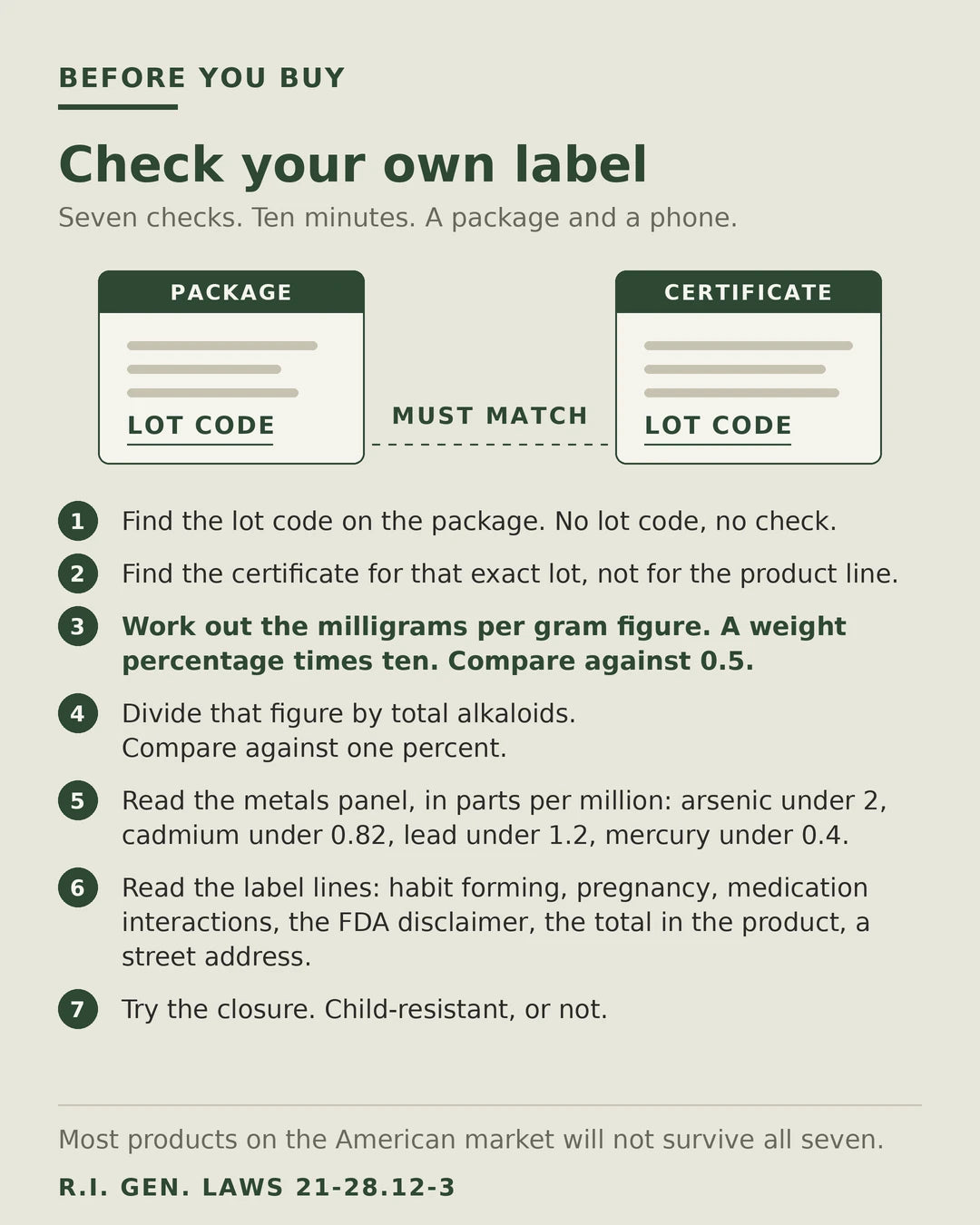
- Find the lot code on the package. No lot code, no check. Stop, and note that as your result.
- Find the certificate for that exact lot. A certificate for the product line with no lot number is a brochure with a chart in it.
- Work out milligrams of the named alkaloid per gram. If the certificate gives a weight percentage, multiply by ten. Compare against 0.5.
- Divide the named alkaloid by total alkaloids. Compare against one percent.
- Read the metals panel. Arsenic under 2, cadmium under 0.82, lead under 1.2, mercury under 0.4, in parts per million.
- Read the label lines. Habit forming. Pregnancy. Medication interactions. FDA disclaimer. Total in the product, not just per serving. A street address.
- Try the closure. Child-resistant, or not.
Most products on the American market will not survive all seven, and the failures cluster in interesting places. Leaf powder usually sails through the concentration limbs and stumbles on the label lines. Concentrates usually pass the label lines and stumble on the per-gram figure. Neither pattern is a verdict on the plant. Both are a verdict on a market nobody ever asked to answer a written question.
If you are reading this from a state that has closed its market, we cannot sell to you: GRH does not ship kratom where it is prohibited, and our shipping policy carries the current list. Check it there, not here. The seven checks travel anywhere, and our batch records are on the lab results page. Hold us to them.
This article is general information, not legal or medical advice. Kratom law varies by state, county and city and changes without much notice, so confirm the rules where you live before you buy, carry or ship anything. Statutory text is summarised here for readability; read the sections themselves before relying on them. Nothing here claims that any product treats, cures or prevents a disease, and these statements have not been evaluated by the Food and Drug Administration. If you are pregnant, nursing, taking prescription medication or managing a health condition, speak to a clinician first.


