



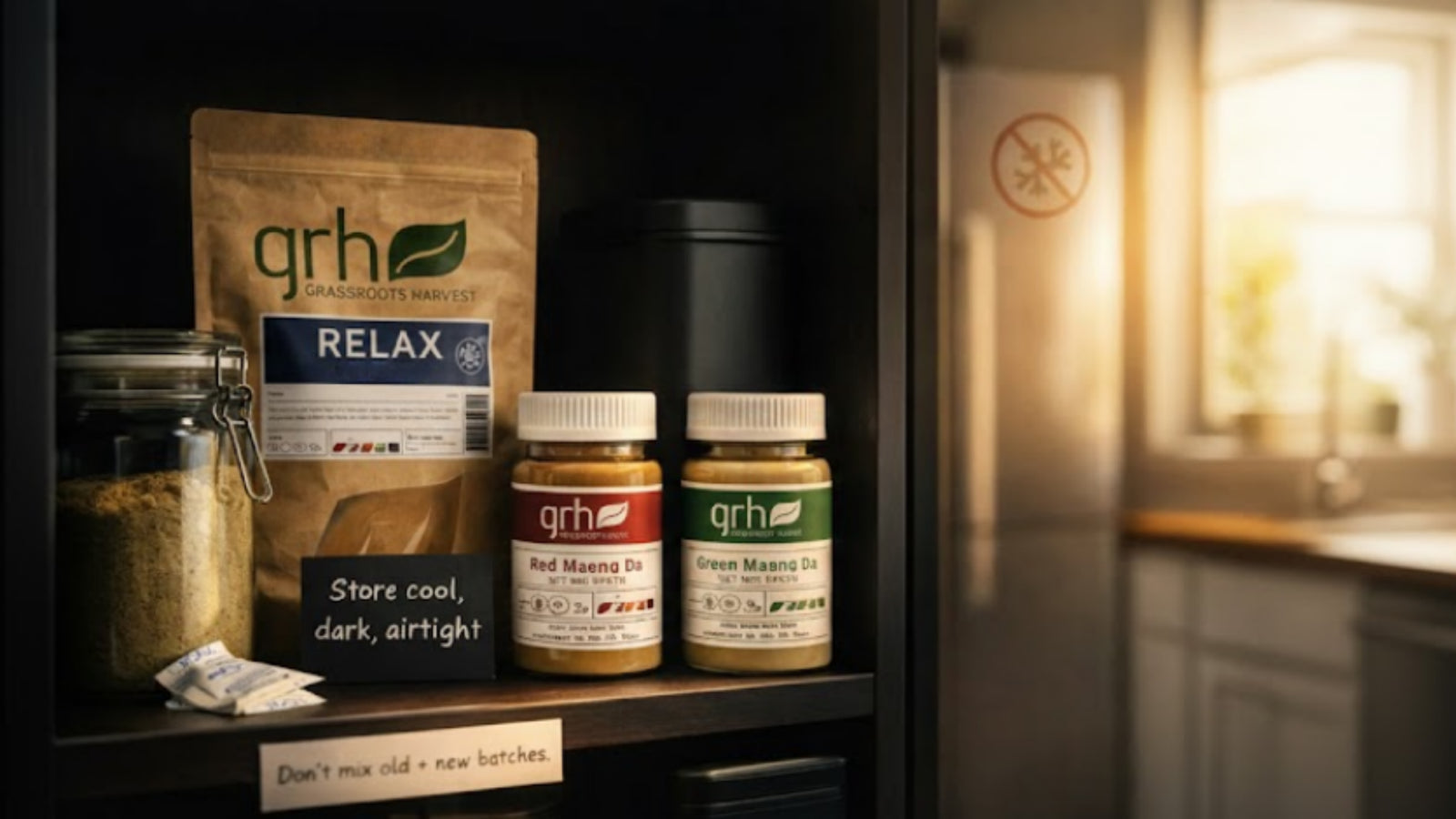
Most kratom users figure out the hard way that a fresh bag and a six-month-old bag do not feel the same. The bag from last spring still smells earthy, but the kick is dulled, the green looks browner than it should, and the dose that used to land is now a vague hum. So, does kratom expire? The honest answer is yes, and the way you store it matters more than the date stamped on the pouch.
Past-year kratom use in the United States is small but real, with one nationally representative analysis estimating roughly 0.7% of U.S. adults reporting past-year kratom use, a figure later studies have nudged closer to 1.8% in 2022 and 2023. Translate that into bags of powder, capsule jars, and extract bottles sitting on shelves across the country, and you get a lot of kratom slowly losing its punch because the storage conditions are wrong.
We have spent years sourcing single-origin Indonesian leaf, packaging it tight, and getting questions like "how long is this good for?" almost daily. This guide covers what kratom expiration really means at the alkaloid level, how long each form keeps its potency, the three forces that break kratom down, the home setups that work, and the warning signs that tell you to throw a batch out.

Table of Contents
- The Short Answer on Kratom Expiration
- How Long Does Kratom Powder Stay Good?
- The Three Forces That Degrade Kratom
- Storage 101: What Works at Home
- Long-Term Storage: Vacuum Sealing and the Freezer Question
- Form by Form: Powder, Capsules, Extracts, Shots, and Tea
- How to Tell If Your Kratom Has Gone Off
- Buying Habits That Protect Your Stash
- Frequently Asked Questions
- Final Thoughts
TL;DR
- Kratom does not "spoil" the way milk does, but mitragynine and the supporting alkaloids degrade with light, oxygen, heat, and moisture.
- For peak potency, use kratom powder within roughly 3 months of opening, and avoid stretching past 12 months even with great storage.
- The three biggest enemies are UV exposure, air contact, and humidity above about 60%, with heat as a multiplier on all three.
- For everyday use, an opaque airtight container in a cool dark cupboard handles most of the work.
- For deep storage, vacuum-sealed bags in a freezer (single-use portions) buy you the longest realistic shelf life on kratom.
- Capsules and tablets store similarly to powder, extracts last longer when sealed, kratom tea is a "use within days" item.
- Color drift toward brown, off smells, clumping, and a flat dose are the four tells that a batch is past its window.
- Buying smaller, more frequent batches from a vendor that tests every lot beats stockpiling a year of powder you'll never finish fresh.

The Short Answer on Kratom Expiration
Kratom does have a usable shelf life, just not the kind printed on a yogurt lid. The plant material, mitragyna speciosa, is dried leaf at heart, and dried plant matter slowly oxidizes whether you want it to or not. The active alkaloids, mainly mitragynine and 7-hydroxymitragynine, are the part that actually fades. The fiber and dust around them stay edible long after the kick is gone, which is why a lot of people end up with brown, clumpy "kratom" that technically isn't dangerous but isn't doing much either. Keeping the leaf in a dark place with controlled humidity is the cheapest way to slow that fade.
So when we talk about kratom expiration date or kratom shelf life, we're talking about potency loss first and spoilage a distant second. If a bag has gone visibly moldy or smells fermented, that is a hard discard, no debate. But most kratom that "expired" was simply stored wrong and lost its alkaloids over time.
The federal regulatory frame matters here too. The FDA's Dietary Supplement Labeling Guide treats kratom-style botanicals as dietary supplements for labeling purposes, which means a product must contain the labeled ingredient amounts when its expiry date is reached. Translation: when you see a "best by" date on a kratom pouch, that is the vendor saying "we believe the labeled mitragynine percentage holds until this date if you don't open it." Once you open the bag, your storage habits take over.
How Long Does Kratom Powder Stay Good?
Here is the realistic kratom powder shelf life, sealed at room temperature in opaque packaging:
| Time Since Packaging | Expected Potency | What You'll Notice |
|---|---|---|
| 0 to 3 months | ~95-100% | Bright color, distinct earthy aroma, predictable dosing. |
| 3 to 6 months | ~85-95% | Slight color dulling, dose feels close to baseline. |
| 6 to 12 months | ~70-85% | Color drifts browner, you may bump dose slightly, kick still there. |
| 12+ months | Below 70%, often well below | Flat effects, oxidized smell, clumping if humidity got in. |
These ranges shift in either direction depending on storage. A vacuum-sealed pouch in a freezer can hold close to opening-day potency for over a year. A mason jar on a sunny windowsill loses noticeable kick in eight weeks. The single biggest variable is whether your storage controls light, air, and moisture (we'll get into that next).
If you're new to a strain or a vendor, buy small first. A 100-gram bag is enough to test the dose response, see how your body reacts, and figure out if you actually want a kilo of it. Buying a kilo of green maeng da kratom up front and then deciding three weeks in that you prefer the red is how perfectly good kratom ages out before it gets used.
The Three Forces That Degrade Kratom
Lab work backs up what most longtime users figured out by trial and error. A 2020 study on the temperature and pH-dependent stability of mitragyna alkaloids measured short-term half-lives across pH 2-10 and 4-80 degrees Celsius and confirmed that mitragynine breaks down faster as conditions get harsher. A separate 2025 Frontiers in Plant Science analysis of postharvest factors showed that drying kratom leaf below 40 degrees Celsius preserved mitragynine, speciogynine, and paynantheine across cultivars, while higher drying heat dropped alkaloid yields by double-digit percentages. In your kitchen, that translates into three concrete enemies.

1. Light, especially UV
Sunlight breaks alkaloid bonds the same way it bleaches fabric. Window-side storage is the fastest way to dull a strain, and clear glass jars on open shelves only slow that process slightly. Direct sunlight is worst, but ambient daylight over weeks adds up. Opaque packaging or a closed cabinet handles this for you.
2. Oxygen and air contact
Every time you open a bag, you're letting oxygen in. Mitragynine slowly oxidizes into mitragynine pseudoindoxyl and other byproducts when it sits in contact with air. The first scoop of a fresh bag and the last scoop are not the same potency, even with the same gram weight, mostly because of this. Squeezing air out of resealable pouches and using smaller daily containers limits the damage.
3. Moisture and heat
Humidity above roughly 60% gives you two problems at once. Powder absorbs water and clumps, and the moist environment becomes friendlier to mold growth, which is a hard discard event. Heat acts like a multiplier here, since warm and damp is the worst combination. A pantry that gets above 80 degrees in summer is not great kratom storage, no matter how dark it is.
Storage 101: What Works at Home
For everyday kratom storage, you don't need anything exotic. The bar is "dark, dry, cool, and sealed." Here is the short stack of what we recommend to people who order from us and ask how to keep their bag fresh between scoops.
- Pick the right container. An airtight container made of glass or food-grade plastic with a tight gasket lid. Mason jars work great. Resealable mylar pouches work too if you actually press the air out before sealing.
- Pick the right spot. A pantry shelf, a kitchen cabinet that doesn't share a wall with the oven, a closet shelf in a cool room. Avoid spots above the stove, near the dishwasher, or in direct line with a window.
- Avoid the temperature swing zone. Garages and uninsulated basements cycle hot and cold across seasons, which condenses moisture inside the container. Climate-controlled rooms are better.
- Decant smaller portions. Keep your "daily driver" jar small (a week or two of use), and leave the rest of the bag sealed. Each opening of the big bag costs you potency.
- Label and date everything. A piece of masking tape with the strain, the open date, and the lot number on it ends most "is this still good?" debates before they start.

The five-step setup above covers powder, capsules, and tablets equally well. Different vein colors have small differences in alkaloid balance, but the storage rules don't change with strain. White, green, and red maeng da behave the same in a sealed jar.

Long-Term Storage: Vacuum Sealing and the Freezer Question
If you've stocked up (or you bought in bulk because the price per gram dropped at the kilo tier), long-term storage is its own conversation. The goal here is to slow the alkaloid clock as far as it will slow.
Vacuum sealing
Pulling air out of the bag is the single most useful upgrade you can make over default storage. A consumer vacuum sealer with the right kind of bag will get you most of the way there. Portion the powder into one-week or one-month doses before sealing, so you only break a vacuum when you actually need to refill the kitchen jar. Re-vacuuming a half-empty bag works but is less effective than sealing fresh portions.
Freezer storage
Once kratom is vacuum-sealed, the freezer is the deepest setting on the dial. Cold dramatically slows oxidation, and a freezer also stays dark. The catch is that you must let the bag reach room temperature before opening, every time, or condensation will form on the powder and you've just added moisture, the third enemy from above. Dedicated freezer bags (the thicker kind) handle freezer burn better than thin pouches.
Worth flagging: kratom does not need to be frozen for normal short-term use. If you go through a 100-gram bag in a month or two, a sealed jar in a dark cabinet is enough. We've covered freezing kratom in detail if you want the deeper read.
Refrigerator storage
Refrigerator storage is a middle ground that we generally don't love. Fridges are humid by design, which fights against the dryness you want for powder. If you do refrigerate, vacuum sealing is non-negotiable, and you accept the same condensation rule on temperature changes.

Form by Form: Powder, Capsules, Extracts, Shots, and Tea
Different kratom products age differently because the packaging and the form factor change which enemies matter most.
Kratom powder
Loose powder has the highest surface area, which means it's most exposed to oxygen and most prone to absorbing moisture. It's also the form most people buy. The powder shelf life numbers from earlier in the article apply here. Sealed and dark and cool, expect 6-12 months of useful potency. Vacuum and freezer extends that.
Kratom capsules
Kratom capsules contain the same powder inside a gelatin or vegetarian shell, which buffers the powder from air slightly while it sits in the bottle. Practical shelf life is similar to bulk powder, with the gel cap acting as a minor protective layer. Storage rules don't change. Capsule bottles benefit from a desiccant pack inside if humidity is a concern.
Kratom extracts (liquid)
Liquid extracts (King K Silver, Gold, Platinum and similar concentrates) are formulated for shelf stability. Sealed and unopened, most liquid extracts hold for 12-24 months at room temperature. Once opened, the rules tighten: cap fully every time, store upright in a dark cool spot, and finish within the window the manufacturer prints (usually 60-90 days post-open). The concentration also matters here, since extracts are dissolved in stabilizers that resist the same oxidative breakdown that hits loose powder. We covered the differences in our piece on kratom extract vs powder if you want the deeper read on what changes during processing.
Kratom shots and tablets
Kratom shots and extract tablets fall between extracts and powder. Shots are similar to liquid extract: long sealed, finite once opened. Tablets are similar to capsules, with a slight edge on shelf stability since the powder is compressed and slightly less exposed.
Kratom tea
Once you've brewed kratom tea, the clock is short. Refrigerated, a brewed batch holds about 5 days. Frozen in ice cubes, you can stretch that to a few weeks. Beyond that, both flavor and potency fall off a cliff. Brewed kratom is the one form where the word "expire" applies the most.

How to Tell If Your Kratom Has Gone Off
Four signs to actually pay attention to:
Color shift. Green strains drift olive then brownish. Whites get tan. Reds darken to a dull rust. Some color change over time is normal. A dramatic shift in a few weeks of "normal" storage means light, heat, or oxygen got in.
Smell change. Fresh kratom smells like green tea, hay, and dry forest floor. Old kratom smells flat. Bad kratom smells sour, fermented, or musty. Sour or musty is a discard.
Texture change. Fresh powder is fine and pours clean. Older powder may clump slightly. Powder that's actually wet, sticky, or shows visible mold is a hard discard, no second-guessing.
Effect drop. Same dose, same time of day, same body, much weaker effect. Once a strain you've used for months suddenly needs a noticeably bigger dose to land, the alkaloids have likely faded.
Quick decision flow when in doubt:
- Visible mold or wet powder, throw it out.
- Sour or musty smell, throw it out.
- Color drift but smell and texture are fine, reduce expectations, finish what you have, buy fresh.
- Just looks dull, it's likely old but safe; potency is reduced.

Buying Habits That Protect Your Stash
Storage is half the equation. Buying habits are the other half, and the most efficient kratom storage strategy is honestly buying less at a time.
Buy what you'll use in 90 days
Most home users do best buying what they'll go through in roughly three months. That keeps your average bag young, your alkaloid potency high, and your money out of "stockpile depreciation."
Pick a vendor that tests every lot
Lot-level testing for mitragynine percentage and contamination matters more than any storage hack. The American Kratom Association publishes the GMP standard most reputable vendors follow, which covers labeling, testing, and packaging requirements. If your supplier can't show you a Certificate of Analysis for the bag in your hand, the freshness conversation starts on shaky ground.
Subscribe instead of stockpile
If you use a daily strain, a small recurring shipment beats one giant order. Smaller frequent batches mean what's on your shelf is always new, and the powder you actually scoop will stay fresh week after week instead of slowly fading on a shelf.
Watch the regulatory backdrop
Kratom rules keep moving. As of early 2026, fifteen states plus Rhode Island (effective April 1, 2026) have enacted versions of the Kratom Consumer Protection Act, which requires age verification, accurate alkaloid labeling, and prohibits adulterated products. That regulatory pressure quietly improves freshness too, since labeled alkaloid percentages are much more meaningful when the lab tests are real and current.
Worth noting: California's CDPH ran a statewide enforcement campaign in March 2026 removing non-compliant kratom products from retail shelves, a reminder that buying from a tested vendor protects you from products that may have been packaged or stored badly upstream.

Frequently Asked Questions
Does kratom powder expire?
It loses potency rather than spoiling outright. Sealed and stored properly, kratom powder holds peak strength for about 3 months and useful strength for 6-12 months. Past 12 months, expect noticeably weaker effects even with great storage.
Does kratom extract expire?
Liquid kratom extracts are formulated for longer shelf life and typically hold 12-24 months sealed. Once opened, finish within the window printed on the bottle (usually 60-90 days), kept upright in a cool dark spot.
Does kratom ever expire?
Yes, in the sense that the alkaloid content drops over time. The plant fiber stays edible far longer than the active compounds remain potent, so "old kratom" is usually weak rather than unsafe. Mold or fermented smells are the exception and mean discard.
Does kratom capsules expire?
Capsules age similarly to bulk powder. The gel or vegetarian shell offers minor protection from air, but storage rules are the same. Expect roughly the same 6-12 month useful window.
Do kratom tablets expire faster than powder?
Tablets compress the powder, which actually reduces oxygen exposure compared to loose powder. Practical shelf life is comparable or slightly longer than powder, assuming both are stored in sealed dark conditions.
When does kratom expire if I keep it in the freezer?
Vacuum-sealed in a freezer, kratom can hold close to opening-day potency for 12-18 months and stay usable beyond two years. Always let the bag reach room temperature before opening to avoid condensation.
Can I use kratom that smells slightly off but doesn't have mold?
If the smell is just flat or "dusty," it's probably reduced potency rather than spoiled, and it's fine to finish. If the smell reads sour, fermented, or musty, throw it out.
How long does kratom expire after opening the bag?
Opening starts the clock. For best alkaloid retention, finish a 100-gram pouch within 60-90 days, and use a smaller daily container to keep the bulk of it sealed.
Where should I not store my kratom?
Above the stove, in direct sunlight, in an uninsulated garage or basement, in the bathroom, or anywhere humidity climbs above about 60%. Heat plus humidity plus light is the worst combination.

Final Thoughts
Kratom does expire in the way that matters most to a daily user: the alkaloids fade, the dose response drifts, and the bag you bought six months ago doesn't deliver what it did on day one. The fix is straightforward. Buy what you'll actually use in three months, store it dark and dry and sealed, vacuum and freeze the deep stash, and trust your nose and your dose response if something feels off. None of this requires special equipment beyond an airtight container and a label maker.
If you've been frustrated by uneven kicks from a bag that should still be young, the cause is usually storage, not strain. We package our single-source Indonesian leaf in opaque resealable pouches with the lot date and lab certificate, then encourage smaller more frequent orders precisely so freshness is one less variable for you to manage. If you're rebuilding a kratom shelf from scratch, our White Maeng Da is a solid daytime starting point and our Red Maeng Da covers the evening end of the spectrum, both lab-tested per lot. For a longer-storage option, our liquid King K Silver extracts hold up well past the powder timeline. Browse the full GRH Kratom shop and we'll get the freshest possible bag on its way to you.


