



If this question is urgent for you, these come before the rest of the page.
If someone is difficult to wake, is not breathing normally, is having a seizure, or is unresponsive, call 911.
1-800-222-1222. Poison Control, around the clock, for a reaction that worries you or a question about a product you are holding.
988. The crisis lifeline, anywhere in the United States, by call or text.
Treatment. The federal treatment locator, findtreatment.gov.
Two things stated once. Kratom is not a treatment for opioid use disorder or for opioid or kratom withdrawal; the medicines with an evidence base for opioid use disorder are buprenorphine, methadone and naltrexone. And every clinical question this page raises belongs with a clinician rather than with us.
Listen to this page
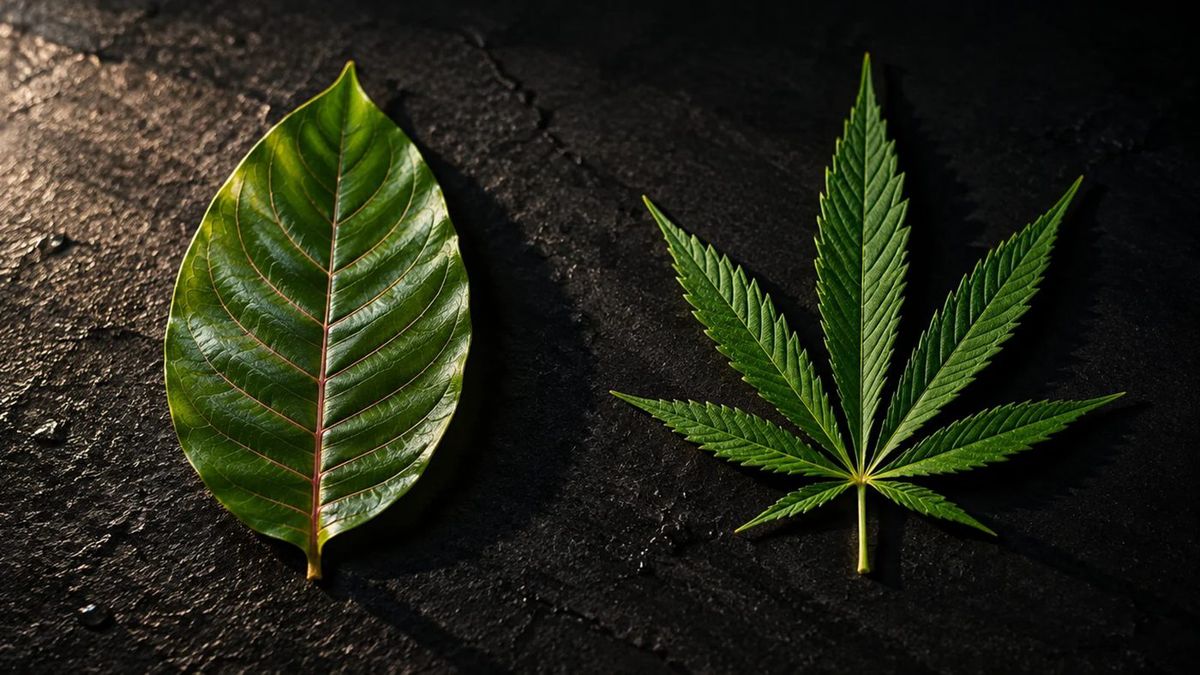
Read by an AI voice. The full article is read aloud, top to bottom. Every helpline in the box above is read aloud near the start, and the comparison table and the two images are on the page.
Checked October 26, 2026. This page compares kratom and cannabis on plant, compounds, receptors, federal and Texas law, the federal workplace drug panel and mixing the two. Quotations were read in the named documents.
Who wrote it, and what we sell. GRH Kratom, which sells kratom and kava products. As of October 26, 2026, we sell no hemp, THC, delta-8 or CBD product, so the hemp rules below do not touch our catalog. The kratom rules do, and so does every kratom warning quoted here. This article links to no product. If a line here is wrong, tell us.
Federal law on October 26, 2026. Kratom leaf is not controlled under the Controlled Substances Act. Mitragynine pseudoindoxyl, MGM-15 and MGM-16 have been temporarily in Schedule I since August 26, 2026 (FR Doc 2026-17429). DEA's notice of intent of October 14, 2026 (91 FR 65370, FR Doc 2026-20943), on a concentrated minor kratom alkaloid and mitragynine pseudoindoxyl above a set threshold, says an order will be published "on or after November 13, 2026"; none had been published when we checked on October 26, 2026. The new federal hemp definition applies in two steps: from November 12, 2026, to products with cannabinoids the plant cannot produce naturally, and in full from December 11, 2026, under current law.
Next review January 26, 2027, or sooner if DEA publishes a kratom order or the hemp dates move.
Is kratom like weed? No. Kratom and weed come from different plants, contain different active compounds, act on different receptor systems in the brain, and are regulated under different laws. Federal agencies describe kratom's active compounds as alkaloids, such as mitragynine, and the active compounds in cannabis as cannabinoids, such as THC. Kratom is not a kind of cannabis, and it is not "legal weed".
The legal gap is just as wide. As of October 26, 2026, most marijuana is still in Schedule I, while kratom leaf is not federally controlled, though the FDA warns consumers not to use it. In Texas, where we are based, kratom may not be sold to anyone under 18, and hemp products not to anyone under 21.
Kratom vs weed: the short answer, side by side
| Question | Kratom | Cannabis (marijuana and hemp) |
|---|---|---|
| The plant | Mitragyna speciosa, "a tree in the coffee family" (NCCIH). | Cannabis sativa L. (NIDA). Hemp is the same species with very little delta-9 THC. |
| Main active compounds | Alkaloids. FDA counts "over 50"; mitragynine is the one the agencies name first. | Cannabinoids. NIDA counts "at least 125", including delta-9 THC and non-intoxicating CBD. |
| Receptor system, in agency words | "mu-opioid receptors" (NIDA); mitragynine also acts on other systems (FDA). | THC connects to "cannabinoid receptors" (DEA). |
| Federal status, October 26, 2026 | Leaf "not controlled" (DEA); not lawfully marketed as a drug, supplement or food additive (FDA). Three related compounds temporarily in Schedule I; a threshold notice on one of them and a minor alkaloid pending. | Marijuana in Schedule I, except FDA-approved drug products and state-licensed medical marijuana (Schedule III since April 28, 2026). Hemp definition changes in two steps, November 12 and December 11, 2026. |
| Texas status | No sales to anyone under 18 (Health and Safety Code chapter 445). | Medical: low-THC cannabis only (Compassionate Use Program). Hemp products: 21 and over. Delta-8: on the state schedule from July 31, 2026. |
| On the federal workplace drug panel? | No kratom analyte listed. | Yes. Urine: a "Marijuana metabolite". Oral fluid: marijuana. |
What each plant is, and what is in it
Kratom. The National Center for Complementary and Integrative Health (NCCIH) puts it in one line: "Kratom (Mitragyna speciosa) is a tree in the coffee family, found in Thailand and neighboring countries." Its active compounds are alkaloids. The FDA says kratom "contains over 50 alkaloids" and that most scientific research focuses on two of them, mitragynine and a minor kratom alkaloid.
Cannabis. NIDA, the National Institute on Drug Abuse: "Cannabis, which some people call marijuana, refers to the dried leaves, flowers, stems, and seeds of the Cannabis sativa L plant." Its active compounds are cannabinoids. The plant "contains at least 125 different cannabinoids, including delta-9 tetrahydrocannabinol (THC)." NIDA also names "non-intoxicating cannabinoid compounds like cannabidiol (CBD)", and calls delta-8 THC "another intoxicating cannabinoid found in the cannabis plant." Hemp is the same species: Cannabis sativa L plants "containing very small, non-intoxicating amounts of delta-9 THC", in NIDA's words.
And "weed"? A street name. The DEA lists "Weed" among marijuana's street names; for kratom it lists "Thang, kakuam, thom, ketum, and biak". Even in slang, kratom is not weed.
Does kratom have THC?
THC is a cannabinoid, and the agencies place it in the cannabis plant. None of the federal pages we read, from the FDA, NIDA, NCCIH and the DEA, lists THC or any other cannabinoid among kratom's compounds. None of them says the words "kratom contains no THC" either. They describe a different set of compounds, from a tree rather than the cannabis plant.
People also ask whether kratom can show up as THC on a drug test. We found no primary source on that, either way, so we make no claim.
How each acts in the brain, in the agencies' words
Kratom: opioid receptors. NIDA says of mitragynine and that minor alkaloid: "Both activate mu-opioid receptors (specific molecular structures on the surface of nerve cells), but the resulting effects only partially compare to those of opioids like heroin or oxycodone." The FDA adds that mitragynine acts on "other chemical systems of the brain, including serotonin, dopamine, norepinephrine, and kappa opioid receptors," and that these compounds "may produce classic opioid-related effects such as sedation, nausea/vomiting, constipation, physical dependence/withdrawal, and respiratory depression that may lead to death."
Cannabis: cannabinoid receptors. The DEA's marijuana fact sheet: "In the brain, THC connects to specific sites called cannabinoid receptors on nerve cells and influences the activity of those cells." The sheet says THC "is believed to be the main ingredient that produces the psychoactive effect." NIDA adds that cannabis "can cause altered time perception, and impaired thinking, memory, and body movement."
Two different receptor systems, then. NIDA adds a caution about kratom itself: "kratom products vary, so effects are difficult to predict."
Risks and dependence, each in its own agency's words
People search "is kratom stronger than weed". No agency we read ranks the two, so we do not either. Here is what each agency says, kept apart on purpose.
Kratom. "FDA has warned consumers not to use kratom because of the risk of serious adverse events, including liver toxicity, seizures, and substance use disorder (SUD)." The DEA's kratom fact sheet says "Kratom consumption can lead to addiction." That is what we sell, and those warnings cover our products as much as anyone's.
Cannabis. The DEA's marijuana fact sheet: "Long term, regular use can lead to physical dependence and withdrawal following discontinuation, as well as psychological addiction or dependence." NIDA: "Studies have estimated that 22% to 30% of people who use cannabis have the disorder," meaning cannabis use disorder.
These come from different kinds of evidence and cannot be lined up to say which plant is worse. If the question is about you, ask a clinician.
Kratom vs weed under federal law, as of October 26, 2026
Kratom. The DEA's kratom fact sheet says "Kratom is not controlled under the Controlled Substances Act," and that "DEA has listed kratom as a Drug and Chemical of Concern." Not controlled is not the same as approved. The FDA says kratom "is not lawfully marketed in the U.S. as a drug product, a dietary supplement, or a food additive in conventional food."
Some kratom-related compounds are controlled. Mitragynine pseudoindoxyl, MGM-15 and MGM-16 have been temporarily in Schedule I since August 26, 2026, under a DEA order (FR Doc 2026-17429). On October 14, 2026, DEA published a notice of intent (91 FR 65370, FR Doc 2026-20943) to temporarily schedule a concentrated minor kratom alkaloid and mitragynine pseudoindoxyl when either, or both combined, is above a set threshold (the August order covers mitragynine pseudoindoxyl without one). A notice is not an order. DEA says the order "will be published in the Federal Register on or after November 13, 2026" and would take effect on publication. If it has been published since our check on October 26, 2026, the Federal Register copy is what counts.
Marijuana. Most marijuana is still in Schedule I. What changed on April 28, 2026, was narrower: a final rule published that day (FR Doc 2026-08176) moved marijuana in FDA-approved drug products, and marijuana subject to a state medical marijuana license, to Schedule III. Every other form of marijuana, in the rule's words, "remains a schedule I controlled substance", and "synthetic THC remains in schedule I."
The general move to Schedule III, first proposed on May 21, 2024, is still a proposal. Executive Order 14370 of December 18, 2025, told the Attorney General to finish it "in the most expeditious manner in accordance with Federal law" but rescheduled nothing itself, and DEA set a hearing to begin on June 29, 2026, and end by July 15, 2026. As of October 26, 2026, we found no final rule, and no record of what came of the hearing.
Hemp. Until the change, federal law defines hemp as cannabis "with a delta-9 tetrahydrocannabinol concentration of not more than 0.3 percent on a dry weight basis", and hemp is excluded from the definition of marijuana. Congress rewrote that definition in section 781 of Public Law 119-37, approved November 12, 2025, and effective 365 days later, then split the start in section 2019 of Public Law 119-103, approved September 2, 2026: "Until December 11, 2026," the new definition applies only to products named in two of its paragraphs.
So there are two dates. From November 12, 2026, the new rule reaches products containing "cannabinoids that are not capable of being naturally produced by a Cannabis sativa L. plant". From December 11, 2026, under current law, the rest applies: a 0.3 percent limit, on a dry weight basis, on total THC including tetrahydrocannabinolic acid; an exclusion for cannabinoids "synthesized or manufactured outside the plant"; and, for final products, a cap of "0.4 milligrams combined total per container" (the innermost package) of total THC and other cannabinoids with similar effects. Congress has moved this start once, so check it before relying on it.
Products that fall outside the definition do not fall outside the law: Executive Order 14370 warned that "some full-spectrum CBD products will once again be controlled as marijuana under the CSA" because of section 781's per-container THC limit, which applies from December 11, 2026, under current law. We sell no hemp products.

Kratom and weed in Texas
Kratom: 18 and over. Texas's kratom law began as Senate Bill 497, the Texas Kratom Consumer Health and Safety Protection Act, in effect since September 1, 2023, and now in Health and Safety Code chapter 445 (chapter 444 before a 2025 renumbering). Under section 445.004, selling, distributing or exposing for sale "a kratom product to an individual younger than 18 years of age" is a Class C misdemeanor. SB 1868, a 2025 bill to raise the age to 21, stayed in committee. Our own site asks visitors to confirm they are over 21; that is our gate, not the law.
Marijuana: a narrow medical program. The Supreme Court of Texas set out the background in May 2026: "Both federal and state law historically have treated all parts of the cannabis plant as 'marihuana,' a Schedule I controlled substance." The medical exception is the Department of Public Safety's Compassionate Use Program: low-THC cannabis, "not more than 10 milligrams of tetrahydrocannabinols in each dosage unit", prescribed by registered physicians to permanent residents with listed conditions, and not smoked. Whether the federal Schedule III change reaches this program, we could not determine.
Hemp THC: 21 and over. On June 22, 2025, the governor vetoed SB 3, which would have banned hemp products containing "any amount of a cannabinoid other than" CBD or CBG. Announcing order GA-56 on September 10, 2025, his office said DSHS and TABC "must ban sales to minors and require verification of government-issued ID at the point of sale". DSHS's rules, effective March 31, 2026, define a minor as "A person under 21 years of age", and TABC's rule bars its license and permit holders from selling these products to anyone "under 21." Agency rules, then, not a statute.
The veto message even named kratom. Among the potential regulations the governor listed for legislators to consider: "Products containing THC may not contain other psychoactive substances (e.g., alcohol, tobacco, kratom);". A suggestion in a veto message. Not Texas law.
Delta-8: controlled in Texas. On May 1, 2026, the Supreme Court of Texas ruled in Texas Department of State Health Services v. Sky Marketing Corp. (No. 23-0887). It reversed the temporary injunction, leaving the commissioner discretion "to include manufactured delta-8 THC as a controlled substance." DSHS's consumable hemp page says "The Texas schedule affecting delta-8 THC becomes effective July 31, 2026," and that hemp products labeled with delta-8 or shown to hold more than trace amounts of THC "may be detained and referred to law enforcement." The ruling went against the side we backed: our own news post on the lawsuit says GRH Kratom "was among the Texas businesses that supported the broader challenge."
A disclosure about our own record. Some other posts on this site about hemp THC, Select Spectrum and delta-8 say things this page does not, including that those products are legal federally and can be bought from our store. We sell none of them as of October 26, 2026. Where those posts disagree with this page, this page is the dated check.

Kratom, weed and drug tests
The federal workplace drug list is published in an HHS notice of March 13, 2026 (FR Doc 2026-04981), which "publishes the panels of Schedule I and II drugs and biomarkers authorized for testing in federal workplace drug testing programs" and made no revisions to the current panels. The urine panel lists a "Marijuana metabolite", delta-9-tetrahydrocannabinol-9-carboxylic acid. The oral fluid panel lists marijuana as delta-9 THC. Neither panel lists kratom, mitragynine or any other kratom analyte.
Read that narrowly. It is one federal list for federal workplace programs, not a description of every "5-panel" or "10-panel" test sold, and we have not read what any private employer or laboratory tests for. Rules can also reach kratom whatever a routine test looks for. The armed forces are one example, set out on our page on whether the military tests for kratom. And on the hemp side, NIDA notes that "some products marketed as CBD have been found to contain THC."
Using kratom and weed together: what agencies and studies say
No agency page we read warns specifically about combining kratom with cannabis or THC. What they say covers kratom with "other drugs" in general, and it is not reassuring. NIDA: "Case reports suggest using kratom in combination with other drugs (sometimes called polysubstance use) may produce severe adverse effects, such as liver problems or even death." And NIDA says cannabis "can interact with other drugs a person is taking."
The main figure comes from the CDC. Its Morbidity and Mortality Weekly Report of March 26, 2026, analyzed poison-center reports involving kratom from 2015 through 2025. Reports naming kratom plus another substance were 38% of all kratom-associated reports, and in those, "cannabis and cannabinoids" appeared in 12%. That category includes "cannabidiol, synthetic cannabinoids, and minor cannabinoids", so it is not THC alone; it counts calls, not people; and it is not a share of kratom users. Multiple-substance reports were associated with more hospitalizations and serious outcomes than kratom-only ones, though the CDC says "determining which substance was most related to clinical effects or medical outcome, including death, was not possible." Our page on whether kratom is safe quotes the same co-use figures.
There is also one animal study. In male rats, cannabidiol (CBD, not THC) given alongside kratom produced "a 2.8-fold increase in the exposure of the most abundant kratom alkaloid, mitragynine," and the authors urged caution "until more information is known." A rat finding about CBD. It shows nothing about people, or about THC.
Our advice: if you use kratom, cannabis or both, tell a clinician about all of it, including every medicine you take, before you mix anything. No agency we read says the combination is safe, and a seller's page, ours included, is not where that answer should come from.
What to do if this matters to you
Deciding whether to use either one? Talk to a clinician first. The FDA has warned consumers not to use kratom, and the DEA notes that "FDA has not approved kratom for any medical use." Kratom is not a treatment for opioid use disorder or withdrawal, and findtreatment.gov lists help that is. In an emergency, the numbers at the top of this page come first.
Facing a drug test? Our advice: do not plan around any panel. If a test matters to your job, your license, a court order or your command, read the written policy that applies to you, and take questions about it to your employer, your program or a lawyer.
A question for us? We can answer questions about our own products and about this page through our contact page. We cannot answer clinical questions, and we will not tell anyone how to pass a test.
Questions people ask about kratom and weed
Does kratom have THC?
The agencies describe kratom's active compounds as alkaloids, such as mitragynine, and cannabis's as cannabinoids, such as THC. None of the FDA, NIDA, NCCIH or DEA pages we read lists THC or any other cannabinoid among kratom's compounds, though none of them says "kratom contains no THC" in those words.
Is kratom stronger than weed?
No agency we read ranks them. Here is what agencies say about each. The FDA has warned consumers not to use kratom "because of the risk of serious adverse events, including liver toxicity, seizures, and substance use disorder (SUD)." The DEA says long-term, regular marijuana use "can lead to physical dependence and withdrawal following discontinuation, as well as psychological addiction or dependence."
Is kratom a good substitute for weed?
No agency we read recommends either one, as a substitute or otherwise. The FDA has warned consumers not to use kratom, and kratom is not a treatment for anything. If you want to change how you use cannabis, start with a clinician or findtreatment.gov, not a kratom seller.
Is kratom legal where weed is not?
As of October 26, 2026, federally, kratom leaf "is not controlled under the Controlled Substances Act", in the DEA's words, while most marijuana "remains a schedule I controlled substance". But legal is not approved: the FDA says kratom is not lawfully marketed as a drug, a dietary supplement or a food additive in conventional food. The DEA adds that "there may be some state regulations or prohibitions against the possession and use of kratom"; in Texas, kratom may not be sold to anyone under 18.
Can you take kratom and weed together?
No agency page we read addresses that pairing specifically. NIDA says case reports suggest using kratom with other drugs "may produce severe adverse effects, such as liver problems or even death." In CDC poison-center data, "cannabis and cannabinoids", a category that includes CBD and synthetic cannabinoids, appeared in 12% of the reports where kratom was taken with other substances. Our advice: talk to a clinician before you combine anything.
Disclaimer: this page summarizes publicly available material as of October 26, 2026, and links to primary sources so you can check them. It is general information, not legal or medical advice, and it does not speak for any government agency. Statements about botanical products have not been evaluated by the Food and Drug Administration, and no product is intended to diagnose, treat, cure or prevent any disease.


