



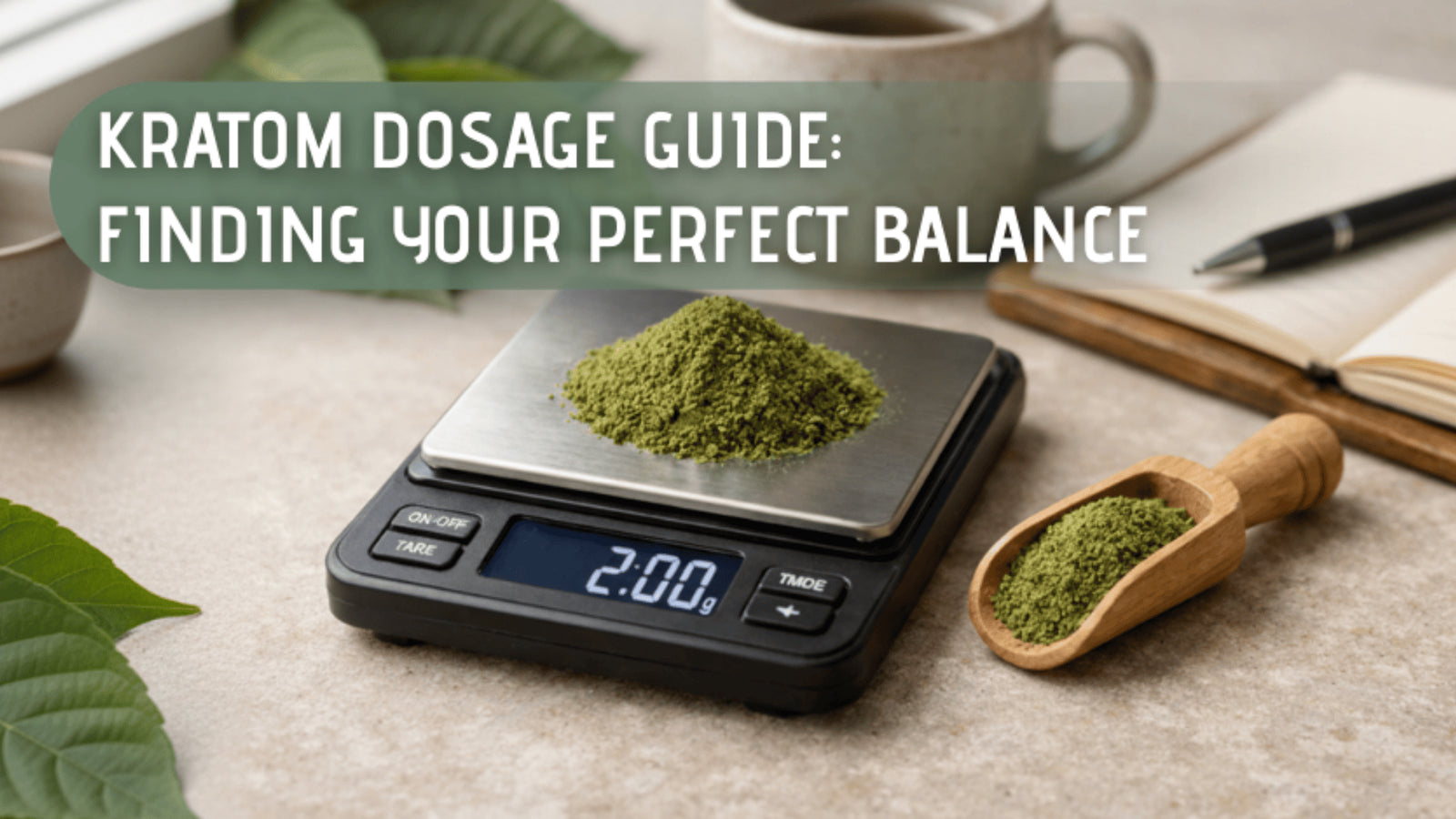
Most kratom problems trace back to the same root cause: the dose. Take too little and the leaf feels like flat coffee. Take too much and the day collapses into nausea, sweating, and a body that wants to sit in one spot. The middle window is narrower than most people expect, and it changes with the strain, the format, the body in front of the bag, and how often that body has met kratom before.
This guide is the protocol we hand new customers when they ask the only question that really matters at the start: how much. We walk through the four standard dose tiers, how mitragynine concentration changes what "one gram" actually means in your body, how white, green, and red strains lean differently at the same number, and how powder, capsules, extracts, and shots translate into each other. By the end, you should be able to weigh a starter dose, time a safe redose, and recognize when a number is too high before the day takes you with it.

One ground rule before we start. Kratom is not FDA approved to treat, cure, or prevent any condition. If you take prescribed medications, are pregnant or nursing, or are under 21, kratom is not recommended. The American Kratom Association reports that an estimated 10 to 16 million Americans use kratom, which is exactly why the dose conversation has to be specific rather than vague.
Table of Contents
- Why kratom dosing is measured in grams, not milliliters or scoops
- The four-tier kratom dose framework
- How mitragynine concentration changes a "gram"
- Kratom dosage by strain: white, green, and red leans
- Kratom dosage by format: powder, capsule, extract, shot, and tea
- Body weight and tolerance adjustments
- First-time starter protocol
- Safe redose windows
- Warning signs you took too much
- When to skip a dose
- Daily-use cap and occasional-use cap
- Tolerance and rotation strategy
- Frequently asked questions
- Final thoughts
TL;DR
- The four standard kratom dose tiers are threshold (1 g), light (1 to 3 g), moderate (3 to 5 g), and heavy (5 g and up). Most adults find their working window inside the light-to-moderate range.
- Strain matters as much as strain quantity. Whites lean stimulating, greens lean balanced, reds lean sedating at the same gram count.
- Format changes the math. Capsules deliver the same milligrams as powder but slower. Extracts and shots are concentrated, so the gram label does not match the felt effect.
- Body weight, tolerance, food in the stomach, and time of day all shift the curve. The dose that works for a 240 lb daily user is not the dose for a 130 lb beginner.
- The standard safe redose window is 3 to 5 hours after the first dose, and only if the first dose was clearly under the working window.
- Warning signs of an overshoot include nausea, profuse sweating, dizziness, and "the wobbles" (eye-tracking trouble). The fix is water, food, rest, and not chasing it with more kratom.
- Daily kratom users should cap most days at 5 g total and rotate strains weekly. Heavy daily dosing carries dependence risk, and a persistent need for higher doses warrants a step back, not an escalation.
- Kratom is not FDA approved to treat, cure, or prevent any condition. If you take prescribed medications, are pregnant or nursing, or are under 21, kratom is not recommended.

Why Kratom Dosing Is Measured in Grams, Not Scoops
Kratom is a botanical, which means the active alkaloid (mitragynine) lives inside a leaf that varies from batch to batch, strain to strain, and vendor to vendor. The standard kratom dose unit is grams of leaf powder for a reason. Grams give you a direct line to the alkaloid load. A level teaspoon of one powder might pack 2 grams of fine green leaf and a level teaspoon of another might pack 2.6 grams of coarser red. That is the difference between a light dose and the start of a moderate one. A small kitchen scale solves the whole problem for about fifteen dollars.
Mitragynine concentration is the second piece. Lab-tested kratom powders typically run 1.0 to 1.7 percent mitragynine by weight. A clean 3 g dose of 1.4 percent leaf delivers about 42 mg of mitragynine. The same 3 g of a 1.0 percent batch delivers 30 mg. That is why two "three gram" doses from two different bags can feel meaningfully different even from the same strain category. Trust the gram, then check the lab on the bag.
The Four-Tier Kratom Dose Framework
Every kratom dosage chart you find on the internet sits on the same four tiers. The names vary. The numbers do not. These are the working tiers for healthy adults using powdered leaf.

| Tier | Range (powder) | What it feels like | Best for |
|---|---|---|---|
| Threshold | 0.5 to 1.5 g | Subtle lift in mood and focus, mild warmth, no obvious sedation | First-time users, body-weight test dose, light afternoon pick-me-up |
| Light | 1.5 to 3 g | Clean energy, sharper focus, sociable mood, gentle physical ease | Workdays, social events, study sessions, morning routine |
| Moderate | 3 to 5 g | Stronger physical ease, fuller mood lift, mild sedation on red strains | Active recovery days, longer evening sessions, experienced users |
| Heavy | 5 to 8 g | Pronounced sedation, heavier limbs, higher risk of nausea | Rarely needed; reserve for occasional use only |
A 2024 review published in the PMC NCBI literature on kratom pharmacokinetics notes that mitragynine plasma concentrations rise roughly linearly with leaf dose up to about 6 to 8 grams, then plateau as receptor binding saturates. In plain language, doses past 8 grams do not give you more lift, they give you more side effects.
How Mitragynine Concentration Changes a "Gram"
If you have ever taken 3 g of one bag and felt nothing, then 3 g of another and ended up on the couch, this is the explanation. Two variables move underneath the gram count. The first is mitragynine concentration in the powder itself. The second is the ratio of mitragynine to 7-hydroxymitragynine (7-OH), the more potent metabolite that some batches carry in slightly higher proportion.
Fresh, well-stored powder from a vendor with current Certificates of Analysis (COAs) gives you predictable numbers. Old powder, sun-exposed powder, or powder from a vendor with no published lab work gives you a gram count and a coin flip. We publish lab results on every batch we ship for exactly this reason. A trustworthy gram is the entire foundation of a trustworthy dose.
Kratom Dosage by Strain: White, Green, and Red Leans
Strains in kratom describe the color of the central vein in the leaf at the time of harvest, and that vein color tracks loosely with the alkaloid profile. The gram math stays inside the same four tiers above, but where you land in the tier depends on which strain you pick. White Maeng Da Kratom Powder at 2.5 g feels different from a red Bali at 2.5 g, and the difference is not subtle.

White vein strains skew toward the stimulating end. A light dose of white (1.5 to 2.5 g) lands close to a strong cup of coffee with a cleaner edge. Greens sit in the middle, with the broadest "balanced" window and the fewest sharp edges at moderate doses. Reds lean sedating, which means a 3 g red feels heavier than a 3 g white even with the same gram count on the scale. New users who want a clean introduction to the plant typically start with a green strain at the low end of the light tier, then branch into whites for daytime and reds for evening.
Kratom Dosage by Format: Powder, Capsule, Extract, Shot, Tea
Format changes onset time, peak intensity, and total duration even when the gram count stays the same. Here is the working translation.

Powder is the reference standard. Everything else maps back to it. Capsules typically hold 0.5 g of leaf each, so a 3 g powder dose equals 6 standard capsules. Capsules carry the same milligrams but onset 15 to 30 minutes slower because the body has to digest the capsule shell first. Extracts and concentrated products are where most overshoots happen. A 1 g serving of a quality 50 mg mitragynine-per-gram extract is closer to 3 to 4 grams of leaf in felt strength, so the gram label on an extract is not the gram you want to start from.
Shots are concentrated liquid extracts. A standard King K Rush Kratom Shot serving sits in the light-to-moderate felt range despite the small volume, which is why we recommend half a bottle for first-timers and the full bottle only after you have calibrated to leaf. Tea slows down absorption further still, because the heated water extracts alkaloids from the leaf and the brewed liquid passes through faster. A 4 g powder tea brew typically feels closer to a 3 g powder swallow.
For a deeper format primer with brewing ratios, capsule conversions, and toss-and-wash technique, our companion guide on the best way to take kratom is the next read.

Body Weight and Tolerance Adjustments
The four-tier framework assumes a healthy adult between roughly 140 and 200 pounds. Bodies outside that range need a simple weight adjustment. A working rule is roughly 0.02 g of leaf per pound of body weight at the bottom of the light tier, and 0.04 g per pound at the top of it. A 130 lb user lands closer to 2.6 g for a strong light dose. A 220 lb user lands closer to 4.4 g.
Tolerance is the second multiplier. A daily user who has been on the same strain for months will need slightly more leaf to reach the same effect, which is a sign to rotate rather than escalate. The National Institute on Drug Abuse notes that mitragynine acts as a partial mu-opioid receptor agonist, and partial agonists are exactly the class of compounds where tolerance creep is most common. Catch it early by tracking your doses and capping daily totals before they grow on their own.
First-Time Kratom Starter Protocol
If this is your first time meeting kratom, the day looks like this.
- Eat a light breakfast first. An empty stomach amplifies both onset and nausea risk.
- Weigh out 1.5 g of a green vein powder on a kitchen scale. Greens have the widest comfortable window for new users.
- Take the dose with 16 oz of water. Toss-and-wash, capsule, or stirred into juice all work. Avoid hot tea on the first dose so the timeline is predictable.
- Set a 45-minute timer and do not redose during it. Onset typically arrives in 20 to 40 minutes.
- At the timer, rate your experience from 1 (nothing) to 5 (clearly working) and write it down. This is your baseline for every future dose.
- If you scored a 1 or 2 and feel completely normal, add 1 g more at the 60-minute mark. Do not add more than that on day one.
- If you scored a 3 or higher, stop. You found your working dose. Spend the day on it and do not chase it higher.
- Drink water throughout the day. Note any side effects in a single line in your journal so the next dose builds on real data.

Safe Redose Windows
The most common dosing mistake we see is the redose taken too soon. Mitragynine has a plasma half-life that the PMC NCBI review cited above measures at roughly 3 to 4 hours in healthy adults, with subjective effects often outlasting plasma peak by another hour or two. The practical takeaway is a standard 3 to 5 hour redose window for a second dose on the same day, and only when the first dose was clearly below the working window.
Redose math is simple. If your 2 g morning dose landed weaker than expected and you want to extend the day, a 1 to 1.5 g top-up at the 4-hour mark is the conservative move. Doubling the first dose, doubling the bag, or stacking a shot on top of a powder dose are the moves that cause same-day overshoots. The day after a heavy dose is usually a skip day, not a continuation.
Warning Signs You Took Too Much
Kratom is forgiving compared to many psychoactive substances, but it tells you when you crossed the line, and it tells you with specific signs. Watch for nausea, profuse sweating, dizziness, flushed skin, and "the wobbles", which is the slang term for trouble keeping your eyes still on a single object. These signs typically appear 30 to 90 minutes after the dose, peak around the 90 to 120 minute mark, and resolve over the next two to four hours.
The fix is supportive, not chemical. Sit down. Drink water. Eat a small carbohydrate snack like crackers or toast. Stay off screens that move. Do not take more kratom to "ride it out." Do not combine with alcohol, sedatives, or stimulants while you are still uncomfortable. If symptoms include severe vomiting, breathing difficulty, or confusion that does not clear within a couple of hours, treat it as a medical situation and call for help. Those edge cases are rare with leaf-based dosing but they are not zero.
When to Skip a Dose
Skip days are the single most useful tolerance lever you have. The clearest indicators that today is a skip day are a previous-day heavy dose, broken sleep, an empty stomach with no time to eat, a new prescription medication that has not been cleared with a clinician, and any day where you are already feeling under the weather. The kratom does not get "saved up" by skipping. It does, however, keep your working dose smaller, which keeps the bag cheaper and the receptor system happier.
Daily-Use Cap and Occasional-Use Cap
For most daily users, the long-running pattern that holds up over time is a single light-to-moderate session per day, capped at 5 g total. Focus Blend Kratom Powder is a popular pick for this slot because the green-leaning blend keeps daytime dosing on the energy-and-focus side of the tier without sliding into sedation. Occasional users can run up to 6 g in a session safely, but the higher you go the more the next-day fog and the more your tolerance creeps.
The FDA's general guidance on dietary supplements reminds users that botanicals are not standardized the way pharmaceuticals are, which is exactly why a personal cap matters more than a universal one. Pick a number you can live with on a Tuesday afternoon and let that be your ceiling.
Tolerance and Rotation Strategy
If your working dose has crept up by more than a gram over a couple of months on the same strain, your receptors are telling you to rotate, not escalate. A simple rotation looks like white Monday and Tuesday, green Wednesday and Thursday, red Friday and Saturday, skip day Sunday. The cross-strain rotation gives partial cross-tolerance relief and keeps the gram count from drifting upward. Our companion read on kratom tolerance and resistance over time walks through the receptor side of the conversation in detail. A 2022 dose-response paper indexed on PubMed (Garcia-Romeu and colleagues) found that self-reported regular users dosed within a relatively narrow gram range when tolerance was managed actively, which supports rotation as a behavioral intervention.

For a comparison view of how the dose duration plays out from threshold to heavy, our guide on how long a kratom high lasts walks through the time curve at each tier. Read together with this dosage guide it gives you both the amount and the clock.
Persistent need for higher doses warrants a step back, not an escalation. Daily heavy dosing carries dependence risk. If your relationship to the leaf starts feeling like an obligation, take three to seven days off and reassess at the threshold dose on the other side.

Frequently Asked Questions
What is a safe kratom dosage for beginners?
A 1.5 g green vein powder dose with food and 16 oz of water is the standard starter dose. New users who are smaller than 140 lb can start at 1 g and add a half gram at the 60-minute mark only if there is no felt effect.
How much kratom is too much?
Most adults overshoot above 6 g of powder in a single dose. The signs are nausea, sweating, and the wobbles. Doses above 8 g rarely add felt effect, they only add side effects, which is why the literature describes a plasma plateau near that point.
How many capsules equal a 3 g dose?
Standard kratom capsules hold 0.5 g of leaf each, so a 3 g dose is 6 capsules. Some brands sell 0.6 g or 0.7 g capsules, so verify the per-capsule gram count on the label before counting.
Does body weight really matter for kratom dosage?
Yes, but less than tolerance and strain choice. A practical adjustment is roughly 0.02 to 0.04 g of leaf per pound of body weight at the light tier. Smaller users start lower; larger users start a half gram higher.
How long should I wait before redosing kratom?
Three to five hours after the first dose, and only if the first dose felt clearly under your working window. Stacking a redose on top of an already-working first dose is the most common path to nausea and the wobbles.
Is there a kratom dosage chart in milligrams?
Mitragynine doses cluster around 15 mg for threshold, 25 to 40 mg for light, 45 to 70 mg for moderate, and 75 mg and up for heavy. Convert from grams of leaf using the lab-tested mitragynine percentage on the bag.
Can I take kratom every day?
Many users do, with a cap of about 5 g per day and a weekly skip day. Daily heavy dosing carries dependence risk. If you find yourself climbing the gram count to chase the same effect, that is the signal to rotate strains or take a tolerance break.
Are kratom extracts dosed the same way as powder?
No. Extracts concentrate mitragynine, so a 1 g serving of a quality extract can feel like 3 to 4 g of leaf. Treat extracts as their own category, follow the bottle label, and never stack an extract on top of a powder dose without first calibrating to the extract alone.
What if I feel nothing from my kratom dose?
Verify the gram count on a kitchen scale, confirm the bag has a current COA, and rule out tolerance from frequent recent use. If the math is right and the leaf is fresh, try a different strain category before increasing the gram count.
Final Thoughts
Kratom dosing is one of those topics where ten extra minutes of preparation saves the entire day. A small scale, a notebook, a baseline strain, and the four-tier framework are the entire toolkit. The hard part is not the math, it is the discipline of staying at your working dose once you find it.
If you are new to the leaf and want a clean starter setup, the green-leaning Focus Blend Kratom Powder and a kitchen scale will carry you through the first month of calibration. For daytime users who already know they want a brighter top end, our White Maeng Da Powder is the cleanest white in our lineup.

Track your doses, rotate strains weekly, drink water, and treat the redose window as a real number rather than a suggestion. Kratom is forgiving when you respect the gram and unforgiving when you ignore it.
If you do nothing else with this guide, start small, weigh your leaf, and write down what each dose actually felt like for the first ten sessions. By session eleven, you will know your working dose better than any chart can tell you, and the chart was never the point. The protocol exists so you can put it down once your own body has answered the question.


