



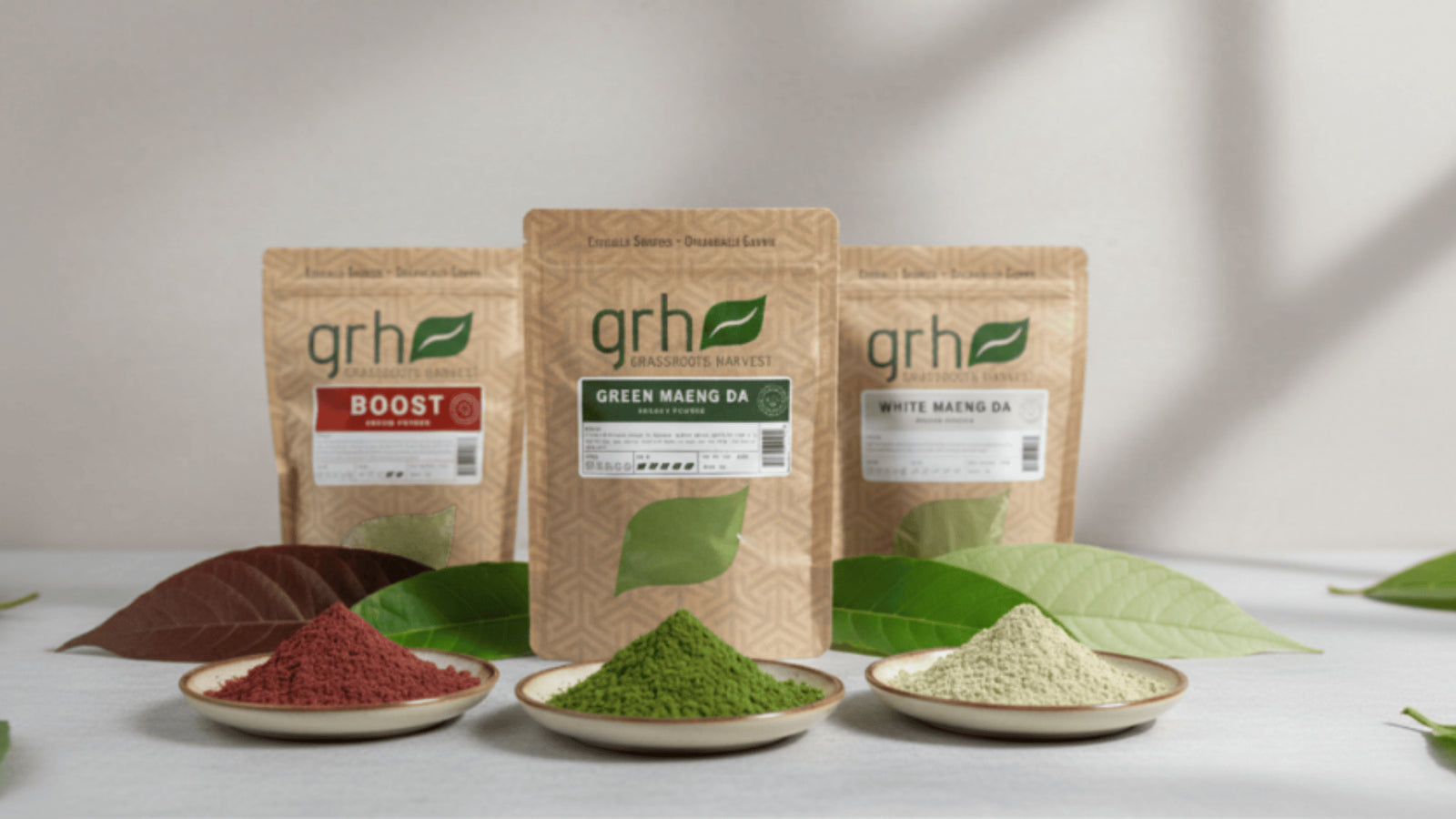
Pick green if you need energy and focus. Pick red if you need calm and ease. That is the short answer most readers come for, and it is mostly correct, but the full picture is more useful. Red and green kratom come from the same plant, harvested at different leaf ages and processed in different ways. The American Kratom Association estimates that several million Americans use kratom regularly, and the red versus green decision is the one that comes up most often after a person picks a vendor.
This guide is written for the reader who is standing in front of two pouches and trying to decide which one to take home tonight. We will compare red and green head to head on alkaloid profile, effect, onset, duration, dose, and time of day, and answer the questions that show up in the support inbox more than any others. White vein gets one mention where it belongs, then goes back on the shelf. The decision in front of you is red or green.
Table of Contents
- The Short Answer: Pick Green If, Pick Red If
- Alkaloid Profile: Mitragynine and 7-Hydroxymitragynine
- Effect Profile Head to Head
- Onset and Duration Head to Head
- Dose Head to Head
- Who Should Pick Green
- Who Should Pick Red
- Can You Stack Red and Green
- How Time of Day Changes the Answer
- When Neither Is the Right Pick
- Quality Vetting Checklist for Both Veins
- Frequently Asked Questions
- Final Thoughts
TL;DR
- Pick green if your goal is energy, focus, mood, or social ease. Pick red if your goal is calm, body relief, off-switch quality, or sleep preparation.
- Both veins come from the same plant, Mitragyna speciosa. The difference is leaf maturity and post-harvest processing, not species.
- Green vein typically tests in the 1.2 to 1.8 percent mitragynine range. Red vein tests slightly lower at 0.8 to 1.4 percent but carries a larger share of 7-hydroxymitragynine in mature leaf.
- Green onset runs 25 to 45 minutes with a 3 to 5 hour duration. Red onset runs 20 to 40 minutes with a 4 to 6 hour duration that ramps slower and lands heavier.
- Typical green dose is 2 to 4 grams. Typical red dose is 2.5 to 5 grams. Both veins have small effective windows, so start at the low end of the range and track how you feel.
- Most regular users settle into a green AM, red PM rotation. The veins answer different needs, not different doses.
- Stacking red and green in the same dose is rare in practice. Most stackers reach for a pre-made blend that targets a single direction (energy or calm) instead.
- If you cannot decide, our Green Maeng Da is the most forgiving starting point for daytime use. Red Maeng Da is the equivalent starting point for evenings.

The Short Answer: Pick Green If, Pick Red If
Most readers do not need a biology lecture. They need a clear sentence that tells them which bag to open. Here is the cleanest version of that sentence.
Pick green when you need to be sharper, lighter, or warmer. Green vein leans toward energy, focus, and a brighter mood lift. It is the vein people reach for when they want to replace an afternoon coffee, get through a long focus block, ease into a social setting, or smooth out a sluggish morning. Green does not knock you down. It clears a small lane in the day and lets you walk through it.
Pick red when you need to be softer, calmer, or more settled. Red vein leans toward physical ease, emotional decompression, and what regular users call the off-switch quality. It is the vein people reach for after a long shift, before sleep, or on a day when the body is tight and the mind is loud. Red is heavier than green by design. The point of red is not to add output. The point is to subtract noise.

That is the short answer in two sentences each. The rest of this guide is the long version, with the specific reasons each rule of thumb is true and the edge cases where it is not.
Alkaloid Profile: Mitragynine and 7-Hydroxymitragynine
Two compounds drive the felt difference between red and green. Mitragynine is the dominant alkaloid in fresh kratom leaf, accounting for most of the activity at a typical dose. 7-hydroxymitragynine, often shortened to 7-OH, is present in much smaller amounts but punches above its weight on a per-milligram basis. A 2020 alkaloid review published in PMC NCBI walks through the receptor-binding work and notes that the ratio between these two compounds shifts as the leaf matures and as the processing changes.
Green vein, harvested at mid-maturity, typically lab-tests in the 1.2 to 1.8 percent mitragynine range by dry weight. Its 7-OH share is small, usually well under 0.05 percent. The felt result is a cleaner, lighter lift with less body weight.
Red vein, harvested from late-maturity leaves and often given longer post-harvest curing or fermentation, tests slightly lower in mitragynine, often in the 0.8 to 1.4 percent range. Its 7-OH share, while still small in absolute terms, is proportionally larger and more consistently present. That shift is part of why red feels heavier in the body even at a comparable gram dose.

None of these numbers are large in absolute terms. Both veins stay well under 0.05 percent 7-OH in fresh leaf, which is why kratom-naive readers should not over-index on the alkaloid math. The shift is real, but the practical takeaway is simpler: green leans cleaner and lighter, red leans heavier and slower. The National Institute on Drug Abuse fact sheet covers the broader pharmacology if you want the policy-level view.
Effect Profile Head to Head
Here is what each vein actually feels like at a typical dose, written the way a long-time user would describe it to a friend.
| Dimension | Green Vein | Red Vein |
|---|---|---|
| Alkaloid lean | Higher mitragynine, lower 7-OH share | Slightly lower mitragynine, larger 7-OH share |
| Effect direction | Lift, focus, mood, social ease | Ease, calm, settling, body relief |
| Onset | 25 to 45 minutes | 20 to 40 minutes |
| Duration | 3 to 5 hours | 4 to 6 hours |
| Typical dose | 2 to 4 grams | 2.5 to 5 grams |
| Best for | Morning, midday, focus blocks, social settings | Evening, wind-down, post-work, pre-sleep |
Green vein lands as a clear-headed lift. The thinking gets a little sharper. The mood floor lifts a step or two. People often describe a quiet warmth, more conversational ease, and a tolerance for routine work that was annoying ten minutes before. It is the closest kratom comes to feeling like a clean cup of coffee that does not also produce the coffee jitter.
Red vein lands as physical ease. The body softens before the mind does. Shoulders drop. Tight calves loosen. Emotional reactivity gets dialed back. After thirty minutes, the off-switch quality settles in: tasks that felt urgent are still on the list, but they do not feel urgent in the body the way they did before. Red is not sedating like a sleep aid, but you will not want to launch a hard sprint of work on red.

Onset and Duration Head to Head
Onset and duration matter because they tell you when to take a dose. Green starts working in the 25 to 45 minute range on an empty stomach, with most people reporting peak around the 60 to 90 minute mark, and a tail that fades by hour three to five. Red starts working a little sooner at 20 to 40 minutes, but the curve is gentler and the tail is longer, often reaching into the four to six hour range.
Green is better suited to a known time-boxed window of focus or social activity. If you want to be lifted for a 10 a.m. meeting, take green at 9:15. Red is better suited to a long open-ended evening. If you want to start unwinding at 7 p.m. and have that ease carry you to bedtime, take red at 6:15.
Food and hydration shift both numbers. A full meal pushes onset out by 15 to 30 minutes. Dehydration makes both veins land harder than expected, the most common reason a first-time user feels more than they wanted from a small dose. Water before, water during.
Dose Head to Head
Dosing is where the comparison gets practical. Green typically lives in the 2 to 4 gram range for a single session. Red typically lives in the 2.5 to 5 gram range, with most regulars settling around 3 to 4 grams.
The narrow effective window matters more than the absolute number. Both veins move from useful into uncomfortable in a fairly small step. A reader who pushes from 4 grams of red to 6 grams thinking the felt effect will scale linearly tends to find nausea, the wobbles, or just an over-heavy body load instead of the calm they were chasing. The smart approach with both veins is to start at the low end of the range, wait the full onset window, and only redose if the felt effect is genuinely under what was needed.
Tolerance also creeps in faster than people expect. Daily same-vein, same-dose use builds a working tolerance that pushes the effective dose up and the felt effect down over weeks. Rotating between green and red, or between a vein and a few rest days, keeps tolerance in check. Our green kratom primer covers tolerance management in more depth.

Who Should Pick Green
Green is the right pick for a few specific reader profiles, and recognizing yourself in one of them is more useful than trying to decide on theory alone.
You should pick green if you are stacking kratom into a productivity routine. Morning writers, designers, freelancers on a deadline, anyone who needs sustained attention without coffee-style jitter, all tend to settle on green. Green plays well with a focus block of two to three hours, which lines up almost exactly with its felt-effect window.
You should pick green if you are using kratom socially. A meeting, a long lunch, a dinner with new people, an event where conversation is the work. Green takes the small edge off the social load without flattening you. The 1 to 1 trade is replacing the third coffee of the day or the glass of wine with dinner.
You should pick green if your goal is mood lift more than body ease. Mid-maturity leaves carry the alkaloid balance that pushes mood up a step without pushing body weight up with it. Green Maeng Da Kratom Powder is the most forgiving starting point in our lineup for this use case, partly because Maeng Da is selected from leaves with higher mitragynine concentration to begin with.
Who Should Pick Red
Red is the right pick for the inverse of the green profile. Recognize yourself here and the decision is already made.
You should pick red if you are using kratom to unwind after work. The thirty minutes between closing the laptop and starting whatever the evening actually is can be hard to bridge on willpower alone. Red shortens that bridge. Most regulars settle on red for the 5 p.m. to 8 p.m. window, and the felt effect carries into a calmer evening without forcing sleep.
You should pick red if you carry physical tension. Office workers with tight shoulders, runners on a long-mileage week, anyone whose body is the loudest part of the day. Red has a measurable body-ease lean that mitragynine alone does not fully account for. The shift is real even at low dose.
You should pick red if you are using kratom in service of sleep, not as a sleep aid but as a pre-sleep wind-down. Taken 90 to 120 minutes before bed, red softens the runway to sleep without producing the heavy-headed morning that some sleep aids do. The Red Maeng Da Kratom Powder is our evening default. Red Bali sits heavier in the body for the deepest wind-down, and Red Borneo lands as a more even calm. For a wider look at the red side of the family, see our red strain primer.
Can You Stack Red and Green
The short answer is yes, you can take them together, but most regulars do not. Stacking red and green in the same dose tends to muddy both effect profiles. You get a fraction of green's lift and a fraction of red's ease, but neither one cleanly. The result is often less useful than either vein alone at a sensible dose.
What most stackers actually want is one of two things. First, a pre-made blend that targets a clear direction. Boost Blend combines white and green to push toward energy and focus. A red-heavy blend targets calm. Pre-made blends are formulated to land cleanly, where ad hoc home stacks often do not.
Second, an AM/PM rotation rather than a stack. Green at 9 a.m., red at 7 p.m. The two veins do not compete inside a single session, and the body has hours to clear one before the other lands. This is the pattern most long-term users settle into, and it gets the best of both worlds without the muddy middle.

How Time of Day Changes the Answer
If the clock is the only data point you have, it is usually enough. Green before noon, red after 6 p.m. The reasons are biology, not folklore.
Green sits well in the morning because the mitragynine-dominant profile lines up with the body's own cortisol rhythm. You are already on the upslope of the day, and green nudges that upslope along without forcing it. Caffeine does the same thing, often less smoothly. A small green dose at 9 or 10 a.m. tends to land as a clean lift instead of a stimulant kick.
Red sits well in the evening because the heavier body-ease profile lines up with the body's own evening-cortisol drop. You are already on the downslope, and red helps the downslope land. The risk of taking red mid-morning is a soft, low-output afternoon, which is fine on a Sunday and a problem on a Tuesday.
Edge cases are real. Night-shift workers can flip the rule entirely. Athletes on a hard training day may want red mid-afternoon to ease into recovery. Creative work that runs late may benefit from a small green dose at 4 p.m. and no red at all. The rule of thumb is useful, but the clock is not the only data point.

When Neither Is the Right Pick
There is a slim category of readers who walk into the red versus green decision and the right answer is white. Brand-new kratom users sometimes benefit from a white-vein starting point because white is the most predictable in its lift direction and runs at slightly lower mitragynine concentration in many lots, which makes a first dose easier to interpret. Our white vein primer covers the case for white.
White is the right pick if you have never tried kratom and you want a single clear data point about how your body responds. It is also the right pick if you are stacking with coffee and want to add focus without adding body weight. For the red versus green decision specifically, white is context only. We are mentioning it once so the slim category of readers who actually need it can find their way there. If you are reading this guide because you are choosing between red and green, the answer is one of those two.
Quality Vetting Checklist for Both Veins
Vein color is irrelevant if the underlying product is poorly sourced. Before you put either red or green in a cart, check that the vendor clears these bars.
- The vendor is an American Kratom Association GMP-qualified seller. The AKA list is the single best filter against contaminated or adulterated kratom in the US market.
- Each batch has a third-party certificate of analysis (COA) available on request or on the product page. The COA should list mitragynine and 7-OH percentages, plus screens for heavy metals and microbial contamination.
- The pack date and the COA date are recent. Kratom alkaloids degrade over months in unfavorable storage. A pack date over six months old is a yellow flag, over twelve months is a red flag.
- The vendor names the region and the leaf maturity. Indo, Maeng Da, Bali, Borneo, and Sumatra all carry different terroir defaults, and a vendor who cannot tell you the source is selling you a label.
- The vendor does not make therapeutic claims. The FDA dietary supplements page sets the regulatory frame, and any vendor promising to treat or cure a condition is operating outside it.
Both red and green sit inside the same quality frame. The vein does not protect you from a bad batch. The COA does.


Frequently Asked Questions
Which is stronger, red or green kratom?
Stronger is the wrong frame. They are different, not graded. Green hits sharper and clearer at the same gram dose. Red lands heavier and lasts longer at the same gram dose. If by strong you mean felt body weight, red usually feels stronger. If you mean lift and output, green usually feels stronger. Neither vein is universally more potent. A peer-reviewed kratom alkaloid review walks through why the per-gram comparison is misleading.
Should I take red or green kratom for energy?
Green. Energy is in the green vein's effect profile. Red can produce a soft uplifted feeling at very low dose for some users, but the dose window for energy on red is narrow and the more typical felt effect of red is calm. If energy is the goal, green is the answer almost every time.
Can you mix red and green kratom in the same dose?
You can, but most regulars do not. The mixed dose tends to muddy both effect profiles instead of giving you the best of each. If you want the energy-and-calm combination, an AM/PM rotation or a pre-made blend designed for that direction is a better path.
Is green kratom better for daytime focus?
Generally yes. Green vein's mid-maturity alkaloid profile and shorter duration line up with a daytime focus block. Red mid-morning often produces a soft, low-output afternoon that is fine for a weekend but a problem on a workday. Green is the default daytime pick for almost every regular user.
What if I am new, should I try red or green first?
Try the one that matches the time of day you are most likely to use kratom. If your first session will be a morning or midday session, start with a small dose of green. If your first session will be an evening session, start with a small dose of red. Match the vein to the moment, and the first session will tell you more than any guide can.
Do red and green come from different plants?
No. Both come from the same plant species, Mitragyna speciosa. The difference between red and green is leaf maturity at harvest and post-harvest processing. Green is harvested at mid-maturity. Red is harvested at late-maturity and often given longer drying or fermentation. Same tree, different leaf age, different feel.
Why does my red feel like green sometimes, or vice versa?
Three reasons usually. The first is sourcing variation: two batches labeled the same can carry meaningfully different alkaloid profiles, especially across vendors. The second is dose: a small red can lift more than a large red. The third is your own state: a tired body responds to green like it would to red, and a fresh body responds to red like it would to green. Track how you feel in a notes app for two weeks, and the variance gets a lot clearer.
Final Thoughts
The red versus green decision is mostly a question about what you need from the next few hours. Green is the daytime tool. Red is the evening tool. The alkaloid math is real, but it is the felt difference (lift versus ease, sharper versus settled, output versus off-switch) that actually decides which pouch comes off the shelf tonight.
If you are new to GRH and looking for a single starting point, Green Maeng Da Kratom Powder is the most forgiving daytime green, and Red Maeng Da Kratom Powder is the equivalent evening red. Both ship with current COAs, both come from AKA GMP-qualified facilities, and both are dosed at the gentler end of their respective ranges so a first session is easy to read.

The right rotation for most people is simple. Start with one vein and one time slot, log how it lands for a week, then add the other vein in the other time slot. The two veins will tell you what they are for faster than this guide can.
The difference between red and green has been observed for longer than the alkaloid names have existed. You are choosing between two long-tested options. Try the one that matches your next session, take it at the low end of the range, and let the felt effect teach you the rest.


