



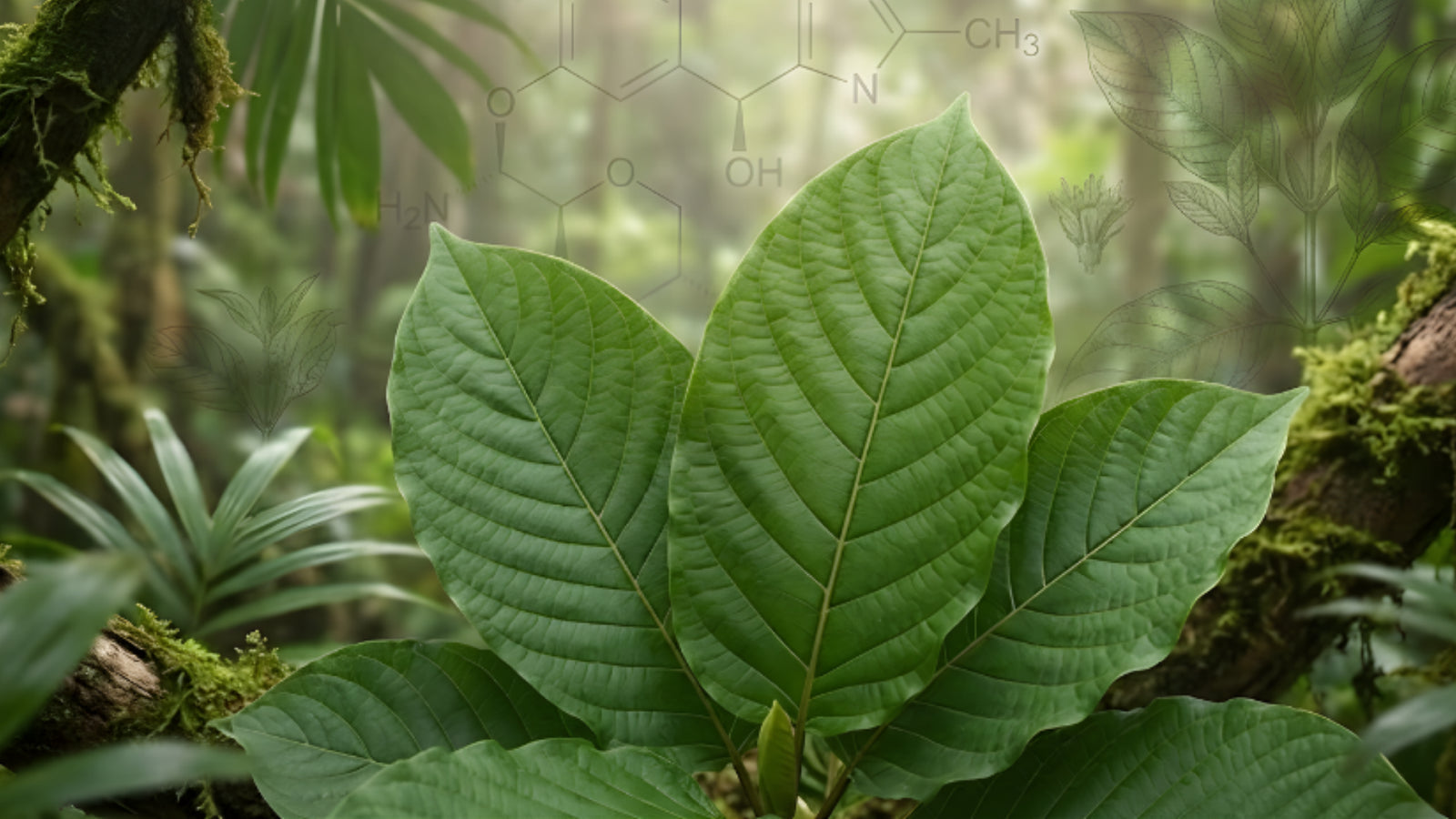
If you've spent any time reading about kratom, mitragynine and 7-hydroxymitragynine probably show up in nearly every article you click. Paynantheine almost never does. That's a strange gap, because paynantheine is one of the most abundant alkaloids in the leaf and shows up in nearly every batch of properly cured kratom on the market.
This guide pulls paynantheine into the spotlight. We'll cover what it is, where it sits in the kratom alkaloid family, what current research suggests about its effects, and why understanding the minor alkaloids changes how you read a strain label. Per a 2018 review in Frontiers in Pharmacology, paynantheine accounts for roughly 8 to 9 percent of the total alkaloid content in dried Mitragyna speciosa leaves, putting it second only to mitragynine itself [Kruegel & Grundmann, 2018].
By the end, you'll know why some strains feel different from others even when the mitragynine percentage looks identical, and how to choose kratom that delivers a fuller alkaloid profile rather than a one-note experience.

Table of Contents
- What Is Paynantheine?
- Where Paynantheine Sits in Kratom's Alkaloid Lineup
- How Paynantheine Differs From Mitragynine and 7-Hydroxymitragynine
- What the Research Says About Paynantheine's Effects
- Paynantheine and the Body: Smooth Muscle and Receptor Activity
- 3-Iso-Paynantheine and 7-Hydroxypaynantheine: The Lesser-Known Cousins
- Strain Variation: Why Paynantheine Levels Aren't Equal Across Kratom
- Is Paynantheine Safe? What Current Studies Suggest
- Why Paynantheine Matters for Kratom Users in 2026
- How to Choose Kratom That Reflects a Full Alkaloid Profile
- Frequently Asked Questions
- Final Thoughts
TL;DR
- Paynantheine is an indole alkaloid found in Mitragyna speciosa, accounting for roughly 8 to 9 percent of total alkaloid content in dried kratom leaves.
- It sits second to mitragynine by mass and ahead of speciogynine and speciociliatine, making it one of the four primary alkaloids in nearly every kratom strain.
- Pharmacology research suggests paynantheine has weaker opioid receptor binding than mitragynine, with notable smooth muscle relaxant activity in early studies.
- Two related compounds, 3-iso-paynantheine and 7-hydroxypaynantheine, show up in chemistry papers as isomeric and metabolic variants worth tracking as research expands.
- Levels of paynantheine vary across strains and growing regions, which partly explains why two batches of "Maeng Da" can feel different even at the same dose.
- Compared to the dominant alkaloids, paynantheine has been studied less, but interest is growing in 2025 and 2026 with new NIDA-funded research into minor kratom constituents.
- The American Kratom Association reports that more than five million Americans use kratom, which is fueling the demand for clearer labeling around full alkaloid profiles, not just mitragynine percentages.
- For most users, the practical takeaway is to look for strains with a balanced alkaloid spread rather than chasing a single number on a lab certificate.

What Is Paynantheine?
Paynantheine is a naturally occurring indole alkaloid produced by the leaves of Mitragyna speciosa, the tree that gives us kratom. Chemically, it shares the same core scaffold as mitragynine and the other major kratom alkaloids, with a slight structural twist that changes how it behaves in the body.
You won't find paynantheine in isolation on any reputable shelf. It comes as part of the natural alkaloid blend in whole-leaf kratom, and its concentration depends on the strain, the harvest, the drying process, and where the tree was grown. In peer-reviewed kratom chemistry papers, paynantheine is consistently flagged as one of the four "major" indole alkaloids alongside mitragynine, speciogynine, and speciociliatine.
What makes it interesting is the gap between how often it appears in the leaf and how rarely it shows up in mainstream kratom conversation. That mismatch is part of what this guide is here to fix.
Where Paynantheine Sits in Kratom's Alkaloid Lineup
Mitragyna speciosa contains more than 40 identified alkaloids, but only a handful show up in concentrations large enough to matter for the user experience. Per published chemistry data, the rough breakdown looks like this:
| Alkaloid | Approximate share of total alkaloid content | Notes |
|---|---|---|
| Mitragynine | 60 to 66 percent | Dominant alkaloid, drives most of the recognized effects |
| Paynantheine | 8 to 9 percent | Second most abundant, smooth muscle relaxant activity in studies |
| Speciogynine | 6 to 7 percent | Another smooth muscle relaxant candidate |
| Speciociliatine | 1 to 2 percent | Stereoisomer of mitragynine, weaker opioid receptor binding |
| 7-Hydroxymitragynine | Less than 2 percent | Far stronger opioid activity per mg, present in trace amounts |
| Mitraphylline | Less than 1 percent | Found in trace amounts in many leaves |
That table makes the case quickly. Paynantheine is not a trace compound. It is consistently the runner-up by mass and contributes to whatever you're feeling, even if the marketing language only mentions mitragynine. For more on the parent plant and its full chemistry, read our Mitragyna speciosa overview.

How Paynantheine Differs From Mitragynine and 7-Hydroxymitragynine
Mitragynine is the alkaloid that put kratom on the pharmacology map. It binds mu-opioid receptors as a partial agonist, which is the technical way of saying it activates the receptor with a ceiling that opioid pharmacologists describe as functionally limited. 7-Hydroxymitragynine is structurally similar to mitragynine but with a hydroxyl group added at carbon 7, and that single change makes it dramatically more potent at the receptor.
Paynantheine sits in a different lane. Its binding profile at mu-opioid receptors is weaker than mitragynine's in most published assays, and early work suggests it may interact more meaningfully with smooth muscle tissue than with central opioid pathways. Researchers Hassan and colleagues (2013) noted in their PubMed-indexed review that paynantheine and speciogynine display smooth muscle relaxant properties that mitragynine does not [Hassan et al., 2013].
Practically, that suggests paynantheine isn't doing the heavy lifting on the opioid side of the kratom experience, but it could be contributing to the body-relaxation feel that some users describe with red strains and certain blends.
What the Research Says About Paynantheine's Effects
Here's where I need to be straight with you. The research on paynantheine specifically, as opposed to kratom as a whole, is limited. The peer-reviewed literature is dominated by mitragynine and 7-hydroxymitragynine because those compounds are easier to isolate, easier to dose in animal models, and more directly relevant to opioid receptor science.
That said, three threads from the published work are worth knowing:
- Smooth muscle activity. Multiple studies, including Hassan and colleagues' 2013 review, identify paynantheine as a smooth muscle relaxant in isolated tissue assays. That category covers the muscles lining your intestines, blood vessels, and airways.
- Weaker opioid receptor activity. In binding assays comparing the major kratom alkaloids, paynantheine shows lower affinity at mu-opioid receptors than mitragynine. That doesn't mean zero activity, but it means it's not the alkaloid driving the analgesic profile.
- Modulation of mitragynine effects. A small but growing thread in pharmacology research suggests minor alkaloids may modulate how mitragynine behaves at the receptor level, which could explain why isolated mitragynine and whole-leaf kratom feel different at equivalent mitragynine doses.

The honest summary is that paynantheine looks more like a supporting cast member than a lead actor. It's there in every batch, it has measurable activity, and it likely shapes the texture of the experience without dominating it.
Paynantheine and the Body: Smooth Muscle and Receptor Activity
The smooth muscle finding deserves a closer look because it shows up consistently in the literature. Smooth muscle tissue contracts and relaxes throughout your body without conscious control, regulating things like gut motility, blood vessel diameter, and bronchial tone.
If paynantheine is genuinely promoting smooth muscle relaxation, that has a few real-world implications. It could contribute to the body-loose feeling that users associate with red vein strains and slower-leaning blends. It might also factor into how kratom interacts with the digestive tract, which is one of the more commonly reported effect areas in user surveys.
Worth noting: smooth muscle activity in a tissue bath does not automatically translate to whole-body effects in a person. In vitro findings have to clear several research hurdles before they show up as named clinical effects. But the consistency of the finding across studies makes paynantheine a reasonable candidate for further investigation in 2026 and beyond.
3-Iso-Paynantheine and 7-Hydroxypaynantheine: The Lesser-Known Cousins
Two paynantheine variants pop up in the kratom chemistry literature, and they're worth knowing if you're reading lab analyses or research papers:
- 3-Iso-paynantheine is a stereoisomer of paynantheine, meaning the molecules share the same atoms but arranged in a slightly different three-dimensional configuration at carbon 3. The shift can change receptor binding profiles, sometimes meaningfully. Some kratom batches contain measurable 3-iso-paynantheine, especially after extended drying or processing.
- 7-Hydroxypaynantheine is the paynantheine equivalent of 7-hydroxymitragynine. Adding a hydroxyl group at carbon 7 dramatically changes opioid receptor affinity for mitragynine, but the analogous transformation in paynantheine has been studied much less. It's been detected in certain extracts and metabolic studies, though concentrations are typically very low in raw leaf.

These cousins show up in academic chemistry papers and analytical method development (think LC-MS/MS protocols for distinguishing kratom alkaloids), but they're not part of the everyday kratom user's vocabulary yet. As research deepens, expect more attention.
Strain Variation: Why Paynantheine Levels Aren't Equal Across Kratom
Two batches of kratom labeled with the same strain name can have different alkaloid profiles. Soil chemistry, rainfall, leaf maturity at harvest, and post-harvest drying all shift the final alkaloid distribution. That includes paynantheine.
A few patterns worth knowing:
- Region matters. Indonesian-grown kratom (the source for most commercial kratom in the United States) tends to have higher mitragynine and paynantheine levels than kratom from Malaysia or Thailand, though there is significant overlap.
- Vein color is a rough proxy, not a chemistry guarantee. Red vein, green vein, and white vein labels reflect leaf maturity at harvest and curing decisions, which influence alkaloid ratios. Reds typically show slightly elevated paynantheine and other minor alkaloids relative to whites in many published profiles.
- Maeng Da is a marketing term. "Maeng Da" doesn't refer to a specific botanical variety. It's a vendor selection, often picked for high alkaloid content. That selection bias usually means more paynantheine, but only a third-party lab analysis confirms it.

If you want a real-world example of how alkaloid balance shows up in the cup, browse the GRH Kratom Red Maeng Da Powder and compare its analysis with our Green Maeng Da Powder. Same strain family, two different vein selections, two different alkaloid stories.
Is Paynantheine Safe? What Current Studies Suggest
Paynantheine has not been associated with the safety concerns that pop up in occasional reports involving kratom and other substances. That said, the research on isolated paynantheine in humans is essentially nonexistent. What exists is:
- Tissue and cell culture studies showing the smooth muscle activity discussed above, with no acute toxicity flags at typical concentrations.
- Animal pharmacology generally lumped into whole-leaf kratom studies, where paynantheine is part of the alkaloid mixture being administered.
- Survey data on whole-leaf kratom users, which represent the most common real-world exposure to paynantheine.
In a 2020 survey published in Drug and Alcohol Dependence and indexed on NCBI, regular kratom users reported low rates of serious adverse events, though they noted dependence and withdrawal as concerns at heavy chronic doses [Coe et al., 2019]. That study assesses the whole alkaloid mix, not paynantheine specifically.
The honest position for 2026: paynantheine looks safe at the levels found in standard kratom products, but the field needs targeted human studies before anyone can make confident isolated-compound claims.

Why Paynantheine Matters for Kratom Users in 2026
A few converging trends make paynantheine more relevant this year than it was even two years ago.
First, the American Kratom Association estimates more than five million Americans use kratom, and that number keeps climbing. With that audience, demand for accurate labeling has grown. Vendors are publishing certificates of analysis showing not just mitragynine percentage, but a fuller alkaloid breakdown, and paynantheine shows up on those certificates.
Second, the National Institute on Drug Abuse has expanded research funding into kratom alkaloids, including the minor ones. That means more peer-reviewed work on paynantheine specifically is likely in the pipeline through 2026 and 2027 [NIDA, 2024].
Third, the 2025 push for federal regulatory clarity around kratom (the AKA's continued advocacy for the Kratom Consumer Protection Act at the state level, with similar efforts at the federal level) makes alkaloid transparency a competitive advantage for vendors. The brands publishing fuller profiles, paynantheine included, are positioning themselves for the next regulatory phase [American Kratom Association, 2026].
For users, this matters because reading a label correctly increasingly means looking past the headline mitragynine number and noticing the supporting cast.
How to Choose Kratom That Reflects a Full Alkaloid Profile
A short, practical buyer's guide if you want kratom where paynantheine and the other minor alkaloids are working alongside mitragynine rather than fading into background noise:
- Look for a third-party lab certificate of analysis. Reputable vendors publish them. The certificate should show mitragynine percentage and ideally a breakdown of additional alkaloids, including paynantheine and speciogynine.
- Favor whole-leaf powders over heavy extracts. Extracts often concentrate mitragynine and 7-hydroxymitragynine while diluting the relative share of paynantheine and other minor alkaloids. That changes the texture of the experience.
- Check the harvest and curing notes. Vendors who describe their drying and curing process tend to deliver more consistent alkaloid profiles, which means more reliable paynantheine content from batch to batch.
- Pay attention to vein color and strain notes. Red veins generally show fuller minor alkaloid profiles in published analyses. Green and white selections trade some of that for different effect profiles.
- Be skeptical of "ultra-high mitragynine" marketing. A 2 percent mitragynine number sounds impressive, but it can sometimes signal an alkaloid profile that has been pushed out of natural balance.

You can apply these checks to any kratom vendor. They aren't unique to one brand, and they'll save you from paying premium prices for a one-note product.

For balanced everyday strains that retain a fuller alkaloid profile, our Red Maeng Da Powder and our broader kratom blend lineup are common starting points. Pair them with the basics covered in our guide to kratom benefits for context on what to expect.
Frequently Asked Questions
What is paynantheine in simple terms?
Paynantheine is one of the four main alkaloids found in kratom leaves. It sits second by mass behind mitragynine, accounting for roughly 8 to 9 percent of the total alkaloid content. It contributes to the overall feel of kratom even though it's rarely highlighted on packaging.
Does paynantheine get you high?
On its own, paynantheine has weaker opioid receptor activity than mitragynine, so it isn't the compound driving the recognizable kratom effects. It does appear to contribute to smooth muscle relaxation, which is part of why some strains feel more body-loose than others.
Is paynantheine the same as mitragynine?
No. They share the same core indole structure but differ in side chain configuration. That structural difference changes how each compound binds receptors. Mitragynine acts as a partial agonist at mu-opioid receptors; paynantheine binds those receptors much more weakly.
How is paynantheine measured in kratom products?
Reputable labs use liquid chromatography paired with mass spectrometry, often LC-MS/MS, to quantify individual alkaloids in a kratom sample. A full third-party certificate of analysis will list paynantheine alongside mitragynine, speciogynine, speciociliatine, and 7-hydroxymitragynine.
Are 3-iso-paynantheine and 7-hydroxypaynantheine the same as paynantheine?
They're related compounds. 3-iso-paynantheine is a stereoisomer (same atoms, slightly different shape), and 7-hydroxypaynantheine is a hydroxylated variant. Both show up in chemistry research and certain analyses, but they're far less abundant in raw leaf than paynantheine itself.
Which kratom strains have the highest paynantheine?
Red vein selections from Indonesia, especially Maeng Da and Bali types, generally show the fullest paynantheine and minor alkaloid profiles in published analyses. Strain consistency varies by vendor, so a batch-specific lab certificate is the most reliable answer.
Is paynantheine safe?
Based on tissue studies and the broader human safety data on whole-leaf kratom, paynantheine appears safe at the levels naturally present in kratom products. Targeted human research on isolated paynantheine is limited as of 2026, so confident isolated-compound claims aren't possible yet.
Can paynantheine cause withdrawal?
Withdrawal reports in the kratom literature are tied to chronic heavy use of whole-leaf kratom, which contains mitragynine plus the other alkaloids. Paynantheine on its own has not been shown to drive withdrawal in the published research, though it likely contributes alongside the dominant alkaloids in chronic use.
Why isn't paynantheine more famous if it's so abundant?
Two reasons. First, mitragynine and 7-hydroxymitragynine are far more potent at opioid receptors, which makes them more interesting to pharmacology researchers. Second, kratom marketing in the United States has historically focused on a single number (mitragynine percentage), which crowds the minor alkaloids out of the conversation. That's slowly changing as analytical labs publish fuller profiles and as research catches up.

Final Thoughts
Paynantheine is the alkaloid that's been hiding in plain sight. It shows up in nearly every batch of properly cured kratom, accounts for the second-largest share of total alkaloid content, and almost certainly shapes the body-loose, smooth-muscle-relaxant feel that some kratom users describe. The peer-reviewed literature is still catching up, but the research that exists points in a consistent direction: paynantheine matters, even if it doesn't carry the headline.
The practical takeaway for 2026 is straightforward. When you read a kratom label, glance past the mitragynine percentage and look for the full alkaloid profile on a third-party certificate of analysis. Paynantheine, speciogynine, and speciociliatine should be there. If they aren't, you're getting a partial picture.
If you want strains that retain a fuller, more natural alkaloid balance, our Red Maeng Da Powder and Green Maeng Da Powder are good starting points, and our guide to kratom blends walks you through how vendors layer different leaf profiles. The kratom story is bigger than mitragynine, and paynantheine is one of the reasons why.


