



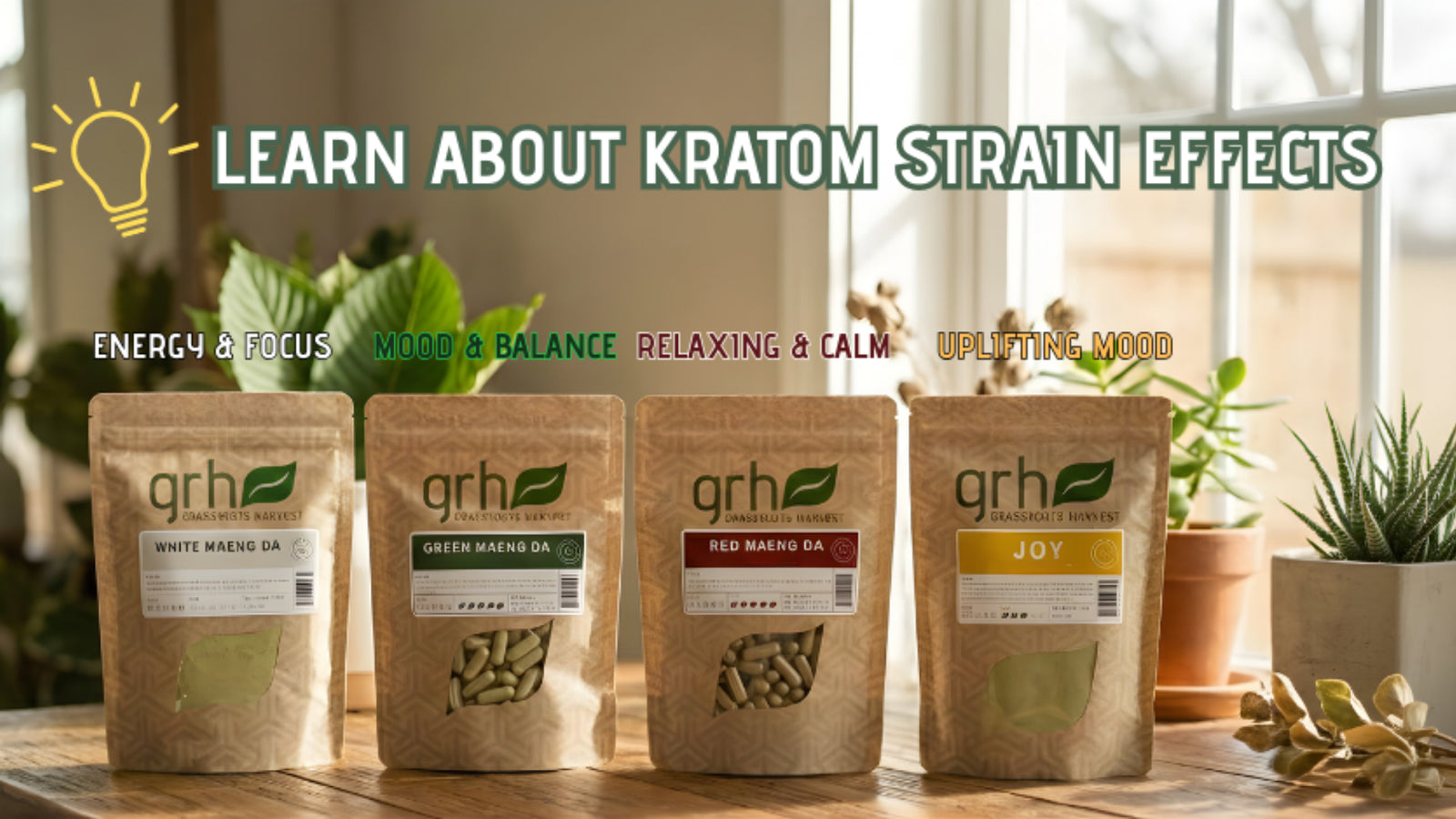
If you've ever stood in front of a kratom shelf with eight different bag colors and tried to decide which one fits your day, this is the guide that should have come in the box. Kratom strains aren't a marketing taxonomy. They're a real reflection of where the leaf grew, when it was harvested, and how it was processed, all of which shifts the alkaloid profile in ways most users feel directly. The problem is that retailers describe these differences in language ranging from accurate to wishful, and most "strain charts" online are either oversimplified or quietly seeded with vendor preferences.
This guide gives you the chart, then explains how to use it. We cover the meaning of vein color (more important than most users realize), the role of geographic origin (less important than most marketing implies), the alkaloid profile shifts that produce real differences in subjective effect, and the strain rotation strategies that experienced users actually rely on. By the end, you'll have a one-page mental model that lets you walk into any reputable kratom retailer and pick a strain that matches what you actually want from the day.
According to SAMHSA's 2024 National Survey on Drug Use and Health, lifetime US kratom users have grown from roughly 4 million to 5 million between 2019 and 2023, and the question that comes up most often in user surveys isn't "is kratom safe" but "which strain should I start with." This chart answers that.

Table of Contents
- The Master Strain Chart
- What Vein Color Actually Means
- The Role of Geographic Origin
- Vein Colors in Detail
- Major Strains by Origin
- How Alkaloid Profiles Drive Effect Differences
- How to Read a Strain Label Honestly
- Strain Rotation and Tolerance
- Frequently Asked Questions
- Final Thoughts
TL;DR
- Vein color (white, green, red, yellow/gold) is the strongest signal for what a strain will feel like.
- Geographic origin (Maeng Da, Bali, Borneo, Thai, Indo, Sumatra, Malay, Vietnam) shapes the secondary alkaloid profile but has a smaller effect on overall character.
- White veins lean stimulating and energetic. Greens are balanced and social. Reds lean calming and analgesic. Yellow/gold is processed for a unique blended profile.
- Maeng Da is generally the most potent designation across colors, regardless of where it was grown.
- The alkaloid profile (mitragynine, 7-OH, paynantheine, speciogynine, speciociliatine ratios) drives the subjective difference between strains, not vein color alone.
- The chart in this guide is a reference, not a prescription. Individual response varies.
- Lab-tested products with COAs are how you confirm what's actually in the bag.
- Rotating across vein colors is the simplest tolerance-management strategy long-term users rely on.

The Master Strain Chart
Save this. Bookmark it. Print it. The full reference.
| Vein color | Typical effect profile | Best for | Common origins |
|---|---|---|---|
| White | Stimulating, energetic, alert | Mornings, focus, social energy | Maeng Da, Borneo, Thai, Indo |
| Green | Balanced, mood-lifting, sociable | Daytime general use, work blocks | Maeng Da, Malay, Bali, Borneo |
| Red | Calming, analgesic, sedating | Evenings, relaxation, sleep prep | Bali, Borneo, Sumatra, Maeng Da |
| Yellow/Gold | Blended, milder, longer onset | Mid-day, transitional moments | Vietnam, Bali (post-processed) |
That's the four-color foundation. Now the geographic origin layer.
| Origin | Typical character notes |
|---|---|
| Maeng Da | Most potent designation across all colors |
| Bali | Smooth, classic profile, widely available |
| Borneo | Long-lasting, traditional alkaloid balance |
| Thai | Higher mitragynine, energetic in white form |
| Indo | Mellow, balanced, often imported as raw leaf |
| Sumatra | Smoother red profile, popular for evenings |
| Malay (Malaysian) | Often reported as longer-lasting |
| Vietnam | Newer, often mid-potency, balanced |
| Riau | Smoother profile, less commercial visibility |
Combine the vein color from the first chart with the origin from the second, and you get the full strain name (e.g., "Red Bali" or "White Maeng Da"). The two layers together explain most of what a user means when they call out a strain by name.

What Vein Color Actually Means
The single most important variable on the strain chart, and the one most beginners underestimate.
The Botanical Reality
Vein color refers to the color of the central vein and stem of the kratom leaf at harvest time. White-vein leaves are harvested early in the maturation cycle, before the central vein has fully reddened. Green-vein leaves are harvested at the midpoint of maturation. Red-vein leaves are harvested late, when the central vein has darkened to a reddish-brown. The color difference is a function of leaf maturity and the alkaloid balance shifts that come with it.
Why This Drives Different Effects
The alkaloid mix shifts with maturation. Whites tend to have higher mitragynine and lower 7-hydroxymitragynine. Reds tend to have higher 7-hydroxymitragynine relative to total alkaloid load, plus elevated paynantheine and other secondary alkaloids associated with sedation and analgesia. Greens sit in the middle. Yellow/gold is often the result of post-harvest processing (extended drying, fermentation) that shifts the profile yet again.
The 2022 Frontiers in Pharmacology review of mitragynine and its diastereomers walks through how these alkaloid ratios produce the subjective effect differences users describe. It's not just marketing. The biology is genuinely there.

The Role of Geographic Origin
Less consequential than vein color, but still meaningful for the connoisseur user.
What Origin Actually Influences
Soil mineral content, rainfall patterns, sun exposure, and altitude all influence alkaloid production in the kratom tree. Borneo soil produces a slightly different alkaloid balance than Sumatra soil. Vietnamese kratom is often grown at higher altitude and produces a profile that sits between traditional Thai and Bali characters. These differences are real but typically smaller in magnitude than the differences between vein colors.
Maeng Da Is Not a Place
This trips up nearly every new user. Maeng Da literally translates to "pimp grade" in Thai slang, and it's a quality designation rather than a geographic origin. Originally, Maeng Da meant grafted strains selected for higher mitragynine content; now the term has become more generic and gets applied to potent versions of strains from many origins. White Maeng Da, Red Maeng Da, and Green Maeng Da exist precisely because Maeng Da designates strength and processing, not place.
The Marketing-vs-Reality Gap
Some origin labels carry more marketing weight than pharmacological substance. "Premium Bali" and "Super Maeng Da" and "Ultra Enhanced" are vendor branding more than product specifications. The lab-tested mitragynine percentage on a current COA is a far better signal of potency than any origin label. Reputable vendors publish these numbers; the rest is branding.

Vein Colors in Detail
White Vein
The earliest harvest, lowest 7-OH content, highest relative mitragynine. Subjective profile: alertness, mild euphoria, increased focus, mild appetite suppression. Best for mornings and tasks that need clean energy. Common substitute for coffee or low-dose stimulants. White Maeng Da is the highest-volume "swap your coffee" recommendation in most user surveys. GRH Kratom's White Maeng Da is batch-tested for consistent alkaloid content, which is the single biggest practical concern with white veins (newer harvests vary in mitragynine percentage).
Green Vein
Mid-harvest, middle alkaloid balance. Subjective profile: balanced energy, mood lift, increased sociability, mild analgesia, no significant sedation. Best for general daytime use, work-from-home blocks, social settings. Most "I just want one strain that does everything" users land on a green vein eventually. Green Maeng Da is the most-rotated strain in long-term-user routines.
Red Vein
Late harvest, highest 7-OH relative to total alkaloid load. Subjective profile: relaxation, mild sedation, analgesia, mood smoothing. Best for evenings, post-work decompression, mild sleep support, and pain management contexts. Reds also tend to have the strongest body-feel quality, which is why they dominate user reports for muscle tension and physical discomfort. Red Maeng Da is a popular evening pick.
Yellow / Gold Vein
Not a separate harvest stage. Yellow/gold kratom is post-processed (typically through extended drying or controlled fermentation) to shift the alkaloid balance. Subjective profile: blended characteristics, slower onset, longer subjective duration, often described as "like a green but smoother." Best for mid-day transitions or for users who want a single product that lasts through varied tasks.
Why Not Mix Vein Colors in One Sitting
Common new-user question. Mixing white and red in the same dose tends to produce a muddled experience because the alkaloid signals work against each other. Stimulating and sedating effects partially cancel, and the net result often feels like a lower effective dose than either strain alone. Most experienced users dose one vein color per session and rotate across days instead.

Major Strains by Origin
Maeng Da
The big one. Available in white, green, red, and yellow/gold. Typically the highest-mitragynine versions on the shelf. "Maeng Da" is more about quality designation than place, so a "Red Maeng Da" can come from Indonesia, Thailand, or Borneo depending on the vendor. What matters: the mitragynine percentage on the COA.
Bali
Classic, widely available, smoother profile across all colors. Red Bali is one of the most popular evening strains in the entire kratom marketplace. White Bali is less common; most Bali users choose red or green.
Borneo
Long-lasting, traditional alkaloid balance, slightly higher paynantheine in many lots. Red Borneo is well-regarded for sedation; Green Borneo for moderate balanced effect. Less common in the US retail market than Bali or Maeng Da.
Thai
Higher mitragynine in white-vein versions, energetic profile. Less common as a primary product in the US because of historical export restrictions, although availability has improved.
Indo
Mellow, balanced, often available as raw leaf or basic powder. Many Indo strains aren't called out by name; they're processed into "house blends" by retailers.
Sumatra
Distinct red-vein character, smoother body feel, popular for evening use. Sumatran kratom tends to be more expensive due to slower harvest cycles.
Malay (Malaysian)
Often reported as longer-lasting, moderate potency. Green Malay is the most common variant. Sometimes called "Super Green Malay" by vendors, which is a marketing-grade modifier rather than a pharmacological one.
Vietnam
Newer to the US market. Higher altitude growing produces a profile some users describe as "between Thai and Bali." Most often available in white and green.
Riau (and Other Smaller Origins)
Indonesian provinces beyond the well-known ones (Riau, Jongkong, Hulu Kapuas) produce distinctive lots that sometimes appear at boutique retailers. Worth trying if you've worked through the standard origins.

How Alkaloid Profiles Drive Effect Differences
This is the chemistry layer behind every "what's the difference between X and Y" question users ask.
The Five Alkaloids That Matter Most
- Mitragynine. The dominant alkaloid by mass in most leaf. Drives most of kratom's subjective effect at typical doses. Higher in white veins.
- 7-Hydroxymitragynine (7-OH). Much smaller percentage of total alkaloid load but roughly tenfold more potent at the mu-opioid receptor. Higher in red veins. Drives the analgesic and sedating qualities reds are known for.
- Paynantheine. Modulates smooth muscle, contributes to body-relaxation feel.
- Speciogynine. Reported to contribute to muscle relaxation.
- Speciociliatine. Less well-characterized; appears to contribute to the calming end of the profile.
A meaningful share of strain-to-strain variation comes from the ratios of these five compounds, not just total mitragynine content. The 2024 human pharmacokinetic study published in Clinical Pharmacology in Drug Development confirmed that subjective onset and duration are governed primarily by total mitragynine load, while strain-to-strain "character" tracks the secondary alkaloid mix.
How Tolerance Affects Strain Selection
Long-term users typically find that no single strain stays equally effective forever. Receptor adaptation produces a fade in subjective effect that responds well to strain rotation, as our kratom tolerance guide covers in depth. Rotating across vein colors (and to a lesser extent, origins) is the simplest non-break-based strategy that works. For users dialing in their gram count alongside a rotation, our kratom dosage guide walks through the standard ranges and how response varies by strain.

How to Read a Strain Label Honestly
Three checks that separate marketing from substance.
The COA Test
Reputable vendors publish current third-party Certificates of Analysis showing mitragynine percentage, 7-OH percentage, heavy metals, microbial contamination, and pesticide residue. No COA, no purchase. The mitragynine percentage tells you actual potency; the contamination panel tells you whether the product was processed in conditions that meet basic safety standards.
The Pricing Sanity Check
Premium-grade kratom in the US typically runs $0.10 to $0.20 per gram in standard 100g+ purchases. Drastically cheaper product is usually older inventory, lower-mitragynine batch, or both. Drastically more expensive product is usually paying for branding rather than potency. Stay near the middle.
The Origin Honesty Check
Vendors who can name the specific province (or at least the specific country) the leaf came from are usually more transparent than vendors who use generic "imported" language. The FDA's kratom safety page notes that supply-chain opacity is one of the bigger drivers of contamination and adulteration risk; transparent sourcing is the closest thing the industry has to a regulatory backstop.
Use This Quick Reference Table
| Label claim | What to verify |
|---|---|
| "Lab-tested" | Get the COA, check the date |
| "Premium" or "Super" | Mitragynine % on COA, not the marketing |
| "Pure leaf" | Should be powder only, no extracts in the bag |
| "Concentrated" | Means extract; dose math is different |
| "Imported direct" | Origin should be a real country/province |


Strain Rotation and Tolerance
The single biggest mistake long-term kratom users make is single-strain loyalty. Receptor adaptation gets very efficient at predicting one specific alkaloid ratio, and the fade hits faster than it does with strain rotation. A 2024 review on kratom safety in PMC's kratom toxicology in public health context notes that consumer-survey patterns of strain rotation are associated with more stable long-term use profiles than single-strain dosing.
A Three-Color Weekly Rotation
The simplest pattern that works:
- Monday-Wednesday: white vein (mornings, focused work)
- Thursday-Friday: green vein (balanced productivity)
- Saturday: red vein (decompression)
- Sunday: off-day (no kratom)
Vary the origin within each color across weeks. Buy three batches at a time so you always have the rotation available.
Why This Works
Different alkaloid ratios touch the receptor population from slightly different angles, reducing the speed at which adaptation efficiency builds. Combine with a planned weekly off-day and most users keep their daily totals stable across years rather than escalating. For more on the receptor-level mechanism, our grapefruit juice and kratom recipe covers a related extraction technique.
Frequently Asked Questions
What's the most popular kratom strain?
Maeng Da, in any vein color. It's the most widely available designation, the most consistent in mitragynine percentage from reputable vendors, and the strain most users mention by name when they recommend kratom to a friend.
What's the best kratom strain for energy?
White vein, with White Maeng Da being the most common pick. White Borneo and White Thai are also energetic. The energy profile peaks around the 60-90 minute mark and lasts 4-6 hours.
What's the best kratom strain for relaxation?
Red vein. Red Bali, Red Borneo, and Red Maeng Da are the dominant evening picks. The calming and analgesic effects scale with dose; most users find 3-5 grams effective for relaxation purposes.
What's the difference between Maeng Da and Bali?
Maeng Da is a quality designation that signals higher mitragynine content; Bali is a geographic origin known for smoother profiles. A Red Maeng Da from Bali combines both qualities. Maeng Da is generally more energetic per gram than standard Bali.
Is yellow/gold kratom stronger than other colors?
Not necessarily. Yellow and gold strains are post-processed (extended drying or fermentation) which shifts the alkaloid profile but doesn't necessarily increase total potency. The character is different, not categorically stronger.
Can I mix strains in the same dose?
Some users do, but it's not the most reliable approach. Mixing whites and reds tends to produce a muddled experience because stimulating and sedating signals partially cancel. If you want variety, rotate across days rather than mixing in a single sitting.
Why does the same strain feel different from different vendors?
Batch-to-batch variation. Even the same strain name from the same vendor varies slightly between lots based on harvest timing, soil conditions, and processing. Lab-tested vendors with consistent COAs minimize this; cheaper vendors typically don't.
What's the difference between leaf powder and extract?
Leaf powder is dried, ground kratom leaf with all naturally occurring alkaloids in whole-plant ratios. Extract is concentrated, with mitragynine and 7-OH levels much higher than the leaf supports. Dose math is completely different. Stick to leaf powder unless you've done your homework on extract dosing.
How long does each strain last?
Subjective duration is fairly similar across strains (5-7 hours total), with peak intensity around 60-90 minutes. Yellow and gold strains sometimes feel longer because the post-processing shifts the absorption curve slightly.
Final Thoughts
Kratom strain charts look complicated until you realize they're just two layers stacked: vein color (the dominant signal) and geographic origin (the secondary signal). Once you have the four colors mapped to their general effect profiles, and the major origins mapped to their general character notes, picking a strain becomes a 30-second decision rather than a 30-minute decision. White for mornings, green for balanced days, red for evenings, yellow for transitional times. Maeng Da when you want potency, Bali when you want smoothness, Borneo when you want longevity, Vietnam when you want something different.
The most important thing this chart doesn't tell you is the lab-tested mitragynine percentage of the specific batch you're buying. That number is what determines whether the strain you bought matches the strain you read about. Reputable vendors publish current COAs; that's where the chart meets the actual product on your counter. Once you start matching strain selection to lab numbers, the difference between "I think Red Bali works for me" and "I know Red Bali at 1.6% mitragynine works for me" turns out to be enormous.


