



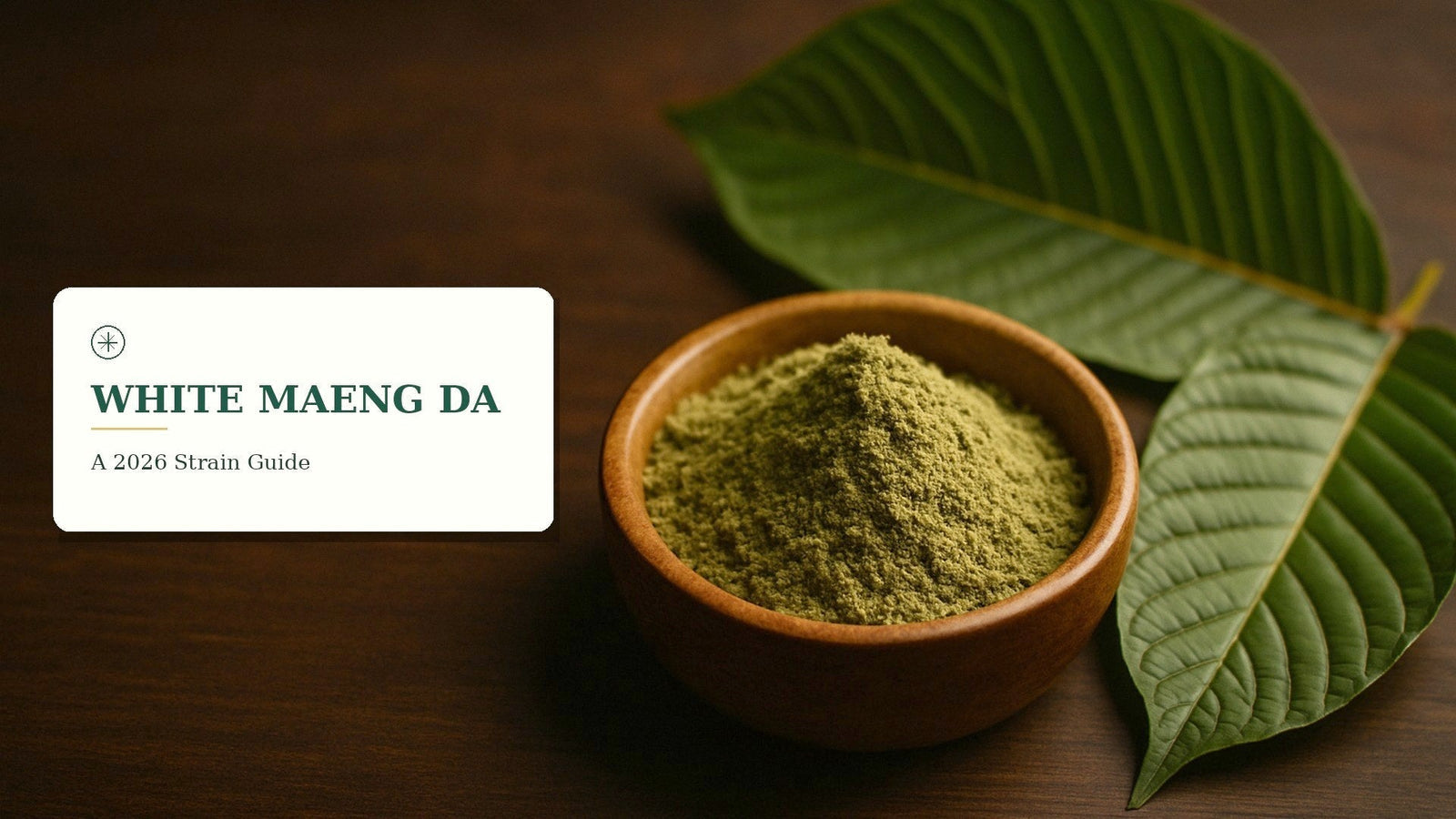
White Maeng Da kratom is the white-vein version of a leaf that carries one of the loudest brand labels in the industry, and the combination has earned it a permanent spot at the front of most morning routines. The "Maeng Da" part is a marketing claim about quality, not a country. The "white" part is a real botanical signal about how the leaf was harvested and dried. Together, they describe a powder regular users keep for the bright end of the day, when the goal is focus and lift, not unwinding.
According to the American Kratom Association, more than 15 million Americans use kratom regularly, and white-vein varieties account for the largest share of pre-work and morning use cases. White Maeng Da is one of the two or three most-searched white-vein names every year, alongside White Bali and White Borneo.

This guide covers what Maeng Da actually means, what the white vein layers on top of it, the alkaloid profile, the typical effect curve, sensible dosing, how it compares to White Bali, quality red flags, common variants, and the daily-use practices that keep it useful instead of habit-forming.
Table of Contents
- What "Maeng Da" Actually Means (Branding, Not a Region)
- What the White Vein Adds to the Maeng Da Branding
- White Maeng Da Alkaloid Profile: Higher Mitragynine, Brighter Lift
- The Typical White Maeng Da Effect Profile
- White Maeng Da Dosage Guide
- Who White Maeng Da Suits (and Who Should Look Elsewhere)
- White Maeng Da vs White Bali: Two Whites, Two Personalities
- Quality Red Flags When Shopping for White Maeng Da
- Popular White Maeng Da Variants You Will See on Labels
- Safe Daily-Use Practices for White Maeng Da
- Frequently Asked Questions
- Final Thoughts
TL;DR
- White Maeng Da kratom is a white-vein Mitragyna speciosa labeled with the Maeng Da branding, which translates loosely as "pimp grade" and refers to curated, selectively bred leaf rather than a specific Indonesian region.
- The white vein, produced when younger leaves are dried quickly indoors with minimal sun exposure, leans the alkaloid profile toward mitragynine, the parent compound associated with alert, mood-forward, focus-friendly effects.
- Among common whites on the US market, white Maeng Da tends to sit at the top of the mitragynine-density range, which is why users describe it as brighter, sharper, and sometimes a little edgy at higher doses.
- Typical white Maeng Da kratom dosage runs 1.5 to 2.5 g for a first session, 2.5 to 4 g for an experienced daytime dose, and rarely above 5 g, because diminishing returns and edge show up faster on white veins than on reds.
- Onset usually lands within 20 to 40 minutes, peaks near 60 to 75 minutes, and tapers across 3 to 5 hours, slightly shorter than a comparable red dose on the same body.
- White Maeng Da and White Bali both lean morning, but Maeng Da feels sharper and more focus-driven while Bali feels softer, slower to build, and a touch more body-friendly.
- Quality red flags include vague "premium" labeling, no harvest date, no batch ID, no lab certificate, and powder that looks tan or olive instead of true pale green.
- The white-vein Maeng Da pick that anchors most morning routines well is a tested, lab-verified powder used 3 to 5 weekdays per week, with a clean weekend off-day, never stacked back to back without a break.

What "Maeng Da" Actually Means (Branding, Not a Region)
Maeng Da is a branding term. The phrase translates loosely from Thai as "pimp grade," and Indonesian and Thai farmers have used it for decades to label leaf they consider their best, selectively bred crop. It is not a country, not a province, and not a specific village. A bag labeled white Maeng Da kratom could be sourced from Borneo, Sumatra, Sulawesi, or Java, depending on which farm the brand contracts with that season.
That matters when you are shopping. The Maeng Da label promises that the farmer believed the harvest was a step above their average run, which usually translates into more mature trees, more careful drying, and a tighter alkaloid range. It does not promise a specific vein color, potency target, or origin. Those details have to come from the vendor in a lab certificate, not from the strain name on the bag.
So when you see white Maeng Da kratom on a shelf, read it as "white-vein leaf that this brand considers its top tier," not as "white-vein leaf from a place called Maeng Da." For deeper context on white-vein strains in general, our companion piece on white Bali kratom walks through how white-vein processing differs from red and green, and why region labeling is mostly a marketing convention.
What the White Vein Adds to the Maeng Da Branding
Once you accept that Maeng Da is a quality label rather than a place, vein color does the heavy lifting in predicting how a batch will feel. Mitragyna speciosa leaves all start green on the tree. Farmers pick them at different maturity points and dry them under different conditions, and the visible color of the central vein at processing tracks the alkaloid composition fairly well.
White-vein leaves are typically picked earlier, while the central vein still reads pale, and then dried indoors with controlled airflow and minimal sun. Less light exposure and less oxidation means the leaf keeps more of its parent alkaloid, mitragynine, and less of it converts to 7-hydroxymitragynine and other oxidized derivatives that show up more strongly in red veins. The result is a powder that tends to feel more alerting, more cognitively forward, and shorter in duration than red or green Maeng Da from the same farm.
That is why white Maeng Da kratom is the version most regular users keep for the front half of the day. Same selectively bred parent leaf, same Maeng Da curation, but pushed toward the bright, morning end of the spectrum by how the leaves were processed.

White Maeng Da Alkaloid Profile: Higher Mitragynine, Brighter Lift
Mitragynine is the compound that does most of the work in white veins. It binds primarily at the mu-opioid receptor at low doses and also touches adrenergic and serotonergic systems, which is the pharmacological story behind the "alert and a little uplifted" feeling regular users describe. According to a review on kratom pharmacology in PMC NCBI, mitragynine concentration in dried kratom leaf typically ranges from about 0.5% to 2.5% by mass, with selectively bred batches pushing toward the upper end.
White Maeng Da tends to sit at the top of that mitragynine density curve. The "Maeng Da" curation is, in practice, a screen for high-alkaloid leaf, and pairing that with white-vein processing concentrates mitragynine even further. That is why the powder reads as sharper than White Bali and more clearly focus-oriented than most generic "white blends" you will see in head shops.
The flip side is the edge it can develop at higher doses. Past about 4 g, some users feel jittery or wired in a way that overstays its welcome. That is not a sign the product is bad; it is a sign the dose crossed into "more is not better" territory for a high-mitragynine white. Smaller doses, taken with food and water, almost always read cleaner.
The Typical White Maeng Da Effect Profile
White Maeng Da kratom effects show up faster than most reds and taper sooner. On an average body and an empty stomach, the typical curve runs like this. Onset lands within 20 to 40 minutes, sometimes faster on a small-stature user or a low-tolerance one. The peak sits around 60 to 75 minutes in. The taper carries the bulk of the effect across the next 2 to 3 hours, with a quieter tail until roughly the 4 to 5 hour mark when most of it has cleared. Food shifts every checkpoint back by about 30 minutes and softens the peak slightly.
The subjective texture, according to NIDA's overview of kratom and matching what most regular users report, leans toward "alert, mildly elevated mood, easier focus, light social warmth." It is not a caffeine-style stimulant. It feels closer to the way a strong morning coffee plus a good night of sleep feels when both happen on the same day, with a steadier baseline once the peak settles.

White Maeng Da is best known for pre-work focus and clean mood. Knowledge workers reach for it on a Monday when the week's first heavy meeting is on the calendar; weekend users reach for it before workouts or chores that benefit from steady drive without the body feeling pushed.

White Maeng Da Dosage Guide
White-vein doses generally run a touch lower than red-vein doses for the same person, because higher mitragynine means a smaller amount produces a clear effect. None of the numbers below are medical advice; they are starting points the typical experienced user lands on after some self-experimentation. Our kratom dosage guide walks through the same logic across vein colors.
First session, no kratom experience: 1.5 to 2 g, taken on a mostly empty stomach with water. Wait a full 60 minutes before any redose. If you feel under-served at the 60-minute mark, 0.5 g more is plenty.
Regular daytime dose: 2.5 to 4 g, depending on tolerance and body weight. Most users settle in the 3 to 3.5 g range for a standard morning. Higher-tolerance dose: 4 to 5 g for users running white Maeng Da for several months. Past 5 g, the curve flattens and the edge outpaces the upside.
Frequency matters as much as size. Three to five weekdays in a row with a clean weekend off-day keeps tolerance manageable. Daily-without-a-break use for more than 4 to 6 weeks is the pattern that most often ends in tolerance creep and dependence concerns, regardless of dose.
Who White Maeng Da Suits (and Who Should Look Elsewhere)
White Maeng Da suits adults who want morning lift without caffeine's crash window, who tolerate a bright stimulant character well, and whose schedules reward focus rather than calm. Office workers, students with long study blocks, parents managing busy mornings, athletes who want a clean pre-workout, and shift workers running a "morning equivalent" at unusual hours are all common white Maeng Da users.
It is a poor fit for adults who are caffeine-sensitive or who already feel jittery without it. If a single cup of black coffee puts you over the edge, white Maeng Da will likely push you further in the same direction, especially in the 3 to 4 g range. It is also a poor fit for people who reach for kratom mainly to wind down at night; that is where red or green veins do the job better. For users who like the Maeng Da curation but want a softer, more social texture, green Maeng Da is the middle path; for users who like white-vein brightness with a touch more body comfort, White Bali is the more forgiving sibling.
White Maeng Da vs White Bali: Two Whites, Two Personalities
Both strains live on the morning side of the shelf, but they are not interchangeable. White Maeng Da feels sharper, faster to climb, more focus-driven, and a little more edgy at higher doses. White Bali feels softer, slower to build, slightly longer-lasting, and easier on the body for users who find pure whites a bit too brisk.

The simplest way to choose between them is to ask what kind of morning you want. If the goal is sharp focus on a heads-down workday, white Maeng Da generally wins. If the goal is a steady, warm-ish lift you can stretch through a long, less time-pressured morning, White Bali generally wins. Sourcing also matters: a well-sourced White Bali will sometimes outperform a poorly sourced white Maeng Da on the same morning, and brand consistency is usually more predictive of how a session lands than the strain name on the bag.

| Strain | Alkaloid Lean | Typical Effect | Dose Range | Best For |
|---|---|---|---|---|
| White Maeng Da | Higher mitragynine | Sharp focus, bright lift | 2 to 4 g | Pre-task energy, study blocks |
| Green Maeng Da | Balanced ratio | Talkative, social, steady | 2 to 4 g | Daytime balance, social |
| Red Maeng Da | Higher 7-OH | Mood smoothing, calm | 3 to 5 g | Evening unwind |
| White Bali | Mitragynine, softer | Warm lift, steady morning | 2 to 5 g | Long morning routines |
Quality Red Flags When Shopping for White Maeng Da
Most of the common quality problems we see in white Maeng Da bags come from one of four places. The first is loose sourcing, where the brand calls anything pale "white Maeng Da" without screening for actual mitragynine density. The second is sloppy drying, where leaves were over-exposed to sun and the powder shifted toward a tan or olive shade. The third is bad packaging, where moisture got in during shipping. The fourth is no lab transparency, where the brand does not publish or share a current certificate of analysis. Per FDA's dietary supplement guidance, third-party lab testing is the only reliable way to verify what is actually in a bag.
Practical red flags to watch on the bag and the brand site include a vague "premium" claim with no batch or harvest details, a powder color that reads brown or olive instead of true pale green, a website that does not show or link to a current lab certificate of analysis, a strain name that bundles "Maeng Da" with marketing words like "super," "ultra," or "premium" without any sourcing data underneath, and any vendor that refuses to share a COA when asked.

A clean white Maeng Da bag tells you the strain, the vein, the harvest date or lot ID, the origin region, and points you to a lab certificate that matches the lot on the bag. Once you find a brand that consistently delivers that, sticking with them is usually more valuable than chasing the lowest price across vendors.
Popular White Maeng Da Variants You Will See on Labels
It helps to know the common label patterns. "White Maeng Da Premium" usually signals a brand's best white Maeng Da lot for the season. "Super White Maeng Da" is a marketing term, not a botanical one; the leaf is the same, the brand is simply telling you they consider it a step above their base white. "White Maeng Da Capsules" is the same powder pre-portioned, useful for travel and dose consistency. According to a Frontiers in Pharmacology review of Mitragyna speciosa cultivation, the alkaloid difference between farms within a single vein color often exceeds the difference between veins from the same farm, which is why brand sourcing matters more than category label.
"Horned White Maeng Da" refers to leaves whose serrated edges hook into a horn-like shape; the chemistry is similar to standard white Maeng Da. "White Maeng Da Blend" usually means the powder is cut with another white or green to soften the edge. For a side-by-side look at where white Maeng Da sits, our kratom strain chart lays the catalog out.

Safe Daily-Use Practices for White Maeng Da
The usual kratom daily-use rules apply to white Maeng Da, with extra emphasis on hydration and food timing because of the brighter mitragynine profile. Drink water before and after dosing. White Maeng Da is mildly dehydrating in the way coffee is, and a half-empty water bottle is the most common reason users report afternoon headaches.
- Weigh 1.5 to 2 grams on a 0.1 gram scale for a first session.
- Mix into 8 to 10 ounces of water or juice and drink slowly over 2 to 3 minutes.
- Take on a mostly empty stomach for the cleanest curve, or with a light breakfast for a softer onset.
- Sit with it for 60 minutes before deciding whether to redose.
- Add only 0.5 to 1 gram if clearly subthreshold at the 60-minute mark.
- Hard stop at 3 grams total for a first session, and at 4 to 5 grams for established daily use.
- Write down what you felt, when, and at what dose for the next three sessions to dial in your personal baseline.
Frequency discipline is the other half. Tolerance climbs faster on whites than on reds. Three to five weekdays with a clean weekend off-day is the pattern that keeps doses small and the effect predictable. Stretches longer than 4 to 6 weeks without any break push users toward higher and higher doses for diminishing returns.
Frequently Asked Questions
What does white maeng da kratom do?
White Maeng Da kratom typically produces a 3 to 5 hour window of bright lift, easier focus, and mildly elevated mood, driven by its higher mitragynine content. It feels closer to a clean morning coffee plus a good night of sleep than to a hard stimulant. Some users describe steady drive without jitters at moderate doses, and others notice a clear edge if they overshoot the 4 g mark.
How much white maeng da kratom should I take?
Most adults land in the 2 to 4 g range for a daytime dose. First-timers should start at 1.5 to 2 g on a mostly empty stomach, wait a full hour before any redose, and treat 5 g as a hard ceiling rather than a target. Body weight, tolerance, food in your stomach, and time of day all shift the right number for any given person.
How long do the effects of white maeng da last?
Onset usually lands within 20 to 40 minutes, the peak hits near 60 to 75 minutes in, and the bulk of the effect runs 3 to 5 hours from dose to taper. Food pushes every checkpoint back by about 30 minutes. Higher doses extend the tail slightly but do not change the overall shape of the curve very much.
Is white maeng da better than white bali?
Neither is universally better; they are tuned for different mornings. White Maeng Da feels sharper and more focus-driven, which suits heads-down workdays and study blocks. White Bali feels softer and steadier, which suits longer, less time-pressured mornings. Plenty of regular users keep both on the shelf and rotate by what the day looks like.
Is white maeng da good for energy?
Yes, white Maeng Da is one of the more energy-forward whites on most catalogs. The brightness comes from higher mitragynine density rather than caffeine, so the experience reads as alert and steady rather than buzzy. Users already running on caffeine often find that stacking is too much and switch the morning coffee for kratom instead.
Is white maeng da good for focus?
For most users, yes. Bright mitragynine lift plus a clean head is what makes white Maeng Da popular among knowledge workers and students. The focus-friendly window sits in the 2.5 to 3.5 g range. Above that, brightness can tip into restlessness.
Why does my white maeng da feel edgy?
Edge almost always comes from one of three places: a dose that crossed into the 4 g and up zone, taking it on a completely empty stomach with no water, or stacking it with caffeine. The fix is the same in every case. Drop the dose by 0.5 to 1 g, eat a small breakfast first, and skip the extra coffee.
What is the difference between red and white maeng da kratom?
Same Maeng Da curated leaf, different processing. White Maeng Da is dried indoors with minimal sun, keeping mitragynine high and the effect alert and focus-forward. Red Maeng Da is dried in the sun longer or oxidized, shifting the chemistry toward 7-hydroxymitragynine and producing a calmer, longer-lasting effect.
Final Thoughts
White Maeng Da kratom is the brightest, most focus-forward leaf in the white-vein family, and the Maeng Da curation gives it a real edge in alkaloid density over the average generic white. Treated with respect, it is one of the easiest morning kratom strains to live with, with a clean curve, a predictable window, and a profile that rewards small, consistent doses over heroics.
For users ready to make white Maeng Da a steady part of the morning routine, our White Maeng Da Kratom Powder is the same lab-verified leaf described throughout this guide, sold in 45 g, 100 g, 500 g, and 1000 g sizes for users who want to start small or stock up.

For a slightly softer lift than pure white Maeng Da, our Boost Blend Kratom Powder blends white and green vein leaf into a rounder morning profile that works well on back-to-back workdays. For users who like the mood-forward side of white Maeng Da with a touch more warmth, our Joy Blend Kratom Powder leans on green and white veins for a social-friendly cup.
Whichever direction you take, the throughline is the same. Pick a brand that tests every lot, weigh your doses, write down what you feel, and treat white Maeng Da as a steady tool for mornings that need extra lift, not a daily without-a-break habit. Kept inside those rails, it rewards you with one of the cleanest, sharpest windows in the kratom catalog.


