



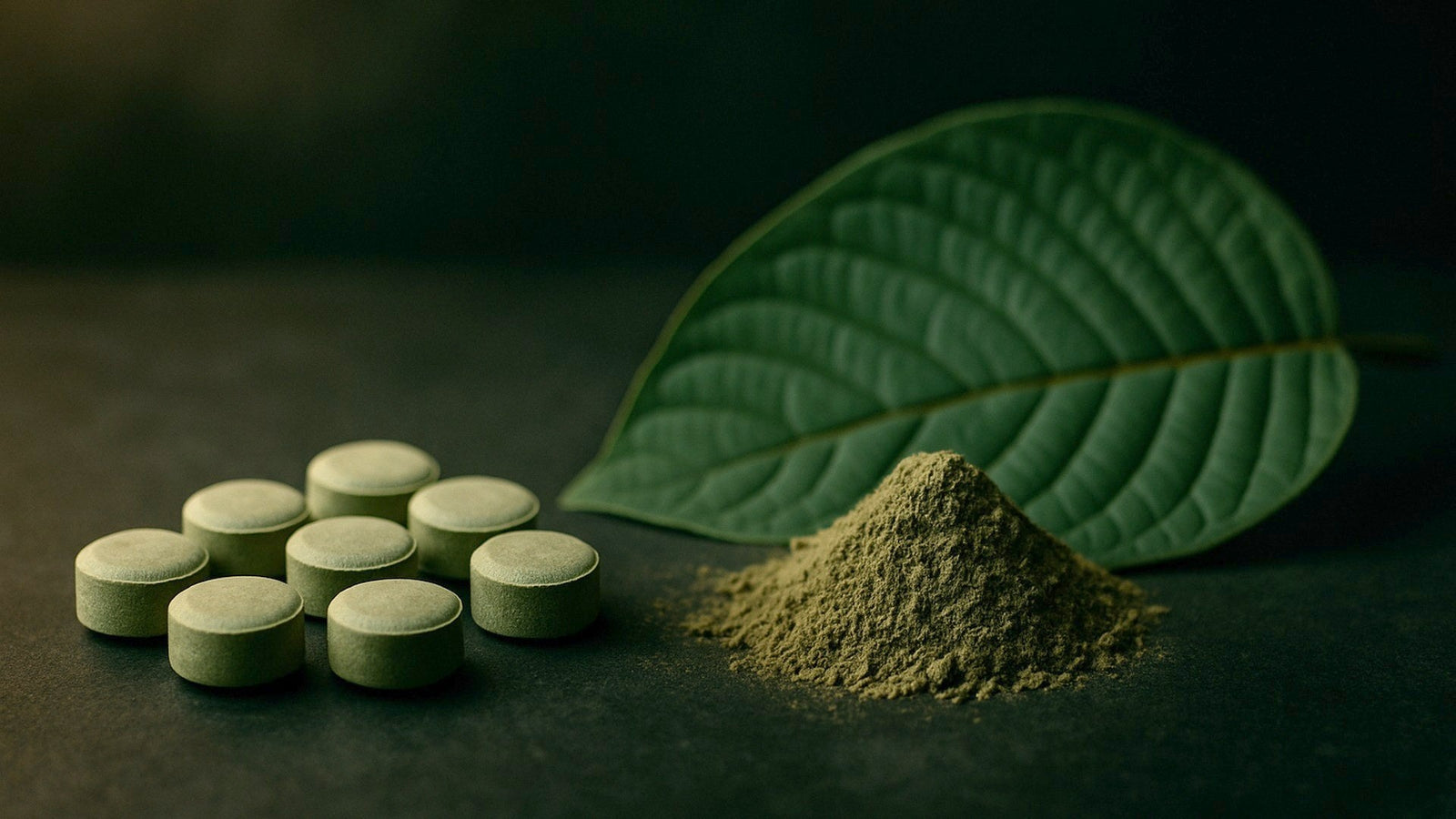
Walk into any smoke shop or wellness store with a kratom shelf and you will see the same three formats over and over: powder, capsules, and tablets. The first two are familiar enough. The third one is the format most people understand the least, and the one with the most uneven quality across brands. Some kratom tablets are pressed kratom powder, full stop. Others are concentrated extracts. A growing subset are 7-hydroxymitragynine tablets, which are a different beast entirely and have been the subject of pointed FDA attention recently.
This guide walks through what kratom tablets actually are, why brands make them, how they compare to capsules and powder, what to look for on a label, what doses make sense across the different tablet types, and the specific category (7-OH tablets) that deserves a hard look before you buy. We are going to be specific about what is in the tablet, not just the marketing on the bottle, because the gap between the two is wider in this category than in the rest of the kratom aisle.

Table of Contents
- What a Kratom Tablet Actually Is
- Why Brands Press Kratom into Tablets
- The Three Categories You Will See
- Tablets vs Capsules vs Powder
- How to Read a Kratom Tablet Label
- Dosing Tablets
- The 7-OH Tablet Category: Read This Before Buying
- Where Tablets Make Sense
- Frequently Asked Questions
- Final Thoughts
TL;DR
- A kratom tablet is compressed kratom powder or extract, formed under high pressure into a coated solid disk. Onset is slower than powder, similar to capsules.
- The category breaks into three: pressed-leaf tablets (least concentrated), standardized-extract tablets (mid), and 7-OH tablets (most concentrated, most controversial).
- Tablets are easier to dose precisely and easier to travel with than powder, but harder to fine-tune dose than capsules and significantly harder to verify alkaloid content than either.
- The 7-hydroxymitragynine tablet category has been flagged by the FDA in 2024 to 2025 as more potent and more problematic than traditional kratom. Treat 7-OH tablets as a different product, not just stronger kratom.
- For most users, a mid-range capsule (like our Relax Blend Kratom Capsules) is the better choice. Tablets shine in narrow use cases.

What a Kratom Tablet Actually Is
A kratom tablet is kratom material (powdered leaf or a concentrated extract of that leaf) compressed under high pressure with binders into a solid disk, then optionally coated for taste, stability, or aesthetics. The active alkaloids inside are the same ones in any other kratom format: mitragynine and 7-hydroxymitragynine, plus a smaller cohort of supporting alkaloids that round out the effect.
The defining feature of a tablet is the manufacturing process. A capsule is just powder loaded into a gelatin or veggie shell, dispensed by weight. A tablet is mechanically pressed; the powder is mixed with binders (microcrystalline cellulose is the most common, sometimes with magnesium stearate, calcium phosphate, or lactose), the blend is fed into a die, and the press applies enough force (often several thousand pounds per square inch) to fuse the powder into a stable disk. The result is denser than capsule fill, more shelf-stable, and easier to coat or score.
The tradeoff: tablets often hide what is inside them better than capsules do. A capsule you can pull apart and inspect; a tablet you cannot. Tablets are also easier to concentrate. A 200 mg tablet of kratom extract can deliver as much active alkaloid as 4 grams of leaf powder, which is part of why the regulatory conversation around kratom is increasingly tablet-focused.
For a deeper read on the alkaloid chemistry that drives all kratom formats, our kratom alkaloids guide covers what mitragynine and 7-hydroxymitragynine actually do at the receptor level.
Why Brands Press Kratom into Tablets
Three reasons drive the tablet format from a manufacturing standpoint:
Dose precision. A 100 mg tablet contains 100 mg of active material, every time. A teaspoon of kratom powder can vary by 20 to 30 percent depending on how packed it is. For brands targeting consistent-experience customers, the tablet is the cleanest answer.
Concentration. Tablets are the practical format for delivering high-potency extracts. Capsules can hold extracts too, but the volume limit of a capsule shell caps how concentrated the dose can be. A tablet has no such ceiling.
Travel and shelf stability. Tablets do not absorb moisture the way loose powder does, do not crack like some capsules can, and do not require measuring tools. They are the kratom format closest to a normal pharmaceutical product, which is part of their appeal and part of the regulatory concern.
Cost is a fourth factor. Tablet manufacturing has higher upfront tooling cost than capsule filling but lower per-unit cost at scale, which is why the format dominates discount-retail kratom shelves.

The Three Categories You Will See
This is the most important framing in the guide. Tablets are not a single product category. They split into three:
Pressed-leaf tablets. Plain kratom powder, pressed with binders into a tablet. Same active material as a capsule, just compressed. Typical dose: 250 to 500 mg per tablet, with most users taking 4 to 8 tablets for a standard dose. Common examples are private-label products at smoke shops and a handful of national kratom brands. These behave like a slow-release capsule.
Standardized-extract tablets. A kratom extract (typically 10x to 50x concentration) pressed into a tablet, often with a marketing label like "alkaloid-enhanced" or "MIT extract." Typical dose: 50 to 200 mg per tablet, with most users needing only 1 to 2 tablets. Effects are stronger and faster than pressed-leaf, and tolerance builds noticeably faster too.
7-Hydroxymitragynine (7-OH) tablets. A relatively new category that isolates or concentrates 7-hydroxymitragynine, the more potent of kratom's two main alkaloids, into tablet form. Doses are measured in single digits of milligrams. The effect profile is much closer to a synthetic opioid than to traditional kratom leaf. Several smoke-shop labels and a small number of dedicated 7-OH brands operate in this category. The FDA issued warning letters in 2024 to 2025 targeting 7-OH products specifically, separate from its broader stance on kratom.
These three categories share a shape but not a risk profile. The user experience and the safety considerations differ enough that "kratom tablet" as a single search term collapses three different products into one phrase. Read the alkaloid declaration on the label before you decide which one is in your hand.
Tablets vs Capsules vs Powder
The honest comparison, by use case:
| Factor | Powder | Capsules | Pressed-leaf tablets | Extract tablets | 7-OH tablets |
|---|---|---|---|---|---|
| Dose precision | Low | High | High | High | Highest |
| Onset speed | 20-40 min | 30-60 min | 40-70 min | 20-45 min | 15-30 min |
| Effect strength | Standard | Standard | Standard | Strong | Strongest |
| Travel friendliness | Low | Medium | High | High | High |
| Verifiable contents | High | Medium | Low | Low | Low |
| Tolerance build | Standard | Standard | Standard | Faster | Fastest |
| Beginner friendly | Yes | Yes | Yes | Caution | No |
The summary in plain language: powder is the most transparent format and the format with the deepest research base. Capsules are the most convenient daily format. Pressed-leaf tablets are a slightly slower-onset alternative to capsules. Extract tablets and 7-OH tablets are stronger formats with corresponding tradeoffs in tolerance, regulatory attention, and beginner suitability.
For a first-time kratom user, the path from least risky to most is: powder, capsules, pressed-leaf tablets, extract tablets, 7-OH tablets. Most readers should stop at the first two. Our Relax Blend Kratom Capsules sit in the second slot for evening wind-down use.

How to Read a Kratom Tablet Label
The label on a tablet bottle does more work than the label on a powder bag because you cannot inspect the contents. Five things to look for:
Active material declaration. The label should explicitly state what is in the tablet: pressed leaf, extract (with concentration like 10x or 50x), or isolated 7-hydroxymitragynine. If the label says only "kratom" with no qualifier, treat it as suspect; that ambiguity is a marketing choice, not a regulatory limit.
Mitragynine milligrams per tablet. A reputable tablet brand will declare mitragynine content in milligrams. Pressed-leaf tablets are typically 1 to 2 percent mitragynine by weight (so a 500 mg tablet has 5 to 10 mg of mitragynine). Extract tablets can run 20 to 50 mg per tablet. 7-OH tablets are dosed in milligrams of 7-hydroxymitragynine, not mitragynine.
Lab testing. Look for a third-party Certificate of Analysis (COA) on the brand's website or via a QR code on the bottle. Tests should cover alkaloid content, heavy metals (lead, cadmium, mercury, arsenic), and microbiological contaminants (salmonella, E. coli, yeast and mold). The American Kratom Association maintains a GMP-standards program that participating brands can certify into.
Inactive ingredients. Microcrystalline cellulose, magnesium stearate, and dicalcium phosphate are normal binders. Sucralose, FD&C dyes, and proprietary "flavor systems" are not. The cleaner the ingredient list, the better.
Origin and brand transparency. Indonesia-grown leaf is the standard. Brands that disclose source farms, harvest dates, and batch numbers are doing the bare minimum a serious supplement brand should.
If the label hides any of these, that is a signal. Cheap kratom tablets exist precisely because the label clutter makes opacity easy.
Dosing Tablets
The unit that matters is milligrams of active alkaloid per dose, not number of tablets. Here is the rough map by category:
| Category | Typical alkaloid dose per tablet | Standard daily-use dose |
|---|---|---|
| Pressed-leaf tablets | 5-10 mg mitragynine | 30-60 mg mitragynine total |
| 10x extract tablets | 20-30 mg mitragynine | 30-60 mg mitragynine total |
| 50x extract tablets | 50-80 mg mitragynine | 50-100 mg mitragynine total |
| 7-OH tablets | 5-15 mg 7-hydroxymitragynine | Highly variable, see warning below |
For pressed-leaf and extract tablets, the practical pattern is the same as for any kratom format: start at the low end, wait 60 minutes for full onset, only re-dose if needed. Most users find a comfortable single-dose total of 30 to 80 mg of mitragynine across the day.
For 7-OH tablets specifically, "standard daily-use dose" is misleading because the alkaloid is potent enough that user reports diverge widely. We do not recommend 7-OH tablets for any reader who has not first established a tolerance baseline with traditional kratom, and even then we would recommend the lowest-available-dose tablet, taken occasionally rather than daily.
For more on dosing across formats, our kratom dosage guide walks through the same math in more detail.

The 7-OH Tablet Category: Read This Before Buying
The 7-OH tablet category deserves its own section because it is what most regulatory attention in 2024 and 2025 is about, and because mistakes in this category are different from mistakes in the rest of the kratom aisle.
7-hydroxymitragynine is one of two main active alkaloids in kratom leaf. In a normal kratom session, 7-OH is present at roughly 0.01 to 0.05 percent of the leaf weight, which is to say in trace amounts. Mitragynine, the other main alkaloid, makes up about 1 to 2 percent of leaf weight. The two alkaloids work together; mitragynine is the bulk effect, 7-OH adds a sharper potency at low concentrations.
A 7-OH tablet inverts that ratio. Instead of trace 7-OH alongside mitragynine, the tablet is mostly 7-OH with little to no mitragynine. The pharmacological profile shifts. 7-OH binds the mu-opioid receptor more strongly than mitragynine does and produces effects that look more like a low-dose oxycodone than like a kratom tea.
The FDA issued warning letters in 2024 to companies marketing 7-OH products as kratom equivalents, calling out the misleading framing. The American Kratom Association has been clear that 7-OH-isolate products are not what the AKA's GMP standards cover and should not be sold under the kratom umbrella. Several state legislatures (notably Tennessee, Mississippi, and Louisiana) have passed or are considering bills that specifically distinguish 7-OH products from traditional kratom.
What this means for you as a buyer:
- A 7-OH tablet is not "stronger kratom." It is a different product with a different risk profile.
- The dependence and withdrawal pattern with 7-OH is closer to opioid dependence than to traditional kratom dependence.
- Tolerance with 7-OH builds significantly faster than with traditional kratom.
- The labeling on 7-OH tablets is uneven and the dose accuracy varies more than in either capsule or powder kratom.
Our recommendation: avoid 7-OH tablets entirely unless you have a clear reason to be in that category and a stable tolerance baseline from traditional kratom. The traditional kratom alkaloid profile is what 60 years of cultural use and 20 years of research are about; 7-OH isolates are a 5-year-old commercial category with much thinner safety data.
For everything else, the American Kratom Association is the policy-and-quality-standard body that maintains the GMP program serious brands certify into.
Where Tablets Make Sense
Tablets are not the wrong format. They are the right format for specific use cases:
Travel. A 30-tablet bottle is the most discreet kratom format for air travel and long road trips. The doses are pre-measured, the bottle looks like any supplement, and the format does not draw attention.
Workplace day-time use. Pressed-leaf tablets at a low dose (one tablet, 5 to 8 mg mitragynine) are used by some people as a low-key afternoon energy alternative. The format does not require water, mixing, or kitchen tools.
Stable-routine users. Customers who have settled on a precise daily dose appreciate the consistency. A 100 mg tablet at 8 AM and another at 2 PM is easier to track than measuring scoops of powder twice a day.
Specific extract preferences. Some users find that the alkaloid balance of a particular extract suits them better than leaf powder, and the tablet format is how that extract is sold.
Where tablets stop making sense: first-time users, large-dose sessions (where the volume of tablets needed gets unreasonable), and any user who needs to fine-tune dose by 50 to 100 mg increments (capsules are easier to split mentally than tablets are physically).

Frequently Asked Questions
How long does a kratom tablet take to kick in? Pressed-leaf tablets typically take 40 to 70 minutes for noticeable onset, peaking at 90 to 120 minutes. Extract tablets are faster (20 to 45 minutes onset) because the active alkaloids are concentrated and the binder breaks down more quickly.
Can I cut a kratom tablet in half? If the tablet is scored, yes. If it is uncoated and unscored, it can usually be split with a pill cutter. If it is coated, splitting often shatters it; either accept the full dose or pick a smaller-strength tablet.
Are kratom tablets stronger than capsules? Pressed-leaf tablets and capsules are roughly equivalent at the same milligram weight. Extract tablets are stronger per tablet because the alkaloids are concentrated, not because the tablet form changes anything pharmacologically.
Can I take kratom tablets on an empty stomach? Yes, and they will hit faster. With food they hit slower and the peak is lower. For most daily-use cases, a small snack 30 minutes before a tablet is the comfort-stomach option.
What is the difference between MIT extract and 7-OH tablets? MIT extract is concentrated mitragynine plus the supporting alkaloid profile (so it tastes and feels like strong kratom). 7-OH tablets isolate 7-hydroxymitragynine, which is a different alkaloid with a different receptor profile. They are not interchangeable.
Are kratom tablets legal? Federally, yes. State and local laws vary; six states (Alabama, Arkansas, Indiana, Rhode Island, Vermont, Wisconsin) ban kratom outright. Several states regulate 7-OH products separately from traditional kratom. Always check your state and city before ordering.
Can I switch from powder to tablets without changing dose? Yes for pressed-leaf tablets at the same milligram weight. No for extract tablets, the equivalent powder dose would be much larger.
Do tablets show up on a drug test? Standard 5- and 10-panel drug tests do not screen for mitragynine or 7-hydroxymitragynine. Specialized kratom panels exist but are rare in employment screening.
How long do kratom tablets last after the bottle is opened? Sealed and stored in a cool, dry place, kratom tablets are stable for 18 to 24 months. After opening, 6 to 12 months is the practical window before alkaloid content begins to drift.
Can I make my own kratom tablets at home? Technically yes with a tablet press and pharmaceutical-grade binders, but the equipment cost and the difficulty of getting consistent compression makes it a niche hobby. Capsules are dramatically easier to fill at home.

Final Thoughts
Kratom tablets are a useful format for the right user, in the right category, at the right dose. The honest summary: pressed-leaf tablets are a slower-onset alternative to capsules and a fine choice for stable-routine users; standardized-extract tablets are a stronger alternative that builds tolerance faster and deserves a careful start; 7-OH tablets are a different product entirely and should not be treated as just stronger kratom.
If your goal is consistent daily-use kratom in a clean, dose-accurate format, capsules are usually the better answer. Our Relax Blend Kratom Capsules cover the evening wind-down case with the AKA-GMP-certified quality standard the tablet aisle does not consistently match. For day-time energy use, the same applies: capsules give you transparency, dose flexibility, and the same alkaloid profile without the binder load and the regulatory grey area of the more concentrated tablet categories.

If you are a current tablet user and the format works for you, the practical guidance is to read the label, verify the alkaloid declaration, get the COA, stay below 80 mg of mitragynine per day, take regular breaks, and treat 7-OH tablets as a separate decision from traditional kratom. Those rules cover most of the avoidable problems we see in this corner of the kratom market.

For people coming from extract or 7-OH tablets back to traditional kratom, the transition usually feels mild for the first few days. Mitragynine and 7-OH have meaningfully different receptor binding profiles, so the body adjusts quickly when you step back to leaf or low-strength capsule. Plenty of our customers have made that transition and reported the steadier, less-tolerance-prone experience is worth the slight reduction in peak intensity.

Pick the format that fits the use case, read the label like it matters, and the kratom tablet aisle becomes a useful tool rather than a confusing shelf.


