



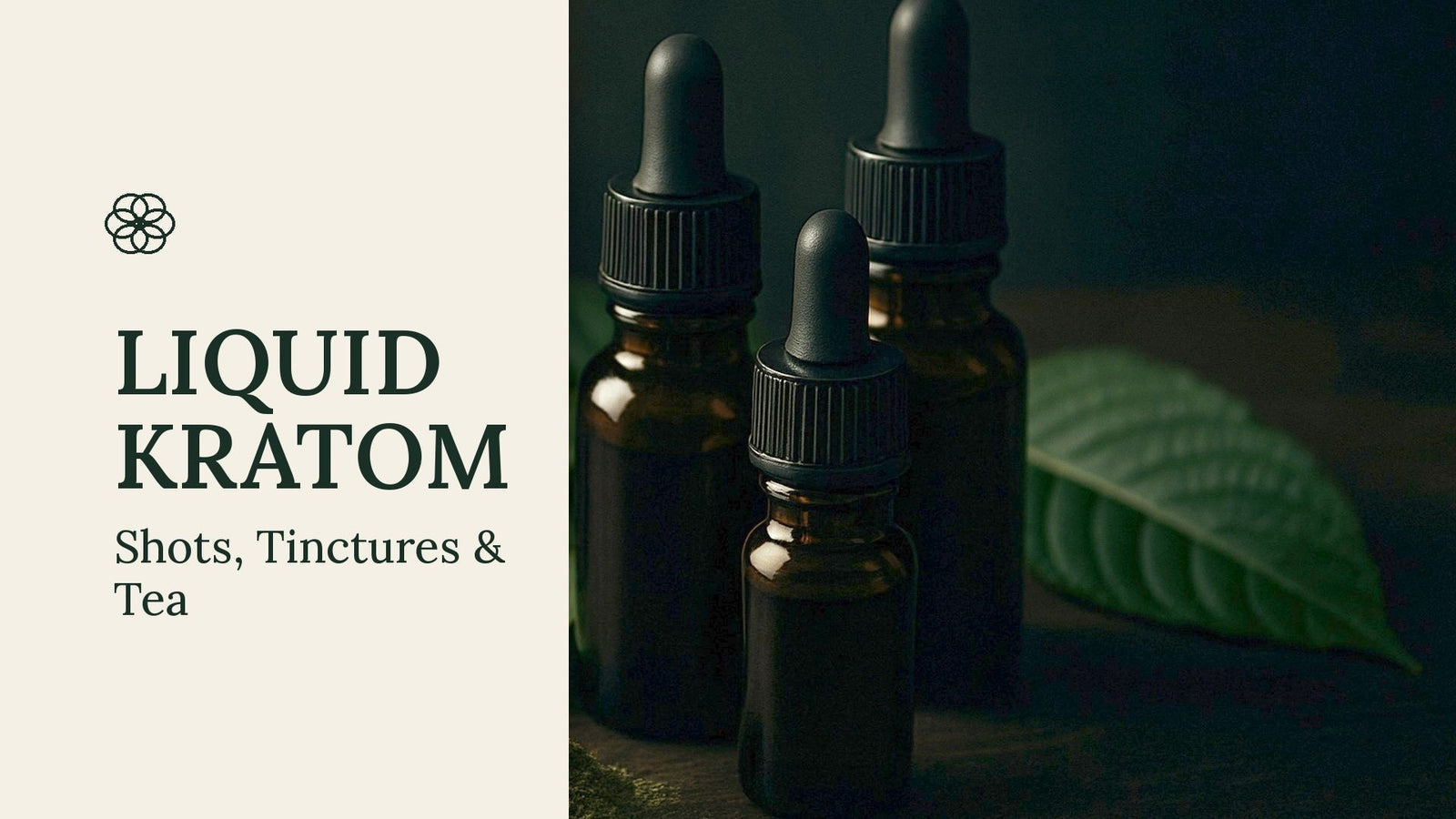
Liquid kratom isn't one product. It's a shelf of formats that all share a single trait: the alkaloids ride in water (or alcohol, or glycerin) instead of dry leaf powder. That shelf has grown fast. The American Kratom Association reports the U.S. kratom market now serves more than 21 million adult consumers, and liquid extracts are the fastest-growing slice of that audience because they trade slow brewing for a 30-second pour.
Here's the problem. Shoppers see "liquid kratom" and assume the bottles on the shelf are interchangeable. They aren't. A 5 mL extract shot and a 30 mL tincture and a freshly brewed cup of tea behave nothing alike. They cost different amounts per effective dose, they hit at different speeds, and they label their potency three different ways. A reader who picks the wrong one wastes money or, worse, takes a dose that lands harder than expected.
This guide walks the whole shelf. We cover what counts as liquid kratom, how shots compare to tinctures and brewed tea, the math behind milligrams of mitragynine per milliliter, what onset and duration actually feel like in each format, how to read the label so you know what you bought, and where each format genuinely fits the day. By the end you should be able to look at any bottle in any shop and know within ten seconds whether it's right for you.
Table of Contents
- What Counts as Liquid Kratom
- The Four Liquid Formats: Shots, Tinctures, Brewed Tea, and Homemade
- The Potency Math: Mitragynine per Milliliter
- Onset, Peak, and Duration Across Formats
- Taste, and How Brands Mask It
- Shelf Life and Storage
- How to Read a Liquid Kratom Label
- When Liquid Makes More Sense Than Powder
- Common Mistakes With Liquid Kratom
- Cost Per Effective Dose, Side by Side
- Frequently Asked Questions
- Final Thoughts
TL;DR
- Liquid kratom is a category, not a product. It covers shots, tinctures, brewed teas, and homemade extracts, and each one behaves differently in your body.
- Shots are pre-dosed bottles in the 5 to 15 mL range, usually labeled by total mitragynine content in milligrams. They prioritize speed and portability.
- Tinctures are alcohol or glycerin-based extracts in dropper bottles, dosed by the mL. They prioritize precision and consistency across servings.
- Brewed kratom tea is the old-school option. It's the cheapest per dose but the slowest to prepare, and the alkaloid content depends entirely on your powder and your steep.
- Mitragynine concentration is the only honest way to compare two liquid products. A label saying "extract" without a mg number is asking you to trust marketing.
- Onset is faster than powder across all four formats. Liquids skip the gut work of dissolving leaf, so the alkaloids reach your bloodstream in 10 to 30 minutes instead of 45.
- Liquid format raises potency, which means it also raises the cost of a mistake. New consumers should start at a quarter of the label serving and wait the full window before redosing.
- The right liquid format depends on the moment. Quick midday boost, dial-in evening wind-down, or a slow Sunday brew each fit a different bottle.

What Counts as Liquid Kratom
Any kratom product where the active alkaloids are suspended in a liquid carrier counts as liquid kratom. That definition covers a wider shelf than most shoppers expect.
The simplest case is brewed kratom tea, where powder or crushed leaf gets steeped in hot water and strained. The alkaloids leach into the water, and the liquid is what gets consumed. The next step up is a kratom shot, which is usually a small bottle of pre-extracted liquid concentrated enough that 5 to 15 mL delivers a useful dose. Tinctures sit in the same general neighborhood as shots, but they trade ready-to-drink convenience for dropper-controlled dosing and a higher concentration per mL. Then there are homemade extracts, where consumers reduce brewed tea or evaporate alcohol off a soak to make a thick, concentrated syrup.
What unites the four formats is the carrier. What separates them is concentration, packaging, and the dosing math you have to do at the bottle. A 12 oz cup of kratom tea and a 5 mL extract shot can deliver the same total mitragynine load, but the tea took forty minutes to make and the shot took zero. The shot also costs roughly six to ten times more per serving. Both are "liquid kratom," and both belong in this guide.

The Four Liquid Formats: Shots, Tinctures, Brewed Tea, and Homemade
The shelf splits cleanly into four categories. Each one solves a different problem.
Kratom shots are the format most people picture when they hear "liquid kratom." A shot is a small bottle (5 to 15 mL is typical) holding a pre-measured dose of extracted kratom. The label tells you the total mitragynine content, which is the honest unit to compare across brands. Shots are designed for one decision: drink it or don't. They land fast because the alkaloids are already extracted, and they travel well because the bottle is sealed and shelf-stable. The trade-off is cost per dose, which runs higher than every other format on this list.
Tinctures are dropper bottles, typically 15 to 30 mL, where the alkaloids are dissolved in an alcohol, glycerin, or oil base. A tincture isn't a single-serving product. It's a multi-dose bottle that asks you to measure your own pour. The reward is precision. You can dial 0.5 mL for a microdose, 1 mL for a standard serving, or 2 mL for a stronger one without opening a second bottle. Tinctures hold mitragynine in solution, which is why a well-made one keeps its potency for a year or longer in a cool, dark cabinet.
Brewed kratom tea is the original liquid format. You measure powder or crushed leaf, simmer it in water with an acidic agent (lemon juice helps), strain it, and drink. Tea is the cheapest per effective dose because the only inputs are kratom powder you already own and water. The catch is variance. Two pots made from the same bag can land at different strengths because the extraction depends on time, temperature, and how aggressively you press the powder. Tea also requires planning. It's a slow ritual, not a midday tool.
Homemade extracts are the DIY route. Consumers reduce brewed tea on the stove until most of the water boils off, leaving a thick, concentrated syrup. The result is a kratom concentrate that delivers more mitragynine per mL than the original tea, but the math is rough. Without lab equipment you can't measure the final potency, so home extracts are best treated as personal experiments and dosed conservatively. We cover the safer routes in our kratom dosage guide because the principles transfer.
| Format | Typical Serving | Onset | Cost / Dose | Best For |
|---|---|---|---|---|
| Kratom shot | 5 to 15 mL | 10 to 20 min | $8 to $15 | On-the-go, no prep |
| Tincture | 0.5 to 2 mL | 15 to 30 min | $2 to $5 | Precision, low waste |
| Brewed tea | 6 to 12 oz | 30 to 45 min | $0.50 to $2 | Cost, ritual, slow days |
| Homemade extract | 5 to 10 mL | 15 to 30 min | $1 to $3 | DIY, advanced users |

The Potency Math: Mitragynine per Milliliter
Mitragynine is the alkaloid that does most of the visible work in kratom. The National Institute on Drug Abuse notes that mitragynine and its cousin 7-hydroxymitragynine are the two compounds responsible for most of kratom's effects, and they are the two numbers any honest label reports. When you compare two liquid products, you compare mitragynine concentration. Everything else is marketing.
The concentration math is simple. Bottle volume in mL, total mitragynine in mg, divide. A 12 mL shot labeled "150 mg mitragynine" delivers 12.5 mg per mL. A 30 mL tincture labeled "1200 mg mitragynine" delivers 40 mg per mL. The tincture is over three times stronger per mL even though both are "liquid kratom."
This matters because dose size on a label doesn't translate across formats. A 5 mL serving of one product can be a microdose while 5 mL of another is a heavy dose. We've seen consumers measure tincture in shot-sized pours because the label said "drink one bottle." The bottle was a tincture. They overshot the dose by 4x. The mg number prevents that mistake every time.
The honest brands cooperate. They print the total mitragynine on the front, the serving size on the back, and a lot number that traces back to a third-party assay. Less-honest brands print "Premium Extract" or "Maximum Strength" and skip the number. If the label has no mg figure, treat the bottle as unknown and pass.

Onset, Peak, and Duration Across Formats
Liquid formats hit faster than capsules or loose powder. The mechanism is straightforward: when alkaloids are already dissolved in water, ethanol, or glycerin, your gut doesn't have to dissolve a leaf first. The alkaloids cross the stomach lining quickly, reach the liver, get partially metabolized, and land in the bloodstream within 10 to 30 minutes for most consumers. Peer-reviewed pharmacokinetic data on mitragynine shows peak plasma concentration around 1 to 1.5 hours after oral dosing, with a half-life that runs roughly 3 to 7 hours depending on the individual.
The format affects the curve shape too. Shots and tinctures spike quickly because the dose lands all at once and the alkaloids enter the bloodstream within minutes. The peak is sharper, the come-up is more obvious, and the come-down is more noticeable. Brewed tea spreads its delivery a bit because consumers sip 6 to 12 oz over several minutes, and the lower concentration per mL means the peak is rounder.
That curve shape is worth treating as a feature, not a flaw. If you want a clear "I can feel it now" moment for an afternoon push, a shot or tincture delivers that. If you want a gentler ramp for a relaxed Sunday morning, brewed tea delivers that.
Taste, and How Brands Mask It
Kratom's leaf taste is bitter, mildly astringent, and slightly grassy. The bitterness comes from the alkaloid profile itself, and it survives extraction. Every liquid format has to deal with it.
Shots use flavoring aggressively. Citrus, berry, and tropical fruit are the three families that dominate the shelf because the acid in those flavor profiles masks bitterness well. Read the ingredient list and you'll see natural and artificial flavors, citric acid, and sometimes a small amount of sweetener. The flavoring isn't decoration, it's the difference between a 5 mL shot you can finish and one you can't.
Tinctures vary. Alcohol-based tinctures are sharp and bitter and don't pretend otherwise. Glycerin-based tinctures lean sweet because glycerin itself carries a mild sugar-like note. Most tincture users add the dose to juice, tea, or a smoothie because direct sublingual dosing is intense. Brewed tea tastes the most like the plant. A squeeze of lemon, a spoon of honey, or a chai tea bag steeped alongside the kratom turns it into something most people can drink without flinching.

Shelf Life and Storage
Shelf life splits the four formats more than potency does. A well-stored kratom product holds its alkaloid profile for months or years. A poorly stored one degrades in weeks.
Tinctures are the most stable. The alcohol or glycerin base inhibits microbial growth and protects the alkaloids from oxidation. A capped tincture stored cool and dark typically holds 90 percent or more of its mitragynine for 12 months, often longer. Shots come next. Sealed shot bottles are pasteurized or preservative-stabilized, and most carry a best-by date 12 to 24 months out. Once opened, refrigerate and finish within a few days.
Brewed tea is the most fragile. Refrigerated tea is safe for 2 to 4 days before bacterial growth becomes a concern. Many consumers freeze tea in ice cube trays, which extends shelf life to several months and lets you portion exact doses. Homemade extracts behave similarly because they're still water-based, just concentrated.
Regardless of format, the storage rules don't change. Keep the bottle out of direct sunlight, away from heat, and tightly capped. UV light and heat are the two fastest paths to alkaloid degradation.

How to Read a Liquid Kratom Label
A label tells you everything you need to know in about ten seconds, if you know which lines matter. Here's the order we read them.
- Total mitragynine in milligrams. This is the number that lets you compare brands honestly. If it's missing, the bottle is unknown territory.
- Volume in milliliters. Combined with the mg number above, this gives you concentration per mL, which is the unit you'll dose by.
- Serving size. Useful for first-time use, but don't trust it without doing the mg-per-mL math yourself. Different brands draw the line at different doses.
- Other alkaloids listed (7-hydroxymitragynine, paynantheine, speciogynine). A full alkaloid panel signals lab work. A label with only mitragynine listed isn't a deal-breaker, but a full panel is a quality indicator.
- Third-party lab certificate reference. Look for a lot number or a QR code that links to a Certificate of Analysis. The COA is the difference between a brand's claim and verified evidence.
- Manufacture date or best-by date. Older bottles have lost some potency. A bottle with no date printed is a yellow flag.
- Ingredients list. Confirms the carrier (water, ethanol, glycerin), any flavorings, and whether anything else is going in your body.
One thing to ignore: marketing words like "Premium," "Maximum Strength," "Founder's Reserve," or "Ultra." Those words don't measure anything. The mg number does.

When Liquid Makes More Sense Than Powder
Powder is the baseline format and works for most kratom routines. Liquid earns its place when one of three things is true.
The first case is time pressure. A long drive starting in ten minutes leaves no room for brewing or measuring powder. A pre-dosed shot like King K Rush Diamond takes the prep step off the table. The bottle opens, you drink, you move on. The format trades cost for reclaimed time, and on a busy day that trade is fair.
The second case is dose precision. Powder dosing depends on a small scale, a known strain, and the discipline to weigh consistently. A tincture like King K Silver liquid kratom extract turns dosing into "0.5 mL twice a day" with a printed dropper. Precision goes up, decision fatigue goes down.
The third case is travel. Powder is bulky, it spills, and it draws unwanted questions when a bag gets searched. A sealed shot or a small dropper bottle travels in a backpack pocket without drama.
Outside those three cases, powder usually wins on cost per dose and depth of strain variety. Liquid is a tool, not a replacement.
Common Mistakes With Liquid Kratom
The same handful of mistakes appears in every customer service inbox. They're worth flagging early.
Treating a tincture like a shot. A 30 mL tincture isn't designed to be drunk in one pour. Read the mg per mL, measure the dropper, and treat the bottle as a multi-dose container.
Doubling up because the first dose "didn't kick in fast enough." Even fast-acting liquids take 10 to 30 minutes to land. Adding a second dose at the 15-minute mark stacks two peaks on top of each other and produces a much stronger experience than the consumer asked for. Wait the full 45 minutes before redosing.
Mixing liquid kratom with alcohol. Both compounds depress the central nervous system at meaningful doses. Combining them isn't worth the gamble.
Buying based on price alone. A cheap liquid with no mg printed on the label is rarely a bargain. Pay for the mg figure, not the bottle.
Skipping the COA. Mainstream lab-tested kratom products print Certificates of Analysis. Brands that don't are either too small to test or motivated not to share. Either way, the bottle stays on the shelf.

Cost Per Effective Dose, Side by Side
Cost comparisons across liquid kratom only work when you normalize to milligrams of mitragynine. Bottle prices alone are misleading.
A premium tincture at $30 for 30 mL with 1200 mg total mitragynine works out to $0.025 per mg. A 12 mL shot at $13 with 150 mg of mitragynine works out to $0.087 per mg. Same alkaloid, more than three times the price per unit. The shot earns the premium with convenience, not chemistry. Powder, for reference, lands around $0.005 to $0.010 per mg of mitragynine depending on the strain and supplier.
That cost ladder is what most consumers don't see when they shop on price alone. A $13 shot looks cheap next to a $30 tincture. Per dose, the tincture is the better deal by a wide margin. Per moment of zero-prep convenience, the shot wins. Knowing which moment you're solving for is the entire decision.
The same ladder runs across the GRH liquid line. King K Gold liquid kratom extract sits between the entry-level Silver and the high-potency Platinum, with mg-per-mL stepping up at each tier. Pick the tier that hits your target dose in the smallest pour.
Frequently Asked Questions
Is liquid kratom stronger than powder?
Not categorically. Strength depends on the total mitragynine delivered, not the format. A shot can be stronger than a heaping teaspoon of powder, or weaker, depending on the mg figures on each. Compare the alkaloid math, not the packaging.
How fast does liquid kratom hit?
Onset for shots and tinctures usually runs 10 to 30 minutes. Brewed tea runs slightly slower at 30 to 45 minutes, mostly because the dose spreads across the time it takes to drink the cup. Capsules and powder typically run 45 minutes or longer because the leaf has to dissolve first.
Can you mix kratom shots with energy drinks or coffee?
Mixing with caffeine isn't dangerous for most adults, but it can push the stimulant edge into uncomfortable territory at higher doses. Start with the shot alone, see how you feel at 30 minutes, then make the call on adding caffeine. Most consumers find one or the other is sufficient.
Are liquid kratom shots legal?
Kratom legality is set at the state and city level, and the same rules apply to liquid formats as to powder. The FDA's dietary supplement guidance covers federal context, and the American Kratom Association maintains a current state-by-state map. Check your local rules before you order.
What's the shelf life of an opened tincture?
A sealed alcohol or glycerin tincture stored cool and dark holds 12 months or longer. Once opened, the same bottle is still good for 6 to 12 months if you keep it sealed between doses and out of light. Refrigeration isn't required for alcohol-based tinctures but doesn't hurt.
Can I make liquid kratom at home from powder?
Yes. The basic recipe is a slow simmer of powder in water with a splash of lemon juice for 20 to 30 minutes, strained through cheesecloth. The result is brewed kratom tea. Reducing the tea further on the stove makes a stronger concentrate, but dosing math gets unreliable without lab testing.
What's the difference between a kratom shot and a kratom drink?
"Kratom drink" is the umbrella category, and "kratom shot" is a sub-format. A drink can be a brewed tea, a ready-to-drink can, or a small shot. A shot is specifically the small, high-mg-per-mL bottle format meant to be consumed in one go.
Final Thoughts
Liquid kratom is a category that earns its place when you need speed, precision, or portability. It does not replace powder for the consumer focused on the lowest cost per dose, but it gives the rest of the audience a faster path to a known result. Once you can read a label and run the mg-per-mL math, you'll know in ten seconds whether a bottle is right for the day you're solving for.
The pattern most regular consumers settle into is a hybrid. Powder for the predictable morning or evening routine where time isn't tight. Shots for the unplanned moment when a meeting moved and the energy window narrowed. Tinctures for the consumer who wants the precision of dropper-controlled dosing across a longer stretch of the day. Each format covers a different gap, and the bottles share shelf space because they solve different problems.

If you're picking a starting point, the GRH liquid catalog covers measured tincture-style dosing through the King K Silver/Gold/Platinum tier and pre-dosed energy in the King K Rush line. All are third-party assayed and print the alkaloid math on the label, and all sit inside the wider catalog of strains we map out in our kratom strain chart. Use the chart to pick a profile, then pick the liquid format that matches the moment.
One last reminder before you shop. The DEA's published fact sheet notes that kratom remains a substance of monitoring at the federal level, and individual U.S. states regulate it differently. A bottle that's legal in one state is restricted in another. Check the local map, read the label, run the math, and start small. For deeper context on the active alkaloids inside every bottle, our complete guide to kratom alkaloids walks the chemistry one layer deeper.


