



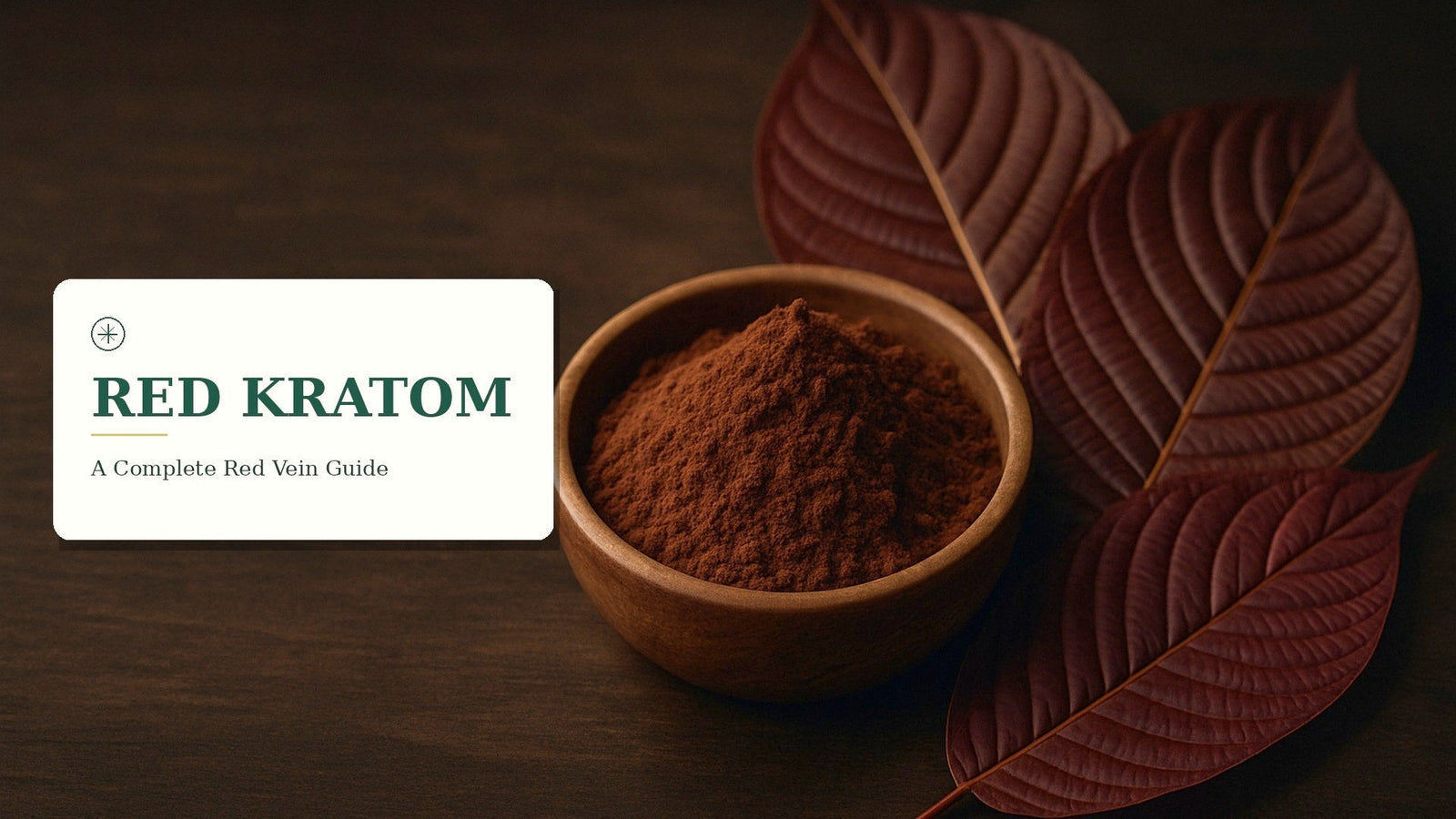
If you ask experienced kratom users which vein they reached for first, most of them will say red. Red vein kratom is the lane most newcomers gravitate toward, and it tends to be the one they keep coming back to for evenings and the kind of slow, body-rooted ease that does not show up in a hurry. This guide unpacks what "red vein" actually means, why it feels the way it does, and how the major red strains differ from one another.
Red kratom is not a single product. It is a whole family of Mitragyna speciosa leaves harvested at a later stage of leaf maturity, then dried in ways that nudge the alkaloid profile toward the calmer, body-leaning side of the kratom spectrum. The label "red" is a shorthand for that combination of leaf maturity, drying method, and the resulting alkaloid lean.
According to the American Kratom Association, there are roughly 15 million adult kratom users in the United States, and the majority of them rotate among red, green, and white vein products depending on the time of day. Red kratom owns the evening lane in that rotation for most users.

Table of Contents
- What "Red Vein" Actually Means
- The Alkaloid Profile of Red Vein Kratom
- How Red Vein Differs from Green and White
- The Typical Effect Profile of Red Kratom
- Major Red-Vein Strain Regions
- Comparing the Major Red Strains
- Recommended Doses for Red Vein Kratom
- Who Red Kratom Suits Best (and Who It Doesn't)
- First-Time Red-Vein Starter Protocol
- Quality Vetting and Buying Tips
- Safe Daily-Use Practices
- Frequently Asked Questions
- Final Thoughts
TL;DR
- Red vein kratom comes from the most mature Mitragyna speciosa leaves, identified by the deep red color of the central leaf vein at harvest.
- The post-harvest drying process shifts the alkaloid balance toward a higher relative share of 7-hydroxymitragynine, which is the alkaloid most associated with body-leaning, calming effects.
- Red kratom feels different from green and white because of that alkaloid lean, not because of any added ingredient.
- Most users describe red strains as best for evenings, winding down, body comfort, and a quieter mood lift.
- The major red-vein strains (Red Bali, Red Maeng Da, Red Borneo, Red Sumatra, Red Thai) share the red lane but differ in onset speed, intensity, and duration.
- Typical starter doses sit at 2 to 3 grams of powder; standard daily ceilings sit at around 5 grams per serving and 8 grams across a day.
- Red kratom suits people who want gentle evening calm or body-rooted relief, and is generally a poor first choice for users hunting daytime focus or energy.
- Quality varies enormously among vendors; insist on third-party lab tests for alkaloid content, heavy metals, and microbial safety before you buy.

What "Red Vein" Actually Means
The "vein" in "red vein kratom" refers to the central rib that runs down the middle of every Mitragyna speciosa leaf. On a young, fresh leaf that vein is green or pale green. As the leaf ages on the tree, the vein darkens. By the time the vein is a clear deep red, the leaf is at peak maturity, and it has spent the most time accumulating alkaloids under the Southeast Asian sun. Farmers harvest these leaves last, after green-vein and white-vein leaves are taken from younger growth on the same tree.
Maturity is only half the picture. The drying step is the other half. Red vein leaves are usually dried more slowly than green or white veins, with a longer initial indoor phase that lets light reach the leaf indirectly. That extended drying lets the alkaloid profile shift through oxidation. Mitragynine, the dominant alkaloid in fresh kratom leaves, partially oxidizes into 7-hydroxymitragynine during this period. The longer and more controlled the drying, the more pronounced that lean becomes.
If you compare the alkaloid breakdown of fresh leaves to dried red-vein powder, that single shift in proportion is what gives red kratom its signature. The leaf was never different; the way it was finished was. That is why two "red Bali" powders from two different farms can taste similar and still feel meaningfully different in effect.
The Alkaloid Profile of Red Vein Kratom
Mitragyna speciosa leaves contain more than 40 known alkaloids, but two do most of the heavy lifting in how kratom feels. The first is mitragynine, which sits at roughly 60 to 70 percent of the total alkaloid content in most kratom material. The second is 7-hydroxymitragynine, which usually sits well under 2 percent of the total alkaloid content but is many times more potent on a per-milligram basis. The National Institute on Drug Abuse covers both alkaloids in its kratom research summary, and peer-reviewed reviews on kratom pharmacology and use patterns describe the same balance.
Red vein kratom shifts this balance through post-harvest oxidation. The relative share of 7-hydroxymitragynine is higher in red-vein material than in green-vein or white-vein material from the same region. That nudge is small in absolute terms (still well under 2 percent of total alkaloid mass) but large in effect, because 7-hydroxymitragynine is the alkaloid most associated with the body-leaning side of kratom's profile.
Why does that matter for a casual user? Because the alkaloid lean predicts the effect lean. A powder with a higher relative share of 7-hydroxymitragynine will feel calmer, slower, and more body-rooted. A powder with a lower relative share will feel sharper, faster, and more cerebral. That is the entire reason red kratom and white kratom feel like different products even when they came from the same tree.

How Red Vein Differs from Green and White
If you have already read our companion primer on green vein kratom or our flagship guide to white kratom, the contrast will already be familiar. Here is the short version, framed for someone choosing a starter strain.
White vein kratom feels the most stimulating of the three. White leaves are the youngest at harvest and dried the fastest, which preserves the highest relative share of mitragynine. White is best for mornings, focus, and energy. Green vein kratom sits in the middle. Green leaves are picked at mid-maturity and dried in moderate light, producing a balanced alkaloid mix that supports steady mood and mid-day activity. Red vein kratom finishes the spectrum. Red leaves are the most mature at harvest, dried slowest, and finish with the relative profile that leans toward calm, body comfort, and end-of-day relaxation.
None of the three is "stronger" than the others in a meaningful way. They are stronger at different things. A heavy dose of white vein will feel intense, but it will feel intensely sharp. A heavy dose of red vein will feel intensely heavy, body-rooted, and possibly sedating. Picking the right vein for the moment matters more than chasing potency.
The Typical Effect Profile of Red Kratom
Across the major red-vein strains, most users describe a similar arc. Onset usually arrives 25 to 45 minutes after taking a standard dose of powder on a relatively empty stomach. The peak effect window sits between 1 and 2 hours after dosing. Total duration runs 4 to 6 hours, with a long, soft taper rather than a sharp drop-off.
The qualitative descriptions cluster around a few themes. Body comfort and physical ease come up almost universally. A quieter, less anxious head state is the second most common report. A subtle mood lift, often described as "settled" or "content" rather than "elated," shows up in many user accounts. Finally, mild drowsiness is common at higher doses, which is one of the reasons red kratom is the standard pick for evenings rather than mornings.
That said, individual response varies. Body weight, recent food intake, hydration, sleep quality, and even genetic variation in liver enzyme activity can shift how a given dose feels. The first time you try a new red strain, treat the experience as data collection, not a prediction.

Major Red-Vein Strain Regions
Red vein kratom is grown across most of the Mitragyna speciosa range in Southeast Asia, but a handful of regions produce the strains that dominate the US market. The names you will see on most product labels trace back to specific islands, provinces, or farming traditions.
Red Bali comes from Borneo (despite the name; "Bali" historically marked the export port, not the growing region) and is one of the most widely sold red strains in the US. Red Maeng Da is a label that originally meant "pimp grade" in Thai vernacular and is now used for selectively harvested, often premium red-vein material from a few different regions. Red Borneo, Red Sumatra, and Red Thai trace to their named islands and historically have slightly different reputations even though all three sit in the red lane.

Comparing the Major Red Strains
The table below summarizes how the five most common red-vein strains tend to feel relative to one another. Treat these as community-reported tendencies rather than guarantees; the same strain name can vary between vendors based on sourcing.
| Red strain | Alkaloid lean | Typical effect | Starter dose | Best for |
|---|---|---|---|---|
| Red Bali | Balanced red, slightly higher 7-OH lean | Heavy body calm, classic evening profile, mild sedation at higher doses | 2 to 3 g | Sleep onset, end-of-day unwind |
| Red Maeng Da | High potency red with mitragynine still well represented | Strongest of the red strains, longer duration, less sedating than Bali | 1.5 to 2.5 g | Body comfort with some residual function, experienced users |
| Red Borneo | Classic red lean | Smooth, steady body calm with less heaviness than Bali | 2 to 3 g | Stress relief, daily evening use |
| Red Sumatra | Red lean, often slightly slower onset | Long-lasting body calm, gradual onset, gentle taper | 2 to 3.5 g | Slow-burn evenings, longer sessions |
| Red Thai | Red lean with a touch more cerebral character than Bali | Calm with a slightly clearer head than other reds | 2 to 3 g | Evening users who want less drowsiness |
If you want a deeper look at how Red Maeng Da specifically compares to the rest of the red lane, our standalone Red Maeng Da kratom guide goes much deeper on origin, alkaloid lean, and dose response than this primer can.

Recommended Doses for Red Vein Kratom
The most reliable way to find a comfortable red kratom dose is to start lower than you think you need, then move up in small steps. Most users settle into a personal range somewhere between 2 and 4 grams of powder per serving. That range covers everything from mild relaxation to deep body calm without crossing into territory where unwanted side effects (nausea, dizziness, excessive sedation) become common.
For a general baseline, a 2-gram serving is a threshold dose for a new user. A 3-gram serving is a typical adult evening dose for someone who has used kratom for a few weeks. A 4-gram serving is on the higher end and is best reserved for users who already know how a given strain feels. Going above 5 grams in a single serving rarely improves the effect and often worsens it. Across a full day, most experienced users stay under 8 total grams to avoid building tolerance quickly.
Capsules complicate the math slightly. A typical "0" size capsule holds about 0.5 grams of kratom powder, so a 3-gram red kratom dose works out to roughly 6 capsules. Capsules are great for consistency and for people who dislike the taste, but they cost more per gram and take longer to release than loose powder.

Who Red Kratom Suits Best (and Who It Doesn't)
Red kratom is a strong default for people who want to take the edge off their day, ease into sleep, or quiet body discomfort that gets in the way of rest. It also tends to work well for users who feel jittery or overstimulated on caffeine and want a calming alternative for evenings.
Red kratom is a poor first pick for users hunting clean daytime focus, sustained energy, or any kind of stimulating effect. White vein kratom is built for that lane, and pushing red harder to compensate usually creates drowsiness, not energy. It is also a less ideal choice for users with chronic low blood pressure or those who are already taking sedating medications; the calming character of red can compound with both.
If you have never used kratom of any kind, red vein is generally one of the gentler starting points, but the conservative move is to start at a lower-than-typical dose (1.5 to 2 grams) on a quiet evening when you have nothing else to do. Treat the first session as a baseline experiment, not a finished routine.
First-Time Red-Vein Starter Protocol
If you are new to red kratom and want a step-by-step way in, the protocol below gives you a low-risk way to learn how a given strain feels for your body. Run it for one strain at a time. Mixing two strains on the same evening makes it impossible to attribute what you are feeling to either one.
- Pick one red strain. Start with Red Bali or Red Borneo for a softer onset, or Red Maeng Da if you want a stronger first impression.
- Confirm the product has third-party lab results on the vendor's site (alkaloid content, heavy metals, microbial).
- Eat a normal meal 60 to 90 minutes before dosing. A full meal slows absorption; an empty stomach speeds it.
- Measure 2 grams of powder using a kitchen scale, not a "teaspoon" estimate. Powder density varies and a "rounded teaspoon" can be anywhere from 1.5 to 3.5 grams.
- Take the dose in your preferred format. Toss-and-wash with water and citrus juice is fastest; a kratom tea brewed for 10 minutes is gentler on the stomach.
- Wait 45 minutes before considering a redose. Most red-strain onset windows close inside that range.
- If at 45 minutes the effect is too mild, add 0.5 to 1 gram more powder and wait another 30 minutes. Do not stack three doses in a row chasing intensity.
- Note how the dose felt: onset speed, peak, duration, side effects. Build a personal log across 3 or 4 sessions before drawing conclusions.
- Do not drive or operate machinery on a first session.
- Hydrate before, during, and after. Red kratom can dehydrate users who skip water.

Quality Vetting and Buying Tips
Kratom is sold in the United States as a dietary supplement under the framework laid out by the FDA's dietary supplements rules, which means the bar for product quality and labeling sits with the vendor, not a federal pre-market review. That makes vendor vetting the most important step you can take before buying any red strain.
Three signals matter most. The first is third-party lab testing. Reputable vendors test every batch for alkaloid content (you want a clearly disclosed mitragynine percentage), heavy metals (especially lead, arsenic, cadmium, and mercury), and microbial contaminants (salmonella, E. coli, total yeast and mold). The second signal is sourcing transparency. Vendors who can name the region a product came from and describe the drying method tend to be more careful upstream. The third signal is product consistency. A red Bali powder from a serious vendor should look, smell, and feel similar across batches; large swings between orders suggest inconsistent sourcing.
A starter pick that fits most evening profiles is our Red Maeng Da Kratom Powder, which is sourced from selectively harvested mature leaves and lab-tested before every release. For users who want the relaxation profile without committing to a single strain, the Relax Blend Kratom Powder combines red and green vein material in a single product and is one of our most consistent picks for end-of-day routines.
Safe Daily-Use Practices
Long-term red kratom users who avoid tolerance creep tend to follow a few shared habits. They rotate strains rather than running one red product daily for months on end. They take at least one or two non-kratom days per week. They keep total daily intake under 8 grams. They do not mix kratom with alcohol or other sedating substances. And they pay attention to early warning signs of overuse, like waking up needing kratom to feel normal or escalating dose ceilings.
The single biggest mistake new users make is daily uninterrupted use of the same strain at slowly climbing doses. The body adapts faster than most people expect, and a 3-gram dose that produced a clear effect in week one can feel barely noticeable by week six if the same strain is run every night. Strain rotation across the red lane helps prevent that drift, and built-in rest days do too.
Hydration deserves its own mention. Red kratom mildly slows gastric motility and can leave new users feeling parched the morning after a heavy evening dose. Drink water before dosing, with the dose, and again before bed.

Research on long-term alkaloid composition and how oxidation shifts the 7-hydroxymitragynine share is available in peer-reviewed reviews on kratom alkaloid chemistry, and is worth skimming if you want a more technical understanding of what is happening inside a red-vein leaf during drying.
Frequently Asked Questions
Is red kratom stronger than green or white?
Not in a meaningful "more potent" sense. Red kratom is stronger at the things red kratom is good at: body calm, evening relaxation, gentle mood lift. White is stronger at clean focus and energy. Green sits between them. Picking the right vein for the moment matters more than chasing total potency.
How long does red kratom take to kick in?
Most users feel onset 25 to 45 minutes after dosing on a relatively empty stomach. A full stomach pushes that closer to 60 to 90 minutes. The peak effect window sits between 1 and 2 hours after dosing, with total duration of 4 to 6 hours.
Can I use red kratom in the morning?
You can, but most users find that red kratom in the morning encourages a calmer, slower start rather than energy. If you want energy and focus, white vein kratom is the better morning choice. Red is built for the back half of the day.
What is the best red kratom strain for sleep?
Red Bali has the strongest reputation as a sleep-onset strain because of its heavier body lean and higher relative 7-hydroxymitragynine share. Red Sumatra is also a common pick for users who want a longer, slower taper rather than a quick onset.
Can I mix red kratom with other strains?
Many users blend red with green or white to balance calm with a bit of clarity or energy. The cleanest way to test a blend is to know how each strain feels alone first, then mix once you have a baseline. Pre-formulated blends are a good shortcut if you do not want to build the math yourself.
Is red kratom legal in the United States?
Kratom is legal at the federal level and in most US states, though a handful of states and counties restrict or ban it. Always check your local laws before purchasing. The American Kratom Association maintains a current state-by-state legality map.
Can I take red kratom every day?
You can, but daily use of the same strain at climbing doses is the fastest path to tolerance. Most long-term users rotate strains, build in 1 to 2 non-kratom days per week, and keep total daily intake under 8 grams.
Final Thoughts
Red kratom is the evening lane of the kratom world. It exists because the most mature Mitragyna speciosa leaves, dried slowly enough to nudge their alkaloid profile toward the body-leaning side, produce a noticeably calmer, slower experience than green or white veins from the same tree. That single fact (leaf maturity plus drying method) explains almost everything about how red vein kratom feels.
If you are choosing a first red strain, Red Bali and Red Borneo are the standard recommendations for new users who want gentle, classic evening calm. Red Maeng Da is the better pick for users who want a stronger first impression and do not mind sitting closer to the edge of their comfort window. Red Sumatra suits users who want a long, slow taper. Red Thai sits between Bali and Maeng Da on intensity and works for users who want calm without heavy drowsiness.

If you are ready to try a red-vein product, the most popular starting point in the GRH lineup is Red Maeng Da Kratom Capsules for users who want pre-dosed convenience, or the full red vein kratom collection if you want to browse the lineup side by side. Both are lab-tested every batch, and both ship with the same alkaloid disclosure GRH applies across the catalog.
Whichever strain you start with, treat the first few sessions as data collection. Note onset speed, peak intensity, duration, and how you feel the next morning. Build a personal log, rotate strains, and respect the dose ceiling. Red kratom rewards patient, deliberate use far more than it rewards chasing intensity, and the users who get the most out of it are almost always the ones who treat it as a part of their evening, not the centerpiece.


