



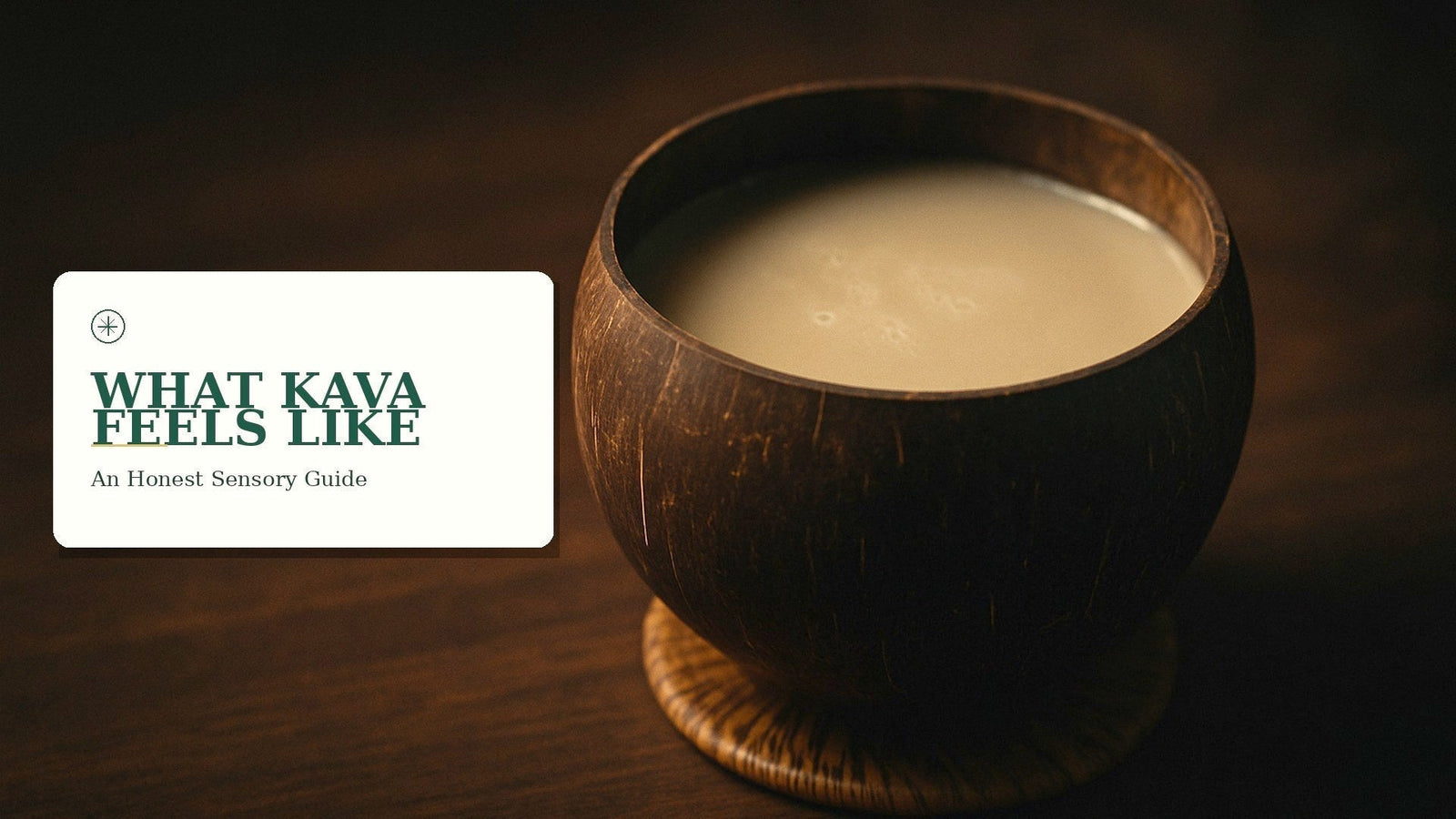
People ask "what does kava feel like" the way they ask what a quiet evening with an old friend feels like. Easy to picture, hard to describe in one word. The honest answer is that kava feels less like a recreational shift and more like the volume being turned down on the day. Shoulders drop. Jaw unclenches. The room gets a little quieter even though nothing in the room actually changed.
For something so subtle, kava has a long history. The plant has been part of social and ceremonial life across the Pacific Islands for roughly 3,000 years, and the U.S. kava market has been growing at around 8% per year through the mid-2020s as more people look for a relaxant that isn't alcohol (Australian Alcohol and Drug Foundation). That is the audience for this guide: curious newcomers who want to know, in plain language, what a kava session feels like in the body and in the head before they ever pick up a shell.

This is the felt-experience primer. We'll walk through the first sip, the body, the mood, the shell gradient (light, medium, traditional), the onset arc, the plateau, and the comedown. We'll also cover how kava feels different from alcohol and from anti-anxiety meds, and what a "bad" kava session feels like so you can spot one before it ruins the evening. For the pharmacology and the deeper "what is kava actually doing in the body" piece, read our companion guide what does kava do. For the taste specifically, we have a separate walkthrough at what does kava taste like.
Table of Contents
- The First Sip Experience: Numbing Tongue, Earthy Taste
- Body Sensations: Muscle Softening Without the Head-Buzz
- Mood Sensations: Calm, Social Warmth, Mental Quietness
- The Shell Gradient: Light, Medium, and Traditional Dose
- The Onset Arc: From First Bowl to Settled Calm
- The Plateau Experience: How a Kava Session Holds
- The Comedown: What the Tail End Feels Like
- How Kava Feels Different From Alcohol
- How Kava Feels Different From Anti-Anxiety Meds
- What Makes a Kava Session Feel Off
- Traditional Versus Western Kava: How Setting Shapes the Feeling
- Frequently Asked Questions
- Final Thoughts
TL;DR
- Kava feels like the volume on your day getting turned down, not like getting "high."
- The very first sip numbs your tongue and lips for a few minutes. That part is a feature, not a bug.
- Body sensations show up first: shoulders drop, jaw softens, breathing slows. Your head stays clear.
- Mood comes in second, usually 15 to 30 minutes after the first shell, as a settled, social warmth.
- A light dose is "I notice I am calmer." A traditional dose is "I want to sit on the porch and not talk for a while."
- The onset arc is gentle. The plateau holds for an hour or two. The comedown is quiet, not a crash.
- Kava does not feel like alcohol. There is no slur, no impaired coordination at moderate dose, no hangover.
- If a kava session feels off, the kava is usually old, cold, low-quality, or you drank it on a full stomach.

The First Sip Experience: Numbing Tongue, Earthy Taste
The very first thing kava does is numb your tongue. It happens within seconds of the first sip and lasts a few minutes. Kavalactones interact with sensory nerves in the mouth before they get absorbed systemically, so the local anesthetic effect on the tongue and lips is the earliest signal that the drink is doing something. It is mild, a little buzzy, and totally harmless.
The taste itself is earthy. Think wet bark, peppery dirt, a hint of pine. It is not a flavor most people fall in love with on the first try. Traditional preparations get described as muddy water with a kick, and that's fair. Most people drink the shell quickly rather than sip it, the same way you would knock back an unpleasant wellness shot. A lemon wedge or a piece of fresh pineapple between shells is the usual chaser in kava bars. If you want a deeper breakdown of the flavor itself, our kava taste guide covers it.
The numbing fades after three to five minutes. By that point you are usually finishing your second shell and waiting for the felt effects to arrive.
Body Sensations: Muscle Softening Without the Head-Buzz
Body sensations show up first, and they are subtle. The most common description is "my shoulders dropped." People who have been hunched at a desk all day notice their upper back releasing a held tension they did not even realize was there. The jaw softens. The forehead unclenches. Breathing slows down by a beat or two per minute without anyone trying to make it slow.
What kava does not do is give you a "head buzz." Caffeine has a head buzz. Alcohol has a head buzz. Nicotine has a head buzz. Kava is closer to the feeling of finishing a long hot shower or stepping out of a sauna into cool air. The body is registering "we are safe now, we can stand down" and your head goes along for the ride without any pressure or floaty disorientation.
A traditional dose in a Pacific island setting can produce mild heaviness in the legs and a slight reluctance to stand up quickly. That is normal at higher doses and is one of the reasons traditional kava is consumed seated on a mat. At the lighter doses most newcomers start with, the heaviness is barely perceptible. You can stand, walk, and hold a conversation without any issue.
Mood Sensations: Calm, Social Warmth, Mental Quietness
The mood layer arrives 15 to 30 minutes after the first shell. The clearest description is a settled, social warmth. You are still you. Your thoughts are still your thoughts. You just stop running the background loop of worry, planning, and self-monitoring that most adults run by default.
People often notice they are more willing to listen. Conversations slow down. The reflex to fill silence with chatter eases. Eye contact gets easier. If you are someone who tends to overthink in social settings, that overthinking quiets down without you having to consciously push it aside. According to the National Center for Complementary and Integrative Health, kava has been studied for its effects on short-term anxiety, and the felt experience tracks with what the research describes: reduced subjective worry without sedation at low to moderate doses.
What kava does not do at moderate doses is sedate you, blur your thinking, or change your personality. You will not feel "out of it." You will feel like a slightly slower, more patient version of yourself. That distinction is why so many newcomers come back to kava after trying it once.
The Shell Gradient: Light, Medium, and Traditional Dose
Kava sessions are usually measured in "shells" (the half-coconut bowl traditional preparations are served in) rather than in grams. The felt experience scales with how many shells you drink and how concentrated they are. A "light" shell at a Western kava bar is roughly 2-3 grams of dry root in 8 ounces of water. A traditional Pacific Island preparation can be 4-6 grams per shell with multiple shells over an evening.

Here is what each level tends to feel like for a newcomer drinking kava on a relatively empty stomach.
| Dose tier | Body | Mood | Social readiness | Best for |
|---|---|---|---|---|
| Light (1 shell, 2-3g) | Shoulders drop, slight muscle softening | Mild calm, easier breathing | Fully social, no slowdown | First-timers, daytime use, casual hangouts |
| Medium (2-3 shells, 6-8g) | Noticeable muscle relaxation, slower movements | Settled warmth, quieter inner voice | Social but slower, prefers small groups | Evening with friends, after-work decompression |
| Traditional (4+ shells, 12g+) | Heavy legs, slow gait, mild sedation | Deep calm, contemplative | Mostly seated, low-talk | Ceremonial use, weekend evenings, before sleep |
Most Western kava drinkers stay in the light-to-medium range, especially in their first few months. The traditional dose is real but it is not a beginner experience. People who try to jump straight to traditional doses often describe the next morning as a kava hangover (called a "kava-over" in kava bar slang), which is mostly just dehydration plus a slightly muddy head.

The Onset Arc: From First Bowl to Settled Calm
Kava onset is famously slow compared to alcohol or caffeine. The first five minutes are about the tongue numbing. Between five and fifteen minutes you start to feel the body soften. The mood shift typically lands between 20 and 30 minutes after the first shell. People who eat a heavy meal before their session tend to push that window out to 45 or even 60 minutes because the kavalactones get absorbed more slowly through a full GI tract.
The onset is so gentle that newcomers sometimes worry the kava "isn't working." That's normal. The right move is to wait a full 20 minutes after a shell before deciding whether to drink another, not to slam three shells in five minutes. Kava rewards patience the way good tea does.
The Plateau Experience: How a Kava Session Holds
Once the felt experience arrives, it plateaus for roughly an hour to ninety minutes. The plateau is not a peak. It is more like a calm, steady level surface where the body feels settled and the mind feels quiet. People often describe it as "the most relaxed I have been all week" without the slurred speech or motor wobble that the same level of relaxation from alcohol would produce.
During the plateau, most people find they are more present. The urge to scroll a phone drops. Music sounds richer. Food tastes a little better. Eye contact is sustained more comfortably. The plateau is the part of the session that people come back for.
If a second shell is consumed during the plateau, the experience deepens rather than restarts. This is part of why traditional kava ceremonies feature multiple shells spaced over an evening rather than one big dose at the start.
The Comedown: What the Tail End Feels Like
Kava does not crash. The comedown is so gentle that most people describe it as "just feeling normal again" rather than "coming down." The plateau slowly fades over 60 to 90 minutes, and the body returns to baseline without the rebound anxiety, low mood, or sleep disturbance that often follow alcohol or caffeine.
Many drinkers find the comedown actually rolls into a particularly easy bedtime. Sleep onset is often faster than usual, and many report waking up feeling clear-headed the next morning. That said, very large traditional doses can produce mild grogginess the next day, similar to a heavy meal sitting too late.
How Kava Feels Different From Alcohol
This is the comparison everyone wants. Kava and alcohol both relax you, but the felt experience is almost opposite in the details. Alcohol disinhibits. It loosens your judgment. It blurs your speech and your motor coordination at moderate doses. Kava does none of those things at light or medium doses. Your speech stays clear. Your coordination stays intact. Your judgment stays online.
The other difference is the morning after. A real alcohol hangover involves dehydration, headache, GI distress, anxiety, and sleep debt. A kava session, even a heavier one, mostly produces clean sleep and a normal morning. There is no rebound anxiety, no shaky hands, no sense of having lost time.

What kava and alcohol share is the social warming. Both are social lubricants. Both make conversation easier. The difference is that kava lets you remember the conversation the next day and tends to leave the room calmer, not louder.
How Kava Feels Different From Anti-Anxiety Meds
Here we want to be careful. Kava is not a substitute for prescription anti-anxiety medication and should never be framed that way. The felt experience is also genuinely different. Prescription anxiolytics typically produce a flatter, more clinical calm that affects cognition. Many people describe a slight brain fog or detachment. Kava does not produce that signature. At light to medium doses, your thinking stays sharp and the calm feels more like relief than sedation.
According to a peer-reviewed pharmacology review, kavalactones act on GABA and other neurotransmitter systems through pathways that overlap with prescription anxiolytics but are distinct enough that the felt experience is not interchangeable. The takeaway: if you are on prescribed medication for anxiety, talk to your prescriber before adding kava. If you are a generally healthy person looking for a non-alcoholic evening relaxant, the felt experience of kava is its own category.
What Makes a Kava Session Feel Off
Most "bad" kava sessions are not the kava's fault. They are usually one of four things. Knowing what to look for is half the battle.
- Old or cold kava. Traditional kava is meant to be drunk fresh and at room temperature. Kava that has been sitting in a fridge for a day or kava that has separated and not been re-shaken loses a lot of its felt character.
- Low-quality root. Cheap kava is often heavy in "tudei" varieties or aerial parts of the plant. Tudei kava can produce next-day grogginess and an unpleasant heaviness. Noble kava cultivars are the standard for daily-use products.
- Full stomach. A heavy meal right before a shell delays the onset and can blunt the felt experience for newcomers. A light snack is fine. A full dinner is not.
- Wrong expectations. If you are expecting a head buzz, kava will feel underwhelming. If you are expecting a quiet body shift, you will notice it immediately.

A first-session sensory checklist helps you actually notice what your body is doing rather than wondering if anything is happening. Track this on your first kava night:
- How does my jaw feel right now (clenched, neutral, soft)?
- Where are my shoulders sitting (up by my ears, mid, fully dropped)?
- How is my breathing (shallow, normal, slow and easy)?
- How busy is my inner monologue (loud, normal, quiet)?
- How does the room feel (overstimulating, normal, comfortable)?
- How is my body posture (rigid, settled, leaning back)?
- How does my face feel (tight, neutral, soft)?
Run that checklist before your first shell. Run it again 30 minutes later. The difference in your own answers is the felt experience.

Traditional Versus Western Kava: How Setting Shapes the Feeling
A traditional kava circle on a Pacific island is a slower, quieter ritual than a Friday night at a U.S. kava bar. The traditional setting emphasizes seating on a woven mat, communal preparation, respectful conversation, and pauses between shells. According to a Memorial Sloan Kettering integrative-medicine overview, kava has been used in Pacific island ceremonies for thousands of years to mark social gatherings, peace settlements, and welcome rituals. The Western setting tends to involve cushions, ambient music, kava cocktails, and a livelier social atmosphere.

The kavalactone content is the same. What changes is the social and sensory frame around the experience, and that frame matters more than newcomers expect. A traditional setting tends to deepen the contemplative quality of the felt experience. A Western kava bar tends to highlight the social warmth and conversation. Both are valid. Both produce the core body and mood shifts described above.

For readers who want to combine kava's evening calm with a stable daytime energy routine, GRH offers a range of relaxation-leaning kratom strains as well, with Super Green Kratom Powder being one of the most balanced. A deeper look at kava kava benefits rounds out the felt-experience picture with the longer-term reasons people return to kava as a regular ritual.
Frequently Asked Questions
Does kava get you high?
Not in the recreational sense. Kava produces a settled, quiet body-and-mood shift without the euphoria, motor impairment, or cognitive blur that the word "high" usually implies. People who try kava expecting a recreational high almost always describe it as "underwhelming." People who try it expecting a quiet relaxation tend to describe it as "exactly what I was looking for."
Is kava sedating?
At light and medium doses, no. You stay awake, alert, and capable of holding conversations and doing normal tasks. At traditional or heavier doses, mild sedation and heavy-legged feelings show up, which is why traditional kava is consumed seated and toward the end of the day.
How long does the kava feeling last?
The plateau holds for about an hour to ninety minutes after the felt experience arrives. From the first sip to fully back to baseline is usually two to three hours for a light session, three to four hours for a medium session.
Will kava make me feel out of it?
Not at moderate doses. Your speech, coordination, and judgment stay intact. The only signature kava-specific sensation is the brief tongue numbing in the first few minutes after the first sip.
Why does my tongue go numb?
Kavalactones interact with sensory nerves in the mouth before they get absorbed. The numbness is a local anesthetic effect on the tongue and lips. It is harmless and fades within 3 to 5 minutes.
What does kava feel like compared to alcohol?
Kava produces relaxation without disinhibition, slurred speech, or motor impairment. Mornings after kava feel cleaner, with no rebound anxiety or hangover signature. The shared trait is the social warmth, but the rest of the experience is meaningfully different.
Can I drink kava and still drive home?
This is not a recommendation. Even at light doses, you are introducing a substance that affects motor function. Best practice is to not drive after any kava session, the same way you would not drive after a drink. If you are responsible for getting home, plan around it before your first shell.
Is kava safe for everyday use?
Most people who use kava regularly stay in the light to medium range and do so without trouble. The FDA classifies kava as a dietary supplement, and the bigger safety consideration is liver health, which is why people on hepatotoxic medications, with liver disease, or who drink alcohol heavily should talk to a doctor before regular use.
What does too much kava feel like?
Heavy doses can produce mild nausea, slight loss of coordination, and next-day grogginess. The right move when this happens is to drink water, eat something light, and rest. Kava intoxication is mild compared to alcohol, but it is still a real ceiling.
Final Thoughts
Kava feels like the volume on your day getting turned down. It is a body-first, mood-second, head-clear-throughout experience. The first sip numbs the tongue. The first shell softens the shoulders. The first 30 minutes brings a settled, social warmth that holds for an hour or two before fading quietly back to baseline.
The reasons it has held up for 3,000 years across the Pacific are the reasons newcomers keep coming back. It is a relaxant that does not blur your thinking, does not punish you the next morning, and does not require you to be in a particular mood to enjoy. You sit down, you drink a shell, you wait, and your nervous system meets you halfway.

For readers ready to try kava, start light, drink it fresh, and run the sensory checklist above. Newcomers who want a complementary daytime calm can also explore Super Green Kratom Powder from GRH for a steady, balanced experience that pairs well with quieter routines.
Most importantly, treat the first session as a tasting, not a destination. Pay attention to what your body actually does. Notice where your shoulders sit before and after. Notice how the room sounds. The felt experience of kava is small in any single moment and substantial across the arc of an evening, and the only way to know what it feels like for you is to sit with it once and pay attention.


