



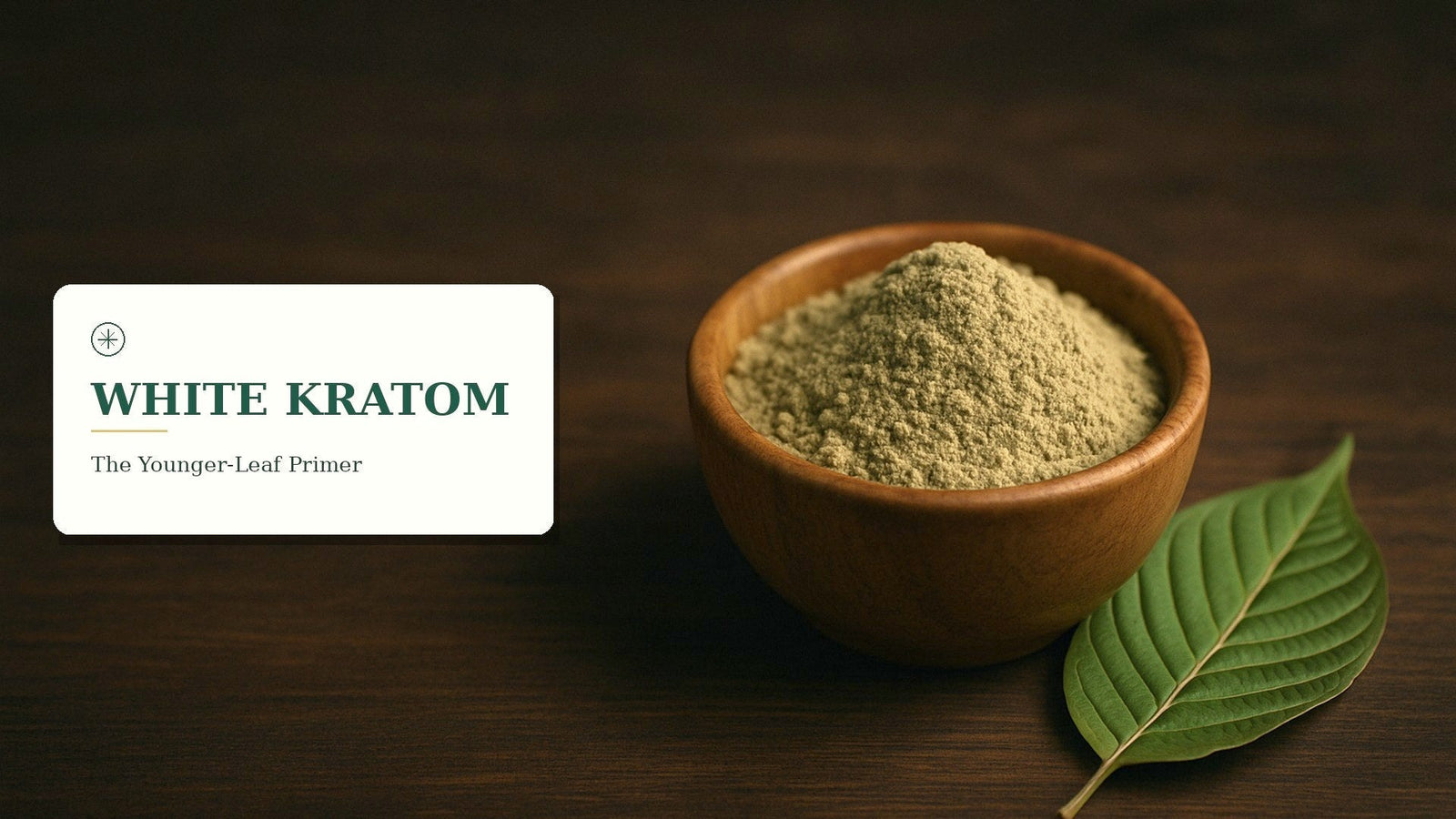
White kratom sits at the bright end of the kratom spectrum, and once you understand why, the rest of the strain world starts to make sense. The "white" part refers to the pale color of the central leaf vein and stem on younger Mitragyna speciosa leaves, harvested before sun exposure and post-harvest curing convert most of the leaf's mitragynine into its more relaxing cousins. That single timing difference, picked early instead of left to mature, drives nearly every effect people associate with white vein strains.
If you have read about the kratom alkaloid family at all, you already have a hint of why this matters. According to the National Institute on Drug Abuse, kratom leaves contain more than 40 active compounds, and mitragynine is the most abundant in fresh, young leaf material. White vein lots tend to lean mitragynine-heavy, which is the alkaloid most associated with a clean, daytime lift rather than evening sedation. That biology is what sets the stage for every section below.
This guide walks through what "white vein" actually means at the farm level, the alkaloid profile that produces the morning-energy reputation, how white differs from green and red, the five regional white strains worth knowing (Bali, Maeng Da, Thai, Borneo, Malay), practical dosing for first-timers and daily users, who white kratom suits and who it doesn't, and how we vet quality at GRH. It is meant to be the one piece you bookmark before trying any specific white-vein product.

Table of Contents
- What "White Vein" Actually Means at the Farm
- The Alkaloid Profile Behind White Kratom
- How White Differs From Green and Red Veins
- The Effect Profile Most Users Notice
- The Five Major White Vein Strains by Region
- Comparing the Big Five Side by Side
- Recommended Doses for White Vein Strains
- Who White Kratom Suits, and Who It Doesn't
- How to Vet Quality on a White Vein Lot
- Safe Daily-Use Practices With White Vein
- Frequently Asked Questions
- Final Thoughts
TL;DR
- White kratom is harvested earlier than green or red, so the leaf is younger and the central vein still pale.
- That younger leaf carries a higher proportion of mitragynine, the alkaloid linked to clean energy and focus rather than sedation.
- The classic white vein effect window: a steady morning lift, sharper attention, a mild mood bump, and almost no body-heaviness.
- The five regional whites that actually matter are White Maeng Da, White Borneo, White Thai, White Bali, and White Malay.
- Each region trades off potency, smoothness, and duration. White Maeng Da is the strongest. White Bali is the gentlest.
- A useful starter dose for a first-time white vein user is 1.5 to 2.5 grams of powder. Most daily users settle between 3 and 5 grams.
- White kratom suits people who want energy and focus without caffeine jitters. It does not suit anyone trying to wind down for sleep.
- Quality vetting matters more than strain branding. Third-party lab tests, single-origin sourcing, and harvest dating beat marketing every time.

What "White Vein" Actually Means at the Farm
The vein color in kratom is not branding. It is a real botanical marker that tells you the leaf's age and stage of curing. On a living Mitragyna speciosa tree, the central vein on a young leaf is pale, almost white. As that leaf matures on the branch, the vein darkens through green and eventually toward red as the leaf prepares to drop. Farmers in Borneo, Sumatra, and Sulawesi time their harvests around this vein color because it predicts the alkaloid balance of the dried product.
White vein lots are harvested when the central vein is still pale, before the leaf reaches biochemical maturity. Two things follow from that timing. First, the active compounds skew toward mitragynine, which makes up roughly 60 to 70 percent of total alkaloid content in young white leaf. Second, post-harvest curing is shorter and uses less sun, so the bright alkaloid profile gets preserved rather than oxidized.
The peer-reviewed PMC literature on mitragynine chemistry confirms what farmers have known for decades. Younger leaves with pale veins yield mitragynine-dominant powder. Older leaves with darker veins shift toward 7-hydroxymitragynine and oxidized variants, which is why red veins feel heavier. That biology is the single most important fact behind the white vein category.
The Alkaloid Profile Behind White Kratom
Mitragynine is the headliner in white vein samples, but it is not alone. A typical white vein lot from a reputable Indonesian farm tests in roughly this range across the major alkaloids that researchers have measured in commercial product surveys.
| Alkaloid | Role | Typical share in white vein |
|---|---|---|
| Mitragynine | Primary energy and focus driver | 60 to 70 percent of total alkaloids |
| Speciogynine | Smooth muscle effects, mild relaxant counterweight | 6 to 10 percent |
| Speciociliatine | Subjective mood lift, secondary energy | 5 to 9 percent |
| Paynantheine | Modest stimulating contribution | 4 to 8 percent |
| 7-hydroxymitragynine | Stronger receptor activity, more prominent in older leaf | under 1 percent in young white leaf |
| Other minor alkaloids | Modulate texture and duration | balance to 100 percent |
The takeaway is the ratio, not the absolute numbers. A red vein lot from the same farm and the same trees might carry only 35 to 45 percent mitragynine because the post-harvest curing has converted a chunk of it into other metabolites. White vein keeps mitragynine intact, and mitragynine is what your morning is asking for.
How White Differs From Green and Red Veins
People usually meet kratom through the green-red-white color taxonomy, and that taxonomy is more useful than confusing once you connect it to leaf age. Green is the middle. White is the early harvest. Red is the late harvest plus extra curing. Each color sits at a different point on the same biological curve, and each one trades energy for relaxation in a predictable way.

If you read our green vein kratom primer, you already know green sits in the middle ground. It still leans mitragynine-heavy, but the leaf has spent a few more weeks on the branch and picked up additional secondary alkaloids that round off the edges. Reds are picked later still and often sun-cured longer, which converts a meaningful share of the mitragynine into 7-hydroxymitragynine and oxidized variants. The result is a heavier body feel, more pronounced relaxation, and a longer evening profile.
White vein is the opposite end of that gradient. Less time on the branch, less oxidation in the cure, more mitragynine arriving in the bag. That is why white users describe a morning-coffee texture rather than an evening tea texture. The same farm, the same trees, the same soil. Just three different snapshots of the same plant at three different ages.
The Effect Profile Most Users Notice
White vein is rarely subtle in the first hour. Most users report a noticeable lift within 20 to 35 minutes of a typical dose taken on a light-food stomach, peaking around 60 to 90 minutes, and tapering by hour 3 to 4. The signature is clean energy, not jittery activation. People who do not tolerate caffeine well often report that white vein gives them productive momentum without the heart-rate spike or the early-afternoon crash.
The mood component is usually mild but real. White vein produces what regular users call "a more interested version of yourself" rather than a euphoric high. Focus sharpens. Conversational ease improves. Routine tasks feel less heavy. The body feel is light, mostly absent. That is by design, because the alkaloids responsible for body-heaviness increase as the leaf matures, and white vein simply has less of them.
Tolerance builds the same way it does for any plant compound. The smart move is to start at the low end of the dose range, log how you respond, and only increase if the effect window is genuinely too short for what you need.
The Five Major White Vein Strains by Region
Once you know that white vein is a harvest-timing category, the regional strain names become legible. White Maeng Da is a high-grade white leaf from selected Indonesian trees, processed at peak mitragynine content. White Borneo carries the geographic stamp of Borneo's Mitragyna trees. White Thai is the historical Thai cultivar at the same young leaf stage. White Bali and White Malay round out the five strains most reputable vendors carry.

The differences between these five are real but smaller than the differences between vein colors. Think of them as variations on a theme. The theme is morning energy and focus. The variations are how strong, how smooth, how long, and what mood notes ride along with the energy.

White Maeng Da
The strongest of the whites by reputation and by lab results. "Maeng Da" translates loosely as "pimp grade" in Thai slang, originally used by growers to flag their best leaf. In modern practice it is a selection rather than a region, often pulled from grafted high-alkaloid trees. We carry it in our White Maeng Da Kratom Powder for daily users who want the cleanest morning lift available. For a deeper sub-variant breakdown, see our White Maeng Da kratom guide.
White Borneo
The workhorse white. Borneo's rainforest conditions produce consistently mitragynine-leaning leaf. White Borneo is usually described as the most balanced white because it carries the morning lift without the sharper edge of Maeng Da. A good first white experience for someone who has only used green or red.
White Thai
The historical cultivar. Mitragyna speciosa is native to Thailand, even though commercial cultivation moved to Indonesia after regulatory changes. White Thai lots that still circulate are the most stimulating on a per-gram basis, sometimes too intense for sensitive people.
White Bali
The gentlest of the five. Bali strains carry a smoother, rounder profile, and the white version follows the pattern. White Bali offers the white vein window with less sharpness. We cover the sub-variant in our white bali kratom guide.
White Malay
The longest-acting of the whites. Users typically report a 4 to 6 hour window instead of the 3 to 4 typical of other whites. A good pick for a single morning dose carried through a long work block.
Comparing the Big Five Side by Side
The table below summarizes how the five major white vein strains tend to behave for an average user at moderate doses. Individual response varies, particularly with new users, so treat these as the starting map rather than the final word.

| Strain | Alkaloid lean | Typical effect | Suggested dose | Best for |
|---|---|---|---|---|
| White Maeng Da | Highest mitragynine concentration | Strongest clean energy and focus | 2 to 4 grams | Experienced users, demanding workdays |
| White Borneo | Solid mitragynine, balanced minors | Smooth morning lift, sustainable | 2.5 to 4.5 grams | Everyday workhorse white |
| White Thai | Mitragynine-dominant, slightly sharper | Wide-awake energy, alert focus | 2 to 3.5 grams | Cognitive sessions, study, writing |
| White Bali | Mitragynine-leaning, more secondary alkaloids | Gentler lift, milder edge | 3 to 5 grams | White vein first-timers, sensitive users |
| White Malay | Mitragynine plus slow-release minors | Long-duration energy, 4 to 6 hour window | 2.5 to 4 grams | Long sessions, single-dose mornings |
White Bali sits at the higher end of the dose range because its gentler edge invites users to push slightly more powder to reach the same subjective effect, not because it is weaker per gram. All numbers fall within safe daily-use territory for an adult without medical contraindications.
Recommended Doses for White Vein Strains
Dosing is the single most overlooked piece of the kratom experience. People who get bad results from kratom are almost always either taking too much, mixing strains they have not tested individually, or using on an aggressively empty stomach. White vein is forgiving in many ways but rewards a small amount of discipline.
A practical starter protocol for any new white vein user, regardless of strain:
- First session: 1.5 to 2 grams of powder, on a light food base, in the morning. Note effect onset, peak, and duration.
- Second session, 48 hours later: same strain, same conditions, 2 to 2.5 grams. Compare against the first session.
- Third session: bump to 3 grams only if the second session felt too short or too thin. If 2.5 was right, stay there.
- Hold steady for two weeks at the dose that gives you a clean morning lift without afternoon flatness or rebound.
- Reassess monthly. If tolerance has crept up, take a three-day break before continuing.
The numbers in the comparison table above assume an adult user without medical contraindications and without any other stimulant in the system. If you also drink coffee, halve the kratom dose for your first session. Combined stimulant load is the most common cause of "white kratom made me jittery" reports, and the kratom usually gets blamed when the coffee was the real culprit. The American Kratom Association publishes consumer guidance that aligns with this general protocol, particularly the emphasis on starting low and staying consistent.
Who White Kratom Suits, and Who It Doesn't
White vein is a great fit for a specific use case and a poor fit for the opposite one. Knowing which side of that line you sit on saves the trial-and-error step.
White vein suits knowledge workers, students, athletes warming into a session, and anyone who finds caffeine too sharp or too anxiety-inducing. Mood-wise, it produces a mild positive shift rather than sedation. Duration-wise, it delivers a clean 3 to 4 hour window rather than an all-day haze.

White vein does not suit people trying to wind down for sleep, manage acute pain, or sit through high-anxiety situations. For those use cases, look at our red vein and green vein primers. White vein also does not suit anyone with untreated cardiovascular conditions, anyone on serotonergic medications without provider clearance, anyone pregnant or breastfeeding, or anyone under 21. The FDA dietary supplements guidance applies here in full, and we always recommend consulting your healthcare provider before starting any new botanical.
How to Vet Quality on a White Vein Lot
The biggest variable in your kratom experience is not which color you choose. It is which lot you actually receive. Two bags labeled "White Maeng Da" from different vendors can carry wildly different alkaloid loads, contamination profiles, and freshness. Vetting matters more than strain selection.
A clean white vein lot should come with:
- A current third-party Certificate of Analysis showing mitragynine content (typically 1.0 to 1.8 percent of dry weight for premium young white leaf).
- Heavy metals testing within FDA dietary supplement limits for lead, cadmium, arsenic, and mercury.
- Microbial testing showing absence of salmonella, E. coli, and yeast/mold counts within safe ranges.
- A harvest date and a "best by" window, ideally within 12 months of harvest. Older leaf has oxidized and lost some of the mitragynine signal that makes white vein worth buying.
- Single-origin sourcing language, not a vague blend. White vein is harvest-timing specific, and blending lots from different harvest windows defeats the point.
If any of the five items above is missing or vague, that is your signal to look elsewhere. We publish current lab tests for every batch of our white vein products, including our Focus Blend Kratom Powder which combines white and green vein leaf for users who want a steady, sustained focus profile rather than a peakier solo white.
Safe Daily-Use Practices With White Vein
Daily white vein use is reasonable for many adults when handled with the same care any active compound deserves. The main risks are tolerance, dependency, and dosing creep. None of them are inevitable. All of them respond to a few simple practices.

The four practices that keep daily use sustainable:
- Hold a steady dose. Pick the number that works for you in the protocol above and stay there. Most tolerance issues come from steady micro-increases that the user does not notice.
- Rotate strains weekly. Same vein color, different region. The receptor binding profile of White Maeng Da is not identical to White Bali, and rotating keeps the body from settling into a single pattern.
- Take a planned break. A three-day off period every two to three weeks resets tolerance better than any other lever. Schedule it the way you schedule any other recovery practice.
- Track your sessions. A note in your phone with date, strain, dose, and a one-line subjective report is enough. Patterns become obvious after four weeks.
A peer-reviewed kratom user survey published in PMC found that daily users who followed structured rotation and break practices reported fewer tolerance issues and lower dose creep. The people who use white vein well treat it like any other active compound, with a small amount of structure.

Frequently Asked Questions
Is white kratom stronger than green or red?
Not stronger in a single dimension, but stronger in the energy and focus dimension specifically. White vein has the highest mitragynine concentration of the three veins, which is why it produces the cleanest morning lift. For pain or sleep, red and some greens are stronger in the relevant dimension. "Strength" depends on what you are asking the leaf to do.
What is the best white kratom for first-time users?
White Bali or White Borneo. Both carry the white vein effect profile without the sharp edge of White Maeng Da. Start at 1.5 to 2 grams, see how the first session lands, then adjust. Save White Maeng Da and White Thai for after you have a baseline reference.
How long does white kratom take to kick in?
20 to 35 minutes on a light-food stomach is typical. Empty stomach is faster but slightly harsher. Heavy meal is slower and more diffuse. Most users find a small breakfast 30 minutes before the dose gives the most predictable onset.
Can I take white kratom every day?
Many adult users do, with reasonable structure. Daily use is more sustainable when you hold a steady dose, rotate strains weekly, plan a three-day break every two to three weeks, and track your sessions. Daily use without any of those practices tends to drift into tolerance and dose creep.
Does white kratom help with energy without caffeine?
Yes, and that is one of its strongest fits. People who do not tolerate caffeine well often report that white vein delivers focus and momentum without heart-rate spikes or the early-afternoon crash. If you do combine the two, halve your normal kratom dose for the first session so you can see how your body responds to the stack.
Is white kratom legal in the United States?
Kratom is federally legal as of this writing but is restricted or banned in a handful of states and municipalities. The American Kratom Association tracks the current legal status by state. Check your local laws before ordering.
What is the difference between white kratom and yellow kratom?
Yellow is not a vein color. It is a processing step, usually a blend of veins fermented or dried under specific conditions to shift the alkaloid profile toward a yellow-tinted powder. Yellow tends to behave more like green or aged white. White is a true vein color that maps to leaf age and harvest timing. They are not interchangeable.
How long does a serving of white kratom last?
Most users report a 3 to 4 hour effect window from a moderate dose of White Maeng Da, Borneo, Thai, or Bali. White Malay typically runs longer at 4 to 6 hours. Onset and peak are similar across strains. Duration is where the regional differences show up most clearly.
Final Thoughts
White kratom is the easiest entry point into the strain world for anyone whose primary need is energy, focus, or a clean morning lift without caffeine. The biology is simple. Younger leaf, more mitragynine, brighter effect. The five regional strains are variations on that single theme, and once you know your dose and your preferred region, you can pick a product and move on with your day.
For users ready to start, the practical pick is to begin with a single high-quality white vein strain at the low end of the dose range, log two or three sessions, and adjust from there. Our team carries the strains we use ourselves, including White Maeng Da Kratom Powder for experienced daily users who want the cleanest morning lift, and Boost Blend Kratom Powder for users who want the white vein effect window with a slight green vein smoothness layered in.

One last note on expectations. White vein is excellent at what it does, and unimpressive at what it does not do. If you find yourself reaching for white in the evening and getting frustrated that it is not winding you down, that is not a white vein problem. That is a strain-selection problem, and a red vein or a calming green is the right tool for that job. Match the strain to the task, and the leaf does its part of the work.
Stay consistent, treat the plant with a small amount of structure, and your white vein experience will look more like a useful morning routine and less like a bag of unpredictable surprises. That is the goal of a primer like this one.


