



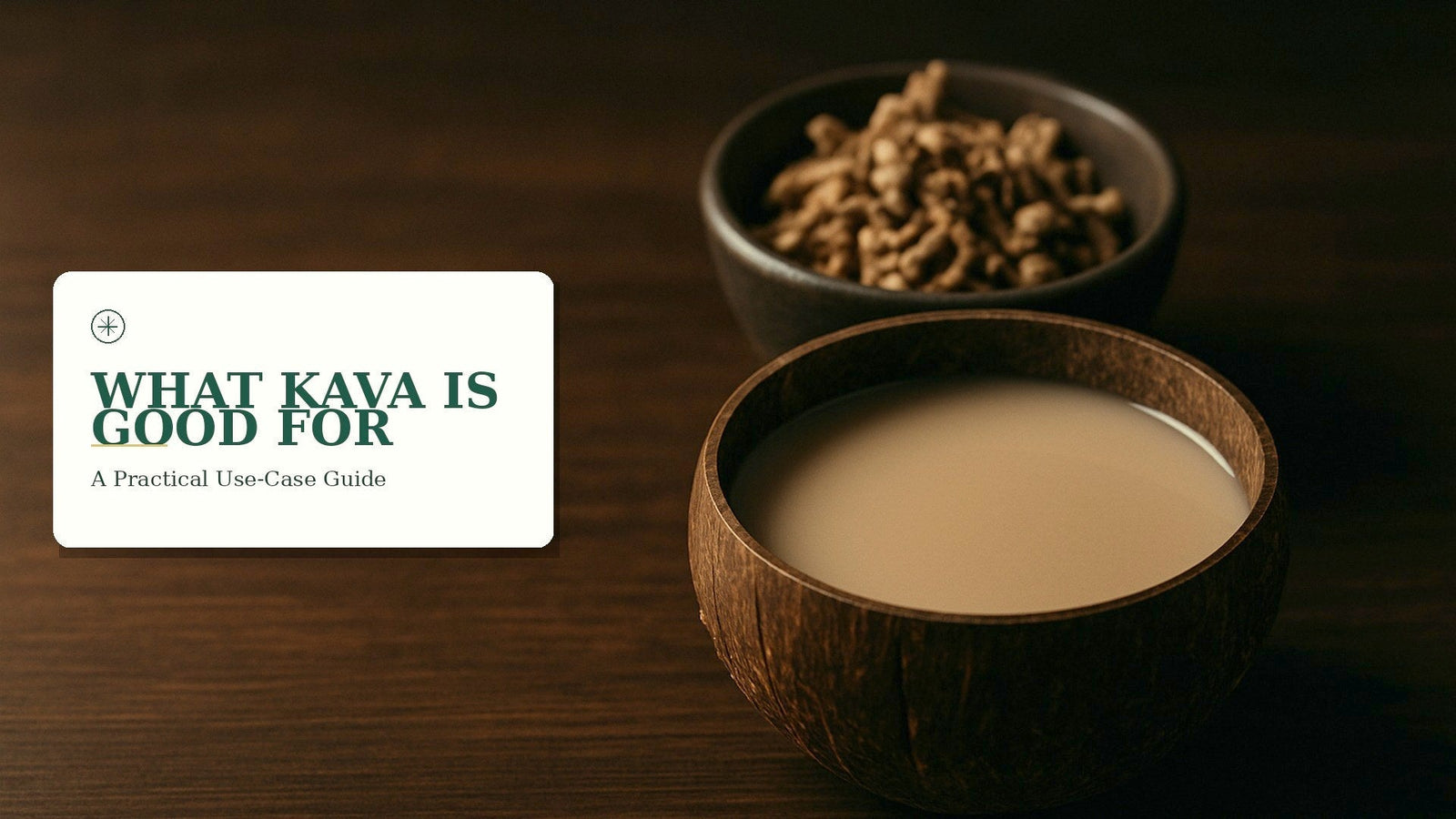
Kava has a long, oddly specific reputation. Pacific islanders pass a coconut shell across a circle for a ceremony. A college senior orders a kava cocktail because they want a chill night, not a hungover one. A first-time founder sips kava tea before a pitch because their hands shake too much for coffee. The plant is the same in all three scenes. The reason people reach for it is different every time.
That gap is the whole question behind this guide. Search "what is kava good for" and you get a tangle of medical claims, ceremony explainers, and influencer takes that all sound vaguely true and not very useful. The honest answer is that kava is good for specific situations, not specific diseases. Sleep onset, not insomnia. A nervous evening, not a panic disorder. A wind-down ritual, not a sedative protocol.
The reason it works the way it does sits inside its chemistry. Kavalactones, the active compounds in kava root, bind to GABA-A receptor sites in the brain and quiet the noise of an over-active nervous system without flattening you, which is why NCCIH lists "calm anxiety in the short term" as one of the few uses with reasonable evidence, while flagging the rest as either unproven or out of scope. Below, every section maps a real situation to whether kava is the right tool, the wrong tool, or somewhere in between.

Table of Contents
- Kava for evening wind-down
- Kava for social ease and pre-event nerves
- Kava for sleep onset support
- Kava for situational anxiety windows
- Kava for muscle tension after exertion
- Kava for ceremonial and cultural settings
- Kava as an alcohol alternative
- What kava is NOT good for
- Dose by use case quick reference
- Match kava to your situation
- Frequently Asked Questions
- Final Thoughts
TL;DR
- Kava is best understood as a situational tool, not a treatment. It earns its keep in evenings, social settings, sleep onset, and short anxiety windows, not in clinical disorders.
- The active compounds, kavalactones, work on GABA-A receptors to take the edge off a busy nervous system without flattening cognition the way alcohol or sleep meds do.
- Evening wind-down is the most reliable use case: 70 to 250 mg kavalactones in tea or a tonic, roughly an hour before you want to slow down.
- For social ease and pre-event nerves, a small dose (about 70 to 100 mg kavalactones) thirty to sixty minutes before you walk in is the practical pattern.
- Sleep onset support works because kava shortens the gap between "in bed" and "actually asleep." It does not fix sleep maintenance or sleep disorders.
- Kava is a credible alcohol alternative at bars and parties, and it is one of the few legal options that does not leave you with a hangover.
- Kava is NOT good for chronic anxiety disorders, opioid withdrawal, sleep disorders, chronic pain, or pediatric use. Those are clinical situations and they need clinical care.
- Kava is not FDA-approved to treat any condition. If you take prescription medications, are pregnant or nursing, or have pre-existing liver concerns, consult your clinician before adding kava.

Kava for Evening Wind-Down
If you only ever use kava for one thing, this is the use case to start with. Evening wind-down is the situation kava handles most reliably and the one with the least nuance. The window between dinner and bed, when work email is technically closed but your shoulders have not heard the news, is where kava earns its long Pacific reputation.
The mechanism is straightforward. Kavalactones cross into the brain and modulate GABA-A signaling, which is the same family of receptors that benzodiazepines and a glass of wine quiet down, just gentler and without the cognitive flattening. Memorial Sloan Kettering's integrative-medicine summary describes the short-term calming effect as the use case with the cleanest evidence base.
Practical pattern: a noble-kava beverage or tea with roughly 70 to 150 mg of kavalactones, taken about an hour before you want to actually slow down. You should feel a mild lip-tingle, a sense that your shoulders have dropped half an inch, and a quieter inner narration. That is the whole feeling. If you do not feel anything after two servings spaced 30 minutes apart, that night is a reverse-tolerance night and tomorrow will likely be different.

Kava for Social Ease and Pre-Event Nerves
The second use case is the one that has built every kava bar in the country. Kava takes the keyed-up feeling out of a social situation without dulling the social part. Coffee makes you jittery before a party. A drink makes you slower. Kava sits between them.
This is where dose discipline matters most. The right pre-event amount is small, about 70 to 100 mg of kavalactones, roughly thirty to sixty minutes before you walk in. Bigger doses are for an evening at home, not for a wedding speech. A small kava drink gives you the looseness of a glass of wine without the slurring, the breath, or the next-day tax. People who switch from a cocktail to a kava drink at a friend's birthday usually notice they remember the conversation better the next morning.
One framing trap to avoid: kava is not "social fuel." It is not going to make a shy night an extroverted one. What it does is take the spike out of pre-event nerves so the version of you that shows up is just the regular you, minus the racing thoughts. That distinction matters when you set expectations for a first try.

Kava for Sleep Onset Support
Sleep is the use case people most often get wrong about kava. Kava is good for the onset side of sleep, the gap between "I want to be asleep" and "I am asleep." It is not a treatment for insomnia, sleep apnea, restless leg syndrome, or any other clinical sleep disorder, and it does not deepen or lengthen sleep the way some packaging implies.
For the onset use case, kava works because it lowers the threshold to drop off. You take a kava beverage about 45 to 60 minutes before bed, your nervous system softens, your inner narration quiets, and the bridge to sleep gets shorter. That is the whole effect. Once you are asleep, kava is not doing meaningful work for the rest of the night, and the morning after a moderate evening dose should feel clear, not groggy.
If sleep is your primary use case, we cover the kava-for-sleep pattern in more detail in our dedicated kava for sleep guide, including how to layer it with sleep hygiene basics for a more honest fix than a single dose can deliver. Kava is not FDA-approved to treat any condition, including any sleep diagnosis, so treat it as a wind-down support, not a sleep medication.
Kava for Situational Anxiety Windows
Situational anxiety is the cleanest research story kava has. Multiple short-term clinical reviews, including the PMC NCBI summary of kavalactone studies, suggest that standardized kava extracts reduce short-term anxiety symptoms relative to placebo in non-clinical populations. The keyword in that sentence is "short-term." The research does not back kava for chronic generalized anxiety disorder, panic disorder, or PTSD.
What that maps to in real life: a job interview, a flight, a presentation, a first date, a difficult phone call, the morning of a wedding you are in. These are situational anxiety windows with a clear beginning, middle, and end. A small kava dose 45 minutes before the window opens often takes the racing heart and tight chest down a notch without making you sleepy or slow.
If anxiety is your everyday baseline rather than a Tuesday afternoon problem, kava is the wrong tool. Our kava for anxiety guide walks through where the line between "situational" and "clinical" sits, and what to do if your situation is really the second category dressed up as the first.

Kava for Muscle Tension After Exertion
This use case is the quietest in the kava literature and one of the most underrated in practice. After a heavy training day, a long hike, or a stressful shift on your feet, kava produces a noticeable muscle-relaxant effect alongside its calming effect. The mechanism is partly the GABA-A action and partly a separate pathway in the kavalactones that affects peripheral muscle tone.
The practical version: a moderate kava beverage in the early evening after a hard physical day. You feel the shoulders, traps, and lower back go quiet about 30 to 45 minutes in, and the next morning you usually feel like you slept slightly better than the soreness would predict. That is not a clinical claim about muscle recovery, it is a real pattern people notice when they swap a beer for kava after a long Saturday.
For more on the mechanism side of why kava feels physical and not just mental, our what does kava do guide covers the kavalactone pathways in depth. Kava is not a pain medication and should not replace one for any clinical pain condition.
Kava for Ceremonial and Cultural Settings
Outside the wellness industry, kava has been a ceremonial beverage in Fiji, Vanuatu, Tonga, Samoa, and elsewhere in the Pacific for several centuries. In those contexts, kava is not a wellness product. It is a social-bonding ritual, a peace-making gesture, a guest-welcoming custom, and a marker of communal time. The Australian Alcohol and Drug Foundation notes that traditional preparation and serving rules carry social meaning that the Western kava-bar version often loses.
What this means for an American reader: if you ever get the chance to drink kava at a traditional Pacific gathering, the etiquette matters more than the dose. You clap before you drink, you drink the cup in one swallow, you say "bula" or the local equivalent, and you sit on the floor with everyone else. The kava is the medium, not the point. People underestimate how good kava is for a use case that is essentially "be present with other people, slowly, without alcohol."
You do not need a Pacific gathering to borrow the spirit of this. A Friday-night circle on someone's back porch, with a kava bowl and no phones, captures the same use case. Match the situation, not the costume.

Kava as an Alcohol Alternative
Of all the kava use cases, this one has the most public traction. Kava bars in Florida, Colorado, California, and the Northeast have built a real subculture around offering the relaxation feel of alcohol with none of the back-half cost. You can have a kava drink, drive home, and wake up tomorrow exactly the way you would have if you had skipped it. That tradeoff is the entire appeal.
Where kava works as an alcohol alternative: happy hour with co-workers, a dinner where you would rather not drink, a wedding where you are driving, a family gathering where the conversation gets heavy. Where it does not work: as a coping tool for problem drinking, as a "harm reduction" rationalization for unmoderated use, or as a substitute for medical support for alcohol use disorder. If alcohol has become a clinical problem, kava is not the answer. Talking to a clinician is.
The mild-doses pattern stays the same here. One to two servings of a noble-kava beverage over the course of a social evening, paired with food and water, gives you the same calm-but-present quality without the hangover penalty. Honest framing: kava is not a treatment for any condition, and the FDA dietary-supplements category is where it lives regulatorily.
What Kava Is NOT Good For
This is the section most kava content skips. Kava is good for a real but narrow band of situations, and the list of things it is not good for is longer and more important.
Kava is not good for chronic anxiety disorders. Short-term, situational kava use has reasonable evidence behind it. Daily use to manage clinical anxiety does not, and the long-term safety story has open questions around liver function that get worse with daily heavy use. If you are reaching for kava every day to function, the situation is clinical and the right next step is a clinician, not a bigger jar.
Kava is not good for opioid withdrawal. There is real anecdotal demand for this use case because the calming feel of kava overlaps with what someone in withdrawal is missing. But kava does not bind opioid receptors, and the literature does not back this use. Medication-assisted treatment programs exist for exactly this reason and they work better than self-managed kava ever will.
Kava is not good for sleep disorders. Onset support is fine. A diagnosed sleep disorder, especially obstructive sleep apnea or chronic insomnia with daytime functional impairment, needs a sleep workup, not an evening tonic. Kava is not good for chronic pain. It produces a mild muscle-relaxant feel after exertion, which is different from analgesic action for arthritis, neuropathy, or any pain syndrome. It is also not good for pediatric use under any circumstance.

Dose by Use Case: Quick Reference
The right kava dose changes more by situation than by person, which is part of why generic kava advice often misses. The table below is the practical map between use case and dose.
| Situation | Why kava fits | Typical kavalactone dose | When to skip |
|---|---|---|---|
| Evening wind-down | GABA-A calming after the workday | 70 to 150 mg, 60 min before slow-down | You are already exhausted, not wound up |
| Pre-event nerves | Takes spike off social anxiety | 70 to 100 mg, 30 to 60 min before | You need to drive or operate machinery |
| Sleep onset | Shortens time-to-fall-asleep | 100 to 200 mg, 45 to 60 min before bed | Diagnosed sleep disorder |
| Situational anxiety | Short-term GABA-A modulation | 70 to 150 mg, 45 min pre-window | Daily clinical anxiety |
| Muscle tension after exertion | Mild peripheral muscle relaxation | 100 to 200 mg, early evening | Clinical pain condition |
| Alcohol alternative | Calm feel, no hangover | One to two servings over an evening | Problem drinking present |
| Ceremonial setting | Communal pace and ritual | Follow local tradition | Combining with alcohol or sedatives |
Two caveats on the table. First, kavalactone content varies a lot between kava products. A kava tea bag, a fresh-prepared bowl, and a concentrated tonic can all advertise "a serving" and contain very different amounts. Read the label, not the marketing. Second, dose tolerance is not linear. Two servings is not always twice one serving, and "reverse tolerance" is a real thing on your first few sessions, so build up slowly.

Match Kava to Your Situation: A Decision Frame
If you are deciding whether to reach for kava on a given evening or in a given social moment, the question is not "is kava good for me?" but "is kava the right tool for this situation?" The frame below is a simple decision flow we use internally and recommend to first-time users.
- Name the situation in one sentence. Not "I am anxious" but "I have a 7pm work dinner with people I do not know well." Specificity helps you pick the right tool.
- Check if the situation has a clear end. Use cases with a beginning, middle, and end (a flight, a party, a hard conversation, a wind-down evening) are kava's strong zone. Open-ended states (chronic anxiety, daily insomnia, long-term pain) are not.
- Ask if a clinician is already involved. If yes and your kava use intersects with medication or a diagnosed condition, talk to them before you add kava. Liver, sedative, and benzodiazepine interactions are real.
- Match the dose to the situation, not the person. Pre-event nerves get a small dose, evening wind-down gets a moderate dose, sleep onset gets a slightly larger dose. The "right" dose for you is the smallest one that does the job.
- Reassess after one week. Three or four sessions across one week tell you whether kava is solving the situation or just dressing it up. If the situation has not improved or has gotten worse, change tools.

Frequently Asked Questions
Is kava good for everyday use?
Not really. Kava is most useful as a situational tool a few evenings a week or before specific events. Daily long-term heavy use is where the liver-function questions get serious enough that NCCIH and the FDA both flag caution. If you find yourself reaching for it every day, that is the signal to change the question.
What is kava root good for specifically?
Kava root is where the kavalactones live, which makes it the active part of the plant. The leaves and stem peelings contain compounds that have been linked to liver issues and are not used in noble-kava products. "Root only" or "noble kava" on a label is the signal that the manufacturer is sourcing the right part of the plant.
What is kava tea good for compared to a kava tonic?
Kava tea and a kava tonic do the same job at different paces. Tea is slower, gentler, and easier to titrate over an evening. A tonic is faster, more concentrated, and better for time-bound situations like pre-event nerves. The use case picks the format.
Is kava good for anxiety, honestly?
Short-term, situational anxiety: yes, with reasonable evidence behind a small to moderate dose. Chronic clinical anxiety: no, and trying to make it work for that use case is where people get into trouble. The intent is what matters.
Is kava good for sleep or just for falling asleep?
Just for falling asleep. Kava shortens sleep onset but does not deepen, lengthen, or restructure sleep. If you sleep poorly through the night, kava is the wrong tool. A sleep workup is the right one.
Is kava good for alcoholics or people in recovery?
This is a clinical question, not a wellness question, and it should be answered by a clinician who knows the person. Some people in recovery use kava as a social-evening substitute. Others find that any compound that touches the GABA-A system risks brushing against the same patterns they are trying to leave. Talk to your provider.
What is kava NOT good for that gets advertised anyway?
The biggest marketing overreach in the kava space is "kava for chronic pain" and "kava for depression." The first conflates muscle relaxation with analgesia, and the second confuses an evening calming feel with antidepressant action. Kava does neither. If those are the situations you are trying to solve, reach for the right tools.
Final Thoughts
The most useful way to think about kava is to stop asking what it is good for in general and start asking what it is good for in your week. The plant has earned its place as a wind-down tool, a social-evening tool, a sleep-onset tool, and a short-anxiety-window tool. It has not earned a place as a treatment for any condition, and it never will, because that is not the kind of plant it is.
If you are trying kava for the first time, pick one of the situational use cases above, take a small dose, and pay attention to the body and the next morning rather than the marketing. The tools that work for you over a month are the ones that quietly drop into your routine without crowding out the rest of life. Kava, used the way the Pacific cultures who built it use it, is one of those tools. Used as a daily substitute for clinical care, it is not.

For most readers, the easiest entry point is a noble-kava beverage built around real kavalactone content, not a mystery powder. Our GÜD Tonics kava bundle covers three flavor profiles built for different evening vibes, and the GÜD Tonics raw kava extract powder gives you a flexible base if you prefer to build your own drink to fit a specific situation. Pick the one that matches the use case, not the one that looks most clinical on the shelf.
Kava is not FDA-approved to treat any condition. If you take prescription medications, are pregnant or nursing, or have pre-existing liver concerns, consult your clinician before adding kava. Honest expectations beat heroic marketing every time, and kava rewards the readers who treat it like a situational tool with limits, not a wellness panacea.


