



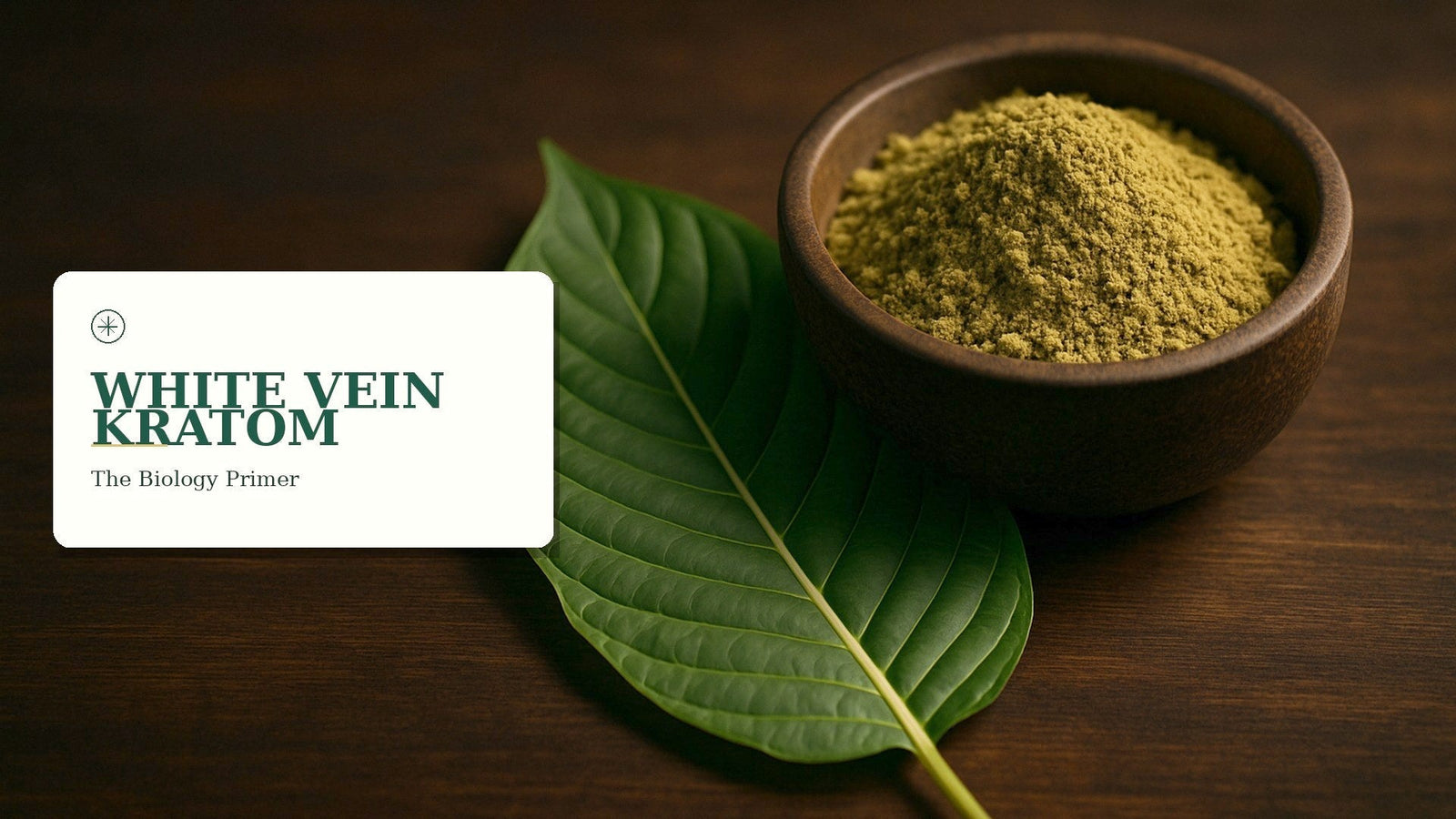
Vein color is the first decision most kratom shoppers make, and white vein sits at one extreme of that decision. It is the youngest leaf on the plant, the one with the highest mitragynine ratio, and the one most people reach for when they want energy or focus instead of relaxation. Marketing copy summarizes it as "the stimulating one," but that label glosses over the botany behind why a white vein leaf behaves the way it does.
This guide stays close to that biology. White vein is not a separate species or a separate plant. It is a harvest timestamp, plus the alkaloid profile that comes with picking a Mitragyna speciosa leaf early in its life. Understand that single idea and the rest of the white vein category becomes much easier to navigate.
To anchor the science: peer-reviewed work in the National Library of Medicine's PMC review of Mitragyna speciosa alkaloid chemistry confirms that mitragynine concentration shifts predictably with leaf maturity, and that the leaf's full alkaloid mix evolves as it ages. That finding is the foundation everything else here rests on.

Table of Contents
- What "White Vein" Actually Means at the Leaf Level
- The Leaf Maturity Timeline: White, Green, Red
- Why Young Leaves Carry the Highest Mitragynine
- Mitragynine vs 7-Hydroxymitragynine: The White vs Red Divide
- How to Identify a True White Vein Leaf at Harvest
- The Alkaloid Concentration Curve Across Leaf Maturity
- "True White" vs "Lightly Processed": The Drying Question
- The Effect Profile of the Mitragynine Lean
- Recommended Doses for White Vein Use
- Vein-Color Biology vs Regional Strain Identity
- How to Vet a White Vein Product
- Frequently Asked Questions
- Final Thoughts
TL;DR
- White vein kratom is the youngest harvested leaf of the Mitragyna speciosa tree, not a different plant or growing region.
- Young leaves carry a higher concentration of mitragynine and a much smaller share of 7-hydroxymitragynine, which is what makes white vein lean stimulating instead of sedating.
- The white central vein on a young kratom leaf is pale because the leaf's chlorophyll and pigment systems have not finished maturing.
- "White" is a botanical timestamp on the leaf maturity curve, sitting before "green" and well before "red."
- The most common feedback themes for white vein are clean energy, mental focus, and gentle mood lift in the first 2 to 4 hours.
- A typical white vein starter dose lands at 1.5 to 2.5 grams, with most experienced users settling between 2 and 4 grams.
- Lab testing matters more for white vein than for red because the gap between a real young-leaf harvest and a lightly processed mature leaf is invisible in finished powder.
- Regional strain names like White Bali, White Borneo, and White Maeng Da still describe a young-leaf product, just grown under different soil and humidity conditions.

What "White Vein" Actually Means at the Leaf Level
"White vein kratom" describes a stage of the leaf, not a separate variety of the plant. Every Mitragyna speciosa tree produces the same leaves. As those leaves grow, the central vein running down the middle changes color from pale cream, to green, to dark red. Farmers pick at the stage that matches the product they want to make, and the harvest timing determines whether the finished powder gets sold as white, green, or red.
On a young leaf, the central vein has a noticeably lighter hue. The leaf has not finished building out its full chlorophyll content, and the cell walls along the vein still have a translucent quality. To the naked eye that reads as cream or light yellow-green. Farmers in Indonesia, Borneo, and southern Thailand use that visual cue along with leaf size and stem flexibility to decide when a tree is ready for a white-vein harvest.
None of this changes the species. A White Bali plant, a White Maeng Da plant, and a Red Borneo plant are the same tree at different ages. The shorthand is helpful for shopping but can mislead first-time buyers into thinking the kratom industry has dozens of botanical varieties. It has one species and three to four named harvest windows.
The Leaf Maturity Timeline: White, Green, Red
Tracking the leaf through its life makes the vein-color system easy to read. Each tree cycles through three distinguishable maturity windows during the growing season, and each window produces a kratom product with a different feel.
| Maturity stage | Approx leaf age | Vein appearance | Dominant alkaloid lean | Effect lean |
|---|---|---|---|---|
| White vein (young) | Early growth, often 4 to 8 weeks post-emergence | Pale cream to light yellow-green | Highest mitragynine ratio, trace 7-hydroxymitragynine | Energy, focus, mood lift |
| Green vein (mid) | Mid life, fully expanded leaf with developed chlorophyll | Bright green central vein | Balanced mitragynine, small but rising 7-hydroxymitragynine | Balanced energy and calm |
| Red vein (mature) | Late life, leaf has reached full alkaloid maturity | Deep red or maroon central vein | Lower mitragynine ratio, highest 7-hydroxymitragynine | Sedation, relaxation, body comfort |
The table flattens a continuous process into three rows. Every farm has slightly different windows for what counts as "white-ready" versus "green-ready," and weather can push those windows forward or back. The farmer's judgment is part of the product, which is why two White Maeng Da batches from two farms can feel a little different.

Why Young Leaves Carry the Highest Mitragynine
Kratom's alkaloid mix is not static. The plant biosynthesizes alkaloids continuously, and the ratio changes as the leaf ages. Young leaves produce mitragynine first and most aggressively. As the leaf moves through its life cycle, the proportion of mitragynine drops slightly while 7-hydroxymitragynine and other minor alkaloids rise in relative share. The total alkaloid content does not change dramatically, but the mix does.
For shoppers, this is the single most important fact. White vein kratom is a product whose alkaloid spectrum is tilted toward mitragynine. Red vein is tilted away from it. Everything else about the white vein experience flows from that tilt, including the energy lean, the lower sedation, and the comparatively bitter taste.
The National Institute on Drug Abuse fact sheet on kratom confirms that mitragynine is the dominant alkaloid behind kratom's stimulant-like effects at lower doses, while 7-hydroxymitragynine is much smaller in concentration but more potent per microgram. White vein leans hard on the first; red vein leans on the second.
Mitragynine vs 7-Hydroxymitragynine: The White vs Red Divide
The two alkaloids that define the kratom experience behave very differently. Mitragynine is partial in its receptor activity, which is why even a moderate mitragynine-heavy dose reads as "alert and uplifted" rather than "sleepy." 7-hydroxymitragynine binds more strongly and reads as "heavy and quiet." A young leaf has a much higher ratio of the first to the second, which is why white vein is consistently described as functional and forward-leaning.
White vein responds well to lower doses for stimulating effects, but a higher dose does not turn sedative the way red vein does. A 5 or 6 gram white vein dose still lands as energy-tilted rather than sedating. Many users find the upper range of white vein simply uncomfortable, not relaxing.

The divide is not absolute. Some users describe white vein as gently relaxing in the second hour, which is mitragynine's biphasic profile showing up. The general rule still holds: if you want sedation, the leaf you want is older, and the alkaloid you want more of is 7-hydroxymitragynine.
How to Identify a True White Vein Leaf at Harvest
In a field, a white-ready leaf has telltale signs. The central vein on the underside reads as pale cream or light yellow-green rather than the deeper greens of a mid-maturity leaf. The leaf itself is smaller and more flexible. The petiole, the small stem connecting the leaf to the branch, is pale and slightly translucent. Farmers also look at the upper canopy versus the lower canopy, because the youngest leaves are typically near the top.
None of this is visible in finished powder. The visual cues that distinguish a young leaf from an older one are gone after grinding. Finished powder color is more about drying technique than vein color, which is why a good kratom purchase is downstream of farmer trust. A reputable supplier publishes the harvest window, the regional source, and ideally a third-party alkaloid panel. Cultivation conditions matter too: the Frontiers review of Mitragyna speciosa cultivation documents how soil, shade, and drying choices alter the final alkaloid profile.

The Alkaloid Concentration Curve Across Leaf Maturity
Plotted on a chart, mitragynine concentration as a percentage of total alkaloid mass starts high in a young leaf and slopes down through the leaf's life. 7-hydroxymitragynine starts at trace levels and slopes up. The crossover is not perfectly clean, but the relative shift is the key point for shoppers.
White vein products land near the peak of mitragynine and the floor of 7-hydroxymitragynine. Green vein products sit near the middle of both curves. Red vein products sit on the down-slope of mitragynine and the upslope of 7-hydroxymitragynine. That distribution is what makes vein color a useful purchase signal even though the chemistry is continuous.

This is why cross-strain consistency requires careful sourcing. A White Maeng Da harvested too late is functionally closer to a green, and a White Bali harvested at the wrong window can have an alkaloid mix that does not match the bag's label. Reputable brands solve this with consistent windows and lab verification rather than relying on vein-color claims alone.
"True White" vs "Lightly Processed": The Drying Question
Vein color in finished powder is influenced by two things: leaf age at harvest, and drying technique afterward. Some producers use shorter or indoor drying cycles to keep finished powder lighter, which can make a green-stage harvest look like a white-stage harvest. This is not always deception, but it means color alone is a weak signal.
A real young-leaf white vein has the mitragynine-tilted profile and the bright energy lean. A green-stage leaf dried quickly to look pale will not. The two are indistinguishable in a bag of powder. The only way to confirm what you bought is a certificate of analysis showing mitragynine and 7-hydroxymitragynine percentages. The American Kratom Association's GMP Standards Program covers the testing and labeling practices reputable vendors follow.
This is also why the price gap between white vein and red vein is often smaller than expected. The harvest labor is similar; the difference is in timing and handling. Pricing that wildly diverges from the rest of a brand's catalog is worth a second look.
The Effect Profile of the Mitragynine Lean
The most common report for a fresh, lab-tested white vein product is a quick onset of clean energy, sharper mental focus, and a gentle uplift in mood. Most users feel the first phase within 20 to 40 minutes of dosing on an empty or near-empty stomach. The peak window typically lands around 1.5 to 2 hours in, and the full duration runs about 3 to 4 hours.
White vein gets compared to coffee constantly, and the comparison works as a first-order approximation. The mitragynine lean reads as a steady, focused energy rather than the jittery edge of a high-caffeine pull. Morning users often describe a smoother arc than coffee alone, with less of a crash on the back end. White vein is not a CNS stimulant in the same pharmacological category as caffeine, so the comparison is shorthand, not equivalence.

The most common limit users hit with white vein is "wired but uneasy" at higher doses. Past about 4 to 5 grams, the energetic lean can tip into restlessness, mild nausea, or a heart-rate bump. That is why white vein tops out lower than red vein in most personal dosing protocols.
Recommended Doses for White Vein Use
Dose ranges for white vein follow the same general framework as the rest of the kratom category, with the caveat that the upper end is less rewarding for white than for red. The numbers below are powder weights; capsule equivalents at 0.5 grams per cap are listed in parentheses.
- Threshold: 0.5 to 1 gram (1 to 2 capsules). The lower bound where most people detect any effect.
- Low: 1.5 to 2.5 grams (3 to 5 capsules). Gentle stimulation, common starter range for newer users.
- Moderate: 2.5 to 4 grams (5 to 8 capsules). The most common white vein dose for daily users.
- High: 4 to 6 grams (8 to 12 capsules). Stronger stimulation, more risk of restlessness or nausea.
- Above 6 grams is generally not recommended for white vein and tips into uncomfortable territory faster than red vein does.
White vein lands best in the first half of the day. Most users avoid dosing within 4 to 5 hours of bedtime to keep sleep clean. If you are pairing white vein with caffeine, halve your usual coffee intake for the first few sessions to gauge how the two stack. The FDA's general guidance on dietary supplements is a reasonable backdrop here: start low, take notes, and treat any new herbal product with the same caution you would give any new substance.

Vein-Color Biology vs Regional Strain Identity
Where the biology stops and the marketing starts is the regional strain layer. White Bali, White Borneo, White Thai, White Maeng Da, and White Malay are all young-leaf products. They share the mitragynine-tilted alkaloid profile that defines the white vein category. The differences between them come from soil composition, humidity, elevation, and cultivar selection at the farm, plus the post-harvest handling each region tends to favor.
Those regional differences are real but smaller than the vein-color difference. Two White Maeng Da batches from different farms can read closer to each other than a White Maeng Da reads to a Red Maeng Da. If you are picking a white strain for a specific feel, vein color is the variable that does most of the work; region is the variable that fine-tunes the experience.
For a deeper look at the regional-strain layer, our companion white vein kratom guide walks through each of the major regional whites, the typical effect profile of each, and how to pick between them. If you want a direct comparison between three of the most popular whites, our White Maeng Da vs White Thai vs White Sumatra breakdown is the most efficient read. For the parallel biology primer at the other end of the spectrum, see our red vein kratom primer for how mature-leaf biology produces the opposite effect profile.
How to Vet a White Vein Product
Buying white vein with confidence means looking past the bag color and confirming what is actually inside. The checklist below is the one we use internally before adding any new white-vein SKU. Apply the same steps to any white product on a shelf or in a cart.
- Confirm the vendor publishes a certificate of analysis for the specific batch you are buying.
- Check that the COA lists both mitragynine and 7-hydroxymitragynine percentages, not just "alkaloid content."
- Verify mitragynine is the dominant peak. A white-vein product should show mitragynine in the high single digits of percent dry weight, with 7-hydroxymitragynine in trace levels.
- Confirm the vendor is a registered participant in the American Kratom Association's GMP program or an equivalent third-party audit.
- Read the harvest window or batch date. White-vein freshness matters; powder past 12 months is past its best window.
- Check that the country of origin is named. "Southeast Asian kratom" with no further detail is a yellow flag.
- Look at the regional strain. A specific name like White Maeng Da, White Bali, or White Borneo gives you something to compare across vendors.
- Read customer reviews for words like "smooth," "clean energy," and "focus." Words like "couch lock" or "sedating" on a white-vein product suggest a mis-aged harvest or a green leaf dried light.
- Buy a small starting size before committing to a kilo. A 45-gram bag is enough for 12 to 20 dosing sessions, which is plenty to evaluate a new product.
- Track your own dose, time of day, and effect over the first week. White vein is sensitive enough to time-of-day and food timing that a notebook is worth the effort.

For a starter white-vein product that scores well across the checklist above, our White Maeng Da Kratom Powder is the bench reference we use ourselves. It carries a current COA, ships fresh, and lands cleanly inside the white-vein alkaloid window described in the science sections above.
Frequently Asked Questions
Is white vein kratom the strongest kratom?
Not by total alkaloid content. White vein leads in mitragynine concentration as a percentage of the alkaloid mix, but the total alkaloid load across vein colors is similar. What white vein delivers is the most stimulating alkaloid profile, which feels strong if you are after energy and underwhelming if you are after sedation. Strength depends on what you are measuring.
How is white vein different from green vein?
Green vein leaves are picked a few weeks later in the growing cycle, when the leaf has finished expanding and the central vein has shifted to bright green. The alkaloid mix is more balanced. Most users describe green vein as steady and even, while white vein reads as more clearly energetic. Some people use white in the morning and green in the early afternoon to cover most of the workday.
Will white vein kratom keep me awake?
It can. Because the mitragynine lean is stimulating, dosing white vein within 4 to 5 hours of bedtime is the most common cause of disrupted sleep among new users. The fix is simple: keep white vein in the first half of the day and shift to green or red later if you want a kratom dose closer to evening.
Is white vein safe to take every day?
Daily use is common, but tolerance builds the same way it does for any kratom strain. Users who keep the experience consistent rotate vein colors across the week rather than dosing the same strain daily. The main risks of daily use are dependency and rebound. Start with a few non-dosing days each week.
What's a good starter dose of white vein?
1.5 to 2.5 grams is the most common starter range. That is roughly 3 to 5 capsules. Wait 45 to 60 minutes before considering a second dose. If you are coming from caffeine and want a sense of where the energy lean lands, halve your usual coffee for the first session.
Why does white vein taste more bitter?
The bitter alkaloid mix in young leaves is concentrated. Many users mix white vein powder into citrus or grapefruit juice to mask the taste. Toss-and-wash works too if you can handle the texture.
Is white vein kratom legal?
Kratom is legal at the federal level in the United States but regulated state by state and in some cases city by city. White vein is no different from any other kratom product in this respect. Check your state's current status before ordering. The American Kratom Association maintains a current map of state laws on americankratom.org.
How long do white vein effects last?
For a typical 2 to 4 gram dose, most users feel the peak at 1.5 to 2 hours and a comfortable tail to about 3 to 4 hours. White vein is on the shorter end of the duration spectrum because the mitragynine-tilted profile metabolizes through faster than the heavier 7-hydroxymitragynine lean of red vein.
What is the recommended white vein product for new users?
A small bag of a well-known regional white from a vendor with current lab testing. White Maeng Da is the most commonly recommended starter white because it represents the category cleanly without the regional nuance that comes with White Bali or White Thai. The White Maeng Da Kratom Capsules at the 50-count size are a low-commitment starting point.
Final Thoughts
White vein kratom is the youngest harvested leaf, the most mitragynine-tilted alkaloid profile in the category, and the most stimulating end of the vein-color spectrum. Read it as a botanical timestamp rather than as a separate plant, and the rest of the white vein experience makes sense. The energy lean is real, the bitter taste is real, the focused arc through the first 3 to 4 hours is real, and the upper-dose ceiling is real.
The shortest path into the category is a small bag of a tested white-vein product from a vendor whose lab work you can read. Our Focus Blend Kratom Powder, which pairs a white vein base with a green vein backstop, is the most forgiving starting point we recommend.

If you are new to vein-color shopping, try one batch of a regional white from a reputable vendor, take notes on dose and time of day, and only then add a second strain to your rotation. Two strains plus a blend covers the full day and helps avoid single-strain tolerance.
For broader context on vein color, browse the full GRH white vein collection or revisit the alkaloid chemistry reference at the top of this article. The science is published, the standards are written, and the right white vein product is no longer a guessing game.


