



Last updated August 4, 2026.
Kratom laws aren't simple.
That's usually the first thing people realize once they start looking into it.
Some states allow it. Some don't. Some are in the middle of changing things and it doesn't stay the same for long.
What's legal now might not be a year from now, and that's where most of the confusion comes from. 2026 has been the clearest example of that in years.
Where Kratom Is Fully Banned
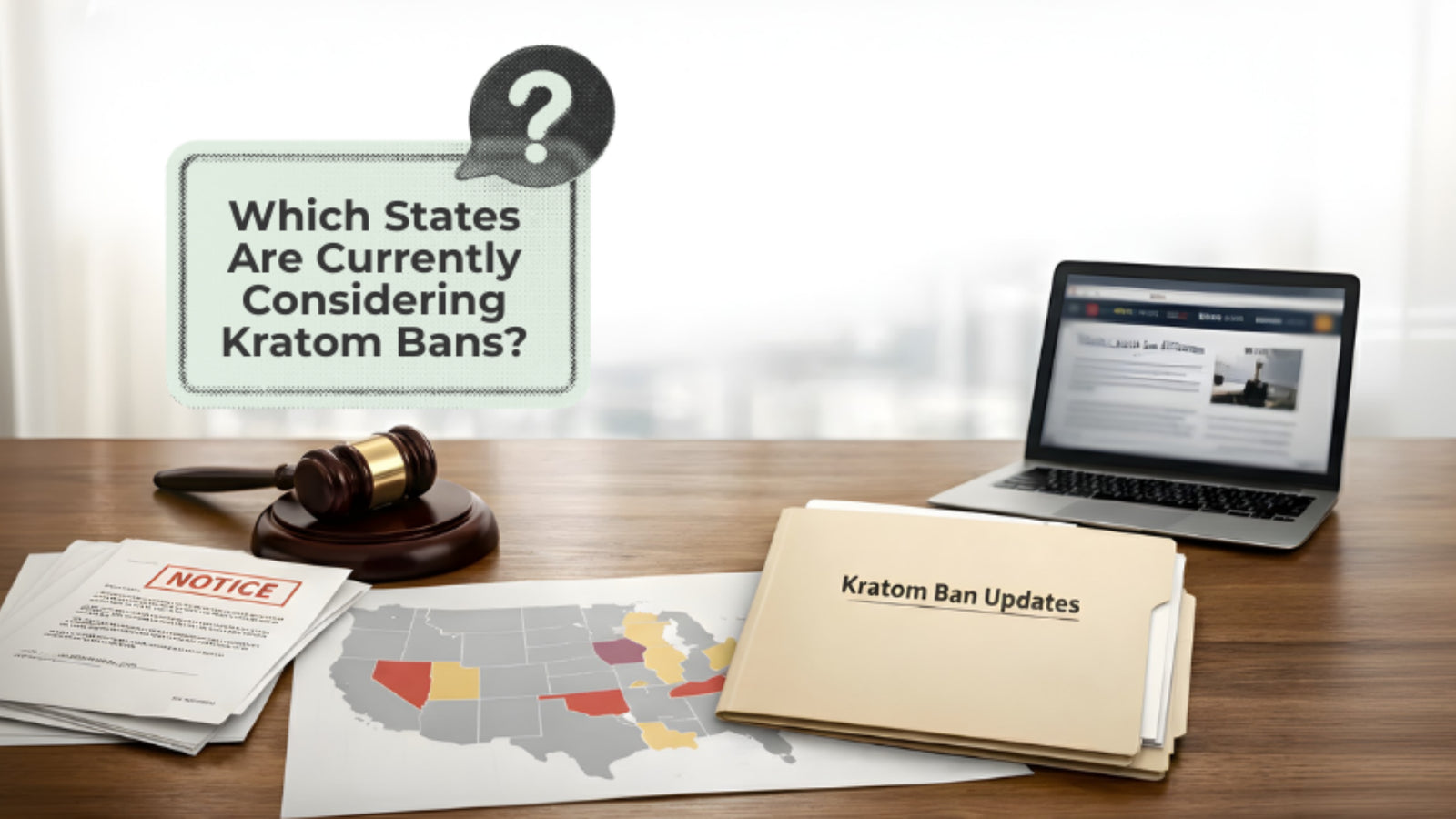
As of August 2026, ten states prohibit kratom outright.
Alabama, Arkansas, Indiana, Vermont, and Wisconsin are the long-standing ones. Kratom has been scheduled in these states for years.
Louisiana also sits in this group.
Connecticut is newer. It scheduled kratom and its derivatives through a regulatory process in February 2026, and businesses were given until late March to clear their stock.
Kansas and Tennessee both took effect on July 1, 2026. Tennessee's law bans possession, sale, and distribution statewide.
North Dakota is the most recent, and it moved faster than any of them. An executive order prohibited the sale and use of all kratom products effective 5 p.m. on August 5, 2026, announced only two days earlier. A separate Board of Pharmacy emergency rule placed 7-OH in Schedule I for 180 days, and a special legislative session convenes September 2 to decide what becomes permanent.
Kentucky is next in line, with a ban scheduled to take effect January 1, 2027.
So in those states, it's not something people can legally buy or use right now.
One State Went the Other Direction
This part surprises people.
Rhode Island used to be on the banned list. In April 2026 it reversed course, becoming the first state to repeal a kratom ban. It now regulates leaf kratom while prohibiting concentrated 7-OH products instead.
That matters, because it shows these decisions aren't permanent. A ban today isn't necessarily a ban in three years.
States That Might Change
This is where things get less clear.
A lot of states aren't banning kratom outright, but they're also not leaving it alone.
Florida is a good example. It's legal in most places, but not everywhere, and there's ongoing discussion about tightening things.
Georgia has laws in place already, but there's still debate about whether more restrictions should be added.
Hawaii and Illinois are in a similar spot. Legal for now, but constantly being reviewed or adjusted.
It's not stable, and that's what people have to keep in mind.
States Regulating Instead of Banning
Some states are going a different direction. Instead of banning kratom, they're trying to control how it's sold. That usually means age restrictions, testing requirements, and labeling rules.
Texas is one of the bigger examples of this. It's legal, but there are bills being discussed to regulate quality and safety. Ohio and Michigan are also looking at ways to manage it instead of removing it completely.
A few states have gotten specific about chemistry rather than product names. Oklahoma caps 7-OH at 1% of total kratom alkaloids and requires the alkaloid content on the label. Colorado caps it at 2% and restricts sales to 21 and older. Ohio banned synthetic kratom compounds through pharmacy rulemaking while leaving natural leaf to a separate debate.
According to the National Conference of State Legislatures, at least 31 states plus Washington, D.C. now regulate kratom in some form. Twenty-two have age restrictions. Nineteen have labeling requirements.
This is where things seem to be heading more often lately.
What the KCPA Actually Is
You'll see this mentioned a lot. The Kratom Consumer Protection Act. It's basically a set of rules for how kratom should be handled. Testing, labeling, keeping harmful products out of the market, things like that. It doesn't ban kratom. It tries to clean up how it's sold.
That's why a lot of people support it instead of full bans.
The Thing That Changed in 2026
Bans used to arrive slowly. A bill gets filed, there are hearings, there's a vote, and there's an effective date months out. You could see it coming.
North Dakota did it in about 48 hours using an executive order and a pharmacy board emergency rule, after its legislature had declined to pass a ban three separate times. Connecticut used a regulatory process rather than a bill. Ohio restricted synthetic compounds the same way.
That's a real shift. If you only watch state legislatures, you can miss the thing that actually closes your state.
Why Everything Feels Unstable
The biggest issue is that nothing is consistent across states.
One place allows it, another doesn't, and another is still deciding. So people end up checking laws more often than they expect. Especially if they travel or order online.
That's just how it is right now.
What People Usually Do About It
Most people don't just sit back and wait. They follow updates. They read what's changing. Some get involved, writing to representatives or joining advocacy groups. The American Kratom Association is one of the main ones people follow. They're involved in most of the updates happening across states.
Final Thoughts
Kratom legality isn't locked in anywhere.
It's either restricted, allowed, or being debated depending on where you are.
And that's probably not changing anytime soon. The best thing people can do is stay aware of what's happening in their state, and check a current source rather than a list that might be a year old. Because that's really what determines everything else.
Wherever you are, you can see the current alkaloid numbers on every batch we sell on our lab results page.


