



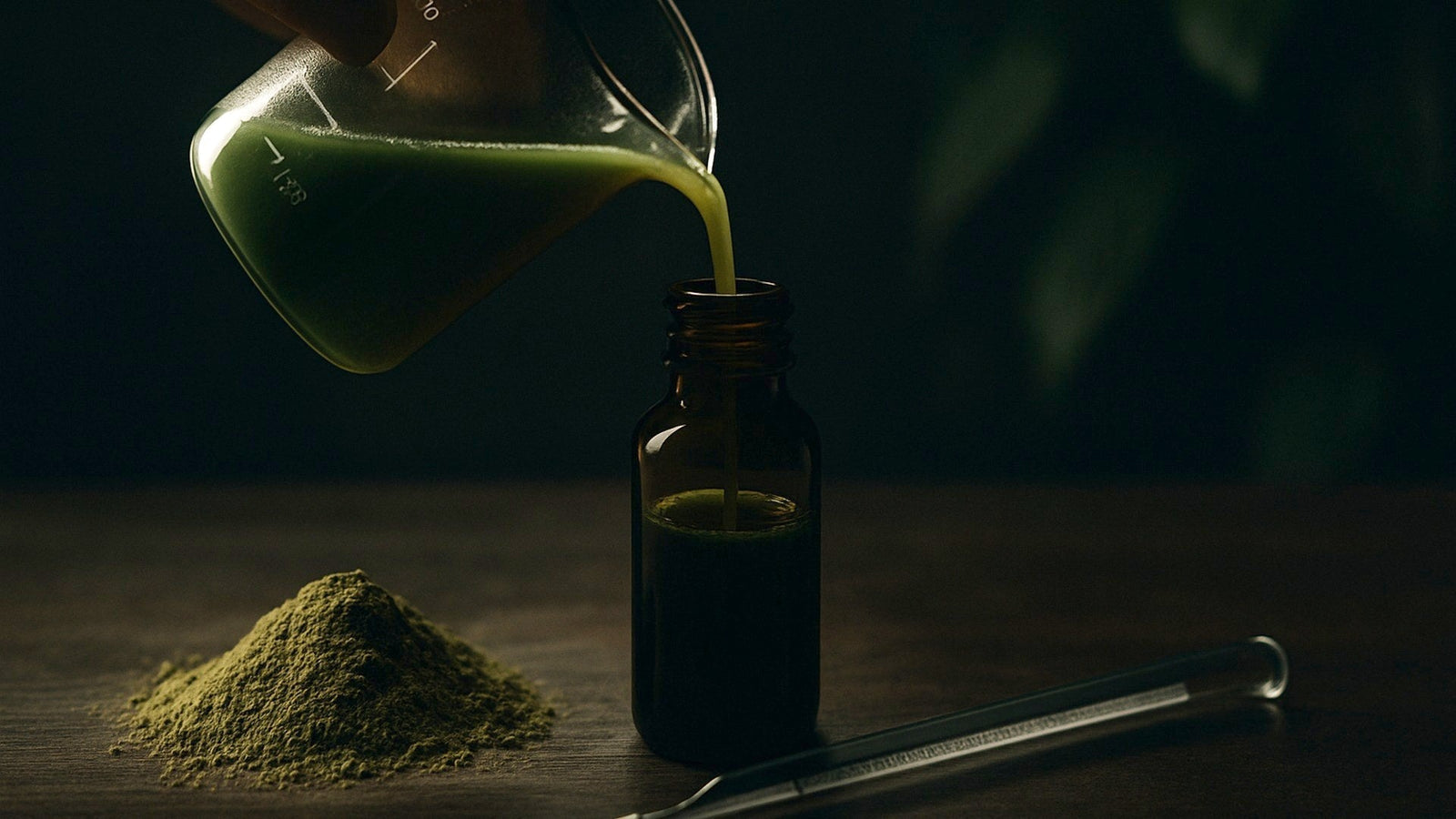
The "how do I make a stronger kratom" question shows up on hobby forums almost every week. Concentrating powder into an extract is one of the oldest tricks in the home-prep playbook, and the chemistry is not complicated. The execution is where most people get burned, sometimes literally.
This guide walks through the three home-extraction methods that actually work, the realistic yields each one produces, and the safety and consistency tradeoffs that commercial extracts solve for you. Mitragyna speciosa contains a family of alkaloids in roughly 0.5 to 1.5 percent of a leaf's dry weight by mass, per public research summarized by the National Institute on Drug Abuse. That ratio is the ceiling on what any home extract can ever concentrate from a given batch of powder.
The aim here is honest information, not a sales pitch for either DIY or commercial. We will show you exactly how the kitchen methods work, where they fail, and when stepping up to a lab-tested product is the calmer choice.
Table of Contents
- What Kratom Extract Actually Is
- TL;DR: The Honest Summary
- The Three Home Methods at a Glance
- Water-Based Extraction Step by Step
- The Acid-Base Variation
- Alcohol Tincture Method
- Realistic Yield and Concentration Math
- Safety, Storage, and Shelf Life
- When You Should Skip the DIY Route
- Frequently Asked Questions
- Final Thoughts
TL;DR: The Honest Summary
- An extract is concentrated kratom. You start with leaf or powder, dissolve the alkaloids into a liquid, then evaporate the liquid until a resin or tincture is left.
- Water extraction is the safest beginner method. It uses kratom powder, water, a stovetop, and patience. Yields a sticky resin in roughly 6 to 10 hours.
- Acid-base extraction adds lemon juice or citric acid to the water step. It pulls slightly more alkaloid out of the leaf but adds a sour taste.
- Alcohol tincture extractions are fastest for a liquid product. They use food-grade ethanol and several weeks of cold maceration.
- Realistic yield is 5 to 12 grams of extract from 100 grams of powder, with potency that varies by 30 percent or more between home batches.
- DIY potency can not be measured at home. Two spoons from the same jar can hit very differently if the resin is not fully blended.
- Commercial extracts like the GRH King K line are third-party tested for alkaloid content, which removes the dosing guesswork that home batches always carry.
- Treat any extract, store-bought or homemade, with more respect than plain powder. The same physical volume holds several times more active material.

What Kratom Extract Actually Is
An extract is concentrated kratom. The plant's active alkaloids, mitragynine being the most abundant and 7-hydroxymitragynine the most potent, sit inside the cell walls of the dried leaf. An extract pulls those alkaloids out into a liquid solvent, then removes most of the solvent so what remains is mostly alkaloid plus a small fraction of plant matter.
The label numbers you see on commercial bottles, like "10x" or "50x," refer roughly to how much starting powder was used per unit of finished extract by weight. A 50x label means 50 grams of leaf was processed down to one gram of extract. Those numbers do not guarantee a specific milligram of mitragynine per gram. They are a manufacturing shorthand, not a potency rating, which is why third-party assays matter more than the label multiplier.
The DEA's public fact sheet on kratom describes the plant and its primary alkaloids without endorsing it, and the FDA's dietary supplement guidance notes that products marketed for ingestion fall under supplement rules even when they are not formally approved. None of that changes the chemistry of what a home extract is, but it does shape why a lab-tested commercial product carries a paper trail your kitchen batch never will.
The Three Home Methods at a Glance
Three methods cover almost every kratom extract recipe you will find online. The names change. The chemistry does not.
| Method | Solvent | Active time | Total time | Equipment | Difficulty | Main risk |
|---|---|---|---|---|---|---|
| Water extraction | Filtered water | 1 hour | 6 to 10 hours | Saucepan, cheesecloth, jars | Beginner | Burning the resin |
| Acid-base water | Water plus lemon juice or citric acid | 1 hour | 8 to 12 hours | Same as water plus pH strips | Beginner-plus | Sour aftertaste, scorching |
| Alcohol tincture | Food-grade ethanol, 80 to 95 percent | 30 minutes | 2 to 6 weeks | Mason jar, cheesecloth, amber dropper bottles | Intermediate | Flammable solvent |
Water-based methods produce a thick paste or dried flake. Alcohol tinctures produce a liquid you measure in drops. Both pathways exist for the same reason: get the alkaloids out of the leaf matrix and into a form you can dose more precisely than scoops of powder. Whether either one actually achieves that goal depends on how carefully you blend the finished product, which most home recipes underestimate.


Water-Based Extraction Step by Step
This is the classic kratom extract recipe and the safest one to attempt at home. Water is non-flammable, food-grade, and gentle on the alkaloids if you keep the heat low. The output is a dark, sticky resin that you can scrape out of a glass dish and store in small portions.
Read the whole procedure before you start. The steps are simple, but the timing window is tight in places, and walking away from a simmering pan is how kitchens catch fire. Pair this with our kratom dosage guide so you understand the milligram math before you start concentrating anything.
- Weigh 100 grams of kratom powder. Pick a strain you already know your tolerance for. White Maeng Da and Green Maeng Da are common starting points because their alkaloid profiles are well characterized.
- Combine the powder with 1.5 liters of filtered water in a stainless steel saucepan. Stir until you see a uniform slurry with no dry pockets.
- Bring the slurry to a gentle simmer, never a rolling boil. Target around 175 degrees Fahrenheit. High heat degrades the alkaloids and turns the batch bitter.
- Hold the simmer for 45 to 60 minutes. Stir every 5 minutes so the powder does not crust at the bottom.
- Remove from heat and let the slurry cool to room temperature. Cover the pan to keep the liquid clean.
- Strain the slurry through a fine mesh strainer first, then through doubled cheesecloth. Squeeze the spent powder gently. Save the liquid. Discard the plant pulp.
- Return the strained liquid to the cleaned pan. Simmer uncovered on the lowest heat your stove allows. The goal is to evaporate roughly two-thirds of the water without scorching what remains.
- When the volume drops to about 500 milliliters, transfer the liquid to a shallow Pyrex baking dish. Place the dish in an oven set to 170 degrees Fahrenheit with the door cracked open one inch for airflow.
- Check the dish every hour. The liquid will reduce to a thick syrup, then a tacky resin, then a hard flake. Stop at the resin stage for easier dosing.
- Scrape the resin into a clean glass jar with a silicone spatula. Weigh the final yield. Label the jar with strain, starting powder weight, and date.
Total active time runs about 90 minutes spread across the day, and total elapsed time is closer to 6 to 10 hours depending on stovetop heat and oven efficiency. The biggest beginner mistakes are using too much heat in step 3 and walking away during step 8. Babysit the dish.

The Acid-Base Variation
The acid-base method is a small tweak on water extraction. You add a food-grade acid, usually lemon juice or citric acid, at the start of the simmer. The acid lowers the pH of the water, which improves the solubility of mitragynine and related alkaloids. Then in some recipes you raise the pH back up with a small amount of baking soda before the final evaporation, hence the "acid-base" name.
For a 100-gram batch, swap step 2 above to use 1.4 liters of filtered water plus 100 milliliters of fresh lemon juice or 5 grams of citric acid powder. Target a starting pH of 3 to 4. Hold the simmer for the same 45 to 60 minutes. Strain and reduce the same way.
The gain is modest. Studies of kratom alkaloid extraction chemistry in PMC NCBI describe acidified-water solvents pulling 10 to 20 percent more alkaloid mass than plain water, though field results in a kitchen are noisier than that. The cost is a sour aftertaste in the finished resin and the extra step of pH monitoring. If you can not stand citrus flavor in your kratom, skip this one.
Alcohol Tincture Method
Alcohol tinctures swap the heat for time. Ethanol pulls alkaloids out of the leaf at room temperature, so there is no risk of scorching the batch, but you wait weeks instead of hours. The finished product is a liquid you store in amber dropper bottles and dose by the drop or milliliter rather than the gram.
For a basic kratom tincture, combine 50 grams of kratom powder with 250 milliliters of food-grade ethanol at 80 to 95 percent purity in a quart-sized Mason jar. Some recipes recommend Everclear (190 proof) for maximum solvent strength. Seal the jar tight, shake it daily, and let it sit in a cool dark cupboard for 2 to 4 weeks. Strain through cheesecloth, then through a coffee filter for clarity. Pour the strained liquid into 30 milliliter amber dropper bottles for storage.
A few practical notes. Ethanol of that proof is flammable. Keep it away from any heat source. Some makers gently warm the jar in a water bath to speed the maceration, which is a fire hazard at full proof and should be skipped. You can also do a "two-stage" tincture where you decant the first round of ethanol after 2 weeks, add fresh ethanol to the same powder, and run a second maceration to capture the remaining alkaloids. That pushes total time to 6 weeks but improves yield by another 15 to 25 percent. Brushing up on which alkaloids you are actually trying to pull will help, and our piece on what kratom alkaloids are and what they do covers that ground.
Realistic Yield and Concentration Math
Yield is the single most over-promised metric in DIY kratom guides. The forums will quote you "10x" and "50x" numbers as if they fall out of the stove like clockwork. They do not.
From a 100-gram batch of standard-quality kratom powder, you can expect a finished resin or dried extract in the range of 5 to 12 grams. That maps roughly to a 10x to 20x concentration by weight, which is on the lower end of what commercial bottles claim. The actual mitragynine content of the finished resin varies even more, because home blending is rarely uniform. One spoon from the same jar might contain 1.5 percent mitragynine by weight, the next 2.3 percent, depending on where in the resin you scrape from.
The math gets more honest when you treat the leaf's natural alkaloid range as the ceiling. Mitragynine alone sits in roughly 1 to 2 percent of a Maeng Da or Bali leaf by dry weight per NIDA's kratom research topic page. If you start with 100 grams of leaf containing 1.5 percent mitragynine, that is 1.5 grams of mitragynine total. The most a perfect extract could produce is 1.5 grams of pure mitragynine plus a little 7-hydroxymitragynine and other minor alkaloids. Home methods recover maybe 60 to 75 percent of that theoretical max, so a realistic home yield is closer to 1 gram of total alkaloid in your finished resin, spread across whatever 5 to 12 grams the resin weighs.
Translation: a 5 gram resin from a 100 gram batch contains about 200 milligrams of mitragynine per gram of resin. A 10 gram resin contains about 100 milligrams per gram. Those are useful numbers if you are dosing carefully, but only if you can trust your blending was uniform. At home, you usually can not. Cross-check your starting material assumptions against our kratom strain chart so you start from a strain whose alkaloid profile is at least roughly known.


Safety, Storage, and Shelf Life
Kratom extracts deserve more caution than plain powder. The dose-response curve is steeper, the visual cue of "a teaspoon of powder" no longer maps to a familiar effect range, and the consistency between batches and within batches is unreliable. The American Kratom Association's consumer resources are worth a read on responsible use in general, and that guidance applies double once you have concentrated the material.
Storage matters. Water-extracted resin keeps for 6 to 12 months in a tightly sealed glass jar at room temperature, longer in the fridge. Alcohol tinctures keep for 2 to 3 years if the ethanol is at least 70 percent. Both should be stored in dark glass and away from heat or sunlight. Label every container with the strain, starting powder weight, extraction date, and the method used.
Heat is the silent killer in storage. Mitragynine oxidizes with prolonged exposure to oxygen, light, and warm temperatures, and a resin sitting on a sunlit kitchen shelf will lose potency over a few months while looking exactly the same. If you are not going to use the batch quickly, portion it into smaller jars, vacuum seal what you do not need this month, and keep the spare jars in the back of a cool cupboard or the fridge.
Never combine homemade extract with other depressants or stimulants. The dosing margin is too narrow and the per-gram potency too uncertain. If you are new to extracts in any form, pre-dosed and lab-tested options like our King K Silver liquid kratom extract takes the dosing math off your plate while you learn what a concentrated dose feels like.
When You Should Skip the DIY Route
Three groups of people should not make kratom extract at home. Period.
First, anyone new to kratom. The dosing guesswork compounds the unknowns. Start with measured powder or pre-dosed capsules of a single strain until you know your baseline. White or Green Maeng Da powder is a sensible entry. Our White Maeng Da kratom powder is a typical starting point. Build the baseline first, then think about concentrates.
Second, anyone without a kitchen scale that measures to 0.01 grams. Extracts are dosed in milligrams, and a normal cooking scale that rounds to the nearest gram is unsafe for measuring out a portion of resin. If your scale rounds, you will guess. Guessing with concentrated kratom is exactly the situation extracts amplify.
Third, anyone who would not feel comfortable explaining the process to a friend, much less a poison control operator. DIY extracts are legal in most US states because the underlying plant is legal there, but the production process can look alarming from the outside, especially if anything goes wrong. A commercial extract removes that liability conversation entirely.
For everyone in those three buckets, a lab-tested commercial product is the calmer answer. The GRH King K line, available in our extracts collection, ships with third-party alkaloid testing so the milligram-per-tablet figure on the label is the actual milligram per tablet inside. That is the single thing your kitchen batch can not reproduce no matter how careful you are.


Frequently Asked Questions
Is making kratom extract legal in the United States?
In states where kratom itself is legal, producing an extract at home for personal use is generally not regulated, the same way brewing tea or making a herbal tincture is not regulated. Selling that extract is a different question and runs into supplement-manufacturing rules under the FDA. The legal picture differs state by state, with kratom currently banned outright in a small number of states, so check your local statute before you start. The DEA fact sheet linked above is a useful federal-level reference.
What is the difference between "10x" and "50x" kratom extracts?
The number reflects how many grams of starting powder went into producing one gram of finished extract. A 50x label means 50 grams of leaf was processed to yield one gram. It does not directly correspond to potency in milligrams of mitragynine. Two different 50x extracts can have noticeably different effects depending on the starting strain, the extraction method, and how well the finished product was blended. Treat the multiplier as a manufacturing note, not a dose chart.
Can I freeze kratom extract to make it last longer?
Yes for alcohol tinctures, which can sit in a freezer indefinitely without harming the alkaloids. For water-based resin, freezing is fine but optional. The bigger storage win is air-tight glass, dark conditions, and cool temperature. A vacuum-sealed jar in a dark cupboard reaches the same shelf life as a freezer for resin, with less mess when you thaw a portion.
What strain makes the best kratom extract?
Maeng Da varieties are the most common starting material because their alkaloid profile is well characterized and the leaves tend to carry mitragynine in the upper range of the natural spectrum. White Maeng Da and Green Maeng Da both work. Bali, Borneo, and Indo strains can also be extracted but tend to produce a milder finished resin. Red strains extract fine but the finished product often reads less stimulating than the source powder did.
How much homemade kratom extract should I dose?
That number depends entirely on how potent your batch came out, which you can not know without lab testing. A common starting point cited on hobby forums is 0.1 to 0.2 grams of finished water resin, which roughly approximates a 2 to 4 gram dose of unextracted powder. Start at the low end of that range, wait two hours, and only redose if you feel nothing. Never start with an extract dose you have not first tested with the same batch.
Why is my homemade extract bitter?
Two usual causes. Either the simmer ran too hot and partially burned the alkaloids and chlorophyll, or the reduction step ran too long and concentrated the bitter plant compounds along with the alkaloids. Cooler heat in step 3 and a slightly earlier stop in step 9 produce a less bitter resin. The flavor is never going to be pleasant, but it should not taste burned.
Can I make a kratom extract in a slow cooker?
You can do the simmer phase in a slow cooker set to low, which removes most of the burn risk from a stovetop. The reduction phase still needs the oven dish step because slow cookers do not evaporate water quickly enough on their own. Skip any "instant pot kratom extract" tutorial that uses high pressure or high heat. Pressure cooking degrades the alkaloids.
Final Thoughts
Making kratom extract at home is one of those projects that reads simpler than it lives. The chemistry is straightforward. The execution is finicky. The yield math is honest only if you keep the multiplier numbers in perspective and treat blending uniformity as the main quality variable.
If you are going to try it, start with the water method, work with a strain you already know, weigh everything, and respect the finished product. Half a gram of resin is not the same as half a gram of powder no matter how much it looks the same. Underdose your first attempt rather than guess high.

And if the dosing uncertainty bothers you, that is a sign you might be a better fit for a tested commercial extract. The GRH King K line was built specifically for the reader who wants the convenience of an extract without the home-lab guesswork. Our King K Platinum extract shot is a representative pick. Either way, treat extracts as a step up in concentration that calls for a step up in attention. The plant rewards that respect.


