



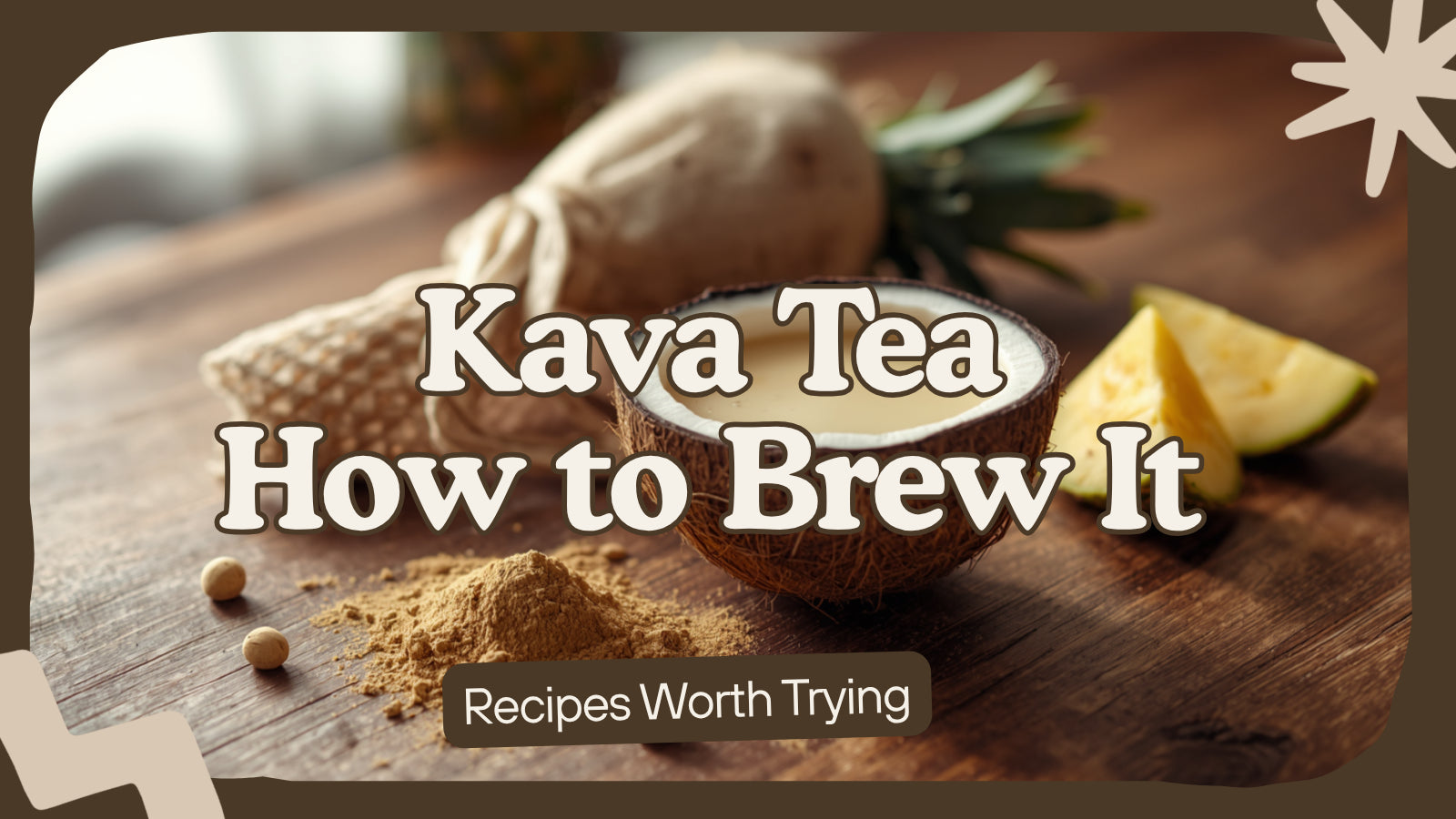
If you have ever stood in a tea aisle and seen a yellow box that promises calm without sleep, you have probably met kava tea. It looks like any other herbal tea on the shelf. It is not. The plant inside that bag has been brewed in the South Pacific for roughly three thousand years, and the calm it produces is closer to a glass of wine than a cup of chamomile. Once you understand what you are working with, the recipe is simple, the effect is reliable, and the rules are non-negotiable.
This guide is the one we wish someone had handed us the first time we tried it: what kava tea actually is, why people drink it, the two recipes worth keeping, the etiquette that makes it work, and the safety guardrails the FDA and EFSA have asked drinkers to respect. Kava tea is also a close cousin of kratom in the calming-botanical world, and we get the comparison question constantly, so we will answer that too.

Table of Contents
- What Kava Tea Actually Is
- The Plant: Piper Methysticum and Its Roots
- How Kava Tea Makes You Feel
- The Two Kava Tea Recipes Worth Knowing
- How to Drink Kava Tea Right
- What Does Kava Tea Taste Like?
- The Benefits at a Glance
- Risks, Side Effects, and the Liver Question
- Kava Tea vs. Kratom Tea, Chamomile, and CBD
- Where to Buy Kava (and Where We Sit on This Plant)
- Frequently Asked Questions
- Final Thoughts
TL;DR
- Kava tea is a brewed drink made from the dried root of Piper methysticum, a Pacific shrub. The active compounds, called kavalactones, produce calm, easy social warmth, and a small numb tingle on the lips.
- The traditional Pacific recipe steeps ground root in cool water and is hand-kneaded for about ten minutes. The modern Western version uses tea bags or a small infusion of root powder.
- Effects start in 15 to 30 minutes and last around 2 to 3 hours. Most people feel relaxed without sedation.
- The big safety rules: do not mix with alcohol, do not combine with acetaminophen or other liver-stressing meds, do not drink it daily for months on end, and check with a doctor if you have any liver condition.
- Kava tea pairs well with relaxing kratom strains in our Relax Blend for people who want the wind-down effect without the bitterness of straight kratom.

What Kava Tea Actually Is
Kava tea is a water-based infusion of the underground parts of Piper methysticum, a slow-growing shrub native to the Pacific Islands. The plant is sometimes called kava kava in older Western herbalism, though the doubled name is a holdover from the Tongan and Fijian languages. The drink itself is just water plus ground root, so kava tea sits in the same broad category as ceremonial drinks like maté or traditional cacao. It is not a culinary tea in the Camellia sinensis sense.
Three things separate kava tea from any other calming herbal drink you can buy at a grocery store. First, the active compounds (kavalactones) are fat- and lipid-soluble, which is why the traditional recipe requires kneading the root in water rather than just steeping it in heat. Second, the drink is part of an actual social ritual in Fiji, Tonga, Vanuatu, and Hawai'i, with its own etiquette. And third, the calming effect shows up in 15 to 30 minutes and is noticeable enough that the Pacific Islands routinely use it the way the West uses a glass of wine: to soften the edges of a long day or smooth the start of a meeting.
If you want a deeper plant-and-history overview before you start brewing, our companion read on what kava is covers the cultural ground in detail.

The Plant: Piper Methysticum and Its Roots
The kava plant is a tall, leafy shrub with heart-shaped leaves and woody stems. Above ground, it looks unremarkable. The active part is below: a tangle of fibrous lateral roots and a thicker rootstock that has to grow for at least three to five years before it produces enough kavalactones to be worth harvesting. Older roots, sometimes nine or ten years in the ground, are prized in the Pacific the way old vines are prized in wine country.
There are two relevant categories of kava. Noble kava is the cultivated, food-grade kind that the Pacific has been drinking for centuries. Tudei kava ("two-day kava") is a stronger, harsher variety that produces a longer effect but a heavier hangover and is no longer recommended for export. Reputable Western suppliers will tell you which they sell. If a label is silent on the cultivar, that is a yellow flag.
The chemistry that matters: kavalactones, of which there are six major ones, plus trace amounts of flavokavain compounds. The kavalactone profile drives the effect. In the Pacific, blends are often described by their "chemotype," a six-digit number that lists the kavalactones in order of prominence. You do not need to memorize chemotypes to drink kava tea well. You only need to know that fresh-tasting, food-grade noble kava is the baseline, and anything else needs justification.
How Kava Tea Makes You Feel
The honest description is that kava tea feels like the first half of a beer, minus the alcohol. There is a quiet, sociable warmth. Conversation gets a little easier. Shoulders drop. The mind stays sharp.
The first physical signal is almost always a faint numbness or tingle on the lips and inside of the mouth, usually within five minutes of the first sip. That is the kavalactones binding briefly to the local nerves, and it is harmless. After 15 to 30 minutes, the broader effect arrives: a relaxed, mildly euphoric calm that most drinkers describe as "the day getting quieter." It is not sedation. You can read, talk, work, or drive (though driving is a bad idea, which we will address in the safety section). The effect peaks in the first hour and tapers over two to three hours.
Two things kava does not do. It does not produce a high in the sense of an altered or distorted state. And it does not cause a crash on the way out. The fade is gentle, and most people sleep normally afterwards if they have been drinking moderately.

The Two Kava Tea Recipes Worth Knowing
We will keep this practical. There are dozens of niche kava preparations in the literature. For a Western kitchen, you really only need two: the traditional Pacific Islander method (best effect) and the tea-bag method (easiest start).
Recipe A: Traditional Hand-Kneaded Kava Tea
This is the recipe used across Fiji, Tonga, and Vanuatu, simplified for a kitchen counter. You will need ground noble kava root, a strainer bag (a paint strainer works, a fine cheesecloth works, or a dedicated kava bag is best), a large bowl, and cool or room-temperature water. Hot water is a common beginner mistake. Heat above 140°F (60°C) breaks down some of the kavalactones.
What you need:
- 2 to 4 tablespoons of ground noble kava root powder (start at 2 if you are new)
- 2 cups (about 480 ml) of cool or room-temperature filtered water
- A fine-mesh strainer bag or a folded square of cheesecloth
- A large mixing bowl
- A small amount of a fat (optional but recommended): a teaspoon of coconut milk, soy lecithin, or whole milk
Method:
- Place the kava powder in the strainer bag and tie or fold it closed.
- Submerge the bag in the bowl of water along with the optional fat. The fat helps emulsify the kavalactones.
- Knead the bag firmly for 10 minutes. Push, twist, squeeze. The water will turn the color of weak coffee with a slight green tint.
- Wring the bag out one final time and discard the spent root.
- Pour into a small cup or coconut shell and drink in one or two long swallows. Kava is not sipped in the Pacific. It is taken in a single committed go, then chased with something sweet.
The reason kneading matters: kavalactones are not water-soluble in the way most herbal compounds are. The traditional method physically extracts them out of the root fiber and emulsifies them into the water with the help of mechanical pressure and a small amount of fat. A 30-second steep in a teapot will not give you the same result. You can find a slightly different angle on this on our kratom-side recipe page, which uses a similar low-heat principle.
Recipe B: The Tea Bag Method (Easy Start)
If you bought a yellow box of kava stress-relief tea bags from a grocery store, this is the recipe on the side panel done correctly. Pre-bagged kava is convenient but produces a milder effect because the root is finely milled and the dose per bag is conservative.
What you need:
- 2 commercial kava tea bags (Yogi, Tea Pigs, or any noble-kava-only brand)
- 8 to 12 ounces of water heated to about 175°F (80°C), not boiling
- A teaspoon of coconut milk, almond milk, or whole milk
Method:
- Heat water just below a boil. Take it off the heat for 30 seconds before pouring.
- Add both tea bags to a mug and pour the water over them.
- Steep for 10 to 15 minutes (yes, longer than a normal tea). Press the bags against the mug periodically to extract more of the root.
- Stir in the milk or coconut milk. The fat is not optional here either.
- Drink while warm.
Two bags is the minimum dose to feel anything from a commercial blend. Some brands also include cinnamon, cardamom, or chamomile, which round out the flavor and add their own mild calming effects.

How to Drink Kava Tea Right
Kava is one of the few botanicals that has its own etiquette in the place it comes from, and following the basic rules gives you a noticeably better experience.
Drink it in one go, not in sips. Pacific tradition calls for committing to the cup, and this is not just custom. Kava tastes better at the moment you commit to it than 20 minutes later when it has gotten thicker and grittier in the cup. Drink, then chase with something sweet: fruit, a cookie, a piece of chocolate, or pineapple juice are all classic chasers.
Drink on a mostly empty stomach. A heavy meal will dampen the effect significantly because the kavalactones get absorbed alongside food fats and slow down. Most regular drinkers will eat a light snack 30 to 60 minutes before, then drink the kava with empty space in the gut.
Stack two or three small servings, not one big one. The classic Pacific way is two or three "shells" spaced 20 to 30 minutes apart. This builds the effect gradually and lets you stop when you have what you want. A single huge dose tends to push past calm into mild nausea, which nobody enjoys.
Sit with people. Kava is genuinely social. The effect is more pleasant in conversation than alone, and the etiquette of kava bars across the Pacific (and increasingly in Hawai'i, Florida, and the West Coast) reflects that.
Do not drive afterwards. Even though kava does not cause a high in the recreational sense, it does affect motor coordination and reaction time, and several jurisdictions including Australia have driving-related regulations around it. Treat it like a glass of wine and arrange your evening accordingly.
What Does Kava Tea Taste Like?
The honest answer is "earthy, peppery, slightly bitter, and a little numb." If chamomile is gentle and chai is warming, kava is closer to a thin black coffee with a hint of fresh-cut wood. The first time, most drinkers find the taste challenging. By the third or fourth time, the brain has linked the taste to the calming effect, and the flavor becomes something you actually look forward to.
Two things help significantly. A small fat (coconut milk, almond milk, whole milk) rounds the flavor and emulsifies the kavalactones. A sweet chaser immediately after the cup resets the palate. Many regular drinkers also mix kava with pineapple juice, which masks the earth notes well. Avoid mixing it with citrus that is too acidic; it tends to curdle the milk component.

The Benefits at a Glance
Kava tea has a real research base, mostly around anxiety. The clearest finding is from a series of clinical reviews published since the early 2000s showing that kava extract is meaningfully better than placebo for generalized anxiety. The Memorial Sloan Kettering integrative medicine database lists anxiety as the most-supported indication, alongside short-term help with stress and tension.
What follows is a quick reality check on the most common claims, with the supporting context our team has actually seen hold up:
| Claim | Evidence Quality | Notes |
|---|---|---|
| Eases short-term anxiety | Strong | Multiple controlled trials |
| Helps with situational stress | Moderate | Common drinker report, smaller trials |
| Improves sleep onset | Moderate | Especially when used in the evening, not for insomnia |
| Lowers blood pressure | Weak | Anecdotal, not clinically established |
| Improves focus | Mixed | Calming effect can clear mental noise but is not a stimulant |
| Acts as a long-term anxiety treatment | Not recommended | Liver concerns and tolerance build-up over months of daily use |
If your goal is wind-down at the end of a day, kava tea is one of the most reliable plant options that has actually been studied. If your goal is all-day calm, this is not the tool, and we would point you toward our calm-focused kratom strains instead.
For more on what to expect from the broader kava category, our kava drink guide walks through the same effect curve in a slightly different format.
Risks, Side Effects, and the Liver Question
This is the section we get the most questions about, so we will be specific.
The big concern in kava's history is liver toxicity. Between 1999 and 2002, several European cases of severe liver injury linked to kava products led Germany, France, the UK, and Switzerland to temporarily ban or restrict kava. The cases were rare, but they were serious enough that the EU paid attention. Closer review since then has narrowed the picture significantly:
- Most of the implicated products used non-noble cultivars (tudei kava) or used acetone or ethanol extraction methods, which concentrate the kavalactones differently than water extraction.
- Many of the patients were also taking acetaminophen (paracetamol) or were heavy alcohol drinkers, both of which independently strain the liver.
- Long-term, daily, high-dose use was a common factor.
The current consensus, including a 2018 World Health Organization assessment, is that traditional water-prepared noble kava appears to carry low liver risk for healthy adults at moderate doses. The FDA still issues a consumer advisory and recommends caution. The American Botanical Council recommends short-term, intermittent use only.
The practical safety rules our team gives every new drinker:
- Do not combine kava with alcohol. Both metabolize through the liver and the combination is unambiguously hard on it.
- Do not combine with acetaminophen. Switch to ibuprofen or naproxen for headaches on a kava day.
- Do not drink kava daily for months. Treat it like wine: a few times a week is fine; every night is not.
- Skip kava entirely if you have any pre-existing liver condition or are taking medications metabolized in the liver. Talk to your doctor.
- Avoid kava if pregnant or breastfeeding. There is not enough safety data and the precautionary call is to skip it.
- Watch for yellowing skin or eyes. That is a classic sign of liver stress and is a stop-everything signal.
Mild, common side effects from a normal cup: a numb mouth (expected), mild stomach upset (especially if you drank on a full stomach), and an occasional headache from over-doing it. None of these are concerning at moderate doses.

Kava Tea vs. Kratom Tea, Chamomile, and CBD
We get this comparison question every week, so the honest answer:
Kava tea vs. kratom tea. Kratom is a different plant (Mitragyna speciosa) with a different alkaloid profile. Both are calming at moderate doses, but kratom has a stimulating window at low doses that kava does not, and kratom has a stronger pain-management effect. Kava is the better choice if your goal is purely social calm or evening wind-down. Kratom is the better choice if you also want energy or if you are managing physical discomfort. Many of our customers run both: kratom in the day, kava in the evening, with our Relax Blend kratom bridging the two when they want a softer kratom experience that pairs well with a kava session.
Kava tea vs. chamomile tea. Chamomile is gentler. The effect is real but mild and primarily sleep-supporting. Kava is noticeably stronger and produces social ease, which chamomile does not really do. Chamomile is the call if you want a quiet pre-bed cup. Kava is the call if you want a social pre-dinner drink.
Kava tea vs. CBD. CBD calm is more diffuse and physical. Kava calm is more direct and social. CBD requires regular dosing for many people to feel the full effect, while kava is felt within 30 minutes of the first cup. CBD is generally considered safer for daily use; kava should be intermittent.
| Option | Effect Strength | Social Effect | Bedtime Friendly | Daily Use OK |
|---|---|---|---|---|
| Kava tea | Moderate-strong | Yes | Yes | No |
| Kratom tea (red strains) | Strong | Some | Yes | Caution |
| Chamomile tea | Mild | No | Yes | Yes |
| CBD oil/drink | Mild-moderate | Some | Yes | Yes |

Where to Buy Kava (and Where We Sit on This Plant)
A quick word on what to look for when you shop for kava root. The category has cleaned up considerably in the last decade, but cheap kava is still risky.
The non-negotiables: noble cultivar, ideally with the chemotype listed on the label. Origin from Vanuatu, Fiji, Tonga, Hawai'i, or Samoa. A clear "lateral root" or "rootstock" callout (the active parts, as opposed to leaves and stems, which can be problematic). Lab-tested for kavalactone content (4 to 12 percent of dry weight is the normal range for noble kava). Recently milled, since ground root loses potency over six months.
We carry kratom and our own branded blends rather than kava root specifically, because the kava market is well-served by specialist suppliers who do nothing else. For customers who want the calming-evening-drink effect without sourcing kava root, our Relax Blend kratom powder is the closest thing in our line: red-strain kratom mixed for a similar wind-down arc, brewable as a hot tea, and produced under American Kratom Association GMP protocols. People often pair it with a kava bag a couple of times a month and use the Relax Blend on the in-between nights.
For people committed to the kava route, our recommendation is to find a regional kava bar or order noble root from a specialist like Kalm with Kava or Bula Kava House and brew at home using Recipe A above.

Frequently Asked Questions
Is kava tea legal in the United States? Yes, kava is legal at the federal level and in all 50 states. The FDA has issued a consumer advisory about liver risk but has not banned it. Always check your state and city for any local rules.
How long does the effect last? 2 to 3 hours from a single serving, peaking in the first hour. Heavy regular drinkers feel it for less time as tolerance builds.
Can I drink kava every day? We do not recommend it. The current best practice is 2 to 3 times a week at most, with frequent breaks. Daily, long-term use is the pattern most associated with the historical liver concerns.
Will kava show up on a drug test? Standard employment drug panels do not test for kavalactones. Kava is legal and the alkaloids are not on the standard 5- or 10-panel tests.
Can I mix kava tea with kratom? Some people do, especially red-strain kratom. The effects are complementary at moderate doses. We would recommend trying each separately first, then combining at half-doses of each.
Can I drink kava tea while pregnant? No. The safety data is insufficient and the precautionary recommendation across the medical literature is to avoid it.
How much kava root powder per cup? Recipe A: 2 to 4 tablespoons in 2 cups of water, with 2 tablespoons being the new-drinker dose. Recipe B (tea bags): 2 commercial bags per 8 to 12 ounces.
What is the difference between kava and kava kava? The same plant. "Kava kava" is a holdover phrasing from older Western herbalism that doubled the name. They are the same drink and the same root.
Does kava tea help with sleep? Yes for sleep onset (falling asleep), less so for sleep maintenance (staying asleep). Drink it 60 to 90 minutes before bed for the best effect.
Will kava tea help with social anxiety? This is one of the strongest use cases. The clinical research on generalized anxiety extends reasonably well to social-anxiety contexts in moderate situations. It is not a substitute for therapy or prescription support.

Final Thoughts
Kava tea is one of the rare botanicals where the drink has been more or less unchanged for thousands of years and still stands up to modern scrutiny. The recipe is simple, the effect is real, the safety profile is well-mapped if you respect a short list of rules, and the experience is one of the more pleasant calming rituals on the planet. The two recipes in this guide are the only ones you need: hand-kneaded for the full Pacific effect, and the tea bag method for an easy weekday version.
If you have read this far and you are also curious about how kratom fits into the same wind-down picture, our Relax Blend is the closest expression of that idea in our own line. Run a kava night once a week, run a Relax Blend night the other times, and skip the alcohol on both. That is the rotation many of our regular customers settle into, and it is a quietly excellent way to handle the end of a day.
Brew with respect, drink in good company, and chase with pineapple. That is how the Pacific has done it for three thousand years, and we have not improved on the formula.


