



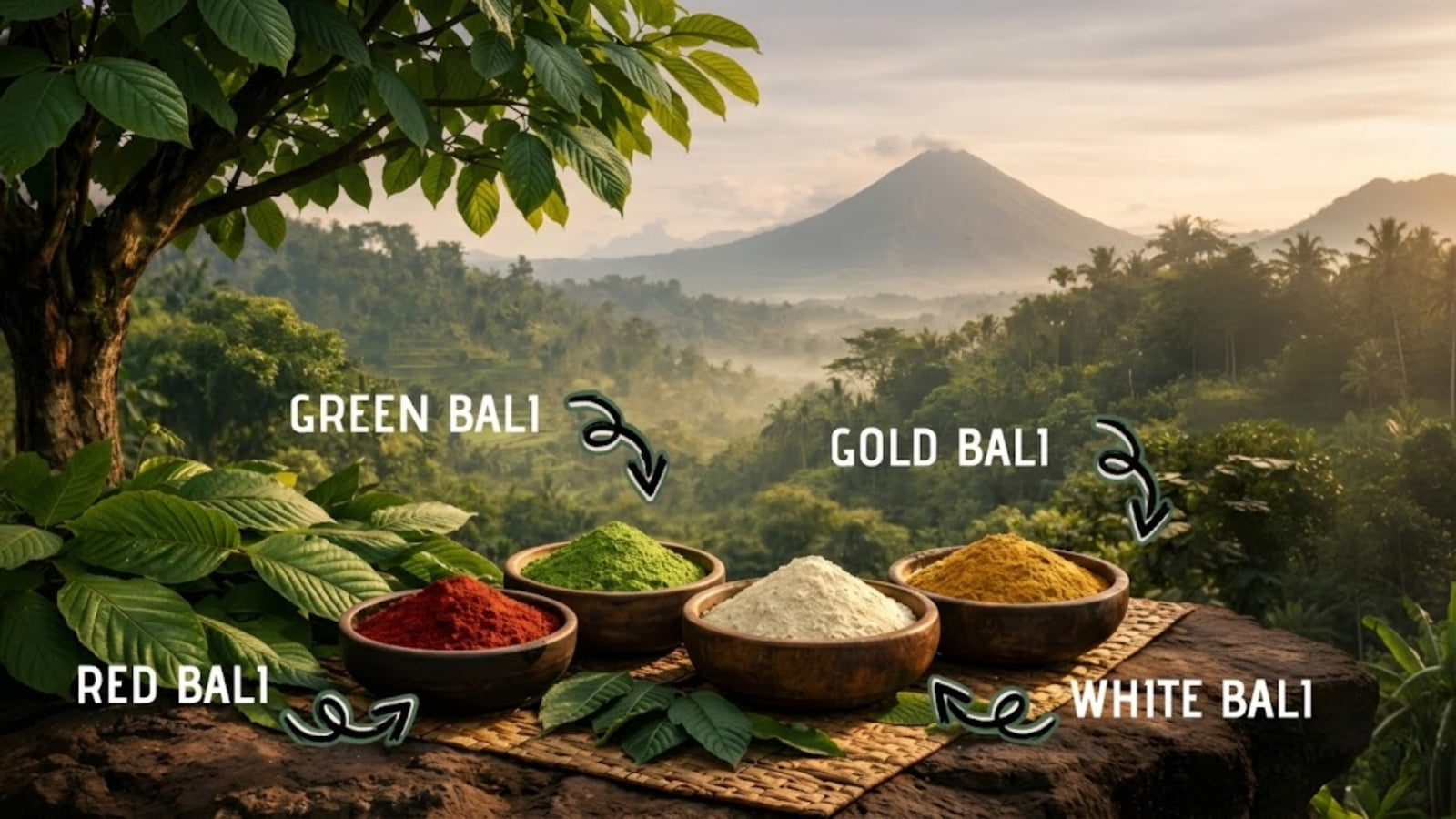
Bali kratom is one of the most-bought strain families on the U.S. kratom shelf, and the name is mostly historical accident. Indonesia produces roughly 95% of the world's commercial kratom supply, and Bali was historically the export port for leaf grown across the Indonesian archipelago. Today most of what gets sold as Bali kratom is actually grown in Borneo, Kalimantan, or Sumatra, then processed using the slow sun-drying tradition that gives Bali strains their signature alkaloid profile. The global kratom market hit over $1.3 billion in recent years, and Bali kratom holds a steady share of that thanks to one rare quality: it's a strain family that fits every part of the day. Red Bali for evening wind-down. White Bali for morning focus. Green Bali for the workday in between. Yellow and gold for users who want something smoother. We'll walk through what each variant actually is, what users report, what to verify before buying, and how to match a Bali variant to your routine.
Table of Contents
- What Bali Kratom Actually Is (And Why the Name Is a Misnomer)
- The Bali Alkaloid Profile
- The Five Vein Colors of Bali: Strain by Strain
- Picking the Right Bali for Your Day
- Bali Kratom Effects: What Users Actually Report
- Forms and Dosing
- Quality Markers and COA Verification
- Honest Limits and Skip Profile
- Where GRH Kratom Fits
- Final Thoughts
TL;DR
- Bali kratom is a strain family, not a geographic origin. Most "Bali" kratom is grown in Borneo, Kalimantan, or Sumatra and processed using traditional Bali sun-drying methods.
- Five vein colors cover most use occasions: White (morning energy), Green (daily balance), Red (evening wind-down), Yellow (smooth and long), Gold (all-day balanced).
- Red Bali is the most popular evening variant. Mitragynine 0.7-1.3%, higher 7-OH for relaxation and body comfort.
- White Bali leads on mitragynine content (1.4-1.8%) for daytime energy and focus.
- Indonesia produces ~95% of the world's commercial kratom. Quality vendors source single-origin and publish the region on every Certificate of Analysis.
- Fewer than 200 vendors in the U.S. market hold GMP certification. Source carefully.

What Bali Kratom Actually Is (And Why the Name Is a Misnomer)
Despite the name, Bali kratom is rarely grown on the island of Bali. The name traces back to Indonesia's colonial-era trade routes, when Bali served as the primary port through which Indonesian kratom was exported to Western markets. Over time, "Bali kratom" stopped meaning "kratom from Bali" and started meaning "kratom processed in the Bali style and shipped through Bali." Today the term describes a specific alkaloid profile and processing approach rather than a precise geographic origin.
Most Bali kratom on the U.S. shelf today comes from West Kalimantan or Borneo, with smaller amounts sourced from Sumatra. The Bali processing tradition involves slow sun-drying over 7 to 10 days, which oxidizes the alkaloids and produces the darker leaf coloration and balanced profile that buyers associate with the Bali name.

Why "Bali" Persists as a Strain Category
The Bali name persists because it tells buyers something useful: the leaf was processed in the slow-dry tradition, and the alkaloid profile leans toward a specific signature that customers have come to recognize. A Red Bali sourced from Borneo and a Red Borneo from Borneo can be genetically related plants, but they get processed differently after harvest. Bali processing produces a smoother, more balanced alkaloid distribution. Borneo processing usually yields a more potent, edgier profile. The processing matters more than the geography.
The Bali Alkaloid Profile
Bali kratom contains the same headline alkaloids as any other kratom strain (mitragynine and 7-hydroxymitragynine), but the ratios shift based on vein color and processing. Quality Bali leaf typically tests at 0.7% to 1.6% mitragynine depending on variant, with 7-hydroxymitragynine staying under 0.04% in unadulterated material.

The 7-OH content is what shifts most between Bali vein colors. Red Bali has higher 7-OH (closer to 0.04%) which tracks with its sedating and body-comfort profile. White Bali has lower 7-OH (often under 0.01%) and higher mitragynine, producing the energy and focus profile. Green sits in the middle. Yellow undergoes additional fermentation that smooths the alkaloid ratio further. Gold typically uses a similar fermentation step but starts from more mature leaf.
The Five Vein Colors of Bali: Strain by Strain
Each Bali vein color suits a different occasion. Knowing the difference saves money and matches the leaf to the goal. Here's the practical breakdown.

Red Bali: The Evening Wind-Down Workhorse
Red Bali is the most-bought Bali variant in the U.S. market. It's harvested from mature leaf, processed through the traditional slow sun-dry, and tests at roughly 0.7% to 1.3% mitragynine with 7-OH near the upper end of the natural range. Users typically report a body-relaxation effect, easier sleep onset, and discomfort relief in the 2 to 3 gram range. Most Red Bali users land at 2.5 grams in the evening as a wine alternative or wind-down ritual. Red Bali is also the variant most users report works best for "rough day" decompression.
Green Bali: The Daily Driver
Green Bali sits in the middle of the alkaloid spectrum. Mitragynine typically tests around 1.0% to 1.4%, with 7-OH between the white and red levels. Users describe Green Bali as the daily-driver Bali variant: a mood lift, a softer focus boost than White, and a calmer profile than Red. A 2 to 3 gram dose in the morning or early afternoon is the most-mentioned routine. Green Bali is the variant most likely to surface in user reports about workday focus and social-setting use.

White Bali: The Morning Energy and Focus Variant
White Bali takes leaf harvested earlier in the maturation cycle, before the alkaloid ratio shifts toward sedation. Mitragynine runs higher (1.4% to 1.8%) and 7-OH drops well under 0.01%. Users report energy, alertness, mental focus, and a mild mood lift, often as a coffee alternative. The dose curve is tighter than Red because higher mitragynine produces stronger effects per gram. Most White Bali users start at 2 grams in the morning. White Bali is the Bali variant most likely to replace a morning coffee for users who want a less harsh energy profile.
Yellow Bali: Smooth, Long-Lasting, Fermented
Yellow Bali isn't a separate harvest stage. It's typically green or white leaf processed through an additional fermentation step that shifts the alkaloid ratio toward something smoother and longer-lasting. The result is a strain that hits less aggressively but lasts noticeably longer than the unfermented version of the same starting material. Users describe Yellow Bali as the variant they reach for when they want gentle effect across several hours rather than a clear peak.

Gold Bali: All-Day Balanced Profile
Gold Bali sits between Yellow and Red in user reports. It's typically more mature leaf processed through the slow sun-dry plus an additional curing step that pushes mitragynine concentration higher (around 1.2% to 1.6%) while keeping the alkaloid ratio balanced. Users describe Gold Bali as the variant that delivers steady all-day effects without the sedation of Red or the energy spike of White. A 2 to 3 gram dose distributed across the day is the most-mentioned routine.
Picking the Right Bali for Your Day
The Bali strain family covers a wider range of use occasions than most single strains, which is why "Bali" sits on so many Effects shelves. The matching framework is straightforward: pick by goal, then pick the dose.

| Variant | Best Time of Day | Primary Goal | Starting Dose |
|---|---|---|---|
| White Bali | Morning | Energy, focus, mental clarity | 2 g |
| Green Bali | Morning to early afternoon | Mood lift, balanced focus | 2-3 g |
| Gold Bali | Distributed across the day | Steady all-day effect | 2-3 g |
| Yellow Bali | Anytime | Smooth, longer-lasting profile | 2 g |
| Red Bali | Evening | Wind-down, sleep onset, body comfort | 2-3 g |
A solid Bali kratom routine for users testing the strain family looks like this:
- Pick the goal first: morning energy, daily balance, evening wind-down, or all-day steady
- Match the variant: White for morning, Green for daily, Red for evening, Yellow or Gold for steady
- Start at 2 grams of weighed powder for any variant; adjust by half-gram increments
- Drink water alongside; kratom is mildly dehydrating regardless of variant
- Track which variant works best for which time of day for the first month
Bali Kratom Effects: What Users Actually Report
User reports across forums, vendor reviews, and community surveys converge on the same handful of effect categories for the Bali strain family. The intensity and direction shift with vein color, but the categories stay consistent.

The most consistently reported Bali kratom effects across the variant family:
- Body relaxation and discomfort relief (strongest in Red, present in Yellow and Gold)
- Mood lift (present across all variants, strongest in Green and Gold)
- Energy and mental focus (strongest in White, present in Green)
- Sleep onset support (specific to Red Bali in the 2.5 to 3.5 gram range)
- Stress comfort (present across the family, strongest in Green and Red)
The kratom benefits associated with Bali variants line up with what alkaloid science would predict from mitragynine and 7-hydroxymitragynine receptor activity, which is why Bali is one of the most-recommended starting strain families for new kratom users.
Forms and Dosing
Bali kratom comes in the same formats as any other kratom strain: powder, capsule, extract, and occasionally pre-brewed tea. Each format shifts onset speed and dose precision but doesn't change the underlying Bali alkaloid profile.

Powder, Capsules, Extracts
Bali kratom powder is the most dose-flexible format. Weigh on a kitchen scale, mix with water or juice, and adjust by half-gram increments. Capsules pre-dose the same powder for users who want convenience over flexibility, but onset is slower (45 to 75 minutes) because the capsule has to dissolve. Liquid extracts concentrate the alkaloids per serving, but quality vendors keep extract 7-OH content well under the 2% Texas legal cap. Bali kratom tea is the closest modern preparation to traditional Southeast Asian use, and produces a softer, slower-onset effect than the toss-and-wash powder method.
Bali Kratom Dosing for First-Time Users
A reader wrote in about her first Bali kratom routine. She started with 2 grams of Red Bali in the evening, kept the dose conservative, and after a week reported a noticeable wind-down effect, easier sleep onset, and no morning grogginess. She added White Bali at 2 grams in the morning for a coffee alternative the following month. After three months she had landed at 2.5 grams of White in the morning and 2.5 grams of Red in the evening as her standard routine, with rest days every Wednesday and the weekend. The same dose worked for her after six months because she rotated.
Quality Markers and COA Verification
Bali kratom only works if the leaf is clean. The market has cleaned up considerably since 2023, but the gap between best-in-class vendors and gas-station-tier extracts is still wide. A current Certificate of Analysis from an independent lab is the test.
A solid Bali kratom COA should report on:
- Mitragynine percentage (varies by variant: White 1.4-1.8%, Red 0.7-1.3%, Green/Gold/Yellow in between)
- 7-hydroxymitragynine percentage (typically under 0.04% in unadulterated leaf)
- Heavy metals: lead, arsenic, cadmium, mercury, all at or below detection limits
- Microbial screen: salmonella, E. coli, yeast, mold, all under regulatory thresholds
- Pesticide screen: confirms no banned ag chemicals
- Region of origin: single farm or single-region sourced (Borneo, Kalimantan, or Sumatra most common)
If a vendor sells "Bali" kratom but can't tell you where the leaf was actually grown, that's a sign the product is either blended or unverified. Walk. The Bali kratom name carries enough market value that low-quality vendors slap it on whatever leaf they can source cheapest.
Honest Limits and Skip Profile
Even the most popular kratom strain family isn't right for everyone. Bali kratom doesn't override the standard skip profile, and Texas legality (or any other state's legality) doesn't change pharmacology.

Skip Bali kratom entirely if any of these apply:
- Pregnancy or nursing
- Under 18 (or under 21 in KCPA states like Florida)
- Prescription medications interacting with opioid receptors or serotonin (SSRIs, MAOIs, certain pain medications)
- Liver disease or hepatotoxic medications
- History of substance dependency
- Drug-tested employment or athletics
- Combining with alcohol, benzodiazepines, or sedating prescription drugs
The Bali kratom benefits a careful user describes after a year of moderate use rarely show up for a user who climbs the dose ladder chasing tolerance. The plant rewards rotation and rest days. It punishes daily heavy use.
Where GRH Kratom Fits
If you've worked through the Bali kratom strain family and want a clean source, our shelf at GRH Kratom carries Red Bali, Green Bali, White Bali, and Gold Bali in powder, capsule, and extract form. Every batch ships with a current Certificate of Analysis, and we publish region of origin (West Kalimantan most often) on every product page. Our Effects shelves sort the catalog by goal: Energy, Focus, Mood, Relaxation, Sleep, and Euphoria, so Bali variants slot into the goal you're matching. We don't sell synthetic or concentrated 7-OH inventory, and our extracts comply with the strictest state-level rules including the Texas 2% 7-OH cap. Browse the catalog at grhkratom.com and pick by what time of day you're filling.
Final Thoughts
Bali kratom is a strain family with a misleading name and a useful breadth. The five vein color variants cover most parts of a daily routine: White for morning energy, Green for the workday, Red for evening wind-down, Yellow and Gold for users who want something smoother and longer-lasting. Most "Bali" leaf is actually grown in Borneo, Kalimantan, or Sumatra and processed through the slow sun-dry tradition that gives the family its alkaloid signature. The plant rewards three habits more than any others: source from a vendor with a current independent COA, match the variant to the goal, and rotate. Skip the dose-ladder chase. Bali kratom isn't a cure for anything and shouldn't replace a conversation with your doctor about anything serious. It's a botanical strain family that fits the wider rhythm of a day better than most single-strain options on the kratom shelf.


