



If you have spent more than a few hours researching kratom vendors, the name Nova Kratom has almost certainly come up. The brand has a clean website, a deep strain menu, and a pricing structure that lands well below the industry average. None of that is a secret, and none of it is in dispute. What rarely gets discussed in the same breath is the other half of the story: the regulatory record, the way the lab paperwork is published, the customer reports that surface on Reddit when you sort by "new," and the gaps in the brand's transparency that a careful buyer notices the second they go looking for them.
This guide walks through the limitations of nova kratom the way a long-time kratom drinker would walk a friend through them at a kitchen table, calmly, with citations, and without the marketing gloss. We will use Nova's own pages, the FDA's public warning letter file, third-party reviewer summaries, and Reddit threads as primary sources. The goal is not to talk anyone out of trying Nova Kratom. Plenty of people order from them and have a fine time. The goal is to make sure you know exactly what you are agreeing to before you click checkout.

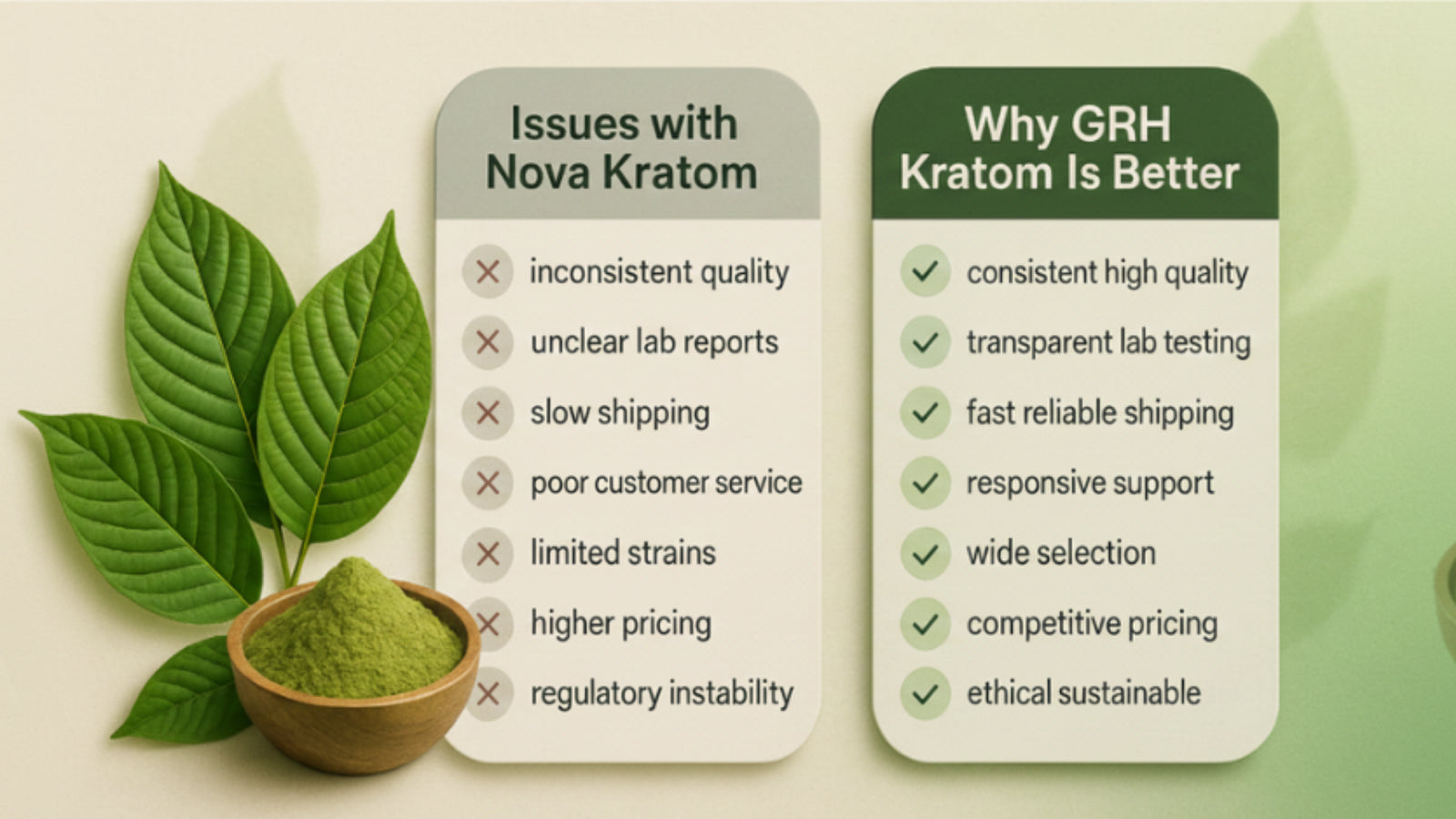
The short version. Nova Kratom is cheap, broad, and easy to order from. The limitations are not in product quality on a good day. They are in regulatory history, in how the lab paperwork is presented, in how consistent the experience is from one batch to the next, and in how much of the brand story you can actually verify if you start asking sourcing questions. We cover all of it below.
Why this guide exists, and why we are writing it
We are GRH Kratom, an Austin, Texas vendor that sources from a single family-run farm in Pontianak, Indonesia, third-party tests every batch through Wonderland Labs, and posts every Certificate of Analysis directly under each product. We are an active member of the American Kratom Association and follow their GMP Standards Program. We compete with Nova Kratom for many of the same customers, and we are aware that writing about a competitor's limitations carries a built-in conflict of interest. We are leaning hard the other way to compensate. Nothing in this article is a claim we cannot show you a public source for, and the citations are linked at the end.
If you would rather skip our coverage and read the FDA's letter or Nova's own lab page directly, we have linked both at the bottom of this article and inside the relevant sections. Read the original sources. Decide for yourself.
The 2023 FDA warning letter, and what it actually says
The most concrete, most verifiable item on the limitations list is a public document. On July 3, 2023, the U.S. Food and Drug Administration issued a warning letter to Sunshine Trading Company, Inc., doing business as Nova Tea and Nova Kratom. The letter is published in the FDA's 2023 warning letter archive and has been reproduced by industry trackers including the Kratom Research Institute and ConsumerLab. It is not a recall, it is not a ban, and it does not allege that Nova's kratom is contaminated. What it alleges is more specific: that Nova's website at the time used drug claims to market its products.
The FDA cited specific Nova Kratom products by name in the letter, including Green Maeng Da Kratom Powder, Green Malay Kratom Powder, Red Bali Kratom Powder, Yellow Vietnam Kratom Powder, and White Borneo Kratom Powder. The agency took issue with statements that suggested these products could be used for the treatment, mitigation, or cure of opioid addiction. Under U.S. law, that kind of claim moves a product from the "dietary supplement" or "botanical" category into the "unapproved new drug" category, and unapproved new drugs cannot be sold in interstate commerce. Sunshine Trading Company was given fifteen working days to respond and to describe the corrective steps it was taking.

What does this mean for a 2026 buyer? Two things. First, the warning letter is a historical fact, not an ongoing enforcement action; Nova Kratom has continued to operate, and the worst of the cited language was reportedly removed from the brand's website. Second, the existence of the letter at all tells you something about the brand's compliance posture in 2023, and it raises a question worth asking before you trust a vendor with your wellness routine: how does this company describe its own products today, and does it stay on the right side of the FDA's "structure-function" line? When you compare nova kratom reviews from 2024 onward, you will see this letter referenced in almost every honest write-up. It is a permanent part of the brand's record.
Lab results: published, but not in the form serious buyers want
This is the most-cited item when knowledgeable kratom drinkers describe the limitations of nova kratom, and it is also the most subtle. Nova Kratom does publish lab results. The brand has a public lab results page at novakratom.com/kratom-lab-results, and the page exists. The problem is what is on the page versus what should be on it.
The accepted standard among American Kratom Association GMP-qualified vendors is batch-specific Certificates of Analysis. A batch-specific COA ties a single test report to a single production lot, identifies that lot by a unique number printed on the consumer's bag, and lets the customer who bought from that lot read the exact alkaloid percentages, the exact heavy-metal results, the exact microbial counts, and the exact pesticide screen for the kratom they have in their hand. This is the gold standard, and it is the standard the AKA's program asks for.
Nova Kratom's lab page leans more toward strain-level summaries than batch-specific COAs. If you sort through it long enough, you can find documents (some of them are clearly recent, some less so), but matching a specific bag in your kitchen to a specific report on the website takes effort that most buyers will not put in. Several third-party reviewers have flagged exactly this gap, including coverage at iherbio.com that describes COA access as requiring "customer effort." When customers ask about specific nova kratom lab results on Reddit, the most common answer is: "their lab page exists, but you have to dig."

Why does this matter? Because the practical safety value of a COA depends on traceability. A heavy-metals test result from January is useful only if you can confirm that the bag in front of you came from the January lot. Without a printed batch number on the package and a corresponding report online, you are trusting the brand's quality assurance program rather than verifying it. For some buyers that is fine. For buyers who specifically ask the question "is nova kratom legit?" before placing an order, the right answer is more nuanced than yes or no. The lab paperwork exists, but it does not give you the level of verification the AKA's program is designed to give you.
Batch consistency: the problem that follows the price
Across third-party reviews and across the brand's Reddit history, one theme repeats: batch-to-batch variability. Some shipments arrive vibrant, fragrant, and exactly the strain profile the customer expected. Others arrive flat, slightly off in color, or noticeably less potent. We are not the first to notice this. Kratom.org's own coverage of Nova Kratom flagged inconsistency as the brand's most frequently mentioned weakness, with reviewers describing experiences where one month of orders worked beautifully and the next month was mediocre.
If you have read enough nova kratom reviews reddit threads, the pattern is recognizable. New buyers post a glowing first-order review. Three months in, the same buyer posts a follow-up: "this strain used to hit, the new bag does nothing." The replies tend to fall into two camps: buyers who report the same drift, and buyers who report the opposite, where their first bag was weak and the next three were great. Both camps are right. That is what variability means.

From a sourcing-engineer point of view, this is the failure mode you would expect from a vendor that sources broadly rather than narrowly. If a brand is buying from multiple suppliers across multiple regions to maintain a two-dozen-strain catalog at a low price point, the alkaloid profile of any given product will move with the supply chain. That is not a moral failure. It is a structural choice. But the customer-side cost of that choice is exactly the inconsistency reviewers describe. A vendor that sources from a single farm and tests every lot end-to-end will have a narrower menu and a higher floor price, and a more predictable cup. Pick your tradeoff.
Strain breadth, with depth as the asterisk
Nova Kratom advertises a wide selection of over two dozen strains across red, green, white, and yellow veins, plus their split-kilo program that lets buyers combine two or four strains in a single order. On paper this is genuinely useful: if you are a buyer who likes to rotate strains, the split-kilo gives you flexibility most vendors do not offer. We are happy to give them credit for the format. Niche items pop up on the site too: silver nova kratom appears on user searches, gold vein bali nova kratom shows up in some long-tail queries, and the brand has historically sold a "trainwreck" blend that draws its own search traffic under the term nova kratom trainwreck.

The asterisk is depth. Two dozen strains is a lot of catalog surface area, and surface area without sourcing transparency is hard to evaluate. With most established kratom brands, you can ask a fair question ("where on the island of Sulawesi does your white horn come from, and what month was it harvested?") and get a real answer. With Nova Kratom, that level of provenance has not historically been part of the public-facing story. There are no farm-visit photos, no harvest-date stamps on the products, and no narrative on the website that ties a specific strain back to a specific grower. You get a name, a price, and a vein color. For some buyers that is plenty. For buyers who care about provenance the way a coffee buyer cares about a single-estate origin, the limitation is real.
Pricing is low, but value is a different calculation
Let us be clear-eyed about the pricing math. Nova Kratom's published prices are competitive: powder runs $28 for 250 grams and $88 for a kilogram on the standard menu, with capsules priced at the same per-gram rate ($28 for 250 capsules of 0.5 g, scaling up). Their nova kratom coupon code program is aggressive: first-order discounts of 40% and 50% are common, and the brand attracts substantial search traffic from buyers chasing those codes specifically.
Cost per gram, in a vacuum, is a real number, and Nova does win that comparison against most premium vendors. The trouble with comparing on cost per gram alone is that you are pricing the kratom and not the program around the kratom. The program around the kratom (the testing protocol, the COA traceability, the FDA compliance posture, the consistency of the cup) is the part that determines whether you get the same result twice. A bag that costs ten dollars less but performs at 70% the consistency of a bag at standard pricing is not actually cheaper for the customer who has to throw out a third of it or who has to re-dose to compensate.

This is the same reason buyers eventually move from generic store coffee to a specialty roaster, or from a $4 bottle of olive oil to a single-origin estate bottle. The cheap product is not a scam. It is just a different category of purchase. If you are buying kratom for occasional, low-stakes use and the per-gram price drives the decision, Nova will probably make you happy most of the time. If you are buying kratom because the cup is part of your routine and you need it to be the same on Tuesday as it was on Monday, you are paying for a different thing.
What is missing from the brand's story
One of the most useful exercises before buying from any kratom vendor is to spend twenty minutes on their About page and see how much of the supply chain they will show you. With the most transparent vendors, you can see photos of the farm, the names of the people who run it, the lab the brand works with, the founder's history with the plant, and how the product moves from the harvest in Indonesia to the warehouse in the United States. With Nova Kratom, much of that is currently absent from the public-facing site. The brand identity reads more like a retailer than a grower-direct importer, and the sections that would normally describe "where this comes from" and "who grew it" are thin.

This is not a moral indictment. There are good reasons a brand might keep its supplier relationships private, including supplier confidentiality and competitive pressure. But buyers should know that the absence of farm-level documentation is one of the gaps that distinguishes Nova Kratom from vendors who lean into provenance. If you have ever read our about page, you know the story we tell: single-farm, family-run, Pontianak, every bag traceable, every batch tested at an independent lab. We are not pretending that is the only valid model. We are pointing out that it is not the model Nova Kratom currently uses, and that the difference shows up in what you can verify before you buy.
The Reddit reality check, plus the "is nova kratom legit" question
If you sort r/kratom by recent posts mentioning the brand, the picture is mixed. There is a steady drumbeat of positive first-order reviews driven in large part by the nova kratom 50% off code traffic. Buyers come for the discount, get a decent bag, and post a quick "tried Nova, was good." There is also a parallel thread of complaints that recur often enough to be worth weighing: shipping delays during peak periods, customer-service responses that take longer than buyers expect, and the same batch-consistency drift we covered above. The phrase nova kratom reddit is searched specifically often enough that Ahrefs flags it as a discrete keyword.
So is nova kratom legit? In the literal sense, yes. The brand is a real, licensed company operating publicly under Sunshine Trading Company, Inc. They ship products. They process refunds, with the friction common to every kratom vendor. They post lab results. They are not a scam. The more useful question is whether they are the right vendor for your use case, and the answer to that question depends on how heavily you weight the limitations we have walked through in this article.

Who Nova Kratom is right for, and who it is not
The fairest way to summarize the limitations is to translate them into a buyer profile. Here is the honest read.
Nova Kratom is probably a fine fit if:
- You are price-sensitive, ordering for casual or experimental use, and the per-gram cost is a meaningful driver of the decision.
- You like rotating strains and you find the split-kilo program genuinely useful as a sampler format.
- You are comfortable evaluating kratom on a "probably good, occasionally meh" basis and willing to absorb the variability between batches.
- You do not need to point at a specific lot number on a specific bag and match it to a specific lab report before you brew.
Nova Kratom is probably the wrong fit if:
- Your kratom is part of a daily wellness routine where consistency from one bag to the next is non-negotiable.
- You want batch-stamped Certificates of Analysis you can verify on the brand's site, by lot number, in under a minute.
- You care about supply-chain provenance and want to be able to read the brand's farm-direct story before you order.
- You want a vendor whose regulatory record is unblemished going back five years, including no FDA correspondence on file.

If you fall into the second profile, the obvious next step is to look at vendors who lead with sourcing transparency and batch-level testing. We are one of those vendors, and we are happy to point you to our public lab page if you want to compare what end-to-end traceability looks like on a vendor site. We also publish a buyer's guide for wholesale evaluation that walks through the same questions a careful retail buyer should be asking. You do not have to buy from us to use those frameworks. We just think the questions are worth asking before any first-time order, and we have written the guides because we wish we had had them when we started.
Frequently asked questions
Is Nova Kratom shut down?
No. The "nova kratom closed" search query that occasionally pops up appears to reflect either a temporary site issue or buyer confusion, not a permanent closure. The brand has continued to operate publicly under Sunshine Trading Company, Inc. and the website at novakratom.com remains active as of 2026. If a regional storefront has closed, that is a different matter from the online vendor's status.
Where can I read the FDA warning letter for myself?
The full warning letter is archived on the FDA's site under "2023 Warning Letters - Health Fraud," and the Kratom Research Institute hosts a copy at kri.org. Both are publicly accessible. Reading the original letter is more useful than reading any third-party summary, including this one.
Are Nova Kratom's lab results trustworthy?
The lab results that are published appear to be from real third-party labs, and there is no public allegation of falsified results. The limitation is not that the documents are fake. It is that they are presented at the strain level rather than at the batch level, which makes per-bag verification difficult. The phrase nova kratom lab results is searched specifically often enough that buyers clearly want better access to this paperwork than the brand currently provides.
How do Nova Kratom's prices compare to premium vendors?
Nova Kratom is priced below most premium American Kratom Association GMP-qualified vendors on a per-gram basis. With first-order coupon codes (the popular nova kratom coupon code drops to 40% or 50% off), the gap widens further. Premium vendors typically charge 20-50% more per gram in exchange for batch-level testing, single-farm sourcing, and tighter quality controls.
What is "nova kratom trainwreck" and is it different from regular trainwreck blends?
"Trainwreck" is a generic term in the kratom market for a multi-strain blend, traditionally made by combining seven or more strains in roughly equal portions. Nova has historically sold a trainwreck product, and the search query nova kratom trainwreck reflects buyers comparing it to other vendors' versions. The blend is not a Nova-exclusive concept; almost every full-line vendor sells a version. Quality differences between brands' trainwreck blends come down to the underlying strain quality and the consistency of the blend ratio, both of which depend on the same sourcing and QA factors covered above.
Should I buy from Nova Kratom for my first kratom order?
If you have never tried kratom and your goal is the cheapest possible introduction, Nova will probably get you a usable first bag. If your goal is to learn what good kratom feels like at its best, so you have a reference point for evaluating other vendors, we would gently recommend starting with a vendor whose batch is verifiable and whose strain profile is consistent. The reason is practical: you cannot calibrate against a moving target. A first-time buyer who orders a mediocre batch from any vendor (Nova or otherwise) walks away thinking "kratom didn't do much for me," when the actual answer is that the bag was below average. Start with a known-good baseline. Branch out from there.

The Bottom Line
The limitations of nova kratom are not a horror story. They are a list of compromises a buyer should know about before placing an order, and most of them stem from a single underlying choice: Nova Kratom is built around price, breadth, and accessibility, not around supply-chain provenance, batch-level traceability, or a regulatory record you would describe as pristine. If those tradeoffs match your use case, the brand will probably make you happy. If they do not, the alternative vendors are not hard to find. Either way, the goal of this article was simple: to make sure that when you make the call, you make it with the full picture in front of you.
If you want to keep going on the same topic, we have a companion piece on kratom side effects and a guide to why 7-OH is not kratom that cover related ground a careful buyer should read. And if the testing transparency theme in this guide resonated with you, our own public lab page is the simplest demonstration of what batch-level paperwork can look like in practice.
Sources
- FDA Warning Letter — Sunshine Trading Company, Inc. dba Nova Tea and Nova Kratom, July 3, 2023. Kratom Research Institute archive.
- FDA — 2023 Warning Letters - Health Fraud. fda.gov.
- ConsumerLab — coverage of the FDA warning. consumerlab.com.
- iherbio.com — Nova Kratom Review 2026 with notes on lab transparency. iherbio.com.
- kratom.org — Nova Kratom vendor profile flagging consistency variance. kratom.org.
- altlaw.org — Nova Kratom vendor review with pricing and quality notes. altlaw.org.
- GRH Kratom — Lab Results page (referenced for comparison). grhkratom.com/lab-results.


